实用医学杂志 ›› 2025, Vol. 41 ›› Issue (21): 3358-3364.doi: 10.3969/j.issn.1006-5725.2025.21.009

• 临床研究 • 上一篇    

慢性阻塞性肺疾病合并高血压对心血管事件的影响

贾睿奕1,张勃1,于国云1,强佳伟1,王新宇2,庞桂芬1()   

  1. 1.承德医学院附属医院,呼吸科,(河北 承德 067000 )
    2.承德医学院附属医院,血液科,(河北 承德 067000 )
  • 收稿日期:2025-08-25 出版日期:2025-11-10 发布日期:2025-11-13
  • 通讯作者: 庞桂芬 E-mail:cyfypang@163.com
  • 基金资助:
    河北省卫生健康委员会医学科学研究课题计划项目(20220428)

The impact of chronic obstructive pulmonary disease combined with hypertension on cardiovascular events

Ruiyi JIA1,Bo ZHANG1,Guoyun YU1,Jiawei QIANG1,Xinyu WANG2,Guifen. PANG1()   

  1. *.Department of Respiratory,Affiliated Hospital of Chengde Medical University,Chengde 067000,Hebei,China
  • Received:2025-08-25 Online:2025-11-10 Published:2025-11-13
  • Contact: Guifen. PANG E-mail:cyfypang@163.com

摘要:

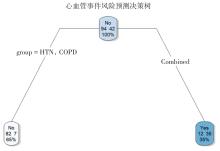
目的 分析慢性阻塞性肺疾病(chronic obstructive pulmonary disease,COPD)合并高血压(hypertension, HTN)患者心血管事件发生率,并分析其影响因素。 方法 回顾性地选取2021年12月至2025年1月在我院确诊的原发性高血压(HTN组,n = 64)、单纯COPD(COPD组,n = 64)及原发性高血压合并COPD(合并组,n = 64)患者作为研究对象。比较3组患者心血管事件发生、肺功能[肺活量(forced vital capacity,FVC)、第一秒用力呼气容积(forced expiratory volume in 1 second,FEV1)、呼气峰值流速(peak expiratory flow,PEF)、第一秒用力呼气容积占预计值的百分比(FEV1% pred)]及平素血压维持水平[收缩压(systolic blood pressure,SBP)、舒张压(diastolic blood pressur,DBP)]水平,心血管事件累积发生率绘制KM曲线并比较,HTN对肺功能的影响采用方差分析,影响因素采用Cox回归分析。 结果 HTN组总心血管事件发生率为14.06%,低于COPD组、合并组的29.69%、48.44%(P < 0.05)。3组患者心血管事件累积发生率差异有统计学意义(P < 0.05),COPD组心血管事件累积发生率高于HTN组(P < 0.05),合并组心血管事件累积发生率高于COPD组、HTN组(P < 0.05)。HTN组FVC、FEV1、PEF、FEV1% pred高于合并组、COPD组(P < 0.05),COPD组FVC、FEV1、PEF、FEV1% pred高于合并组(P < 0.05),合并组SBP、DBP高于HTN组COPD组(P < 0.05),HTN组SBP、DBP高于COPD组(P < 0.05)。校正协变量后,3组间FVC差异有统计学意义(P < 0.05)。与未发生心血管事件患者比较,发生心血管事件在疾病类型中存在差异(P < 0.05),HTN、HTN合并COPD占比高于未发生组(P < 0.05);发生组FVC、FEV1% pred低于未发生组(P < 0.05),SBP、DBP高于未发生组(P < 0.05)。疾病类型、FEV1% pred、SBP均是心血管事件的影响因素(P < 0.05)。决策树分析表明疾病合并状态是心血管风险评估的关键因素。 结论 COPD合并HTN患者心血管事件发生率显著高于单纯疾病患者,且疾病共病状态、肺功能损害(FEV1% pred降低)及血压变异性增加(SBP升高)是心血管事件的独立危险因素。

关键词: 慢性阻塞性肺疾病, 高血压, 心血管事件, 影响因素, 血压

Abstract:

Objective To analyze the incidence of cardiovascular events among patients with comorbid chronic obstructive pulmonary disease (COPD) and hypertension (HTN), as well as to identify the associated influencing factors. Methods A retrospective analysis was conducted on patients diagnosed with primary hypertension (HTN group, n = 64), chronic obstructive pulmonary disease (COPD group, n = 64), and concomitant primary hypertension and COPD (combined group, n = 64) at our hospital between December 2021 and January 2025. Cardiovascular event incidence, pulmonary function parameters?including forced vital capacity (FVC), forced expiratory volume in 1 second (FEV1), peak expiratory flow (PEF), and percent predicted FEV1 (FEV1% pred)?and blood pressure levels (systolic blood pressure [SBP], diastolic blood pressure [DBP]) were compared across the three groups. Kaplan?Meier curves were constructed to illustrate and compare the cumulative incidence of cardiovascular events. Covariance analysis was performed to assess the impact of hypertension on pulmonary function, and Cox proportional hazards regression was employed to identify factors associated with cardiovascular outcomes. Results The total incidence rate of cardiovascular events in the HTN group was 14.06%, which was significantly lower than that in the COPD group (29.69%) and the combined HTN?COPD group (48.44%) (P<0.05). A highly significant difference was observed in the cumulative incidence rates across the three groups (P < 0.05). Specifically, the COPD group exhibited a higher cumulative incidence than the HTN group (P < 0.05), while the combined group showed the highest incidence, exceeding both the COPD and HTN groups (P < 0.05). Pulmonary function parameters?including FVC, FEV1, PEF, and FEV1% pred?were significantly higher in the HTN group compared to both the COPD and combined groups (P < 0.05). Moreover, these indices were also higher in the COPD group than in the combined group (P < 0.05). Systolic and diastolic blood pressure (SBP and DBP) levels in the combined group were significantly elevated compared to both the HTN and COPD groups (P < 0.05), and SBP and DBP in the HTN group were higher than those in the COPD group (P < 0.05). After adjusting for potential confounders, the intergroup difference in FVC remained statistically significant (P < 0.05), and the effect of group on FEV1% pred was particularly robust (partial η2 = 0.754, P < 0.05). Compared with patients without cardiovascular events, those who experienced events differed significantly by disease type (P < 0.05). The proportions of patients with HTN alone and HTN combined with COPD were higher in the event group than in the non?event group (P < 0.05). Additionally, FVC and FEV1% pred were lower in the event group, whereas SBP and DBP were higher (all P < 0.05). Multivariate analysis identified disease type, FEV1% pred, and SBP as independent predictors of cardiovascular events (P < 0.05). Decision tree analysis further highlighted that the coexistence of HTN and COPD constitutes a critical determinant in cardiovascular risk stratification. Conclusions The incidence of cardiovascular events in patients with COPD combined with HTN was significantly higher than in those with either condition alone. Furthermore, the coexistence of these diseases, along with impaired lung function (as indicated by reduced FEV1% predicted) and increased SBP, were independent risk factors for cardiovascular events.

Key words: chronic obstructive pulmonary disease, hypertension, cardiovascular events, influencing factors, blood pressure

中图分类号: