

实用医学杂志 ›› 2026, Vol. 42 ›› Issue (14): 2588-2602.doi: 10.3969/j.issn.1006-5725.2026.14.012
• 论著·机制与实践 • 上一篇
冉益民1,陈友利1,2,曾惜1,唐正龙1,2( )
)
收稿日期:2026-04-21
出版日期:2026-07-25
发布日期:2026-08-05
通讯作者:
唐正龙
E-mail:1985149363@qq.com
基金资助:
Yimin RAN1,Youli CHEN1,2,Xi ZENG1,Zhenglong TANG1,2()
Received:2026-04-21
Online:2026-07-25
Published:2026-08-05
Contact:
Zhenglong TANG
E-mail:1985149363@qq.com
摘要:
目的 探讨局部应用甲状旁腺激素(parathyroid hormone,PTH)能否激活蛋白激酶A(protein kinase A,PKA)/瞬时受体电位香草素4(transient receptor potential vanilloid 4,TRPV4)通路并协同正畸力加速大鼠牙移动及其作用机制。 方法 将48只雄性SD大鼠随机分为空白对照组、单纯牵引组(OTM组)、单纯PTH给药组(PTH组)以及牵引联合PTH给药组(OTM + PTH组),建立大鼠左侧上颌第一磨牙OTM模型,施加0.6 N恒定牵引力,局部隔日注射相应药物。建模后第10天检测牙移动距离、压力侧骨密度、牙周组织病理学改变及PKA、TRPV4、核因子κB受体活化因子配体(RANKL)/OPG的表达。体外培养RAW264.7细胞,用50 ng/mL RANKL诱导破骨分化,分别加入PTH及PKA/TRPV4通路激动剂/抑制剂,检测相关分子表达。 结果 体内实验结果显示OTM + PTH组相较于其他3组牙移动距离显著增加,压力侧骨密度降低,破骨细胞数量增多,PKA、TRPV4及RANKL/OPG比值显著上调(P < 0.05)。体外实验显示,PKA或TRPV4激动剂可增强PTH的促破骨分化效应,抑制剂则可阻断该效应。 结论 局部应用PTH可通过激活PKA/TRPV4信号通路,上调RANKL/OPG比值,协同正畸力共同促进破骨细胞的分化与活化,增强牙槽骨改建效率,从而加速OTM,本研究为临床优化正畸治疗方案提供了新的理论依据。
中图分类号:
冉益民,陈友利,曾惜,唐正龙. 局部应用甲状旁腺激素通过PKA/TRPV4通路协同正畸力加速大鼠牙移动的作用[J]. 实用医学杂志, 2026, 42(14): 2588-2602.
Yimin RAN,Youli CHEN,Xi ZENG,Zhenglong TANG. Study on the effect of local application of parathyroid hormone accelerating tooth movement in rats through PKA/TRPV4 pathway in synergy with orthodontic force[J]. The Journal of Practical Medicine, 2026, 42(14): 2588-2602.
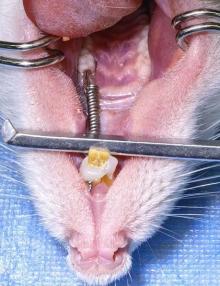
图1
大鼠上颌正畸牵引模型"
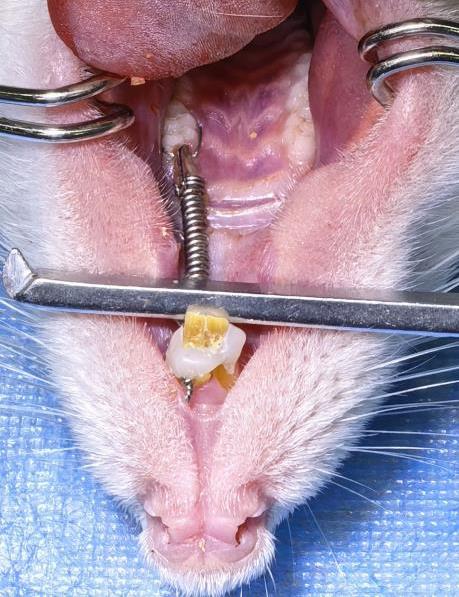
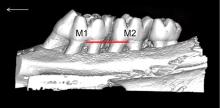
图2
大鼠上颌OTM模型三维重建图"
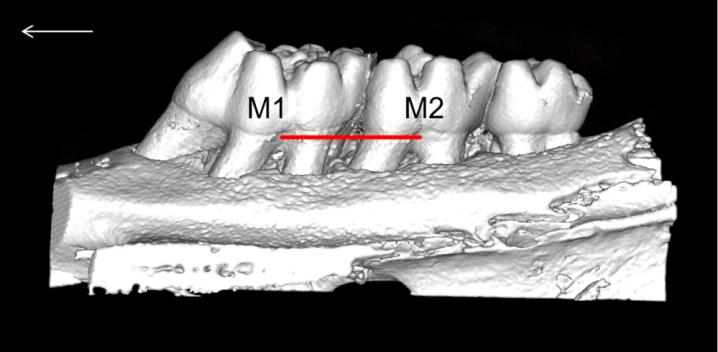
表1
引物序列"
| 引物名称 | 引物序列(5′→3′) |
|---|---|
| TRPV4 | F:GCACGCCACCCTACCCTTACC |
| R:CGCAGACACAACCACCAGCACT | |
| OPG | F:CTCCTGGTGTTCTTGGACATCATTG |
| R:GAGTAGTCAGGGCAAGGGACACAC | |
| RANKL | F:CACACCAAGGGACGACGGAATC |
| R:GGCAGCCACCACTACCACAGAGA | |
| PKA | F:TTCAGGTGACAGACTTCGGTTTTG |
| R:TTGTTGTAGCCTTTGCTCAGGATAAT | |
| GAPDH | F:TTCAGCTCTGGGATGACCTT |
| R:TGCCACTCAGAAGACTGTGG |
表2
引物序列"
| 引物名称 | 引物序列(5′→3′) |
|---|---|
| TRPV4 | F:GCACGCCACCCTACCCTTACC |
| R:CGCAGACACAACCACCAGCACT | |
| OPG | F:CTCCTGGTGTTCTTGGACATCATTG |
| R:GAGTAGTCAGGGCAAGGGACACAC | |
| RANKL | F:CACACCAAGGGACGACGGAATC |
| R:GGCAGCCACCACTACCACAGAGA | |
| PKA | F:CTAAAGCAGATCGAGCACACTC |
| R:GCCACCAGCTACATACTCCA | |
| GAPDH | F:TTCAGCTCTGGGATGACCTT |
| R:TGCCACTCAGAAGACTGTGG |
表3
大鼠OTM距离(n = 12)"
| 组别 | OTM距离 |
|---|---|
| PTH组 | 0.03 ± 0.02 |
| OTM组 | 0.29 ± 0.02 # |
| OTM+PTH组 | 0.46 ± 0.08 #& |
| P值 | < 0.001 |
| F值 | 106.8 |
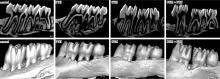
图3
正畸牵引10 d上颌骨μCT及三维扫描图"
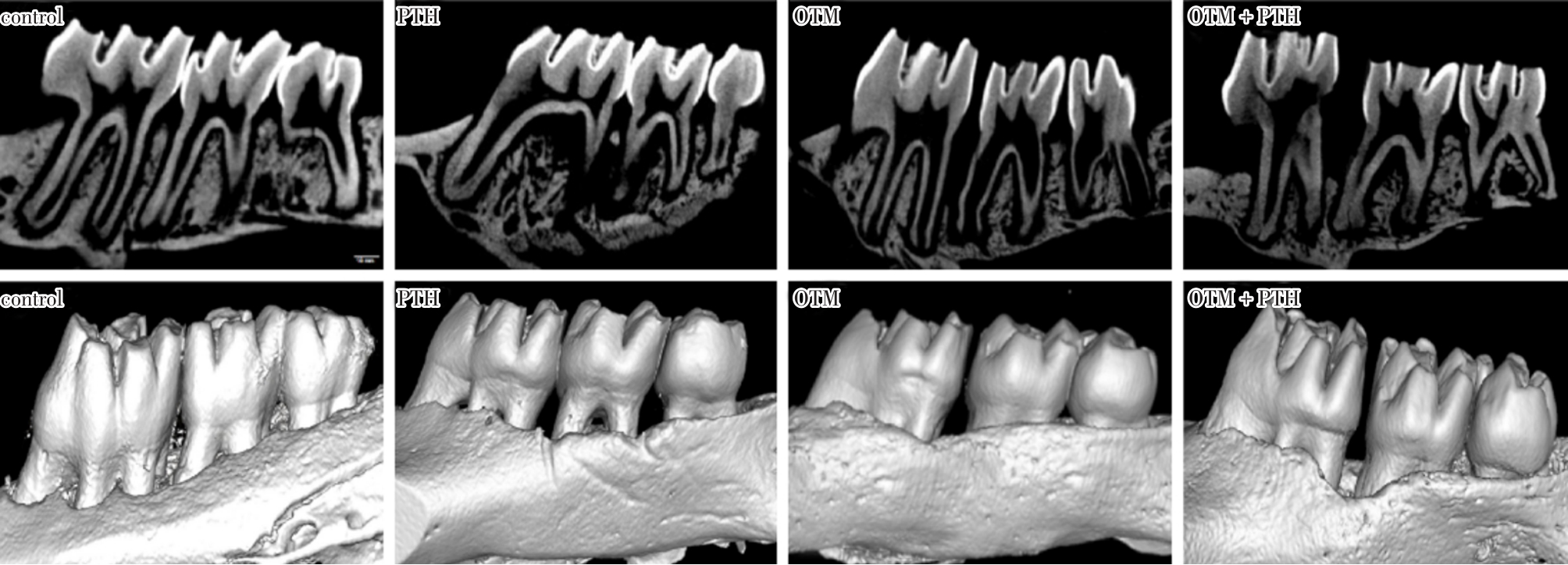
表4
各组大鼠正畸牙压力侧BMD以及骨体积测量结果(n = 3) (x ± s)"
| 组别 | BV/TV/% | BMD/(mg/cm3) |
|---|---|---|
| PTH组 | 0.47 ± 0.03 | 533.59 ± 17.74 |
| OTM组 | 0.38 ± 0.02# | 387.63 ± 13.30# |
| OTM+PTH组 | 0.27 ± 0.05#& | 331.40 ± 15.20#& |
| P值 | 0.001 | < 0.001 |
| F值 | 25.07 | 135.6 |
图4
大鼠正畸牙压力侧骨组织HE染色及TRAP染色注:上为HE染色,放大倍数:20 ×(比例尺:200 μm),放大倍数:40 ×(比例尺:100 μm);下为TRAP染色结果,放大倍数:20 ×(比例尺:200 μm),放大倍数:40 ×(比例尺:100 μm)"
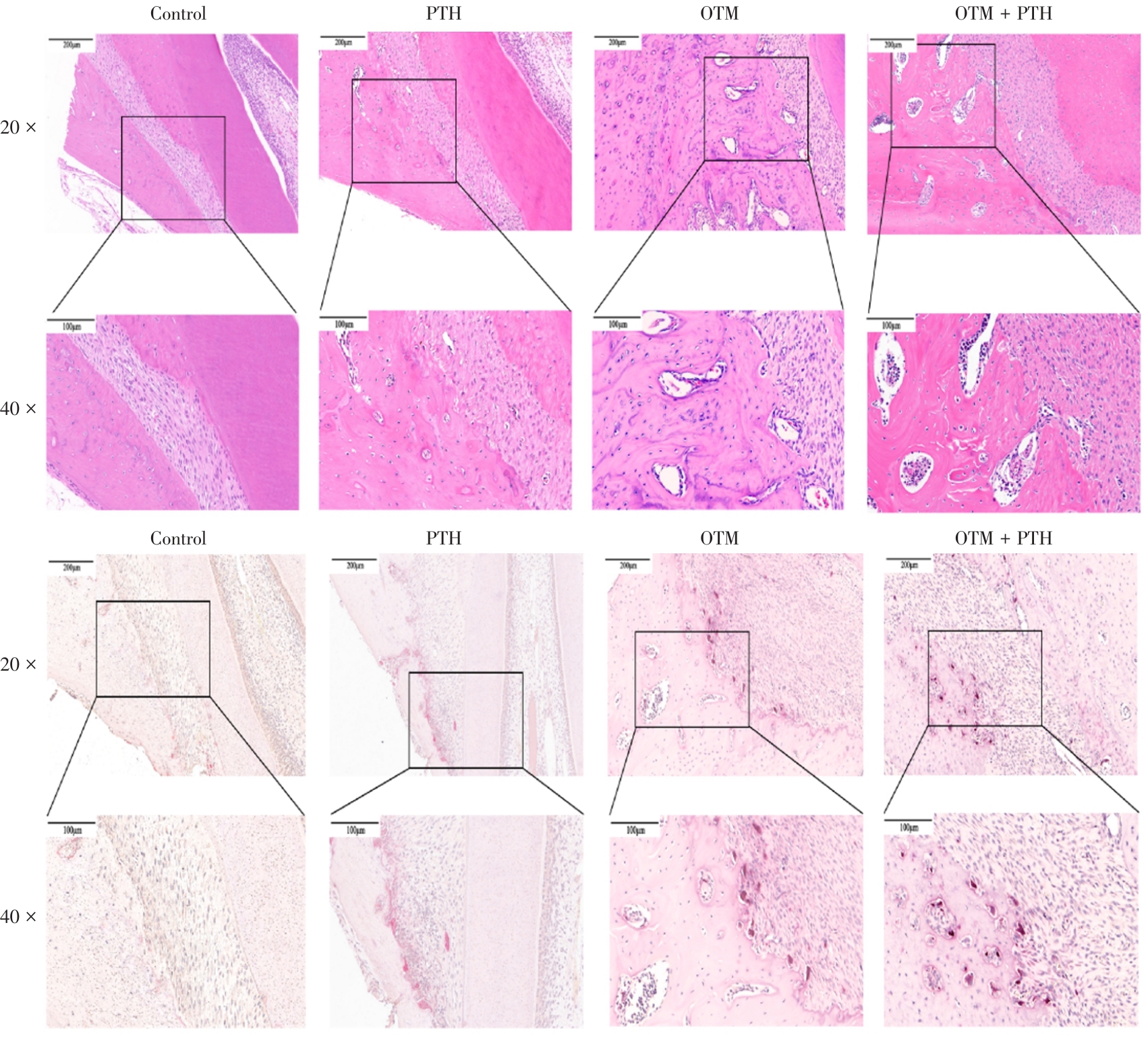
表5
各组大鼠压力侧骨组织中TRPV4、PKA mRNA表达情况(n = 6) (x ± s)"
| 组别 | TRPV4 | PKA |
|---|---|---|
| Control组 | 1.00 ± 0.01 | 1.01 ± 0.01 |
| PTH组 | 1.33 ± 0.08 * | 2.18 ± 0.09 * |
| OTM组 | 1.77 ± 0.11 *# | 1.07 ± 0.11 *# |
| OTM+PTH组 | 2.33 ± 0.16 *#& | 3.32 ± 0.26 *#& |
| P值 | < 0.001 | < 0.001 |
| F值 | 91.02 | 169.4 |
表6
各组大鼠压力侧骨组织中TRPV4、p-PKA/PKA表达情况(n = 6) (x ± s)"
| 组别 | TRPV4 | p-PKA/PKA |
|---|---|---|
| Control组 | 0.63 ± 0.08 | 0.48 ± 0.01 |
| PTH组 | 0.69 ± 0.04 | 0.98 ± 0.02 * |
| OTM组 | 0.84 ± 0.03 *# | 0.83 ± 0.06 *# |
| OTM+PTH组 | 0.97 ± 0.04 *#& | 1.11 ± 0.02 *#& |
| P值 | < 0.001 | < 0.001 |
| F值 | 27.03 | 215.3 |
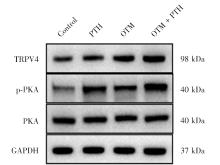
图5
各组大鼠压力侧骨组织中TRPV4、p-PKA、PKA条带图"
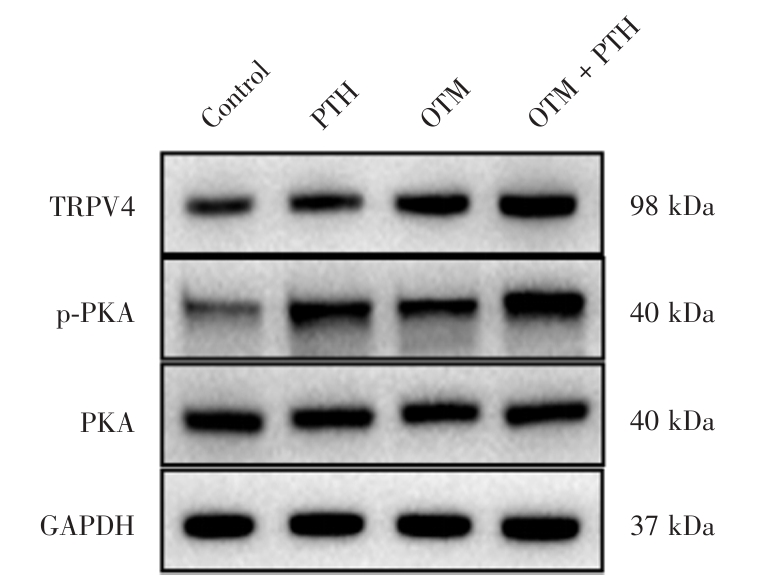
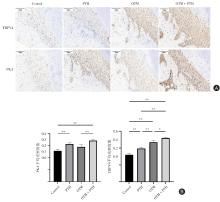
图6
免疫组织化学染色观察大鼠牙周组织TRPV4及PKA表达情况注:A,免疫组化染色结果,放大倍数:40 ×,比例尺:100 μm;B,PKA和TRPV4蛋白平均光密度值统计分析*P < 0.05,**P < 0.01"
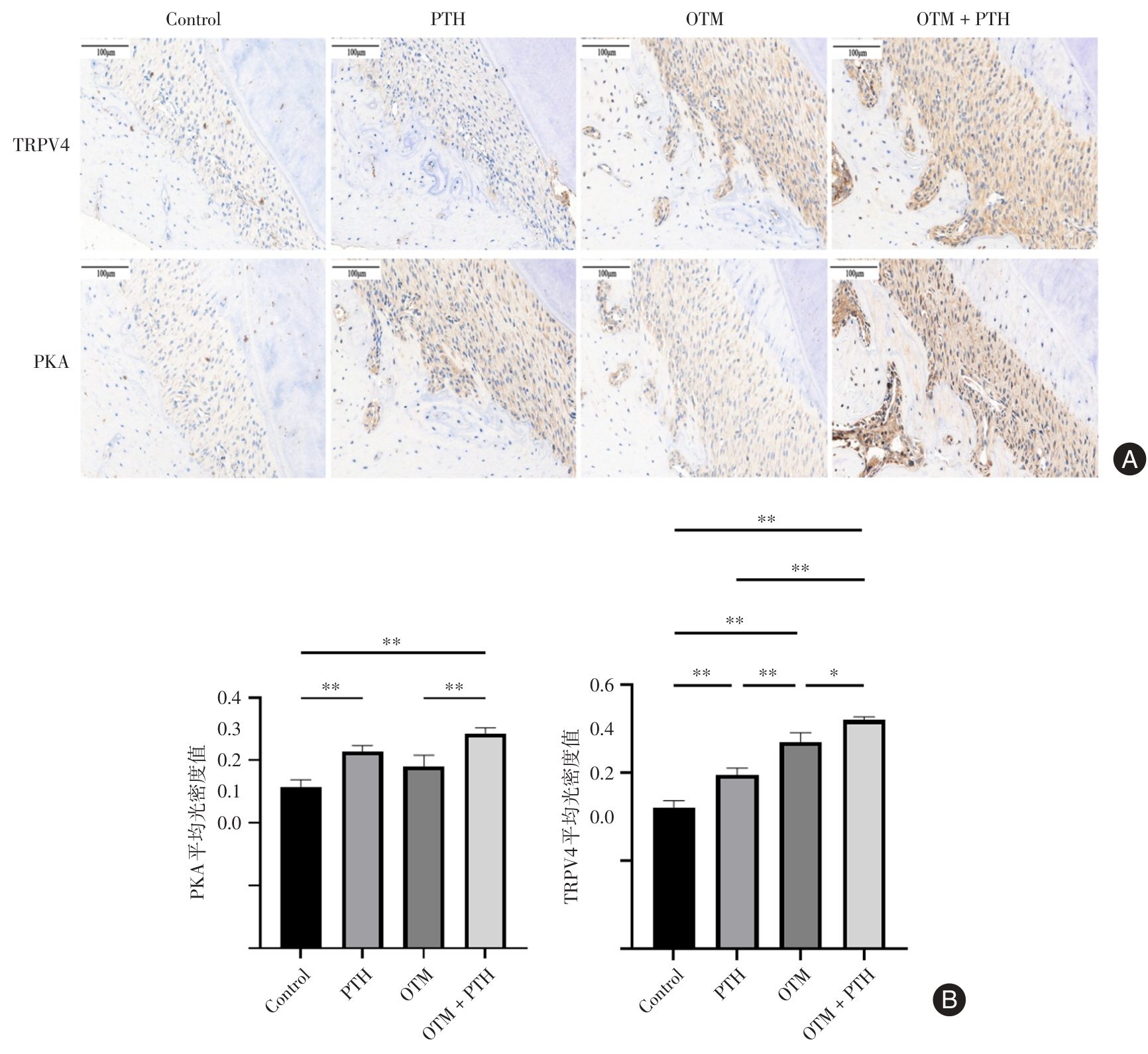
图7
免疫荧光染色观察大鼠牙周组织TRPV4及PKA表达情况注:A,免疫荧光染色结果,放大倍数:40×,比例尺:100 μm;B,TRPV4、PKA相对荧光强度统计。*P < 0.05,**P < 0.01"
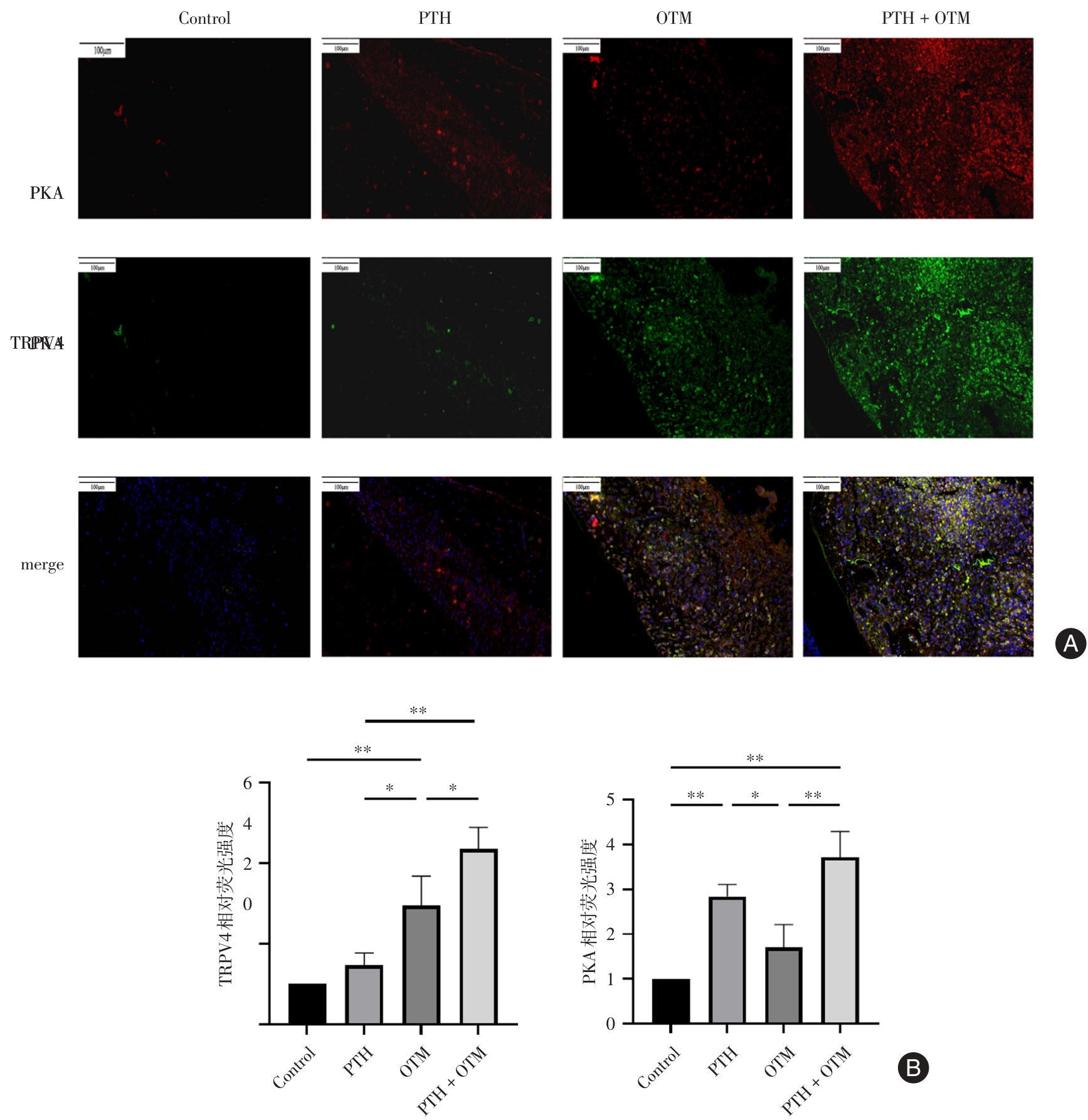
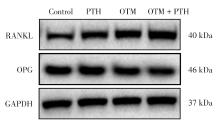
图8
各组大鼠压力侧骨组织中RANKL、OPG条带图"
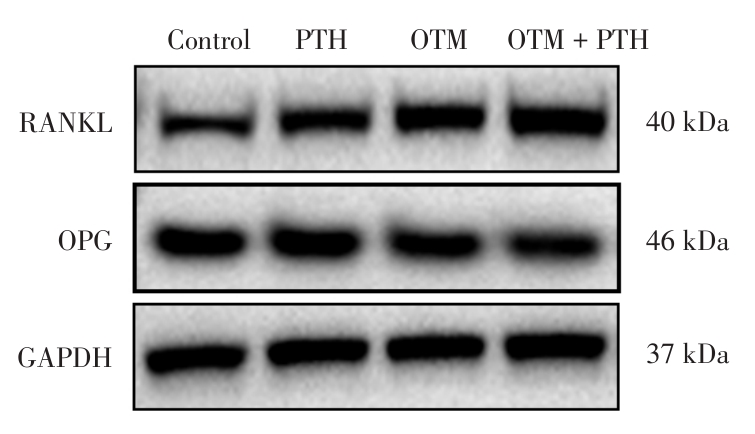
表7
各组大鼠压力侧骨组织中RANKL/OPG蛋白以及mRNA比值的表达情况(n = 6)"
| 组别 | RANKL/ OPG蛋白比值 | RANKL/ OPG mRNA比值 |
|---|---|---|
| Control组 | 0.06 ± 0.02 | 1.01 ± 0.01 |
| PTH组 | 0.69 ± 0.06 | 1.13 ± 0.25 |
| OTM组 | 0.90 ± 0.04 *# | 3.54 ± 0.19 *# |
| OTM+PTH组 | 1.04 ± 0.03*#& | 7.32 ± 1.21 *#& |
| P值 | < 0.001 | < 0.001 |
| F值 | 72.30 | 333.3 |
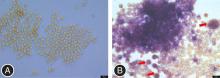
图9
RAW264.7破骨诱导镜下观察注:A,对照组;B,诱导组。红色箭头为破骨细胞,比例尺:100 μm,放大倍数:× 20"
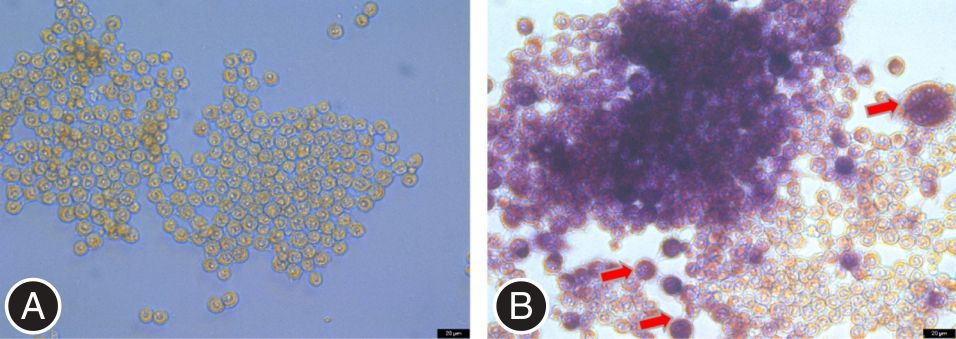
图10
RAW264.7破骨诱导TRAP染色注:红色箭头为破骨细胞,比例尺:100 μm,放大倍数:×40"
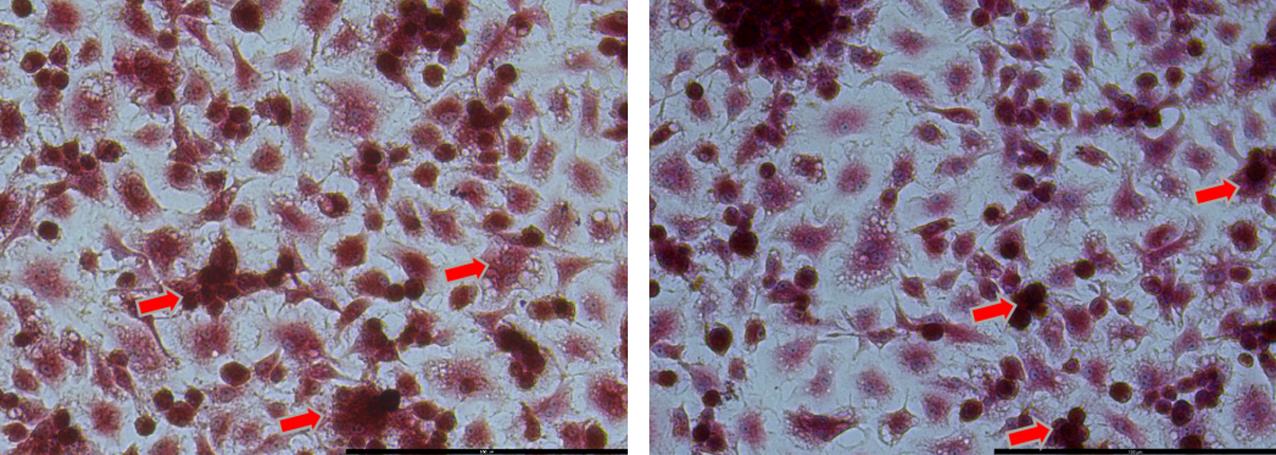
图11
体外RAW264.7细胞中PTH联合TRPV4激动剂对PKA/TRPV4信号通路及相关因子的调控作用注:A,RT-qPCR检测各组RANKL/OPG比值、PKA、TRPV4 mRNA的表达水平;B,Western blot蛋白条带,β-actin为内参;C,蛋白相对表达量统计图。*P < 0.05,**P < 0.01"
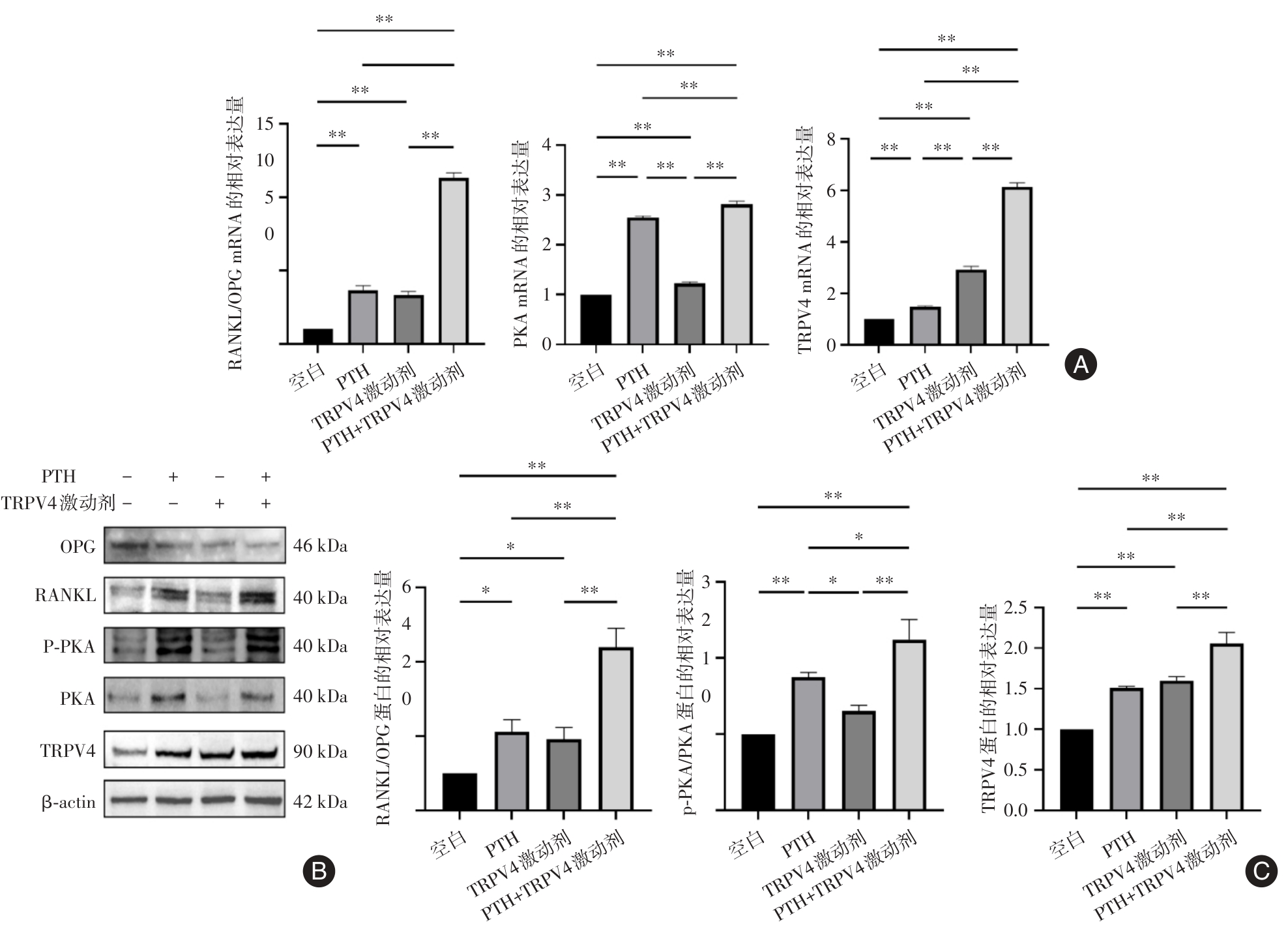
图12
TRPV4抑制剂对PTH调控的RAW264.7细胞中PKA/TRPV4信号通路相关因子的影响注:A,RT-qPCR检测各组 RANKL/OPG、PKA、TRPV4的mRNA表达水平;B,Western blot蛋白条带,β-actin为内参;C,蛋白相对表达量统计图。*P < 0.05,**P < 0.01"
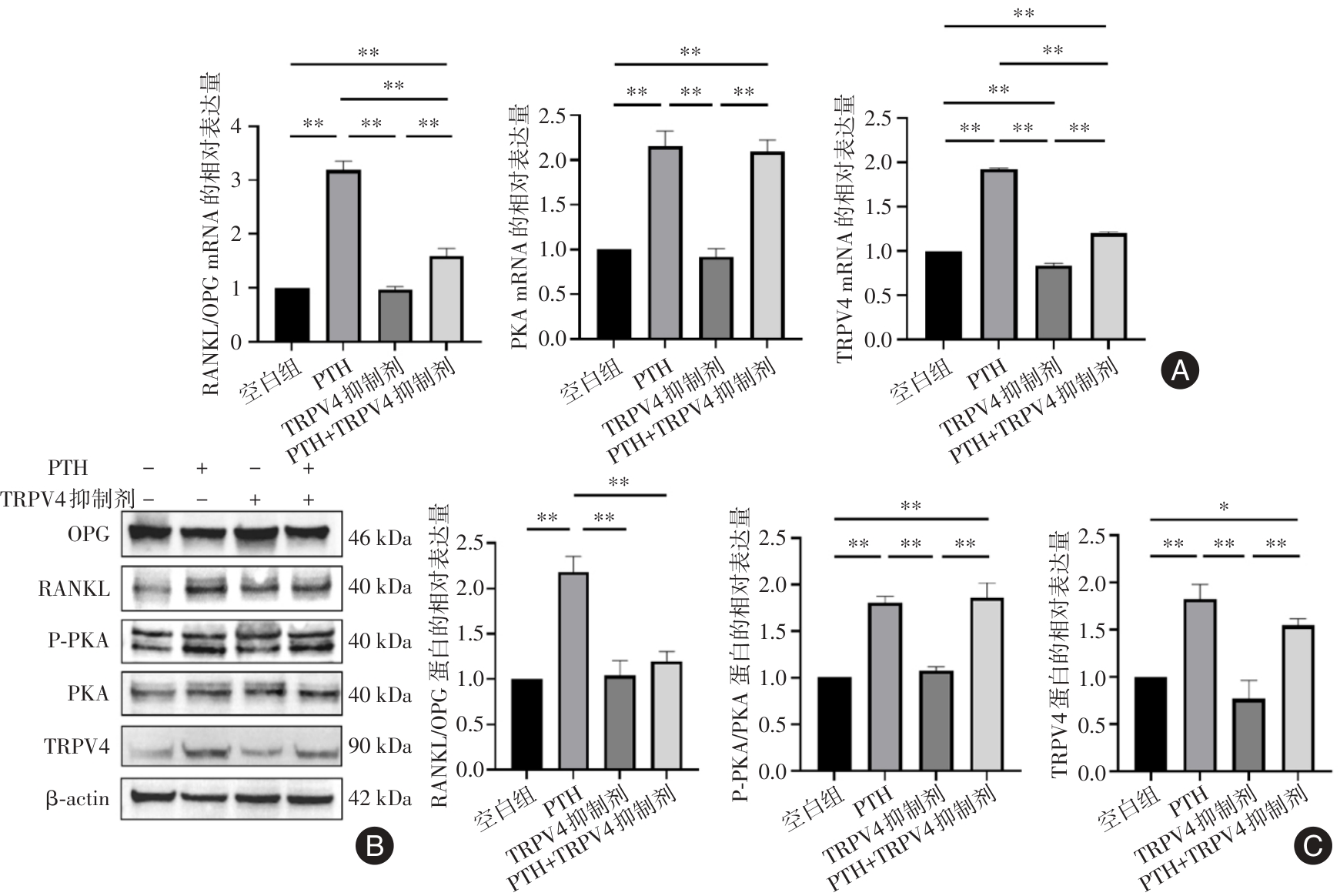
图13
PKA激动剂对PTH调控RAW264.7细胞中PKA/TRPV4信号通路及破骨分化的促进效应注:A,RT-qPCR检测各组RANKL/OPG、PKA、TRPV4的mRNA表达水平;B,Western blot蛋白条带,β-actin为内参;C,蛋白相对表达量统计图。*P < 0.05,**P < 0.01"
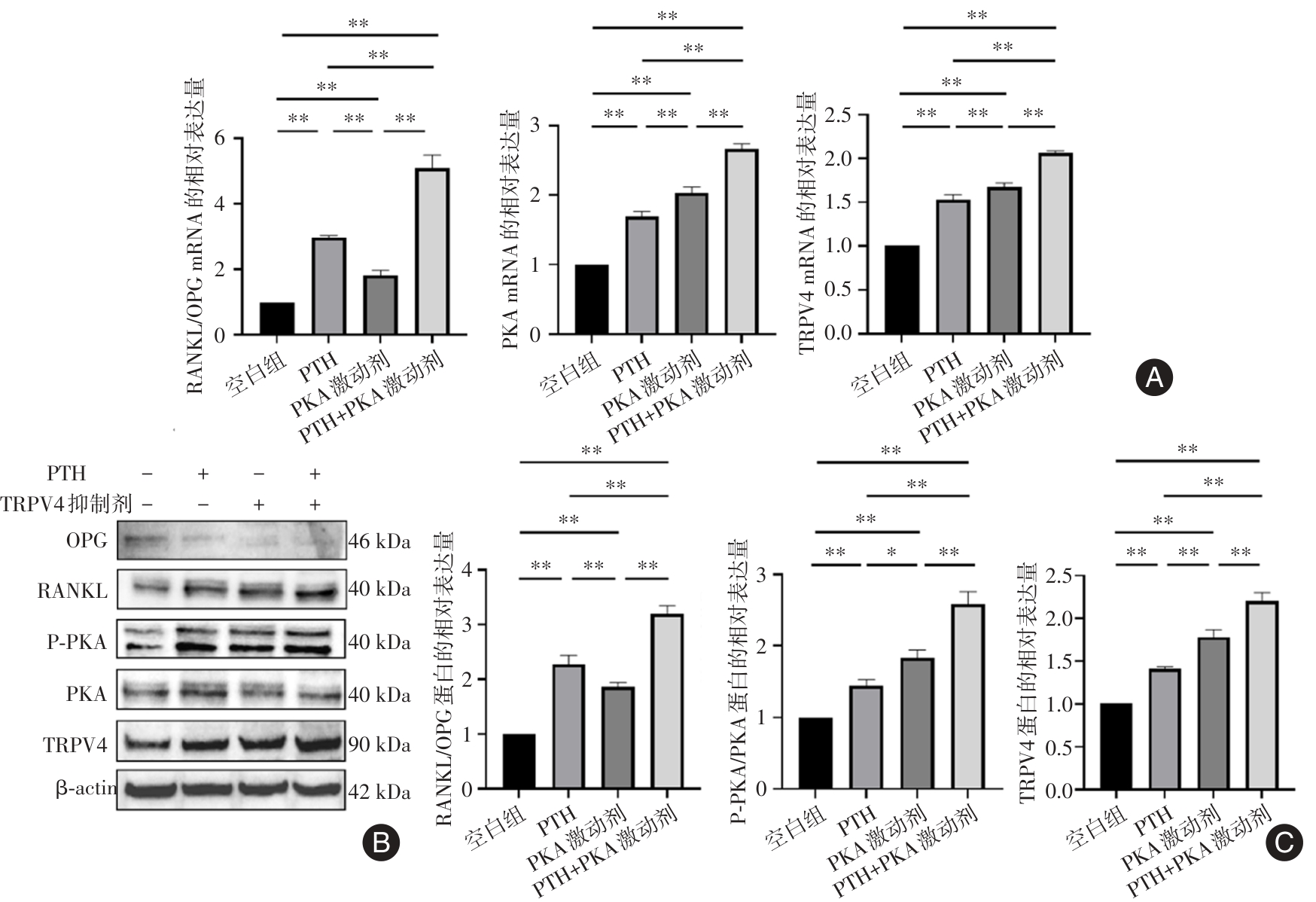
图14
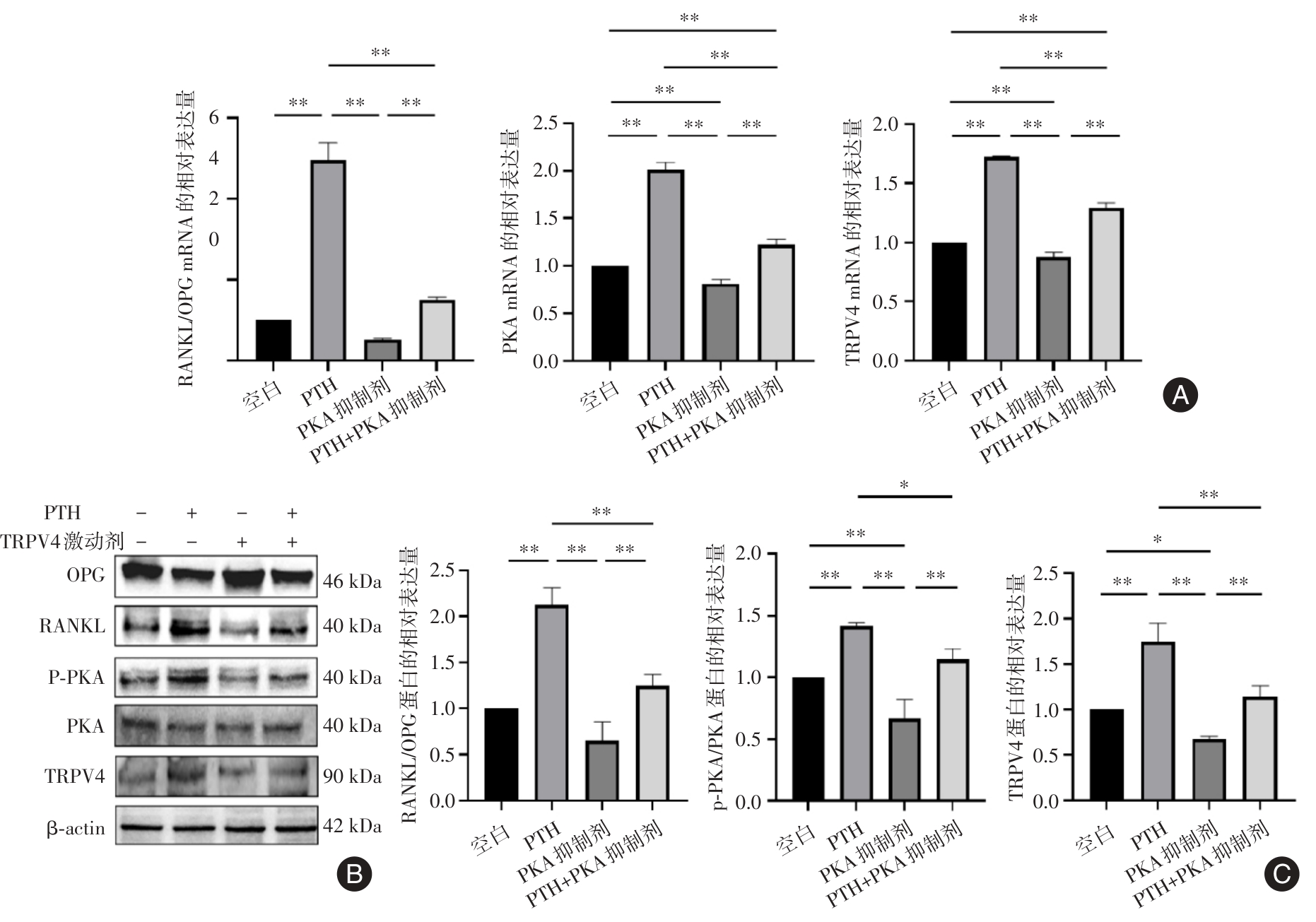
PKA抑制剂对PTH调控的RAW264.7细胞中PKA/TRPV4信号通路相关因子的影响注:A,RT-qPCR检测各组RANKL/OPG、PKA、TRPV4的mRNA表达水平;B,Western blot蛋白条带,β-actin为内参;C,蛋白相对表达量统计图。*P < 0.05,**P < 0.01"
| [1] |
SENDYK M, CEVIDANES L H S, DE OLIVEIRA RUELLAS A C, et al. Three-dimensional evaluation of dental decompensation and mandibular symphysis remodeling on orthodontic-surgical treatment of Class III malocclusion[J]. Am J Orthod Dentofac Orthop, 2021, 159(2): 175-183.e3. doi:10.1016/j.ajodo.2019. 12.020 .
doi: 10.1016/j.ajodo.2019. 12.020 |
| [2] |
COFFEY D, NEEDHAM R. What are the limits of orthodontic treatment before surgical intervention is required?[J]. Br J Oral Maxillofac Surg, 2026, 64(2): 118-125. doi:10.1016/j.bjoms.2025. 07.008 .
doi: 10.1016/j.bjoms.2025. 07.008 |
| [3] |
CAĞLAROĞLU M, ERDEM A. Histopathologic investigation of the effects of prostaglandin E2 administered by different methods on tooth movement and bone metabolism[J]. Korean J Orthod, 2012, 42(3): 118. doi:10.4041/kjod.2012.42.3.118 .
doi: 10.4041/kjod.2012.42.3.118 |
| [4] |
MCGORRAY S P, DOLCE C, KRAMER S, et al. A randomized, placebo-controlled clinical trial on the effects of recombinant human relaxin on tooth movement and short-term stability[J]. Am J Orthod Dentofac Orthop, 2012, 141(2): 196-203. doi:10.1016/j.ajodo.2011.07.024 .
doi: 10.1016/j.ajodo.2011.07.024 |
| [5] |
WISE G E, KING G J. Mechanisms of tooth eruption and orthodontic tooth movement[J]. J Dent Res, 2008, 87(5): 414-434. doi:10.1177/154405910808700509 .
doi: 10.1177/154405910808700509 |
| [6] |
ALSHAMMARI A K, SIDDIQUI A A, SHAMMARY N H AL, et al. Assessment of perception and barriers toward orthodontic treatment needs in the Saudi Arabian adult population[J]. Healthcare, 2022, 10(12): 2488. doi:10.3390/healthcare10122488 .
doi: 10.3390/healthcare10122488 |
| [7] |
AREF S, RAVURI P, KUBAVAT A K, et al. Comparative analysis of braces and aligners: Long-term orthodontic outcomes[J]. J Pharm Bioallied Sci, 2024, 16(): S2385-S2387. doi:10.4103/jpbs.jpbs_268_24 .
doi: 10.4103/jpbs.jpbs_268_24 |
| [8] |
ADARSH K, KAUR H, RAI S, et al. Assessment of outcomes in patients who underwent traditional and advanced orthodontic treatment: A comparative study[J]. J Pharm Bioallied Sci, 2025, 17(): S3527-S3529. doi:10.4103/jpbs.jpbs_345_25 .
doi: 10.4103/jpbs.jpbs_345_25 |
| [9] |
CHEN T, WANG Y, HAO Z, et al. Parathyroid hormone and its related peptides in bone metabolism[J]. Biochem Pharmacol, 2021, 192: 114669. doi:10.1016/j.bcp.2021.114669 .
doi: 10.1016/j.bcp.2021.114669 |
| [10] |
HENNEMAN S, VON DEN HOFF J W, MALTHA J C. Mechanobiology of tooth movement[J]. Eur J Orthod, 2008, 30(3): 299-306. doi:10.1093/ejo/cjn020 .
doi: 10.1093/ejo/cjn020 |
| [11] |
LI H, ZHANG R. The role of calcium ions and the transient receptor potential vanilloid (TRPV) channel in bone remodelling and orthodontic tooth movement[J]. Mol Biol Rep, 2025, 52(1): 297. doi:10.1007/s11033-025-10399-1 .
doi: 10.1007/s11033-025-10399-1 |
| [12] |
郑初蕾, 章文斌, 胡苏皖, 等. 右美托咪定辅助脑深部电刺激术对老年帕金森病患者cAMP/PKA信号通路的影响[J]. 实用医学杂志, 2026, 42(4): 579-587. doi:10.3969/j.issn.1006-5725.2026.04.006 .
doi: 10.3969/j.issn.1006-5725.2026.04.006 |
| [13] |
MARTIN T J, SIMS N A, SEEMAN E. Physiological and pharmacological roles of PTH and PTHrP in bone using their shared receptor, PTH1R[J]. Endocr Rev, 2021, 42(4): 383-406. doi:10.1210/endrev/bnab005 .
doi: 10.1210/endrev/bnab005 |
| [14] |
MASUYAMA R, MIZUNO A, KOMORI H, et al. Calcium/calmodulin-signaling supports TRPV4 activation in osteoclasts and regulates bone mass[J]. J Bone Miner Res, 2012, 27(8): 1708-1721. doi:10.1002/jbmr.1629 .
doi: 10.1002/jbmr.1629 |
| [15] |
GU S, DUANWANG Y, ZHAO Y, et al. Mechanobiological response of osteocyte TRPV4 base on the piezoelectricity of bone matrix[J]. Ann Biomed Eng, 2026. doi:10.1007/s10439-026-04086-w .
doi: 10.1007/s10439-026-04086-w |
| [16] |
WANG X, HUANG M, TANG Y, et al. Hypotonic stimuli promote osteocyte dendrite formation by modulating actin dynamics via the TRPV4-CDC42 signaling pathway[J]. Mater Today Bio, 2025, 34: 102120. doi:10.1016/j.mtbio.2025.102120 .
doi: 10.1016/j.mtbio.2025.102120 |
| [17] |
吴智鹏, 张钰琴, 王明刚, 等. 瞬时受体电位信号通路在肝细胞癌中的表达及生物学功能[J]. 实用医学杂志, 2024, 40(6): 743-747. doi: 10.3969/j.issn.1006-5725.2024.06.003 .
doi: 10.3969/j.issn.1006-5725.2024.06.003 |
| [18] |
PENG H, LEWANDROWSKI U, MÜLLER B, et al. Identification of a Protein Kinase C-dependent phosphorylation site involved in sensitization of TRPV4 channel[J]. Biochem Biophys Res Commun, 2010, 391(4): 1721-1725. doi:10.1016/j.bbrc.2009.12.140 .
doi: 10.1016/j.bbrc.2009.12.140 |
| [19] |
XU W, HUANG X, WU X. The effect of acute hypoxic exercise on the protein kinase A/arachidonic acid/transient receptor potential vanilloid 4 pathway in the prefrontal cortex of rats[J]. Arch Biochem Biophys, 2025, 763: 110214. doi:10.1016/j.abb.2024. 110214 .
doi: 10.1016/j.abb.2024. 110214 |
| [20] |
LU W, LI X, YANG Y, et al. PTH/PTHrP in controlled release hydrogel enhances orthodontic tooth movement by regulating periodontal bone remodaling[J]. J Periodontal Res, 2021, 56(5): 885-896. doi:10.1111/jre.12885 .
doi: 10.1111/jre.12885 |
| [21] |
CAO H, KOU X, YANG R, et al. Force-induced Adrb2 in periodontal ligament cells promotes tooth movement[J]. J Dent Res, 2014, 93(11): 1163-1169. doi:10.1177/0022034514551769 .
doi: 10.1177/0022034514551769 |
| [22] |
DUNN M D, PARK C H, KOSTENUIK P J, et al. Local delivery of osteoprotegerin inhibits mechanically mediated bone modeling in orthodontic tooth movement[J]. Bone, 2007, 41(3): 446-455. doi:10.1016/j.bone.2007.04.194 .
doi: 10.1016/j.bone.2007.04.194 |
| [23] |
HE D, LIU F, CUI S, et al. Mechanical load-induced H2S production by periodontal ligament stem cells activates M1 macrophages to promote bone remodeling and tooth movement via STAT1[J]. Stem Cell Res Ther, 2020, 11(1): 112. doi:10.1186/s13287-020-01607-9 .
doi: 10.1186/s13287-020-01607-9 |
| [24] |
LU W, ZHANG X, FIRTH F, et al. Sclerostin injection enhances orthodontic tooth movement in rats[J]. Arch Oral Biol, 2019, 99: 43-50. doi:10.1016/j.archoralbio.2018.12.011 .
doi: 10.1016/j.archoralbio.2018.12.011 |
| [25] |
LI Y, JACOX L A, COATS S, et al. Roles of autophagy in orthodontic tooth movement[J]. Am J Orthod Dentofac Orthop, 2021, 159(5): 582-593. doi:10.1016/j.ajodo.2020.01.027 .
doi: 10.1016/j.ajodo.2020.01.027 |
| [26] |
KAU C H, SOH J, CHRISTOU T, et al. Orthodontic aligners: Current perspectives for the modern orthodontic office[J]. Medicina, 2023, 59(10): 1773. doi:10.3390/medicina59101773 .
doi: 10.3390/medicina59101773 |
| [27] |
WOLF M, LOSSDÖRFER S, ABUDUWALI N, et al. Potential role of high mobility group box protein 1 and intermittent PTH (1⁃34) in periodontal tissue repair following orthodontic tooth movement in rats[J]. Clin Oral Investig, 2013, 17(3): 989-997. doi:10.1007/s00784-012-0777-2 .
doi: 10.1007/s00784-012-0777-2 |
| [28] |
ZHANG C, LI T, ZHOU C, et al. Parathyroid hormone increases alveolar bone homoeostasis during orthodontic tooth movement in rats with periodontitis via crosstalk between STAT3 and β-catenin[J]. Int J Oral Sci, 2020, 12: 38. doi:10.1038/s41368-020-00104-2 .
doi: 10.1038/s41368-020-00104-2 |
| [29] |
WU X, CHEN X, LU Y, et al. Parathyroid hormone modulates alveolar bone metabolism via inducing periodontal ligament stem cells aerobic glycolysis[J]. Int Dent J, 2026, 76(4): 109572. doi:10.1016/j.identj.2026.109572 .
doi: 10.1016/j.identj.2026.109572 |
| [30] |
CHEONG V S, ROBERTS B C, KADIRKAMANATHAN V, et al. Positive interactions of mechanical loading and PTH treatments on spatio-temporal bone remodelling[J]. Acta Biomater, 2021, 136: 291-305. doi:10.1016/j.actbio.2021.09.035 .
doi: 10.1016/j.actbio.2021.09.035 |
| [31] |
SCHULTE F A, MARQUES F C, GRIESBACH J K, et al. Combined physical and pharmacological anabolic osteoporosis therapies increase bone response and mechanoregulation in female mice[J]. Nat Commun, 2026, 17: 3759. doi:10.1038/s41467-026-70309-2 .
doi: 10.1038/s41467-026-70309-2 |
| [32] |
JIN S S, HE D Q, WANG Y, et al. Mechanical force modulates periodontal ligament stem cell characteristics during bone remodelling via TRPV4[J]. Cell Prolif, 2020, 53(10): e12912. doi:10.1111/cpr.12912 .
doi: 10.1111/cpr.12912 |
| [33] |
SHEN Y, PAN Y, GUO S, et al. The roles of mechanosensitive ion channels and associated downstream MAPK signaling pathways in PDLC mechanotransduction[J]. Mol Med Report, 2020: 2113-2122. doi:10.3892/mmr.2020.11006 .
doi: 10.3892/mmr.2020.11006 |
| [34] |
MARTIN T J. PTH1R actions on bone using the cAMP/protein kinase a pathway[J]. Front Endocrinol, 2022, 12: 833221. doi:10.3389/fendo.2021.833221 .
doi: 10.3389/fendo.2021.833221 |
| [35] |
VAN GOOR M K, VERKAART S, VAN DAM T J, et al. Interspecies differences in PTH-mediated PKA phosphorylation of the epithelial calcium channel TRPV5[J]. Pflügers Arch Eur J Physiol, 2017, 469(10): 1301-1311. doi:10.1007/s00424-017-1996-9 .
doi: 10.1007/s00424-017-1996-9 |
| [36] |
RICARTE F R, LE HENAFF C, KOLUPAEVA V G, et al. Parathyroid hormone(1-34) and its analogs differentially modulate osteoblastic Rankl expression via PKA/SIK2/SIK3 and PP1/PP2A-CRTC3 signaling[J]. J Biol Chem, 2018, 293(52): 20200-20213. doi:10.1074/jbc.RA118.004751 .
doi: 10.1074/jbc.RA118.004751 |
| [37] |
DOUGUET D, HONORÉ E. Mammalian mechanoelectrical transduction: Structure and function of force-gated ion channels[J]. Cell, 2019, 179(2): 340-354. doi:10.1016/j.cell.2019.08.049 .
doi: 10.1016/j.cell.2019.08.049 |
| [38] |
EL-MASRI B M, ANDREASEN C M, LAURSEN K S, et al. Mapping RANKL- and OPG-expressing cells in bone tissue: The bone surface cells as activators of osteoclastogenesis and promoters of the denosumab rebound effect[J]. Bone Res, 2024, 12: 62. doi:10.1038/s41413-024-00362-4 .
doi: 10.1038/s41413-024-00362-4 |
| [39] |
HOOSHIAR S H, TOBEIHA M, JAFARNEJAD S. Soy isoflavones and bone health: Focus on the RANKL/RANK/OPG pathway[J]. BioMed Res Int, 2022, 2022: 8862278. doi:10.1155/2022/8862278 .
doi: 10.1155/2022/8862278 |
| [1] | 刘洋,程畅波,卢鸿铎,陈犇璐,陈志文,陈镇秋,凡一诺. 免疫细胞相关因子介导的骨稳态失衡及其在骨相关疾病中的研究进展[J]. 实用医学杂志, 2026, 42(2): 276-284. |
| [2] | 张谷月,张鸽,王惠. 加味阳和汤对2型糖尿病合并膝骨关节炎患者血清Wnt-3α、OSCAR、RNKL水平及膝关节功能的影响[J]. 实用医学杂志, 2026, 42(13): 2381-2387. |
| [3] | 覃雅庆 刘俊峰 张文忠. 光生物调节疗法在口腔正畸中的现状与展望[J]. 实用医学杂志, 2023, 39(7): 919-922. |
| [4] | 黄帅 黄国樑 令狐熙涛 谢尚延 瓦庆德 郭远清 黄彦. 桦木酸在酸性微环境中对PC⁃3细胞生物学行为及破骨细胞分化的作用 [J]. 实用医学杂志, 2022, 38(9): 1076-1081. |
| [5] | 张琪 屈坤鹏 成晓舟 张宇鹏 王小虎 曹维嘉. 腔镜下甲状腺切除术联合甲状旁腺移植术对甲状旁腺功能的影响 [J]. 实用医学杂志, 2021, 37(19): 2492-2496. |
| [6] | 徐骏 王笑薇 刘旻 齐向明.
碳酸镧联合西那卡塞、骨化三醇对血液透析伴继发性甲状旁腺功能亢进症的疗效
[J]. 实用医学杂志, 2021, 37(1): 82-86. |
| [7] | 余明芳, 刘旭光, 吴晓. 生物钟基因Bmal1与骨代谢相关性的研究进展[J]. 实用医学杂志, 2020, 36(20): 2881-2884. |
| 阅读次数 | ||||||
|
全文 |
|
|||||
|
摘要 |
|
|||||
