

The Journal of Practical Medicine ›› 2026, Vol. 42 ›› Issue (18): 3371-3381.doi: 10.3969/j.issn.1006-5725.2026.18.016
• Treatise:Mechanism and Practice • Previous Articles
Pei Wang, Wenfei Wu, Qi Wu, Ligang Jia, Ping Yan( )
Received:2026-04-30
Revised:2026-06-23
Accepted:2026-07-07
Online:2026-09-25
Published:2026-10-19
Contact:
Ping Yan
About author:Wang Pei performed the experiments and wrote the article. Wu Wenfei performed the experiments. Wu Qi and Ligang Jia revised the article. Yan Ping designed the study and reviewed the article. All authors read and approved the final manuscript as submitted. 【Conflict of interest】:The authors declare no conflict of interest.
CLC Number:
Pei Wang, Wenfei Wu, Qi Wu, Ligang Jia, Ping Yan. Effectiveness and safety of infrared thermotherapy immune induction therapeutic apparatus for high-risk human papillomavirus infection of cervix[J]. The Journal of Practical Medicine, 2026, 42(18): 3371-3381.
Tab.1
Screening status of each center"
| 项目 | 01中心(n = 103) | 02中心(n = 41) | 合计(n = 144) |
|---|---|---|---|
| 筛选 | 103 | 41 | 144 |
| 筛选成功 | 67(65.0) | 30(73.2) | 97(67.4) |
| 筛选失败 | 36(35.0) | 11(26.8) | 47(32.6) |
| 不符合入选/符合排除标准 | 30(29.1) | 11(26.8) | 41(28.5) |
| 撤回知情同意 | 1(1.0) | 0(0.0) | 1(0.7) |
| 其他 | 5(4.9) | 0(0.0) | 5(3.5) |
| 随机入组 | 67(100.0) | 30(100.0) | 97(100.0) |
| 试验组 | 44(65.7) | 21(70.0) | 65(67.0) |
| 对照组 | 23(34.3) | 9(30.0) | 32(33.0) |
Tab.2
Inclusion/exclusion of each analysis set"
| 分析集/剔除原因 | 试验组(n = 65) | 对照组(n = 32) | 合计(n = 97) |
|---|---|---|---|
| FAS | 64(98.5) | 32(100.0) | 96(99.0) |
| 试验组受试者未进行治疗 | 1(1.5) | 0(0.0) | 1(1.0) |
| PPS | 61(93.8) | 31(96.9) | 92(94.8) |
| 试验组受试者未进行治疗 | 1(1.5) | 0(0.0) | 1(1.0) |
| 未收集到主要疗效指标 | 1(1.5) | 1(3.1) | 2(2.1) |
| 未完成方案规定治疗且未收集主要指标 | 2(3.1) | 0(0.0) | 2(2.1) |
| SS | 63(96.9) | 32(100.0) | 95(97.9) |
| 试验组受试者未进行治疗 | 1(1.5) | 0(0.0) | 1(1.0) |
| 未收集到治疗后安全性评价 | 1(1.5) | 0(0.0) | 1(1.0) |
Tab.3
Demographic information of subjects in each group (FAS)"
| 指标 | 试验组(n = 64) | 对照组(n = 32) | 合计(n = 96) | t/χ² 值 | P值 |
|---|---|---|---|---|---|
| 年龄(x ± s)/岁 | 39.5 ±11.34 | 40.5 ±9.25 | 39.8 ±10.65 | -0.428 | 0.670 |
| 身高(x ± s)/cm | 161.9 ± 4.60 | 162.0 ± 3.04 | 161.9 ± 4.13 | -0.110 | 0.912 |
| 体质量(x ± s)/kg | 58.99 ± 7.780 | 60.55 ± 7.845 | 59.51 ± 7.795 | -0.926 | 0.357 |
| 至少有一次既往病史 | 7(10.9) | 2(6.3) | 9(9.4) | 0.552 | 0.458 |
| 至少有一次现病史 | 43(67.2) | 18(56.3) | 61(63.5) | 1.113 | 0.294 |
| 至少有一次合并用药 | 35(54.7) | 13(40.6) | 48(50.0) | 1.721 | 0.190 |
| 至少有一次既往用药 | 7(10.9) | 3(9.4) | 10(10.4) | 0.056 | 0.813 |
Tab.4
Main efficacy indicators based on FAS and PPS"
| 治疗/随机化后6个月 | 试验组 | 对照组 | 组间率差及95%CI/% | χ2 值 | P值 |
|---|---|---|---|---|---|
| FAS分析例数 | 64 | 32 | 42.19(18.57 ~ 60.07) | 17.51 | < 0.001 |
| 缺失 | 3 | 1 | |||
| 有效 | 47(73.4) | 10(31.3) | |||
| 无效 | 14(21.9) | 21(65.6) | |||
| PPS分析例数 | 61 | 31 | 44.79(21.85 ~ 62.85) | < 0.001 | |
| 缺失 | 0 | 0 | |||
| 有效 | 47(77.0) | 10(32.3) | |||
| 无效 | 14(23.0) | 21(67.7) |
Tab.5
Effective rate of HPV virus clearance and specific analysis of HPV52 subtype at each follow-up time point (FAS)"
| 时间点/疗效指标 | 试验组(n = 64) | 对照组(n = 32) | 组间率差及95%CI/% | χ2 值 | P值 |
|---|---|---|---|---|---|
| 首次治疗/随机化后3个月 | -7.81(-28.99 ~ 12.71) | 0.183 | 0.668 | ||
| 缺失 | 2 | 0 | |||
| 有效 | 21(32.8) | 13(40.6) | |||
| 首次治疗/随机化后4个月 | 12.50(-9.25 ~ 31.84) | 1.578 | 0.209 | ||
| 缺失 | 3 | 1 | |||
| 有效 | 28(43.8) | 10(31.3) | |||
| 首次治疗/随机化后6个月——HPV52 | 67.5(23.05 ~ 91.48) | - | 0.003 | ||
| 总数 | 15(100.0) | 8(100.0) | |||
| 有效 | 12(80.0) | 1(12.5) | |||
| 无效 | 3(20.0) | 7(87.5) |
Tab.6
Clinical efficacy cure rate at 3, 4, and 6 months (FAS)"
| 时间点/疗效指标 | 试验组(n = 64) | 对照组(n = 32) | 组间率差及95%CI/ | χ2 值 | P值 |
|---|---|---|---|---|---|
| 3个月治愈率 | 20.3(13/64) | 34.4(11/32) | -14.06(-34.42 ~ 4.61) | 2.25 | 0.140 |
| 4个月治愈率 | 26.6(17/64) | 25.0(8/32) | 1.56(-18.70 ~ 19.51) | 0.027 | 0.874 |
| 6个月治愈率 | 68.8(44/64) | 28.1(9/32) | 40.63(16.12 ~ 58.38) | 14.24 | < 0.001 |
Tab.7
Overall satisfaction rate of life satisfaction at each follow-up time point (FAS)"
| 访视时间点 | 试验组(n = 64) | 对照组(n = 32) | χ2 值 | P值(Fisher) |
|---|---|---|---|---|
| 第1次治疗当天(D0) | 64(100.0) | 25(78.1) | - | < 0.001 |
| 第10次治疗(D45) | 62(96.9) | 27(84.4) | - | 0.038 |
| 首次治疗/随机化后3个月 | 62(96.9) | 27(84.4) | - | 0.038 |
| 首次治疗/随机化后4个月 | 61(95.3) | 28(87.5) | - | 0.186 |
| 首次治疗/随机化后6个月 | 61(95.3) | 30(93.8) | - | 0.762 |
Tab.8
Summary of VAS pain scores during the treatment period (experimental group, FAS)"
| 治疗次数 | 缺失 | Mean(SD) | Median | Q1, Q3 | Min, Max | LSmean(95%CI) |
|---|---|---|---|---|---|---|
| 第1次(D0) | 0 | 0.35(0.572) | 0.00 | 0.00, 0.80 | 0.0, 2.5 | 0.2572(0.1240 ~ 0.3904) |
| 第2次(D1) | 1 | 0.35(0.572) | 0.00 | 0.00, 0.80 | 0.0, 2.5 | 0.2632(0.1301 ~ 0.3964) |
| 第3次(D2) | 1 | 0.33(0.506) | 0.00 | 0.00, 0.80 | 0.0, 2.5 | 0.2443(0.1277 ~ 0.3608) |
| 第4次(D9) | 1 | 0.37(0.595) | 0.00 | 0.00, 0.80 | 0.0, 2.5 | 0.2751(0.1366 ~ 0.4136) |
| 第5次(D10) | 1 | 0.37(0.595) | 0.00 | 0.00, 0.80 | 0.0, 2.5 | 0.2751(0.1366 ~ 0.4136) |
| 第6次(D17) | 2 | 0.36(0.562) | 0.00 | 0.00, 0.80 | 0.0, 2.5 | 0.2756(0.1460 ~ 0.4053) |
| 第7次(D24) | 2 | 0.34(0.554) | 0.00 | 0.00, 0.80 | 0.0, 2.5 | 0.2598(0.1305 ~ 0.3890) |
| 第8次(D31) | 2 | 0.32(0.531) | 0.00 | 0.00, 0.80 | 0.0, 2.5 | 0.2427(0.1179 ~ 0.3675) |
| 第9次(D38) | 2 | 0.31(0.485) | 0.00 | 0.00, 0.80 | 0.0, 1.7 | 0.2329(0.1204 ~ 0.3455) |
| 第10次(D45) | 2 | 0.28(0.426) | 0.00 | 0.00, 0.80 | 0.0, 1.7 | 0.2122(0.1145 ~ 0.3099) |
Tab.9
Summary of adverse event occurrence (SS)"
| 不良事件类型 | 试验组(n = 63)/例次 | 对照组(n = 32)/例次 | 合计(n =95)/例次 | χ2 值 | P值 |
|---|---|---|---|---|---|
| 所有不良事件 | 25(39.7)/ 40次 | 7(21.9)/ 9次 | 32(33.7)/ 49次 | 2.84 | 0.092 |
| 所有不良反应 | 0(0.0)/ 0次 | 0(0.0)/ 0次 | 0(0.0)/ 0次 | ||
| 重度不良事件 | 0(0.0)/ 0次 | 0(0.0)/ 0次 | 0(0.0)/ 0次 | ||
| 重度不良反应 | 0(0.0)/ 0次 | 0(0.0)/ 0次 | 0(0.0)/ 0次 | ||
| 导致停用试验器械的不良事件 | 0(0.0)/ 0次 | 0(0.0)/ 0次 | 0(0.0)/ 0次 | ||
| 导致停用试验器械的不良反应 | 0(0.0)/ 0次 | 0(0.0)/ 0次 | 0(0.0)/ 0次 | ||
| 导致受试者退出试验的不良事件 | 0(0.0)/ 0次 | 0(0.0)/ 0次 | 0(0.0)/ 0次 | ||
| 导致受试者退出试验的不良反应 | 0(0.0)/ 0次 | 0(0.0)/ 0次 | 0(0.0)/ 0次 | ||
| 严重不良事件(SAE) | 1(1.6)/ 1次 | 0(0.0)/ 0次 | 1(1.1)/ 1次 | ||
| 与试验器械相关的SAE | 0(0.0)/ 0次 | 0(0.0)/ 0次 | 0(0.0)/ 0次 |
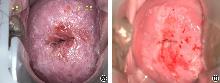
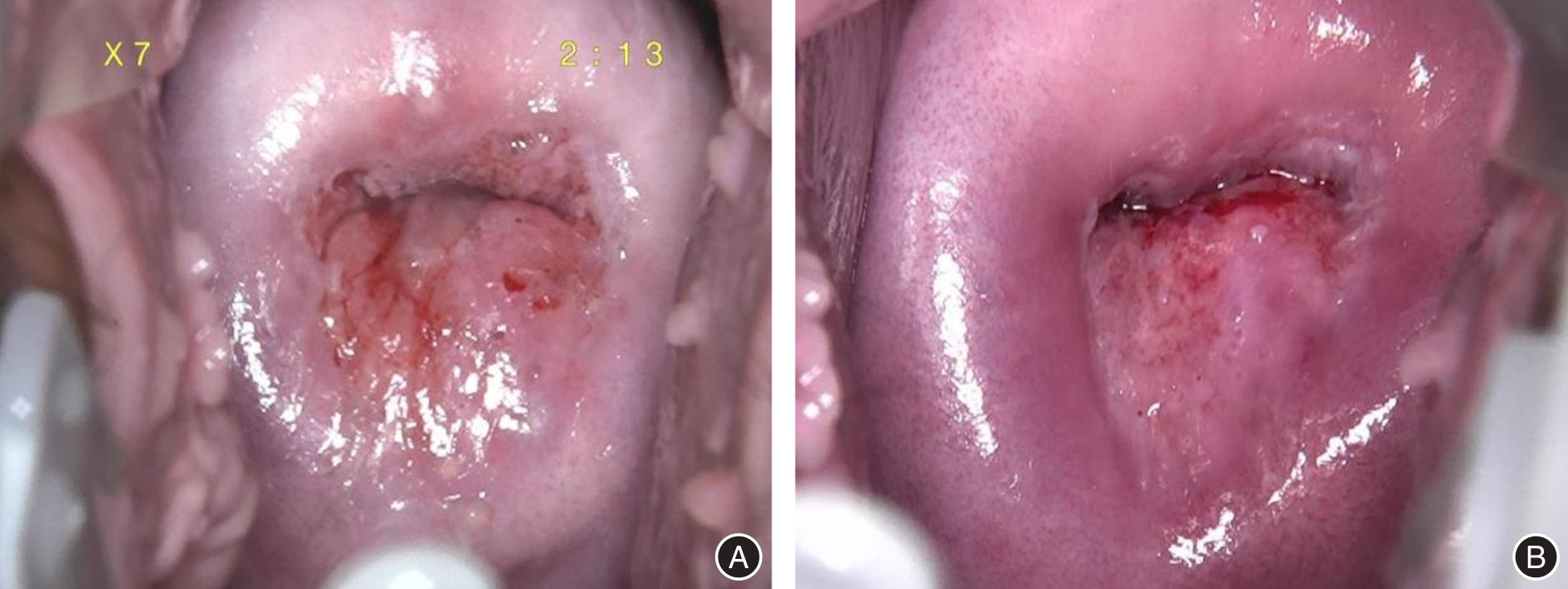
Fig.1
Case 1 in the treatment group"
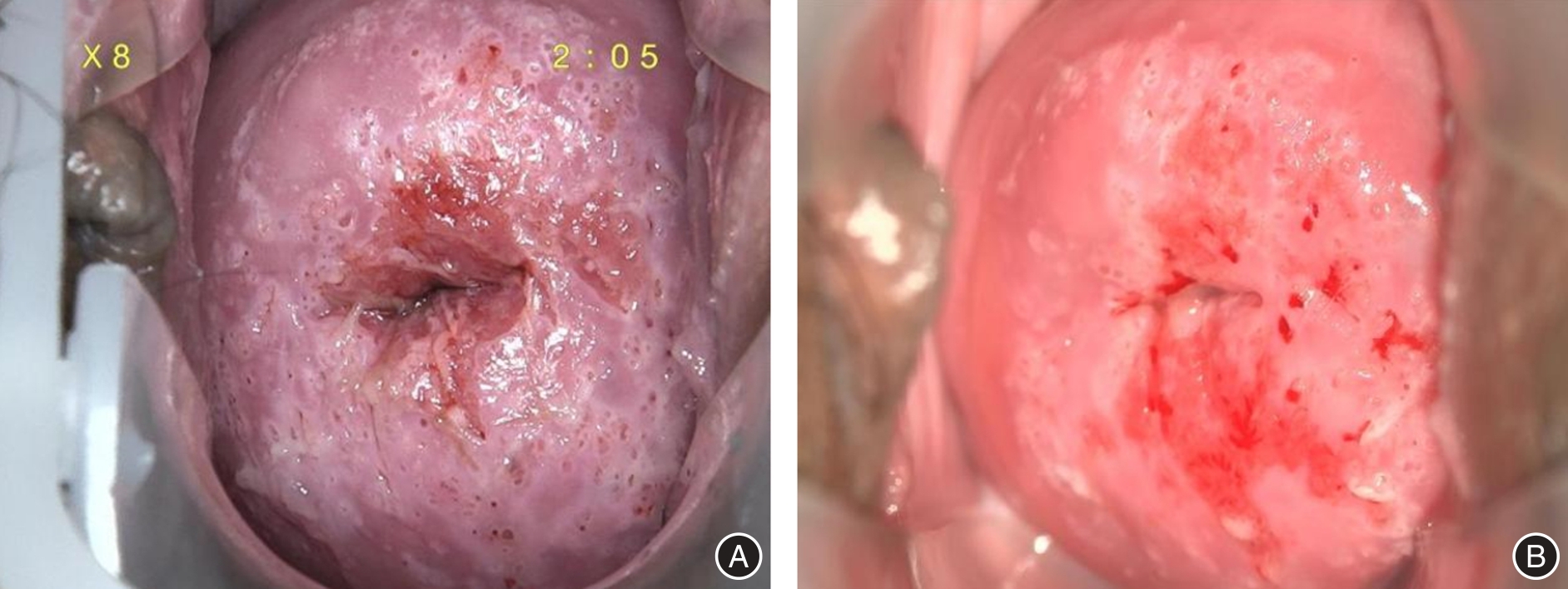
Fig.2
Case 2 in the treatment group"
| [1] |
刁夏尧, 郭超, 金榆凯, 等. 中国癌症现状分析: 基于2024年全球流行病学数据[J]. 癌症, 2025, 44(7): 350-369. doi:10.20124/j.cnki.1000-467X.2025.07.002 .
|
| [2] |
史昭, 肖爽, 马立, 等. 阴道微生态及血清CA125、CEA与HR-HPV持续感染宫颈癌的关系分析[J]. 检验医学与临床, 2025, 22(22): 3056-3060, 3066. doi:10.3969/j.issn.1672-9455.2025.22.006 .
|
| [3] |
|
| [4] |
曾丹凌, 林静, 吴晓春, 等. 微生态失衡对HR-HPV感染及宫颈病变的作用关联[J]. 吉林医学, 2025, 46(10): 2466-2468. doi:10.3969/j.issn.1004-0412.2025.10.039 .
|
| [5] |
唐晓诚, 吴群尔. 阴道菌群失调与宫颈HR-HPV感染及HR-HPV持续感染的关系[J]. 中国性科学, 2025, 34(6): 76-80. doi:10.3969/j.issn.1672-1993.2025.06.016 .
|
| [6] |
|
| [7] |
吴奕君. 康妇炎胶囊联合西药对LSIL伴HPV感染患者子宫颈LEEP后康复效果的影响[J]. 中国医学创新, 2025, 22(31): 103-106. doi:10.3969/j.issn.1674-4985.2025.31.024 .
|
| [8] |
|
| [9] |
|
| [10] |
吴超, 郑琳. 不同级别子宫颈病变患者肿瘤标志物及阴道微生态检查结果分析[J]. 中国医学创新, 2025, 22(26): 106-110. doi:10.3969/j.issn.1674-4985.2025.26.025 .
|
| [11] |
李佳轩, 王志玲, 杨兴升. 基于机器学习算法的LSIL患者漏诊HSIL+的模型构建与验证[J]. 现代妇产科进展, 2025, 34(8): 588-593. doi:10.13283/j.cnki.xdfckjz.2025.08.003 .
|
| [12] |
李婵娟. 冷冻治疗低级别鳞状上皮内病变患者的疗效分析[D]. 太原: 山西医科大学, 2024.
|
| [13] |
|
| [14] |
王辰, 闫晔, 张崴, 等. 派特灵用于女性下生殖道人乳头瘤病毒感染及相关疾病专家共识(2025年版)[J]. 中国实用妇科与产科杂志, 2025, 41(3): 324-331. doi:10.19538/j.fk2025030114 .
|
| [15] |
李聪. 光动力疗法治疗宫颈及阴道上皮内病变的疗效观察[D]. 西安: 西安医学院, 2023.
|
| [16] |
牛雪丽. 温热诱导HSPA6表达在人角质形成细胞抗HPV感染免疫中的作用及机制研究[D]. 沈阳: 中国医科大学, 2022.
|
| [17] |
王晓琴. 局部温热对HPV感染角质形成细胞的促凋亡作用及促炎症细胞因子的影响[D]. 沈阳: 中国医科大学, 2008.
|
| [18] |
杨晨玲. 温热疗法与冷冻治疗病毒疣的临床疗效观察[D]. 昆明: 昆明医科大学, 2024.
|
| [19] |
胡文珍. 温热诱导HPV阳性细胞凋亡改善HPV感染的机制研究[D]. 沈阳: 中国医科大学, 2023.
|
| [20] |
|
| [1] | Yanyan DING,Shenglin ZHOU,Linlin WU,Yanling WANG. Efficacy and prognosis of trastuzumab deruxtecan combined with IP chemotherapy regimen in the treatment of HER2-positive advanced gastric cancer [J]. The Journal of Practical Medicine, 2026, 42(5): 742-749. |
| [2] | Jiangyuan Huang, Weifeng Yao. Research progress and future perspectives on bedside anesthesia monitoring [J]. The Journal of Practical Medicine, 2026, 42(17): 3127-3135. |
| [3] | Canfeng ZHAO,Jiaping REN,Chong OUYANG,Zijing ZHANG,Hua PENG. Real-world study: Efficacy and safety analysis of butylphthalide combined with conventional therapy in the treatment of blast-induced deafness [J]. The Journal of Practical Medicine, 2026, 42(11): 2083-2090. |
| [4] | Jiahao CHEN,Yong HUANG,Ruibing FENG,Xiaofeng DUAN,Gang WU,Yizheng HUANG,Haitao ZHANG,Chao LI,Yinshuai DING,Hao. HU. Treatment effect and safety analysis of intraspinal tumor under 3D microscope [J]. The Journal of Practical Medicine, 2025, 41(3): 371-378. |
| [5] | Chao HAN,Xuemei ZHU,Ying WANG,Hui. SUN. Reflection on the standardized development of ambulatory medical care [J]. The Journal of Practical Medicine, 2024, 40(8): 1038-1041. |
| [6] | Yimei HUANG,Lulu ZHAO,Baotong. HUA. Application effect of insertable cardiac monitorin atrial fibrillation monitoring [J]. The Journal of Practical Medicine, 2024, 40(21): 3095-3100. |
| [7] | Li CAI,Huichao CHEN,Yafei LI,Ding LUO,Jingwei CHEN,Honglian. OUYANG. Analyzing the prevention strategies of accidental puncture in traditional Chinese medicine acupuncture based on occupational exposure data [J]. The Journal of Practical Medicine, 2024, 40(18): 2635-2639. |
| [8] |
WU Yang, LU Hanjie, SHUI Huifeng..
The efficacy and safety of anlotinib plus PD⁃1 blockades in patients with advanced non⁃small cell lung can⁃ cer previously treated with immunotherapy [J]. The Journal of Practical Medicine, 2023, 39(5): 572-578. |
| [9] | Haitao TANG,Xian WANG,Tingxia CHAO,Fengmei WANG,Wenling JIA,Chunhui LIANG,Wenhua. ZHANG. Effectiveness and safety of tenofovir alafenamide for chronic hepatitis B patients with decompensated cirrhosis [J]. The Journal of Practical Medicine, 2023, 39(24): 3249-3254. |
| [10] | Cheng LUO,Shengjie GUO,Zhiling ZHANG,Fangjian. ZHOU. Feasibility and safety analysis of domestic single-port robot system-assisted laparoscopic partial nephrectomy [J]. The Journal of Practical Medicine, 2023, 39(24): 3275-3280. |
| [11] | Xianda CHEN, Nan MA, Shengjie GUO, Zhenhua LIU, Kai. YAO. Efficacy and safety of anlotinib monotherapy and combinated therapy in the treatment of advanced pheochromocytoma/paraganglioma [J]. The Journal of Practical Medicine, 2023, 39(23): 3106-3110. |
| [12] |
XIAO Peng, LI Weijuan, MEI Jiazhuan, BAI Hua, LI Min, LIU Guiju, LI Ruijun..
Efficacy and safety of apatinib plus PD⁃1 blockades as subsequent line therapy for patients with advanced colorectal cancer [J]. The Journal of Practical Medicine, 2023, 39(2): 255-261. |
| [13] | Jianguo LI,Shuman LI,Hui. CHEN. Efficacy and safety of Anlotinib combined with PD⁃1 blockades for extensive⁃stage small⁃cell lung cancer [J]. The Journal of Practical Medicine, 2023, 39(17): 2248-2252. |
| [14] | HU Lang, LIN Xiaoling, TANG Wenjun. . Efficacy and safety of fruquintinib alone and in combination with PD⁃1 inhibitors for postline treatment of advanced metastatic colon cancer [J]. The Journal of Practical Medicine, 2023, 39(15): 1966-1973. |
| [15] | KE Mingjing, LIANG Jiajian, YE Xiangling, WU Huai, XU Xuemeng. . In vivo safety evaluation of bushen qiangjin capsules [J]. The Journal of Practical Medicine, 2023, 39(14): 1762-1768. |
| Viewed | ||||||
|
Full text |
|
|||||
|
Abstract |
|
|||||
