

The Journal of Practical Medicine ›› 2026, Vol. 42 ›› Issue (13): 2277-2283.doi: 10.3969/j.issn.1006-5725.2026.13.002
• Feature Reports:Cardiovascular diseases • Previous Articles
Qin FENG,Yang GAO,Xiaochen YUAN,Zhengang ZHANG,Rujun LI( )
)
Received:2026-04-24
Online:2026-07-10
Published:2026-07-14
Contact:
Rujun LI
E-mail:li-rujun@126.com
CLC Number:
Qin FENG,Yang GAO,Xiaochen YUAN,Zhengang ZHANG,Rujun LI. Circadian timing of symptom onset and severity of ischemia-reperfusion injury following primary PCI for STEMI[J]. The Journal of Practical Medicine, 2026, 42(13): 2277-2283.
Tab.1
General characteristics of the four groups"
| 指标 | 夜间组(n = 74) | 清晨组(n = 127) | 午后组(n = 93) | 傍晚组(n = 68) | F/χ2值 | P值 |
|---|---|---|---|---|---|---|
| 人口学特征 | ||||||
| 年龄/岁 | 57.4 ± 11.2 | 57.3 ± 10.8 | 55.9 ± 11.5 | 56.8±10.4 | 0.364 | 0.712 |
| 男性/[例(%)] | 63(85.1) | 107(84.3) | 78(83.9) | 58(85.3) | 0.089 | 0.981 |
| BMI/(kg/m2) | 25.6 ± 3.1 | 25.4 ± 3.4 | 25.1 ± 3.2 | 25.7±3.0 | 0.558 | 0.623 |
| 心血管危险因素 | ||||||
| 吸烟/[例(%)] | 41(55.4) | 71(55.9) | 48(51.6) | 36(52.9) | 0.486 | 0.871 |
| 高血压/[例(%)] | 38(51.4) | 67(52.8) | 44(47.3) | 37(54.4) | 0.963 | 0.745 |
| 糖尿病/[例(%)] | 22(29.7) | 35(27.6) | 23(24.7) | 20(29.4) | 0.662 | 0.789 |
| 高脂血症/[例(%)] | 29(39.2) | 51(40.2) | 35(37.6) | 26(38.2) | 0.162 | 0.964 |
| 心绞痛/[例(%)] | 15(20.3) | 22(17.3) | 16(17.2) | 11(16.2) | 0.472 | 0.892 |
| 入院时状况 | ||||||
| 入院收缩压/mmHg | 128.4 ± 22.6 | 130.1 ± 20.3 | 131.2 ± 21.8 | 129.7 ± 22.1 | 0.238 | 0.841 |
| 入院心率/(次/min) | 78.3 ± 16.2 | 76.8 ± 15.4 | 75.9 ± 14.7 | 77.4 ± 15.9 | 0.352 | 0.726 |
| Killip Ⅱ―Ⅲ级/[例(%)] | 21(28.4) | 31(24.4) | 19(20.4) | 18(26.5) | 1.573 | 0.524 |
| 梗死相关特征 | ||||||
| 前降支为IRA/[例(%)] | 38(51.4) | 69(54.3) | 45(48.4) | 36(52.9) | 0.799 | 0.782 |
| 右冠为IRA/[例(%)] | 27(36.5) | 45(35.4) | 31(33.3) | 25(36.8) | 0.267 | 0.817 |
| 单支病变/[例(%)] | 20(27.0) | 29(22.8) | 21(22.6) | 16(23.5) | 0.570 | 0.681 |
| 多支病变/[例(%)] | 39(52.7) | 62(48.8) | 43(46.2) | 33(48.5) | 0.696 | 0.643 |
| 时间参数 | ||||||
| 缺血总时间[M(P25, P75)] /min | 263(185, 358)* | 241(172, 318) | 225(162, 296) | 234(169, 310) | 8.150 | 0.043 |
| 门‐球时间[M(P25, P75)] /min | 66(52, 84) | 61(48, 78) | 64(51, 81) | 68(53, 86) | 3.510 | 0.319 |
Tab.2
Procedural parameters of the four groups"
| 指标 | 夜间组(n = 74) | 清晨组(n = 127) | 午后组(n = 93) | 傍晚组(n = 68) | F/χ2值 | P值 |
|---|---|---|---|---|---|---|
| 术前TIMI 0—1级 | 65(88.5) | 110(86.6) | 79(85.5) | 59(86.8) | 0.310 | 0.934 |
| 支架数量(x ± s)/枚 | 1.3 ± 0.5 | 1.3 ± 0.6 | 1.2 ± 0.5 | 1.3 ± 0.5 | 0.798 | 0.642 |
| 血栓抽吸 | 19(25.7) | 28(22.0) | 19(20.4) | 16(23.5) | 0.705 | 0.798 |
| GPI使用 | 24(32.4) | 38(29.9) | 26(28.0) | 21(30.9) | 0.416 | 0.898 |
| 术中并发症及血流 | ||||||
| 无复流/慢血流 | 18(24.3)* | 23(18.1) | 9(9.7) | 10(14.7) | 6.802 | 0.028 |
| 恶性心律失常 | 14(18.9)* | 17(13.4) | 8(8.6) | 8(11.8) | 3.995 | 0.042 |
Tab.3
Primary and secondary endpoints of the four groups"
| 终点指标 | 夜间组(n = 74) | 清晨组(n = 127) | 午后组(n = 93) | 傍晚组(n = 68) | F/χ2值 | P值 |
|---|---|---|---|---|---|---|
| 主要终点 | ||||||
| 峰值CK-MB/(ng/mL) | 306.4(195.8, 478.2)* | 284.7(187.3, 421.6)* | 216.5(141.9, 336.4) | 229.8(152.7, 361.3) | 13.93 | 0.003 |
| 峰值cTnI/(ng/mL) | 8.46(4.81, 15.24)* | 7.19(4.03, 13.10)* | 5.02(2.81, 9.56) | 5.51(3.12, 10.23) | 16.27 | 0.001 |
| 次要终点 | ||||||
| 术后7 d LVEF(x ± s)/% | 51.3 ± 7.8* | 53.8 ± 7.1* | 57.2 ± 6.4 | 55.9 ± 6.9 | 10.958 | 0.003 |
| cTnI峰值时间/h | 16.4(12.8, 22.1)* | 15.8(12.2, 21.6)* | 13.7(10.8, 18.4) | 14.2(11.3, 19.2) | 8.42 | 0.038 |
| 术后7 d MACE/[例(%)] | 9(12.2) | 12(9.4) | 5(5.4) | 5(7.4) | 2.685 | 0.289 |
| 术后30 d MACE/[例(%)] | 12(16.2) | 16(12.6) | 7(7.5) | 7(10.3) | 3.278 | 0.061 |
Tab.4
Multiple linear regression analysis of cTnI"
| 自变量 | B | SE | β | t值 | P值 | 95%CI |
|---|---|---|---|---|---|---|
| 截距 | 2.814 | 0.398 | 7.07 | 0.001 | 2.031 ~ 3.597 | |
| 参照:午后组 | ||||||
| 夜间组 | 0.312 | 0.108 | 0.187 | 2.89 | 0.004 | 0.099 ~ 0.524 |
| 清晨组 | 0.256 | 0.100 | 0.153 | 2.56 | 0.011 | 0.059 ~ 0.453 |
| 傍晚组 | 0.104 | 0.105 | 0.062 | 0.99 | 0.317 | -0.103 ~ 0.311 |
| 年龄 | 0.004 | 0.005 | 0.052 | 0.80 | 0.424 | -0.006 ~ 0.014 |
| 糖尿病史 | 0.127 | 0.098 | 0.081 | 1.30 | 0.196 | -0.065 ~ 0.319 |
| 入院血糖 | 0.031 | 0.019 | 0.098 | 1.63 | 0.104 | -0.006 ~ 0.069 |
| 缺血总时间 | 0.048 | 0.015 | 0.198 | 3.20 | 0.002 | 0.018 ~ 0.078 |
| Killip Ⅱ―Ⅲ级 | 0.241 | 0.104 | 0.144 | 2.32 | 0.021 | 0.036 ~ 0.447 |
| 多支病变 | 0.143 | 0.097 | 0.092 | 1.47 | 0.142 | -0.049 ~ 0.334 |
Tab.5
Logistic regression analysis of risk factors for no-reflow/slow-flow"
| 自变量 | OR | 95%CI | P值 |
|---|---|---|---|
| 参照:午后组 | Ref | Ref | Ref |
| 夜间组 | 2.87 | 1.18 ~ 6.96 | 0.020 |
| 清晨组 | 1.98 | 0.85 ~ 4.62 | 0.113 |
| 傍晚组 | 1.57 | 0.62 ~ 3.97 | 0.343 |
| 年龄 | 1.09 | 0.97 ~ 1.23 | 0.152 |
| 糖尿病史 | 1.89 | 0.98 ~ 3.64 | 0.058 |
| 入院血糖 | 1.14 | 1.02 ~ 1.27 | 0.018 |
| 缺血总时间 | 2.16 | 1.07 ~ 4.35 | 0.031 |
| Killip Ⅱ―Ⅲ级 | 1.72 | 0.88 ~ 3.37 | 0.112 |
| 多支病变 | 1.43 | 0.74 ~ 2.77 | 0.286 |
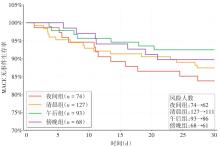
Fig.1
Kaplan-meier curves of 30-day cumulative MACE incidence"
Tab.6
30 days MACE composition of the four groups"
| 事件类型 | 夜间组(n = 74) | 清晨组(n = 127) | 午后组(n = 93) | 傍晚组(n = 68) | χ2值 | P值 |
|---|---|---|---|---|---|---|
| 全因死亡 | 2(2.7) | 3(2.4) | 1(1.1) | 1(1.5) | 0.792 | 0.847 |
| 非致死性再发心梗 | 1(1.4) | 2(1.6) | 1(1.1) | 1(1.5) | 0.103 | 0.981 |
| 恶性心律失常 | 3(4.1) | 4(3.1) | 2(2.2) | 2(2.9) | 0.515 | 0.876 |
| 因心力衰竭再住院 | 4(5.4)* | 5(3.9) | 1(1.1) | 2(2.9) | 2.647 | 0.048 |
| 需行血运重建 | 2(2.7) | 2(1.6) | 2(2.2) | 1(1.5) | 0.417 | 0.912 |
| [1] |
KHALIL M, DULAL D, YOUNES A, et al. Trends of myocardial infarction in young patients[J].Cardiovasc Revasc Med,2026:S1553-S8389.doi:10.1016/j.carrev.2026.01.015 .
doi: 10.1016/j.carrev.2026.01.015 |
| [2] |
李竹, 王嫣, 周雯静, 等. 线粒体呼吸链酶复合物在心肌缺血再灌注损伤中的作用进展[J]. 实用医学杂志,2024,40(15):2172-2176. doi: 10.3969/j.issn.1006-5725.2024.15.022 .
doi: 10.3969/j.issn.1006-5725.2024.15.022 |
| [3] |
MULLER J E, STONE P H, TURI Z G, et al. Circadian variation in the frequency of onset of acute myocardial infarction[J]. N Engl J Med,1985,313(21):1315-1322.doi:10.1056/NEJM198511213132103 .
doi: 10.1056/NEJM198511213132103 |
| [4] |
KELTERS I R, KOOP Y, YOUNG M E, et al. Circadian rhythms in cardiovascular disease[J]. Eur Heart J,2025,46(36):3532-3545.doi:10.1093/eurheartj/ehaf367 .
doi: 10.1093/eurheartj/ehaf367 |
| [5] |
GUO Y, CUI L, LI L, et al. Circadian rhythm pattern of symptom onset in patients with ST-segment elevation myocardial infarction in the Chinese population[J]. Front Cardiovasc Med,2024,11:1393390.doi:10.3389/fcvm.2024.1393390 .
doi: 10.3389/fcvm.2024.1393390 |
| [6] |
ZHAO J, CHEN Z, YANG J, et al. Effect of KLF15-Mediated Circadian Rhythm on Myocardial Infarction: A Narrative Review[J].Int J Mol Sci,2025,26(10):4831.doi:10.3390/ijms 26104831 .
doi: 10.3390/ijms 26104831 |
| [7] |
HJALMARSON A, GILPIN E A, NICOD P, et al. Differing circadian patterns of symptom onset in subgroups of patients with acute myocardial infarction[J]. Circulation,1989,80(2):267-275.DOI:10.1161/01.cir.80.2.267 .
doi: 10.1161/01.cir.80.2.267 |
| [8] |
ARROYO ÚCAR E, DOMINGUEZ-RODRIGUEZ A, ABREU-GONZALEZ P. Influence of diurnal variation in the size of acute myocardial infarction[J]. Med Intensiva,2012,36(1):11-14.doi:10.1016/j.medin.2011.07.002 .
doi: 10.1016/j.medin.2011.07.002 |
| [9] |
孙路轩,党晓平,孙子健. 低温诱导的RBM3对各器官缺血再灌注损伤研究进展[J]. 新医学,2024,55(4):260-264.doi: 10.3969/j.issn.0253-9802.2 024.04.004 .
doi: 10.3969/j.issn.0253-9802.2 024.04.004 |
| [10] |
RUAN W, LI T, BANG I H, et al. BMAL1-HIF2A heterodimer modulates circadian variations of myocardial injury[J]. Nature,2025,641(8064):1017-1028.doi:10.1038/s41586-025-08898-z .
doi: 10.1038/s41586-025-08898-z |
| [11] |
ZHAO Y, LU X, WAN F, et al. Disruption of Circadian Rhythms by Shift Work Exacerbates Reperfusion Injury in Myocardial Infarction[J]. J Am Coll Cardiol,2022,79(21):2097-2115.doi:10.1016/j.jacc.2022.03.370 .
doi: 10.1016/j.jacc.2022.03.370 |
| [12] |
REITER R, SWINGEN C, MOORE L, et al. Circadian dependence of infarct size and left ventricular function after ST elevation myocardial infarction[J]. Circ Res,2012,110(1):105-110.doi:10.1161/CIRCRESAHA.111.254284 .
doi: 10.1161/CIRCRESAHA.111.254284 |
| [13] |
中华医学会心血管病学分会. 急性ST段抬高型心肌梗死诊断和治疗指南(2019)[J]. 中华心血管病杂志,2019,47(10):766-783. doi:10.3760/cma.j.issn.0253-3758.2019.10.003 .
doi: 10.3760/cma.j.issn.0253-3758.2019.10.003 |
| [14] |
罗利红, 邝献宝, 谷红丽, 等. 左心超声造影指标LVESV、LVEF、LVEDV与慢性心力衰竭患者心功能分级的关系及对抗心力衰竭疗效的评估价值[J]. 实用医学杂志,2026,42(10):1763-1770. doi: 10.3969/j.issn.1006-5725.2026.10.010 .
doi: 10.3969/j.issn.1006-5725.2026.10.010 |
| [15] |
KNUTSON K L, DIXON D D, GRANDNER M A, et al. Role of Circadian Health in Cardiometabolic Health and Disease Risk: A Scientific Statement From the American Heart Association[J]. Circulation,2025,152(21):e408-e419.doi:10.1161/CIR. 0000000000001388 .
doi: 10.1161/CIR. 0000000000001388 |
| [16] |
FOURNIER S, MULLER O. Finding the real culprit between circadian rhythm and "out of hours effect" to explain the higher myocardial infarction size among patients with symptom onset occurring at night[J]. Circ Res,2012,110(9):e67-e68.doi:10.1161/CIRCRESAHA.112.269076 .
doi: 10.1161/CIRCRESAHA.112.269076 |
| [17] |
YANG H, LUO L, HUANG Z, et al. Association Between Patient and System Delays and In-Hospital Mortality in Primary PCI for STEMI: Findings from a Large, Nationwide Inpatients Sample[J]. Am J Med,2024,137(12):1227-1235.doi:10.1016/j.amjmed.2024.08.024 .
doi: 10.1016/j.amjmed.2024.08.024 |
| [18] |
PENG H, SUN Z, DI B, et al. Contemporary impact of circadian symptom-onset patterns of acute ST-Segment elevation myocardial infarction on long-term outcomes after primary percutaneous coronary intervention[J]. Ann Med,2021,53(1):247-256.doi:10.1080/07853890.2020.1863457 .
doi: 10.1080/07853890.2020.1863457 |
| [19] |
ECKLE T, BERTAZZO J, KHATUA T N, et al. Circadian Influences on Myocardial Ischemia-Reperfusion Injury and Heart Failure[J]. Circ Res,2024,134(6):675-694.doi:10.1161/CIRCRESAHA.123.323522 .
doi: 10.1161/CIRCRESAHA.123.323522 |
| [20] |
ŠKRLEC I, KOLOMEICHUK S N. Hypoxia-inducible factor-1α in myocardial infarction[J]. World J Cardiol,2024,16(4):181-185. doi:10.4330/wjc.v16.i4.181 .
doi: 10.4330/wjc.v16.i4.181 |
| [21] |
RUAN W, MA X, BANG I H, et al. The Hypoxia-Adenosine Link during Myocardial Ischemia-Reperfusion Injury[J]. Biomedicines,2022,10(8):1939. doi:10.3390/biomedicines 10081939 .
doi: 10.3390/biomedicines 10081939 |
| [22] |
SHI J, TONG R, ZHOU M, et al. Circadian nuclear receptor Rev-erbα is expressed by platelets and potentiates platelet activation and thrombus formation[J]. Eur Heart J,2022,43(24):2317-2334. doi:10.1093/eurheartj/ehac109 .
doi: 10.1093/eurheartj/ehac109 |
| [23] |
ZENG Q, OLIVA V M, MORO M Á, et al. Circadian Effects on Vascular Immunopathologies[J]. Circ Res,2024,134(6):791-809. doi:10.1161/CIRCRESAHA.123.323619 .
doi: 10.1161/CIRCRESAHA.123.323619 |
| [24] |
TUAL-CHALOT S, STELLOS K. Chrono-pharmacology-based antiplatelet therapy for acute myocardial infarction[J]. Eur Heart J,2022,43(24):2335-2337. doi:10.1093/eurheartj/ehac120 .
doi: 10.1093/eurheartj/ehac120 |
| [25] |
JANOSKI J R, AIELLO I, LUNDBERG C W, et al. Circadian clock gene polymorphisms implicated in human pathologies[J].Trends Genet,2024,40(10):834-852. doi:10.1016/j.tig.2024. 05.006 .
doi: 10.1016/j.tig.2024. 05.006 |
| Viewed | ||||||
|
Full text |
|
|||||
|
Abstract |
|
|||||
