

The Journal of Practical Medicine ›› 2026, Vol. 42 ›› Issue (11): 2056-2063.doi: 10.3969/j.issn.1006-5725.2026.11.021
• Treatise:Mechanism and Practice • Previous Articles
Tao LÜ1,Ran TAO2,Min ZHANG1,Changmin LÜ1,Qingrong MENG1,Shiping WANG1( )
)
Received:2026-01-19
Online:2026-06-10
Published:2026-06-15
Contact:
Shiping WANG
E-mail:lwwsp719@163.com
CLC Number:
Tao LÜ,Ran TAO,Min ZHANG,Changmin LÜ,Qingrong MENG,Shiping WANG. The relationship between iNOS, CER and NLRP3/IL-1β signal pathway and urinary tract infection after bladder cancer operation[J]. The Journal of Practical Medicine, 2026, 42(11): 2056-2063.
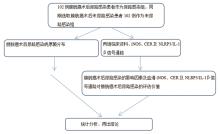
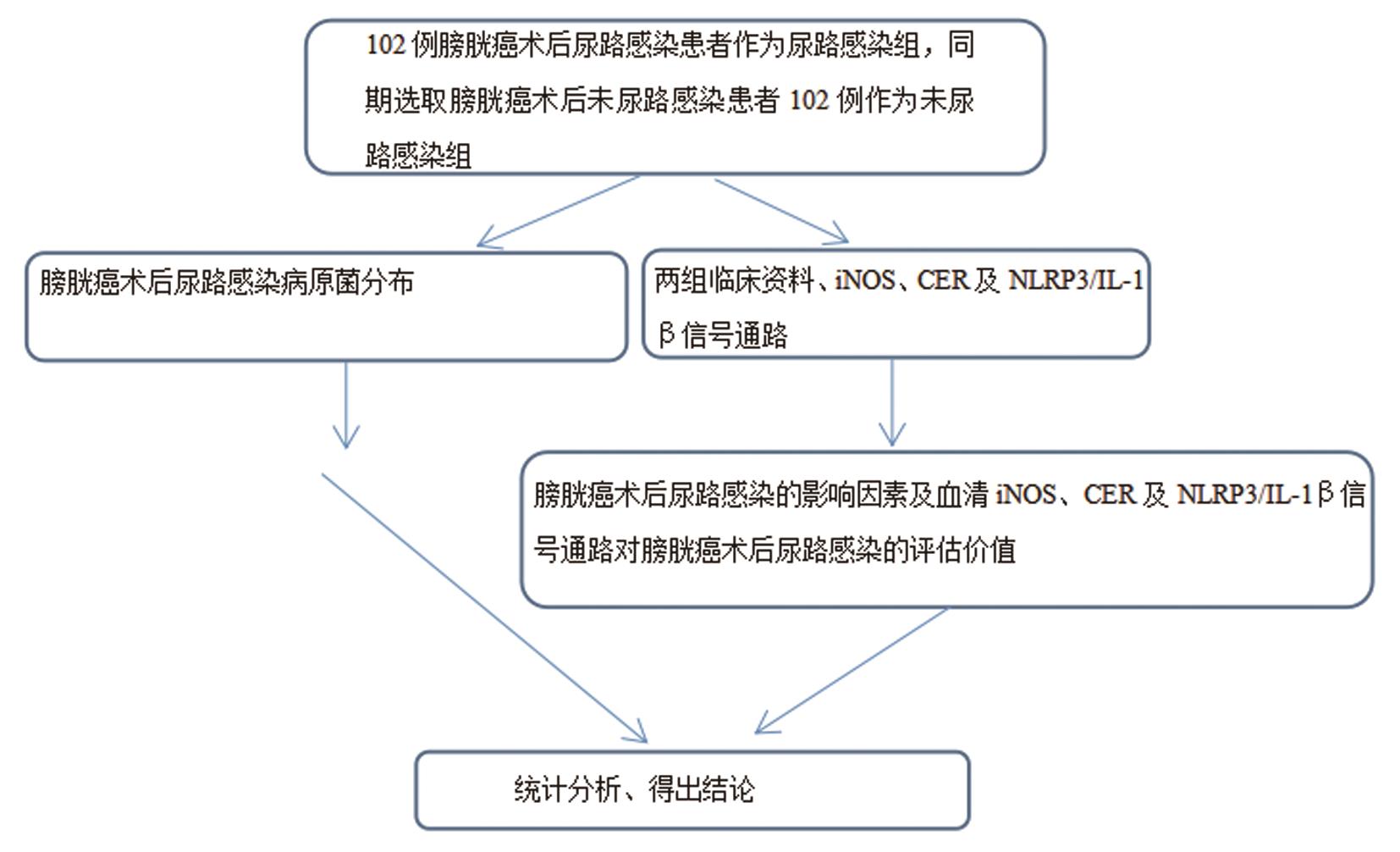
Fig.1
Research flow chart"

Tab.1
Primer sequence"
| 名称 | 上游引物 | 下游引物 |
|---|---|---|
| NLRP3 | 5′-GATCTTCGCTGCGATCAACA-3′ | 5′-GGGATTCGAAACACGTGCATTA-3′ |
| GAPDH | 5′-GCACCGTCAAGGCTGAGAAC-3′ | 5′-TGGTGAAGACGCCAGTGGA-3′ |
Tab.2
Distribution of pathogens causing urinary tract infection after bladder cancer operation"
| 病原菌 | 株数 | 构成比/% |
|---|---|---|
| 合计 | 128 | 100.00 |
| 革兰阴性菌 | 97 | 75.78 |
| 大肠埃希菌 | 48 | 37.50 |
| 肺炎克雷伯菌 | 23 | 17.97 |
| 阴沟肠杆菌 | 12 | 9.38 |
| 铜绿假单胞菌 | 9 | 7.03 |
| 鲍氏不动杆菌 | 5 | 3.91 |
| 革兰阳性菌 | 31 | 24.22 |
| 屎肠球菌 | 11 | 8.59 |
| 链球菌属 | 8 | 6.25 |
| 表皮葡萄球菌 | 7 | 5.47 |
| 粪肠球菌 | 5 | 3.91 |
Tab.3
Comparison of clinical data between two groups"
| 因素 | 尿路感染组 (n = 102) | 无尿路感染组 (n = 102) | t/χ2值 | P值 |
|---|---|---|---|---|
| 性别 | 0.184 | 0.668 | ||
| 男 | 63(61.76) | 60(58.82) | ||
| 女 | 39(38.24) | 42(41.18) | ||
| 年龄(x ± s)/岁 | 63.43 ± 7.32 | 54.79 ± 6.92 | 8.663 | < 0.001 |
| BMI(x ± s)/(kg/m2) | 22.59 ± 0.87 | 22.67 ± 0.93 | 0.634 | 0.527 |
| 合并高血压 | 5.051 | 0.025 | ||
| 是 | 55(53.92) | 39(38.24) | ||
| 否 | 47(46.08) | 63(61.76) | ||
| 合并糖尿病 | 13.384 | < 0.001 | ||
| 是 | 59(57.84) | 33(32.35) | ||
| 否 | 43(42.16) | 69(67.65) | ||
| 吸烟史 | 0.358 | 0.549 | ||
| 有 | 35(34.31) | 31(30.39) | ||
| 无 | 67(65.69) | 71(69.61) | ||
| 饮酒史 | 0.257 | 0.612 | ||
| 有 | 24(23.53) | 21(20.59) | ||
| 无 | 78(76.47) | 81(79.41) | ||
| 肿瘤分期 | 12.384 | 0.006 | ||
| Ⅰ期 | 18(17.65) | 31(30.39) | ||
| Ⅱ期 | 22(21.57) | 34(33.33) | ||
| Ⅲ期 | 35(34.31) | 20(19.61) | ||
| Ⅳ期 | 27(26.47) | 17(16.67) | ||
| 病理特征 | 0.523 | 0.770 | ||
| 尿路上皮癌 | 52(50.98) | 50(49.02) | ||
| 腺癌 | 17(16.67) | 21(20.59) | ||
| 鳞状细胞癌 | 33(32.35) | 31(30.39) | ||
| 术中出血量 | 0.088 | 0.766 | ||
| > 100 mL | 35(34.31) | 33(32.35) | ||
| ≤ 100 mL | 67(65.69) | 69(67.65) | ||
| 手术时间 | 4.412 | 0.036 | ||
| > 360 min | 58(56.86) | 43(42.16) | ||
| ≤ 360 min | 44(43.14) | 59(57.84) | ||
| 受教育程度 | 0.332 | 0.564 | ||
| 初中及以下 | 41(40.20) | 37(36.27) | ||
| 初中以上 | 61(59.80) | 65(63.73) | ||
| 肿瘤个数 | 0.229 | 0.632 | ||
| 单发 | 74(72.55) | 77(75.49) | ||
| 多发 | 28(27.45) | 25(24.51) | ||
| 术后留置导管时间 | 23.573 | < 0.001 | ||
| > 7 d | 78(76.47) | 44(43.14) | ||
| ≤ 7 d | 24(23.53) | 58(56.86) | ||
| 术中出现低温 | 0.081 | 0.776 | ||
| 是 | 43(42.16) | 41(40.20) | ||
| 否 | 59(57.84) | 61(59.80) |
Tab.4
Comparison of iNOS, CER and NLRP3/IL-1β signal pathways between two groups"
| 指标 | 尿路感染组 (n = 102) | 无尿路感染组 (n = 102) | t值 | P值 |
|---|---|---|---|---|
| iNOS/(U/mL) | 179.06 ± 30.99 | 131.43 ± 21.65 | 12.725 | < 0.001 |
| CER/(mg/L) | 376.69 ± 45.26 | 305.47 ± 38.72 | 12.076 | < 0.001 |
| NLRP3 mRNA | 1.46 ± 0.31 | 1.18 ± 0.23 | 7.326 | < 0.001 |
| IL-1β/(pg/mL) | 2.31 ± 0.25 | 1.88 ± 0.22 | 13.041 | < 0.001 |
Tab.5
Assignment table of influencing factors"
| 因素 | 变量性质 | 赋值 |
|---|---|---|
| 术后尿路感染 | Y | 0 =无,1 =有 |
| 年龄 | X1 | 原值输入 |
| 合并高血压 | X2 | 0 =否,1 =是 |
| 合并糖尿病 | X3 | 0 =否,1 =是 |
| 肿瘤分期 | X4 | 0 = Ⅰ期,1 = Ⅱ期,2 = Ⅲ期,3 = Ⅳ期 |
| 手术时间 | X5 | 0 = ≤ 360 min,1 = > 360 min |
| 术后留置导管时间 | X6 | 0 = ≤ 7 d,1 = > 7 d |
| 血清iNOS水平 | X7 | 原值输入 |
| 血清CER水平 | X8 | 原值输入 |
| 外周血NLRP3 mRNA表达 | X9 | 原值输入 |
| 血清IL-1β水平 | X10 | 原值输入 |
Tab.6
Analysis of influencing factors of urinary tract infection after bladder cancer operation"
| 变量 | β | SE | Waldχ2 | P值 | OR | 95%CI |
|---|---|---|---|---|---|---|
| 年龄 | 0.632 | 0.255 | 6.143 | 0.013 | 1.881 | 1.141 ~ 3.101 |
| 合并高血压 | 0.425 | 0.269 | 2.496 | 0.114 | 1.530 | 0.903 ~ 2.592 |
| 合并糖尿病 | 1.563 | 0.533 | 8.599 | 0.003 | 4.773 | 1.679 ~ 13.568 |
| 肿瘤分期为Ⅲ期/Ⅳ期 | 1.085 | 0.631 | 2.957 | 0.086 | 2.959 | 0.859 ~ 10.194 |
| 手术时间> 360 min | 0.377 | 0.102 | 13.661 | < 0.001 | 1.458 | 1.194 ~ 1.781 |
| 术后留置导管时间> 7 d | 1.844 | 0.633 | 8.486 | 0.004 | 6.322 | 1.828 ~ 21.860 |
| 血清iNOS水平 | 1.292 | 0.426 | 9.198 | 0.002 | 3.640 | 1.579 ~ 8.389 |
| 血清CER水平 | 0.893 | 0.348 | 6.585 | 0.010 | 2.442 | 1.235 ~ 4.831 |
| 外周血NLRP3 mRNA表达 | 0.466 | 0.163 | 8.173 | 0.004 | 1.594 | 1.158 ~ 2.193 |
| 血清IL-1β水平 | 1.302 | 0.526 | 6.127 | 0.013 | 3.677 | 1.311 ~ 10.308 |
Tab.7
Evaluation value of serum iNOS, CER and NLRP3/IL-1β signaling pathway in urinary tract infection after bladder cancer operation"
| 指标 | 临界值 | AUC | 敏感度/% | 特异度/% | P值 | 95%CI |
|---|---|---|---|---|---|---|
| iNOS | 163.32 U/mL | 0.713 | 64.71 | 68.63 | < 0.001 | 0.646 ~ 0.774 |
| CER | 343.48 mg/L | 0.736 | 69.61 | 68.63 | < 0.001 | 0.670 ~ 0.795 |
| NLRP3 mRNA | 1.69 | 0.753 | 62.75 | 78.43 | < 0.001 | 0.688 ~ 0.811 |
| IL-1β | 2.16 pg/mL | 0.747 | 77.45 | 66.67 | < 0.001 | 0.682 ~ 0.805 |
| 联合检测 | - | 0.939abcd | 87.25 | 86.27 | < 0.001 | 0.897 ~ 0.968 |
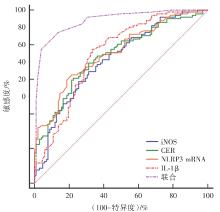
Fig.2
Evaluation value of serum iNOS, CER and NLRP3/IL-1β signal pathway in urinary tract infection after bladder cancer operation"

Fig.3
A typical case of bladder cancer"

| [1] |
蔡令凯, 杨潇, 谈政烨, 等. NeoVI-RADS评分在膀胱癌新辅助治疗患者中的应用研究[J]. 中华外科杂志, 2025, 63(12): 1111-1117. doi: 10.3760/cma.j.cn112139-20250326-00160 .
doi: 10.3760/cma.j.cn112139-20250326-00160 |
| [2] |
NAM K C, PARK B J. Antibacterial and anticancer activity of multifunctional iron-based magnetic nanoparticles against urinary tract infection and cystitis-related bacterial strains and bladder cancer cells[J]. Biomed Eng Lett, 2025, 15(5): 1-13. doi: 10.1007/s13534-025-00489-1 .
doi: 10.1007/s13534-025-00489-1 |
| [3] |
SAHU D, HUAN J, WANG H, et al. Bladder Cancer Invasion is Mediated by mTORC2-Driven Regulation of Nitric Oxide and Invadopodia Formation[J]. Am J Pathol, 2021, 191(12): 2203-2218. doi: 10.1016/j.ajpath.2021.08.002 .
doi: 10.1016/j.ajpath.2021.08.002 |
| [4] |
MUKAE Y, ITO H, MIYATA Y, et al. Ceruloplasmin Levels in Cancer Tissues and Urine Are Significant Biomarkers of Pathological Features and Outcome in Bladder Cancer[J]. Anticancer Res, 2021, 41(8): 3815-3823. doi: 10.21873/anticanres.15174 .
doi: 10.21873/anticanres.15174 |
| [5] |
XU G, HUANG R, XIA W, et al. Associations between inflammasome-related gene NLRP3 Polymorphisms (rs10754558 and rs35829419) and risk of bladder cancer in a Chinese population[J]. J Clin Lab Anal, 2021, 35(11): e23973. doi: 10.1002/jcla.23973 .
doi: 10.1002/jcla.23973 |
| [6] |
陈孝平, 汪建平, 赵继宗. 外科学[M]. 9版. 北京: 人民卫生出版社, 2018: 535-540, 569-570. doi:10.3877/cma.j.issn.1674-3946.2018.05.001
doi: 10.3877/cma.j.issn.1674-3946.2018.05.001 |
| [7] |
中华人民共和国卫生部. 医院感染诊断标准(试行)[J]. 中华医学杂志, 2001, 81(5): 314-320. doi: 10.3760/j:issn:0376-2491.2001.05 .
doi: 10.3760/j:issn:0376-2491.2001.05 |
| [8] | 尚红, 王毓三, 申子瑜. 全国临床检验操作规程[M]. 4版. 北京: 人民卫生出版社, 2015: 624-692. |
| [9] |
尤琴琴, 俞飞, 李如帅, 等. 18F-FDG PET/MR及其衍生参数在膀胱癌诊断与分期中的应用[J]. 中华核医学与分子影像杂志, 2025, 45(7): 405-410. doi: 10.3760/cma.j.cn321828-20250204-00027 .
doi: 10.3760/cma.j.cn321828-20250204-00027 |
| [10] |
刘志聪, 刘戴胤, 龙钧天, 等. 外泌体lncRNA CIAT1促进膀胱癌集体侵袭的机制[J]. 实用医学杂志, 2025, 41(9): 1299-1308. doi: 10.3969/j.issn.1006-5725.2025.09.005 .
doi: 10.3969/j.issn.1006-5725.2025.09.005 |
| [11] |
MICHAEL C, LAURA L, ELIJAH W, et al. Comparing concentration of urinary inflammatory cytokines in interstitial cystitis, overactive bladder, urinary tract infection, and bladder cancer[J]. Urological Science, 2022, 33(4): 199-204. doi: 10.1016/j.biopha.2022.113433 .
doi: 10.1016/j.biopha.2022.113433 |
| [12] |
孙晓宇,方程,李晓阳,等. 1990~2021年全球膀胱癌疾病负担趋势分析及2050年预测:一项基于GBD 2021的系统分析.中华腔镜泌尿外科杂志(电子版),2026,20(1) : 34-43. DOI: 10.3877/cma.j.issn.1674-3253.2026.01.005
doi: 10.3877/cma.j.issn.1674-3253.2026.01.005 |
| [13] |
LARSEN E S, JOENSEN U N, POULSEN A M, et al. Bacillus Calmette-Guérin immunotherapy for bladder cancer: A review of immunological aspects, clinical effects and BCG infections[J]. APMIS, 2020, 128(2): 92-103. doi: 10.1111/apm.13011 .
doi: 10.1111/apm.13011 |
| [14] |
LI J, PARK A, FULMER B R, et al. Leclercia adecarboxylata urinary tract infection in a patient with bladder cancer and recurrent hematuria[J]. Urol Case Rep, 2021, 36: 101579. doi: 10.1016/j.eucr.2021.101579 .
doi: 10.1016/j.eucr.2021.101579 |
| [15] |
陈怡, 陈沛林, 吕晓磊, 等. 膀胱癌尿路感染患者免疫和炎症因子的表达及临床诊断价值[J]. 中华医院感染学杂志, 2022, 32(1): 80-84. doi: 10.11816/cn.ni.2022-210414 .
doi: 10.11816/cn.ni.2022-210414 |
| [16] |
李瑜, 满晓军. 非肌层浸润性膀胱癌患者经尿道膀胱肿瘤切除术后发生膀胱痉挛的影响因素[J]. 中国医科大学学报, 2022, 51(5): 425-428. doi: 10.12007/j.issn.0258-4646.2022. 05.008 .
doi: 10.12007/j.issn.0258-4646.2022. 05.008 |
| [17] |
王晓寒, 杜鹏飞, 屈晓东, 等. 非肌层浸润性膀胱癌患者TURBT术后并发尿路感染危险因素及预测模型构建[J]. 中华医院感染学杂志, 2023, 33(7): 1071-1075. doi: 10.11816/cn.ni.2023-221315 .
doi: 10.11816/cn.ni.2023-221315 |
| [18] |
薛笑楠, 郑伟坤, 官雯娟, 等. 2型糖尿病并发尿路感染病原学和耐药性及其危险因素[J]. 中华医院感染学杂志, 2024, 34(5): 703-706. doi: 10.11816/cn.ni.2024-231119 .
doi: 10.11816/cn.ni.2024-231119 |
| [19] |
金婷婷, 李云娇, 高凤蕊, 等. 根治性膀胱切除术后尿路感染病原学及外周血TLR4/NF-κB信号通路[J]. 中华医院感染学杂志, 2023, 33(24): 3753-3757. doi: 10.11816/cn.ni.2023-230585 .
doi: 10.11816/cn.ni.2023-230585 |
| [20] |
黄家望, 马心悦, 冯芷莹, 等. A型流感病毒通过激活HIF-1α/iNOS/VEGF信号通路诱导肺上皮细胞铁死亡的机制[J]. 微生物学通报, 2024, 51(1): 306-322. doi: 10.13344/j.microbiol.china.230433 .
doi: 10.13344/j.microbiol.china.230433 |
| [21] |
BELGOROSKY D, GIROUARD J, LANGLE Y V, et al. Relevance of iNOS expression in bladder cancer stem cells[J]. J Mol Med (Berl), 2021, 81(13): 1615-1627. doi: 10.1007/s00109-020-01973-0 .
doi: 10.1007/s00109-020-01973-0 |
| [22] |
KANG N L, ZHANG J M, LIU Y R, et al. Novel predictive models using serum ceruloplasmin levels for hepatic steatosis in patients with chronic hepatitis B infection[J]. Clin Res Hepatol Gastroenterol, 2020, 44(1): 57-65. doi: 10.1016/j.clinre.2019. 04.001 .
doi: 10.1016/j.clinre.2019. 04.001 |
| [23] |
BAISHAN A, AIKEBAIER A, DILIMULATI D, et al. Bioinformatics Analysis of the Anti-Inflammatory Mechanism and Potential Therapeutic Efficacy of Kezimuke granules in Treating Urinary Tract Infections by Inhibiting NLRP3 Inflammasome Activation[J]. Int J Mol Sci, 2025, 26(4): 1764. doi: 10.3390/ijms 26041764 .
doi: 10.3390/ijms 26041764 |
| [24] |
PAUDEL S, KUMAR R, ROGERS A K, et al. The NLRP3 Inflammasome Is Dispensable in Methicillin-Resistant Staphylococcus aureus Urinary[J]. Pathogens, 2024, 13(2): 106-106. doi: 10.3390/pathogens13020106 .
doi: 10.3390/pathogens13020106 |
| [25] |
闫红霞, 马磊, 颜彦, 等. 重症肺炎多重耐药菌感染危险因素及NLRP3/IL-1β的预测价值[J]. 中华医院感染学杂志, 2024, 34(6): 812-815. doi: 10.11816/cn.ni.2024-231086 .
doi: 10.11816/cn.ni.2024-231086 |
| [26] |
孙小丽, 申永辉, 刘军云, 等. 精神分裂症患者尿路感染病原菌及外周血NLRP3/IL-1β通路表达[J]. 中华医院感染学杂志, 2024, 34(22): 3417-3421. doi: 10.11816/cn.ni.2024-240176 .
doi: 10.11816/cn.ni.2024-240176 |
| [27] |
MOREIRA J D, IAKHIAEV A, VANKAYALAPATI R, et al. Histone deacetylase-2 controls IL-1β production through the regulation of NLRP3 expression and activation in tuberculosis infection[J]. iScience, 2022, 25(8): 104799. doi: 10.1016/j.isci. 2022.104799 .
doi: 10.1016/j.isci. 2022.104799 |
| [1] | Zhicong LIU,Daiyin LIU,Juntian LONG,Chixing CHENG,Jian HUANG. Exosomal lncRNA CIAT1 promotes collective invasion of bladder cancer [J]. The Journal of Practical Medicine, 2025, 41(9): 1299-1308. |
| [2] | Daiyin LIU,Qiuyan LI,Changhao. CHEN. CircMYCBP2 enhances the formation of lymphovascular invasion of bladder cancer [J]. The Journal of Practical Medicine, 2025, 41(8): 1139-1148. |
| [3] | Zongjian HU,Shun WAN,Jianwei YANG,Li WANG,Siyu CHEN,Li YANG. Research progress of CAR⁃T cell therapy in bladder cancer [J]. The Journal of Practical Medicine, 2025, 41(22): 3496-3500. |
| [4] | Guofen LIANG,Zhenhua YANG,Yibo WANG,Kaiyu HE,La ZHANG,Xusheng LIU,Yueyu GU,Xindong QIN,Guobin SU. Interpretation of 《Global consensus on multidisciplinary diagnostic criteria for urinary tract infections》 [J]. The Journal of Practical Medicine, 2025, 41(18): 2777-2785. |
| [5] | Xufeng YU,Meimian HUA,Shuxiong ZENG,Wei HE,Ziwei WANG,Qing CHEN,Chen ZHANG,Yue WANG,Yi WANG,Chuanliang. XU. Clinical efficacy comparison of ileal conduit, flap embedding method, and traditional cutaneous ureterostomy in patients with bladder cancer [J]. The Journal of Practical Medicine, 2025, 41(10): 1517-1524. |
| [6] | Yawei ZHANG,Hongjin SHI,Shi FU,Jiansong WANG,Haifeng WANG. Research progress in biological role of TIGIT and its application in bladder cancer [J]. The Journal of Practical Medicine, 2024, 40(12): 1762-1766. |
| [7] | Feng XIAO,Xi′nan JIANG,Lu SHU,Jiaqi SHI,Fangmin CHEN,Yi. MU. Expression of ECM1 gene in bladder cancer and its relationships with clinical pathological features and prognosis [J]. The Journal of Practical Medicine, 2023, 39(20): 2629-2632. |
| [8] | Kai DENG,Meng YANG,Ling ZHANG,Jun′an QIAN,Yunqiang SHI,Chunhui. WANG. Bidirectional regulation of tumor associated neutrophils and their role in urothelial bladder cancer: a literature review [J]. The Journal of Practical Medicine, 2023, 39(16): 2142-2147. |
| [9] |
YANG Wenbo, XU Zhendan, GENG Shuai.
Effect of LINC00689 on proliferation and apoptosis of bladder cancer T24 cells through targeting miR⁃876⁃ 5p [J]. The Journal of Practical Medicine, 2021, 37(2): 195-200. |
| Viewed | ||||||
|
Full text |
|
|||||
|
Abstract |
|
|||||
