

The Journal of Practical Medicine ›› 2026, Vol. 42 ›› Issue (3): 504-510.doi: 10.3969/j.issn.1006-5725.2026.03.019
• Treatise: Clinical Practice • Previous Articles
Jianxia HUANG( ),Guoliang ZHANG,Jushan ZHANG,Yan WANG,Qing WU,Binzhang WU,Minghu DU,Yuxia WANG
Received:2025-09-16
Online:2026-02-10
Published:2026-02-09
Contact:
Jianxia HUANG
E-mail:18993557575@163.com
CLC Number:
Jianxia HUANG,Guoliang ZHANG,Jushan ZHANG,Yan WANG,Qing WU,Binzhang WU,Minghu DU,Yuxia WANG. The relationship between levels of serum MuC1, PINP, sFLC and clinical staging, immunophenotyping in patients with multiple myeloma and their predictive value for prognosis[J]. The Journal of Practical Medicine, 2026, 42(3): 504-510.

Tab.1
Comparison of clinical data and serum levels of MuC1, PINP, and sFLC between case group and control group"
| 因素 | 病例组(n = 220) | 对照组(n = 220) | χ2/t值 | P值 |
|---|---|---|---|---|
| 性别/[例(%)] | 0.328 | 0.567 | ||
| 男 | 119(54.09) | 113(51.36) | ||
| 女 | 101(45.91) | 107(48.64) | ||
| 年龄/岁 | 52.54 ± 7.11 | 51.92 ± 6.96 | 0.924 | 0.356 |
| BMI/(kg/m2) | 24.11 ± 1.93 | 23.93 ± 1.91 | 0.983 | 0.326 |
| 高血压史/[例(%)] | 2.366 | 0.124 | ||
| 有 | 77(35.00) | 62(28.18) | ||
| 无 | 143(65.00) | 158(71.82) | ||
| MuC1/(ng/L) | 33.94 ± 4.85 | 16.43 ± 3.11 | 45.078 | < 0.001 |
| PINP/(ng/L) | 77.53 ± 18.76 | 180.43 ± 40.21 | 34.398 | < 0.001 |
| sFLC-κ/(mg/L) | 38.76 ± 8.06 | 16.65 ± 2.65 | 38.652 | < 0.001 |
| sFLC-λ/(mg/L) | 57.25 ± 12.80 | 20.54 ± 4.32 | 40.305 | < 0.001 |
Tab.2
Comparison of serum MuC1, PINP, and sFLC levels in patients with different clinical stages"
| 指标 | Ⅰ期(n = 26) | Ⅱ期(n = 82) | Ⅲ期(n = 112) | F值 | P值 |
|---|---|---|---|---|---|
| MuC1/(ng/L) | 25.65 ± 4.30 | 31.94 ± 4.77? | 37.32 ± 5.04?# | 71.864 | < 0.001 |
| PINP/(ng/L) | 87.72 ± 20.13 | 79.29 ± 19.71? | 73.87 ± 17.75?# | 6.311 | 0.002 |
| sFLC-κ/(mg/L) | 30.32 ± 7.99 | 35.37 ± 8.05? | 43.21 ± 8.09?# | 38.543 | < 0.001 |
| sFLC-λ/(mg/L) | 48.54 ± 12.67 | 54.84 ± 13.62? | 61.03 ± 12.22?# | 12.335 | < 0.001 |
Tab.3
Comparison of levels of serum MuC1, PINP, and sFLC in patients with different immune subtypes"
| 指标 | IgA型(n = 52) | IgG型(n = 96) | 轻链型(n = 47) | 非分泌型(n = 25) | F值 | P值 |
|---|---|---|---|---|---|---|
| MuC1/(ng/L) | 29.03 ± 4.61 | 39.98 ± 4.99△ | 29.31 ± 4.87▲ | 29.62 ± 4.72? | 88.385 | < 0.001 |
| PINP/(ng/L) | 82.32 ± 19.32 | 71.56 ± 18.32△ | 81.99 ± 18.89▲ | 82.10 ± 19.05? | 5.749 | 0.001 |
| sFLC-κ/(mg/L) | 33.18 ± 7.91 | 45.98 ± 8.09△ | 33.28 ± 8.14▲ | 32.98 ± 8.13? | 45.478 | < 0.001 |
| sFLC-λ/(mg/L) | 53.67 ± 11.65 | 61.76 ± 13.71△ | 53.71 ± 11.73▲ | 54.01 ± 11.80? | 7.253 | < 0.001 |
Tab.4
Comparison of levels of serum MuC1, PINP, and sFLC with different prognoses"
| 指标 | 预后不良组(n = 55) | 预后良好组(n = 165) | t值 | P值 |
|---|---|---|---|---|
| MuC1/(ng/L) | 40.85 ± 5.84 | 31.63 ± 4.51 | 12.151 | < 0.001 |
| PINP/(ng/L) | 71.08 ± 18.53 | 79.68 ± 18.84 | 2.944 | 0.004 |
| sFLC-κ/(mg/L) | 45.08 ± 8.43 | 36.66 ± 7.94 | 8.775 | < 0.001 |
| sFLC-λ/(mg/L) | 66.33 ± 13.63 | 54.22 ± 12.67 | 6.023 | < 0.001 |
Tab.5
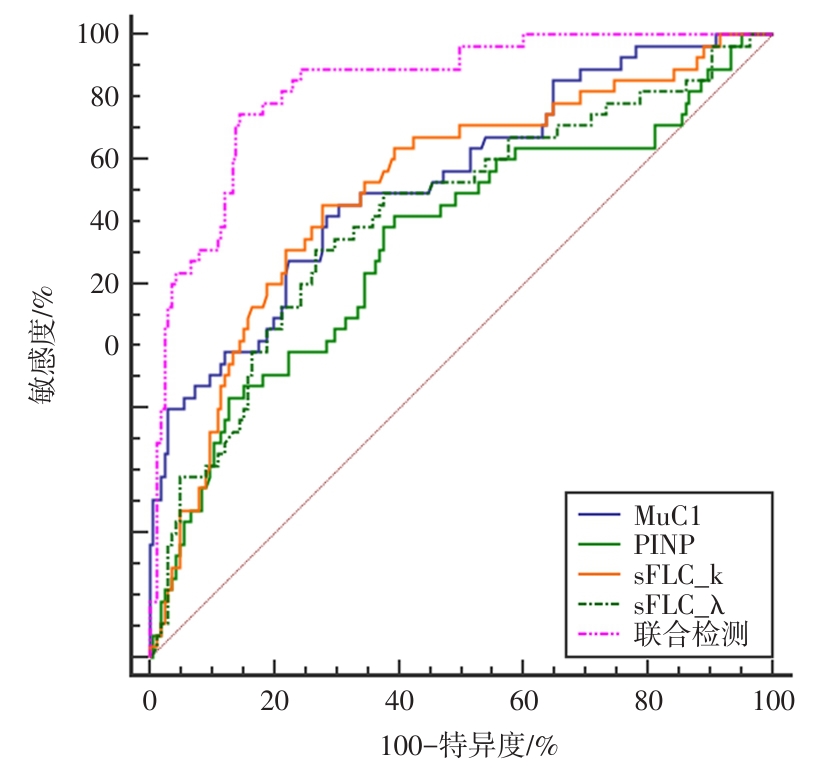
The predictive value of levels of serum MuC1, PINP, and sFLC for the prognosis of patients with multiple myeloma"
| 指标 | 截断值 | AUC | 敏感度/% | 特异度/% | P值 | 95%CI |
|---|---|---|---|---|---|---|
| MuC1 | 35.89 ng/L | 0.765 | 72.73 | 69.70 | < 0.001 | 0.703 ~ 0.819 |
| PINP | 75.71 ng/L | 0.665 | 69.09 | 62.42 | < 0.001 | 0.599 ~ 0.727 |
| sFLC-κ | 40.36 mg/L | 0.753 | 72.73 | 72.12 | < 0.001 | 0.690 ~ 0.808 |
| sFLC-λ | 62.49 mg/L | 0.710 | 65.45 | 73.33 | < 0.001 | 0.645 ~ 0.769 |
| 联合检测 | 0.914bcde | 87.27 | 85.45 | < 0.001 | 0.869 ~ 0.948 |
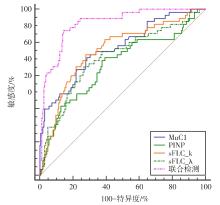
Fig.1
The predictive value of levels of serum MuC1, PINP, and sFLC for the prognosis of multiple myeloma patients"
| [1] |
曹阳, 刘月, 刘琰, 等. 地西他滨联合安罗替尼对多发性骨髓瘤细胞增殖和凋亡的影响[J]. 中国实验血液学杂志, 2023, 31(2): 442-447. doi: 10.19746/j.cnki.issn1009-2137. 2023. 02.019 .
doi: 10.19746/j.cnki.issn1009-2137. 2023. 02.019 |
| [2] |
REES M J, KUMAR S. High-risk multiple myeloma: Redefining genetic, clinical, and functional high-risk disease in the era of molecular medicine and immunotherapy[J]. Am J Hematol, 2024, 99(8): 1560-1575. doi: 10.1002/ajh.27327 .
doi: 10.1002/ajh.27327 |
| [3] |
孔春芳, 李安娜, 柯波, 等. 6-姜辣素对人多发性骨髓瘤细胞的抑制作用及分子机制[J]. 实用医学杂志, 2024, 40(23): 3291-3297. doi: 10.3969/j.issn.1006-5725.2024.23.003 .
doi: 10.3969/j.issn.1006-5725.2024.23.003 |
| [4] |
ENGELHARDT M, KORTÜM K M, GOLDSCHMIDT H, et al. Functional cure and long-term survival in multiple myeloma: How to challenge the previously impossible[J]. Haematologica, 2024, 109(8): 420-2435. doi: 10.3324/haematol.2023.283058 .
doi: 10.3324/haematol.2023.283058 |
| [5] |
MALEKI F, REZAZADEH F, VARMIRA K. Muc1-targeted radiopharmaceuticals in cancer imaging and therapy[J]. Mol Pharm, 2021, 18(5): 1842-1861. doi: 10.1021/acs.molpharmaceut.0c01249 .
doi: 10.1021/acs.molpharmaceut.0c01249 |
| [6] |
FARR J N, ATKINSON E J, ACHENBACH S J, et al. Effects of intermittent senolytic therapy on bone metabolism in postmenopausal women: A phase 2 randomized controlled trial[J]. Nat Med, 2024, 30(9): 2605-2612. doi: 10.1038/s41591-024-03096-2 .
doi: 10.1038/s41591-024-03096-2 |
| [7] |
KASHII M, KAMATANI T, NAGAYAMA Y, et al. Baseline serum pinp level is associated with the increase in hip bone mineral density seen with romosozumab treatment in previously untreated women with osteoporosis [J]. Osteoporos Int, 2023, 34(3): 563-572.doi:10.1007/s00198-022-06642-1 .
doi: 10.1007/s00198-022-06642-1 |
| [8] |
李丹, 闫宏, 江楠, 等. 成都地区淋巴瘤患者血清游离轻链与不良临床特征及血液常规参数的关系研究[J]. 中国实验血液学杂志, 2023, 31(5): 1358-1365. doi: 10.19746/j.cnki.issn1009-2137.2023.05.017 .
doi: 10.19746/j.cnki.issn1009-2137.2023.05.017 |
| [9] |
AZIMI V, FIALA M A, ZAYDMAN M A. Use of the current standard of practice serum free light chains (sflc) reference interval puts black patients at 5 times higher odds for light chain monoclonal gammopathy of undetermined significance (lc-mgus)[J]. Clin Chem, 2023, 69(9): 1084-1086. doi: 10.1093/clinchem/hvad083 .
doi: 10.1093/clinchem/hvad083 |
| [10] |
中国医师协会血液科医师分会, 中华医学会血液学分会, 中国医师协会多发性骨髓瘤专业委员会. 中国多发性骨髓瘤诊治指南(2020年修订)[J]. 中华内科杂志, 2020, 59(5): 341-346. doi: 10.3760/cma.j.cn112138-20200304-00179 .
doi: 10.3760/cma.j.cn112138-20200304-00179 |
| [11] |
张岚, 朱建锋, 潘柏申, 等. 循环浆细胞传统形态学检测对多发性骨髓瘤初诊患者预后的临床意义[J]. 检验医学, 2025, 40(1): 15-19. doi: 10.3969/j.issn.1673-8640.2025.01.003 .
doi: 10.3969/j.issn.1673-8640.2025.01.003 |
| [12] |
FITZPATRICK M J, NARDI V, SOHANI A R. Plasma cell myeloma: Role of histopathology, immunophenotyping, and genetic testing[J]. Skeletal Radiol, 2022, 51(1): 17-30. doi: 10.1007/s00256-021-03754-3 .
doi: 10.1007/s00256-021-03754-3 |
| [13] |
ZHUKOVSKY S, WHITE J, CHAKRABORTY R, et al. Multiple myeloma clinical trials exclude patients with the highest-risk disease: A systematic review of trial exclusion criteria[J]. Leuk Lymphoma, 2024, 65(14): 2163-2172. doi: 10.1080/10428194.2024.2395440 .
doi: 10.1080/10428194.2024.2395440 |
| [14] |
沈娟, 王勇, 王秋萍, 等. 多发性骨髓瘤患者免疫状态及外周血RDW-SD、sFLCR、sBCMA水平变化与预后的关系[J]. 实用医学杂志, 2025, 41(8): 1161-1166. doi: 10.3969/j.issn.1006-5725.2025.08.011 .
doi: 10.3969/j.issn.1006-5725.2025.08.011 |
| [15] |
裴晓杭, 张丽娜, 周盼, 等. sFLC、血清钙离子在多发性骨髓瘤患者诊断及预后判断中的应用价值[J]. 中国实验血液学杂志, 2024, 32(3): 794-798. doi: 10.19746/j.cnki.issn1009-2137. 2024.03.021 .
doi: 10.19746/j.cnki.issn1009-2137. 2024.03.021 |
| [16] |
HENTZEN S, MEIRSON T, KOEHN K, et al. Attrition and withdrawal in multiple myeloma randomized controlled trials: A systematic review[J]. Eur J Haematol, 2023, 111(3): 491-498. doi: 10.1111/ejh.14032 .
doi: 10.1111/ejh.14032 |
| [17] |
ZHOU H, SHEN Y, ZHENG G, et al. Integrating single-cell and spatial analysis reveals muc1-mediated cellular crosstalk in mucinous colorectal adenocarcinoma[J]. Clin Transl Med, 2024, 14(5): 1701-1701. doi: 10.1002/ctm2.1701 .
doi: 10.1002/ctm2.1701 |
| [18] |
LIN X B, YE H, HE L J, et al. Analysis of changes in serum high t-pinp/β-ctx ratio and risk of re-fracture after vertebral osteoporotic fracture surgery[J]. Eur Rev Med Pharmacol Sci, 2023, 27(22): 10860-10867. doi: 10.26355/eurrev_202311_34453 .
doi: 10.26355/eurrev_202311_34453 |
| [19] | ZHONG Y, LI J, LUO J, et al. Advances in Bone Turnover Markers (PINP and CTX) in Optimizing Anti-resorptive and Anabolic Therapies Against Osteoporosis[J]. Discov Med, 2021, 32(167): 149-154. |
| [20] |
马荣军, 杨世伟, 袁晓莉, 等. 蛋白酶体抑制剂对骨髓瘤骨病患者血清骨代谢物的影响及临床意义[J]. 中华医学杂志, 2020, 100(26): 2032-2035. doi: 10.3760/cma.j.cn112137-20200328-00988 .
doi: 10.3760/cma.j.cn112137-20200328-00988 |
| [21] |
TRIDIMAS A, MILAN A, MARKS E. Assessing bone formation in patients with chronic kidney disease using procollagen type I N-terminal propeptide (PINP): The choice of assay makes a difference[J]. Ann Clin Biochem, 2021, 58(5): 528-536. doi: 10.1177/00045632211025567 .
doi: 10.1177/00045632211025567 |
| [22] |
JIANG M, YU Q, MEI H, et al. Early diagnostic value of ect whole-body bone imaging combined with pinp and β-ctx for bone metastasis of lung cancer[J]. Clin Transl Oncol, 2024, 26(12): 3116-3123. doi: 10.1007/s12094-024-03475-8 .
doi: 10.1007/s12094-024-03475-8 |
| [23] |
JIA L, CHENG M. Correlation analysis between risk factors, bmd and serum osteocalcin, cathek, pinp, β-crosslaps, trap, lipid metabolism and bmi in 128 patients with postmenopausal osteoporotic fractures[J]. Eur Rev Med Pharmacol Sci, 2022, 26(21): 7955-7959. doi: 10.26355/eurrev_202211_30147 .
doi: 10.26355/eurrev_202211_30147 |
| [24] |
SHASTRI M, MALHOTRA P, KAUR H, et al. Understanding the constraints and optimization of serum immunofixation electrophoresis and serum free light chains for detecting monoclonal proteins: A single-center experience[J]. J Lab Physicians, 2023, 15(4): 518-523. doi: 10.1055/s-0043-1768684 .
doi: 10.1055/s-0043-1768684 |
| [25] |
CAO D, SHOU L, WU Y, et al.The role of serum-free light chain ratios in the prediction of poor prognosis in multiple myeloma patients: A systematic review and meta-analysis[J]. Hematology, 2022, 27(1): 1130-1139. doi: 10.1080/16078454. 2022. 2127460 .
doi: 10.1080/16078454. 2022. 2127460 |
| [26] |
PEARSON D S, MCEVOY D S, MURALI M R, et al. Use of clinical decision support to improve the laboratory evaluation of monoclonal gammopathies[J]. Am J Clin Pathol, 2023, 159(2): 192-204. doi: 10.1093/ajcp/aqac151 .
doi: 10.1093/ajcp/aqac151 |
| [27] |
LU C, HE D, WANG R, et al. Elevated polyclonal igg4 mimicking a monoclonal gammopathy in igg4-related disease-a case-based review[J]. Clin Rheumatol, 2024, 43(9): 3019-3028. doi: 10.1007/s10067-024-07062-8 .
doi: 10.1007/s10067-024-07062-8 |
| [28] |
肖辉建, 王秋菊, 吴双, 等. 骨髓浆细胞形态分型与单克隆性的相关性及其对高危冒烟型骨髓瘤的诊断价值[J]. 中国实验血液学杂志, 2024, 32(4): 1146-1151. doi: 10.19746/j.cnki.issn1009-2137.2024.04.026 .
doi: 10.19746/j.cnki.issn1009-2137.2024.04.026 |
| [29] |
江志红, 江雅婷, 王晓娜, 等. 不同浆细胞病分型患者骨髓浆细胞的流式特征分析[J]. 复旦学报(医学版), 2024, 51(4): 602-607, 619. doi: 10.3969/j.issn.1672-8467.2024.04.020 .
doi: 10.3969/j.issn.1672-8467.2024.04.020 |
| [30] |
CREES Z D, RETTIG M P, JAYASINGHE R G, et al. Motixafortide and g-csf to mobilize hematopoietic stem cells for autologous transplantation in multiple myeloma: A randomized phase 3 trial[J]. Nat Med, 2023, 29(4): 869-879. doi: 10.1038/s41591-023-02273-z .
doi: 10.1038/s41591-023-02273-z |
| Viewed | ||||||
|
Full text |
|
|||||
|
Abstract |
|
|||||
