

The Journal of Practical Medicine ›› 2026, Vol. 42 ›› Issue (6): 916-922.doi: 10.3969/j.issn.1006-5725.2026.06.002
• Feature Reports:Respiratory Disease • Previous Articles Next Articles
Shiya LIU,Yixin GUO,Wentong LIU,Hang YIN,Yining CUI,Xihua LU( )
)
Received:2025-11-15
Revised:2025-12-10
Accepted:2025-12-12
Online:2026-03-25
Published:2026-03-26
Contact:
Xihua LU
E-mail:hnlxh66@163.com
CLC Number:
Shiya LIU,Yixin GUO,Wentong LIU,Hang YIN,Yining CUI,Xihua LU. Evaluation of postoperative analgesic efficacy of liposomal bupivacaine in thoracoscopy-guided intercostal nerve block[J]. The Journal of Practical Medicine, 2026, 42(6): 916-922.
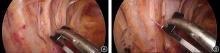
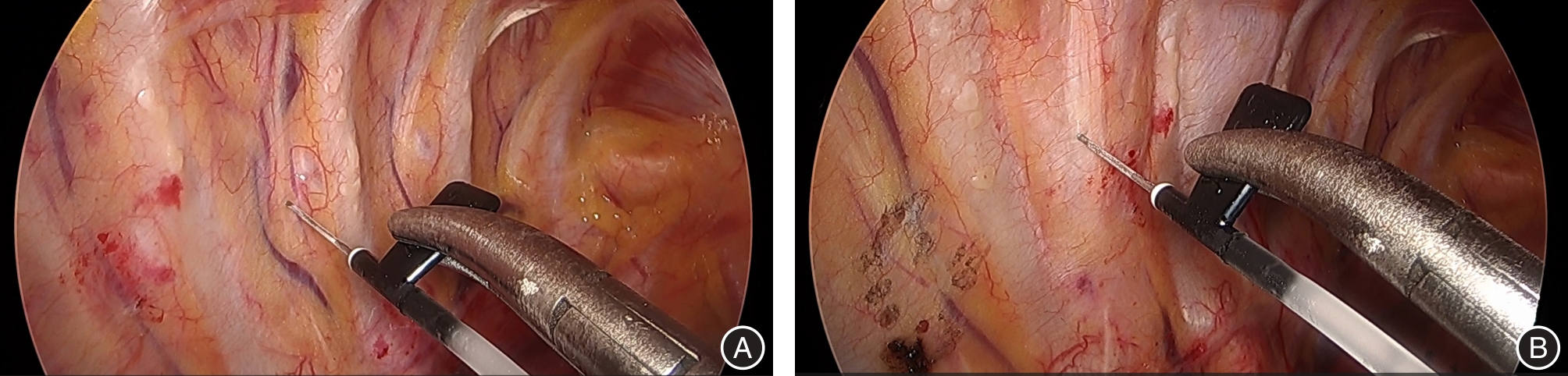
Fig.1
TINB procedural diagram"
Tab.1
Comparison of baseline characteristics between the two groups"
| 指标 | L组(n = 60) | R组(n = 60) | t/χ2 值 | P值 |
|---|---|---|---|---|
| 性别/例 | 0.034 | 0.853 | ||
| 男 | 25 | 26 | ||
| 女 | 35 | 34 | ||
| 年龄/岁 | 59.4 ± 7.6 | 58.1 ± 8.1 | -0.897 | 0.371 |
| BMI/(kg/m2) | 24.1 ± 2.4 | 23.7 ± 2.5 | -0.927 | 0.356 |
| ASA/例 | 0.342 | 0.559 | ||
| Ⅰ级 | 21 | 18 | ||
| Ⅱ级 | 39 | 42 | ||
| 吸烟史/例 | 25 | 32 | 1.637 | 0.201 |
| 手术时间/min | 122.7 ± 8.3 | 124.5 ± 7.9 | 1.223 | 0.224 |
| 麻醉时间/min | 141.1 ± 8.7 | 143.0 ± 9.2 | 1.187 | 0.238 |
| PACU停留时间/min | 74.8 ± 25.8 | 71.6 ± 20.6 | 0.759 | 0.449 |
| 尿量/mL | 401.0 ± 168.0 | 418.0 ± 170.0 | -0.560 | 0.578 |
| 出血量/mL | 62.6 ± 30.5 | 53.3 ± 29.5 | -1.700 | 0.091 |
| 补液量/mL | 1 419.0 ± 502.0 | 1 467.0 ± 475.0 | -0.540 | 0.590 |
| 手术类型/例 | 0.362 | 0.985 | ||
| 左肺上叶 | 17 | 18 | ||
| 左肺下叶 | 14 | 13 | ||
| 右肺上叶 | 10 | 12 | ||
| 右肺中叶 | 8 | 7 | ||
| 右肺下叶 | 11 | 10 |
Tab.2
Resting and activity NRS pain scores in group L vs. group R at postoperative time points"
| 项目 | 时间 | L组(n = 60) | R组(n = 60) | t值 | P值 |
|---|---|---|---|---|---|
静息时 | 术后2 h | 3.05 ± 1.03 | 2.83 ± 0.83 | 1.191 | 0.236 |
| 术后6 h | 3.20 ± 0.55 | 3.30 ± 0.67 | -0.895 | 0.373 | |
| 术后12 h | 3.25 ± 0.70 | 3.75 ± 0.95 | -3.275 | 0.001 | |
| 术后24 h | 3.70 ± 0.67 | 4.10 ± 0.89 | -2.666 | 0.009 | |
| 术后48 h | 3.05 ± 0.67 | 3.60 ± 0.89 | -3.823 | < 0.001 | |
| 术后72 h | 1.28 ± 0.87 | 1.58 ± 0.70 | -2.092 | 0.039 | |
| 活动时 | 术后2 h | 3.22 ± 0.80 | 2.97 ± 0.78 | 1.728 | 0.087 |
| 术后6 h | 3.57 ± 0.69 | 3.70 ± 0.87 | -0.926 | 0.356 | |
| 术后12 h | 3.78 ± 1.50 | 4.52 ± 1.42 | -2.753 | 0.007 | |
| 术后24 h | 3.80 ± 1.04 | 5.07 ± 2.23 | -3.987 | < 0.001 | |
| 术后48 h | 3.45 ± 0.89 | 4.25 ± 1.48 | -3.587 | < 0.001 | |
| 术后72 h | 1.87 ± 0.87 | 1.95 ± 0.96 | -0.496 | 0.621 |
Tab.3
Comparison of postoperative analgesia consumption and recovery indicators between groups"
| 项目 | L组(n = 60) | R组(n = 60) | t/χ2/Z值 | P值 |
|---|---|---|---|---|
| 舒芬太尼总消耗量/μg | 56.5 ± 9.1 | 77.1 ± 13.8 | 9.675 | < 0.001 |
| 镇痛泵首次按压时间[M(P25,P75)]/h | 8.0(6.0,9.0) | 6.0(5.0,8.0) | -3.261 | 0.001 |
| 补救镇痛/[例(%)] | 8(13.33) | 19(31.67) | 5.783 | 0.016 |
| 首次下床时间/h | 24.6 ± 3.0 | 31.1 ± 3.8 | 10.396 | 0.001 |
| 引流管留置时间/h | 71.8 ± 2.5 | 72.5 ± 3.5 | 1.129 | 0.261 |
Tab.4
Comparison of postoperative analgesia pump presses within 72 hours between groups"
| 时间 | L组(n = 60) | R组(n = 60) | Z值 | P值 |
|---|---|---|---|---|
| 0~ 24 h | 3.0(2.0,4.0) | 6.0(4.0,6.0) | -6.581 | < 0.001 |
| 24 ~ 48 h | 5.0(4.0,7.0) | 10.0(8.0,11.0) | -8.345 | < 0.001 |
| 48 ~ 72 h | 3.0(2.0,4.0) | 4.0(3.0,4.0) | -2.261 | 0.024 |
Tab.5
Comparison of QoR-15 scores between groups"
| 时间 | L组(n = 60) | R组(n = 60) | t值 | P值 |
|---|---|---|---|---|
| 术前 | 137.8 ± 5.9 | 139.3 ± 6.04 | -1.398 | 0.165 |
| 术后24 h | 112.2 ± 2.6 | 101.0 ± 5.8 | -13.626 | 0.001 |
| 术后72 h | 134.4 ± 4.4 | 132.7 ± 3.9 | 2.127 | 0.036 |
Tab.6
Comparison of adverse reactions and nerve block-related complications within 72 hours"
| 项目 | L组(n = 60) | R组(n = 60) | χ2 值 | P值 |
|---|---|---|---|---|
| 恶心呕吐 | 6(10.00) | 16(26.67) | 5.570 | 0.018 |
| 头晕 | 1(1.67) | 3(5.00) | 0.259 | 0.611 |
| 嗜睡 | 2(3.33) | 3(5.00) | - | - |
| 咳嗽无力 | 1(1.67) | 2(3.33) | - | - |
| 肺部感染 | 1(1.67) | 1(1.67) | - | - |
| 肺不张 | 0(0.00) | 1(1.67) | - | - |
| 血肿 | 0(0.00) | 0(0.00) | - | - |
| 神经损伤 | 0(0.00) | 0(0.00) | - | - |
| 总体不良反应 | 11(18.33) | 26(43.33) | 8.937 | 0.003 |
| [1] |
CAO W, CHEN H D, YU Y W, et al. Changing profiles of cancer burden worldwide and in China: A secondary analysis of the global cancer statistics 2020[J]. Chin Med J, 2021, 134(7): 783-791. doi:10.1097/CM9.0000000000001474 .
doi: 10.1097/CM9.0000000000001474 |
| [2] |
YAN T D, BLACK D, BANNON P G, et al. Systematic review and meta-analysis of randomized and nonrandomized trials on safety and efficacy of video-assisted thoracic surgery lobectomy for early-stage non-small-cell lung cancer[J]. J Clin Oncol, 2009, 27(15): 2553-2562. doi:10.1200/JCO.2008.21.7695 .
doi: 10.1200/JCO.2008.21.7695 |
| [3] |
MALONEY J, WIE C, PEW S, et al. Post-thoracotomy pain syndrome[J]. Curr Pain Headache Rep, 2022, 26(9): 677-681. doi:10.1007/s11916-022-01069-z
doi: 10.1007/s11916-022-01069-z |
| [4] |
FERGUSON J, TSIM S, KELLY C, et al. Staging by thoracoscopy in potentially radically treatable lung cancer associated with minimal pleural effusion (STRATIFY): Protocol of a prospective, multicentre, observational study[J]. BMJ Open Respir Res, 2023, 10(1): e001771. doi:10.1136/bmjresp-2023-001771 .
doi: 10.1136/bmjresp-2023-001771 |
| [5] |
李月, 张伟新, 梁汉生,等.胸椎旁神经阻滞对老年胸腔镜肺手术患者术后体温的影响[J]. 实用医学杂志, 2025, 41(14): 2199-2203. doi:10.3969/j.issn.1671-0800.2025.14.002 .
doi: 10.3969/j.issn.1671-0800.2025.14.002 |
| [6] |
SUN K, LIU D, CHEN J, et al. Moderate-severe postoperative pain in patients undergoing video-assisted thoracoscopic surgery: A retrospective study[J]. Sci Rep, 2020, 10(1): 795. doi:10.1038/s41598-020-57751-y .
doi: 10.1038/s41598-020-57751-y |
| [7] |
GUERRA-LONDONO C E, PRIVOROTSKIY A, COZOWICZ C, et al. Assessment of intercostal nerve block analgesia for thoracic surgery: A systematic review and meta-analysis[J]. JAMA Netw Open, 2021, 4(11): e2133394. doi:10.1001/jamanetworkopen.2021.33394 .
doi: 10.1001/jamanetworkopen.2021.33394 |
| [8] |
XIAO W, ZHOU W, CHEN X, et al. Analgesic effect of intercostal nerve block given preventively or at the end of operation in video-assisted thoracic surgery: A randomized clinical trial[J]. Braz J Anesthesiol, 2022, 72(5): 574-578. doi: 0.1016/j.bjane. 2021.07.010 .
doi: 0.1016/j.bjane. 2021.07.010 |
| [9] |
CHEN H, SONG W, WANG W, et al. Ultrasound-guided parasternal intercostal nerve block for postoperative analgesia in mediastinal mass resection by median sternotomy: A randomized, double-blind, placebo-controlled trial[J]. BMC Anesthesiol, 2021, 21(1): 98. doi: 10.1186/s12871-021-01291-z .
doi: 10.1186/s12871-021-01291-z |
| [10] |
LI Y, WEI L, DU J H, et al. Comparison of thoracoscopic-guided intercostal nerve block and ultrasound-guided intercostal nerve block in postoperative analgesia of uniportal video-assisted lobectomy: A pilot randomized controlled trial[J]. Int J Surg, 2025, 111(2): 1995-2001. doi: 10.1097/JS9. 000000000000 2165 .
doi: 10.1097/JS9. 000000000000 2165 |
| [11] |
马培奇. 美FDA批准布比卡因脂质体注射用悬浮液Exparel治疗术后疼痛[J]. 上海医药, 2012, 33(15): 29. doi:10.3966/j.issn.1006-1533.2012.15.012 .
doi: 10.3966/j.issn.1006-1533.2012.15.012 |
| [12] |
SHEETS N W, DAVIS J W, DIRKS R C, et al. Intercostal nerve block with liposomal bupivacaine vs epidural analgesia for the treatment of traumatic rib fracture[J]. J Am Coll Surg, 2020, 231(1): 150-154. doi: 10.1016/j.jamcollsurg.2019.12.044 .
doi: 10.1016/j.jamcollsurg.2019.12.044 |
| [13] |
TONG P, GUO Y, WANG Y, et al. Opioid-free anaesthesia protocol based on thoracic paravertebral block enhances postoperative recovery after breast cancer surgery: A two-center, prospective, randomized, controlled trial[J]. J Clin Anesth, 2025, 105: 111904. doi:10.1016/j.jclinane.2025.111904 .
doi: 10.1016/j.jclinane.2025.111904 |
| [14] |
陈巧辉, 苏东风. 罗哌卡因肋间神经阻滞对胸腔镜肺叶切除术后镇痛效果的影响[J]. 外科研究与新技术(中英文), 2025, 14(1): 35-38. doi:10.3969/j.issn.2095-378X.2025.01.008 .
doi: 10.3969/j.issn.2095-378X.2025.01.008 |
| [15] |
SPAANS L N, DIJKGRAAF M G W, SUSA D, et al. Intercostal or paravertebral block vs thoracic epidural in lung surgery: A randomized noninferiority trial[J]. JAMA Surg, 2025, 160(8): 855-864. doi:10.1001/jamasurg.2025.1899 .
doi: 10.1001/jamasurg.2025.1899 |
| [16] |
LEE J, LEE D H, KIM S. Serratus anterior plane block versus intercostal nerve block for postoperative analgesic effect after video-assisted thoracoscopic lobectomy: A randomized prospective study[J/OL]. Medicine, 2020, 99(49): e22102. doi:10.1097/MD.0000000000022102 .
doi: 10.1097/MD.0000000000022102 |
| [17] |
SPAANS L N, DIJKGRAAF M G W, MEIJER P, et al. Optimal postoperative pain management after VATS lung resection by thoracic epidural analgesia, continuous paravertebral block or single-shot intercostal nerve block (OPtriAL): Study protocol of a three-arm multicentre randomised controlled trial[J/OL]. BMC Surg, 2022, 22(1). doi:10.1186/s12893-022-01765-y .
doi: 10.1186/s12893-022-01765-y |
| [18] |
史建明, 陈乃葆, 单靖华, 等. 术后胸腔镜直视下、超声引导下INB分别联合PCIA对单孔胸腔镜肺肿物切除术患者的镇痛效果观察[J]. 山东医药, 2024, 64(33): 63-67. doi:10.3969/j.issn.1002-266X.2024.33.015 .
doi: 10.3969/j.issn.1002-266X.2024.33.015 |
| [19] |
ANGST M S, DROVER D R. Pharmacology of drugs formulated with DepoFoam: A sustained release drug delivery system for parenteral administration using multivesicular liposome technology[J]. Clin Pharmacokinet, 2006, 45(12): 1153-1176.doi:10.2165/00003088-200645120-00002 .
doi: 10.2165/00003088-200645120-00002 |
| [20] |
MANNA S, WU Y, WANG Y, et al. Probing the mechanism of bupivacaine drug release from multivesicular liposomes[J]. J Control Release, 2019, 294: 279-287. doi: 10.1016/j.jconrel.2018.12.029
doi: 10.1016/j.jconrel.2018.12.029 |
| [21] |
卢建国, 赵香梅, 甘绍印, 等. 单孔胸腔镜肺部手术应用布比卡因脂质体进行肋间神经阻滞镇痛疗效的前瞻性临床研究[J]. 中国胸心血管外科临床杂志, 2024: 1-6. doi:10.7507/1007-4848.2024.01.001 .
doi: 10.7507/1007-4848.2024.01.001 |
| [22] |
周岚, 黎鹏, 宋绍永, 等. 超声引导下持续肋间神经阻滞对双孔胸腔镜手术患者术后早期恢复的影响[J]. 临床麻醉学杂志, 2022, 38(6): 603-607. doi:10.12089/jca.2022.06.009 .
doi: 10.12089/jca.2022.06.009 |
| [23] |
ADMIRAAL M, MARHOFER P, HOPKINS P M, et al. Peripheral regional anaesthesia and outcomes: A narrative review of the literature from 2013 to 2023[J]. Br J Anaesth, 2024, 132(5): 1082-1096. doi:10.1016/j.bja.2023.10.013 .
doi: 10.1016/j.bja.2023.10.013 |
| [24] |
徐亚杰, 夏道林, 方兆晶, 等. 胸椎旁联合肋间神经阻滞对胸腔镜手术女性患者术后反弹性疼痛的影响[J]. 临床麻醉学杂志, 2025, 41(8): 807-812. doi:10.12089/jca.2025.08.007 .
doi: 10.12089/jca.2025.08.007 |
| [25] | 沈颖.右美托咪定与地塞米松复合罗哌卡因对胸腔镜直视下肋间神经阻滞效果的影响[D].上海:上海交通大学,2019. |
| [26] |
LI S, FENG J, FAN K, et al. The effect of ultrasound-guided intercostal nerve block on postoperative analgesia in thoracoscopic surgery: A randomized, double-blinded, clinical trial[J]. J Cardiothorac Surg, 2023, 18(1): 128. doi:10.1186/s13019-023-02210-8 .
doi: 10.1186/s13019-023-02210-8 |
| [27] |
ZADRAZIL M, MARHOFER P, OPFERMANN P, et al. Liposomal bupivacaine for peripheral nerve blockade: A randomized, controlled, crossover, triple-blinded pharmacodynamic study in volunteers[J]. Anesthesiology, 2024, 141(1): 24-31. doi:10.1097/ALN.0000000000004988 .
doi: 10.1097/ALN.0000000000004988 |
| [28] |
HU D, ONEL E, SINGLA N, et al. Pharmacokinetic profile of liposome bupivacaine injection following a single administration at the surgical site[J]. Clin Drug Investig, 2013, 33(2): 109-115. doi:10.2460/ajvr.25.05.0158 .
doi: 10.2460/ajvr.25.05.0158 |
| [29] |
HSU D S, ELY S, ALCASID N J, et al. Reduced opioid utilization and post-operative pain in asian vs. Caucasian populations after video-assisted thoracoscopic surgery lobectomy with liposomal bupivacaine-based intercostal nerve blockade[J]. Ann Palliat Med, 2022, 11(5): 1635-1643. doi: 10.21037/apm-21-2269 .
doi: 10.21037/apm-21-2269 |
| [30] |
D’ANDRILLI A, RENDINA E A. Enhanced recovery after surgery (ERAS) and fast-track in video-assisted thoracic surgery (VATS) lobectomy: Preoperative optimisation and care-plans[J]. J Vis Surg, 2018, 4: 4. doi:10.21037/jovs.2017.12.17 .
doi: 10.21037/jovs.2017.12.17 |
| [31] |
BOHANNON R W, CROUCH R. Minimal clinically important difference for change in 6-minute walk test distance of adults with pathology: A systematic review[J]. J Eval Clin Pract, 2017, 23(2): 377-381. doi:10.1111/jep.12629 .
doi: 10.1111/jep.12629 |
| [32] |
SONG W Q, WANG W, YANG Y C, et al. Parasternal intercostal block complementation contributes to postoperative pain relief in modified radical mastectomy employing pectoral nerve block I and serratus-intercostal block: A randomized trial[J]. J Pain Res, 2020, 13: 865-871. doi:10.2147/JPR.S237435 .
doi: 10.2147/JPR.S237435 |
| [33] |
BENDIXEN M, JØRGENSEN O D, KRONBORG C, et al. Postoperative pain and quality of life after lobectomy via video-assisted thoracoscopic surgery or anterolateral thoracotomy for early stage lung cancer: A randomised controlled trial[J]. Lancet Oncol, 2016, 17(6): 836-844. doi:10.1016/S1470-2045(16)00173-X .
doi: 10.1016/S1470-2045(16)00173-X |
| Viewed | ||||||
|
Full text |
|
|||||
|
Abstract |
|
|||||
