

The Journal of Practical Medicine ›› 2026, Vol. 42 ›› Issue (3): 486-496.doi: 10.3969/j.issn.1006-5725.2026.03.017
• Treatise: Clinical Practice • Previous Articles
Zhongpeng NIU1( ),Yun XIANG2,Guosheng HU3,Rui FANG2,Congfeng XU1,Zhongyuan SHEN4
Received:2025-11-10
Online:2026-02-10
Published:2026-02-09
Contact:
Zhongpeng NIU
E-mail:niuzhongpeng2013@163.com
CLC Number:
Zhongpeng NIU,Yun XIANG,Guosheng HU,Rui FANG,Congfeng XU,Zhongyuan SHEN. The influence of the combined treatment with different doses of IVIG and aspirin on lipid metabolism, DeRitis ratio and platelet parameters in children with Kawasaki disease[J]. The Journal of Practical Medicine, 2026, 42(3): 486-496.
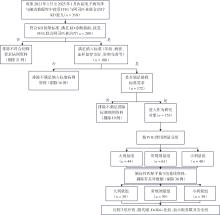
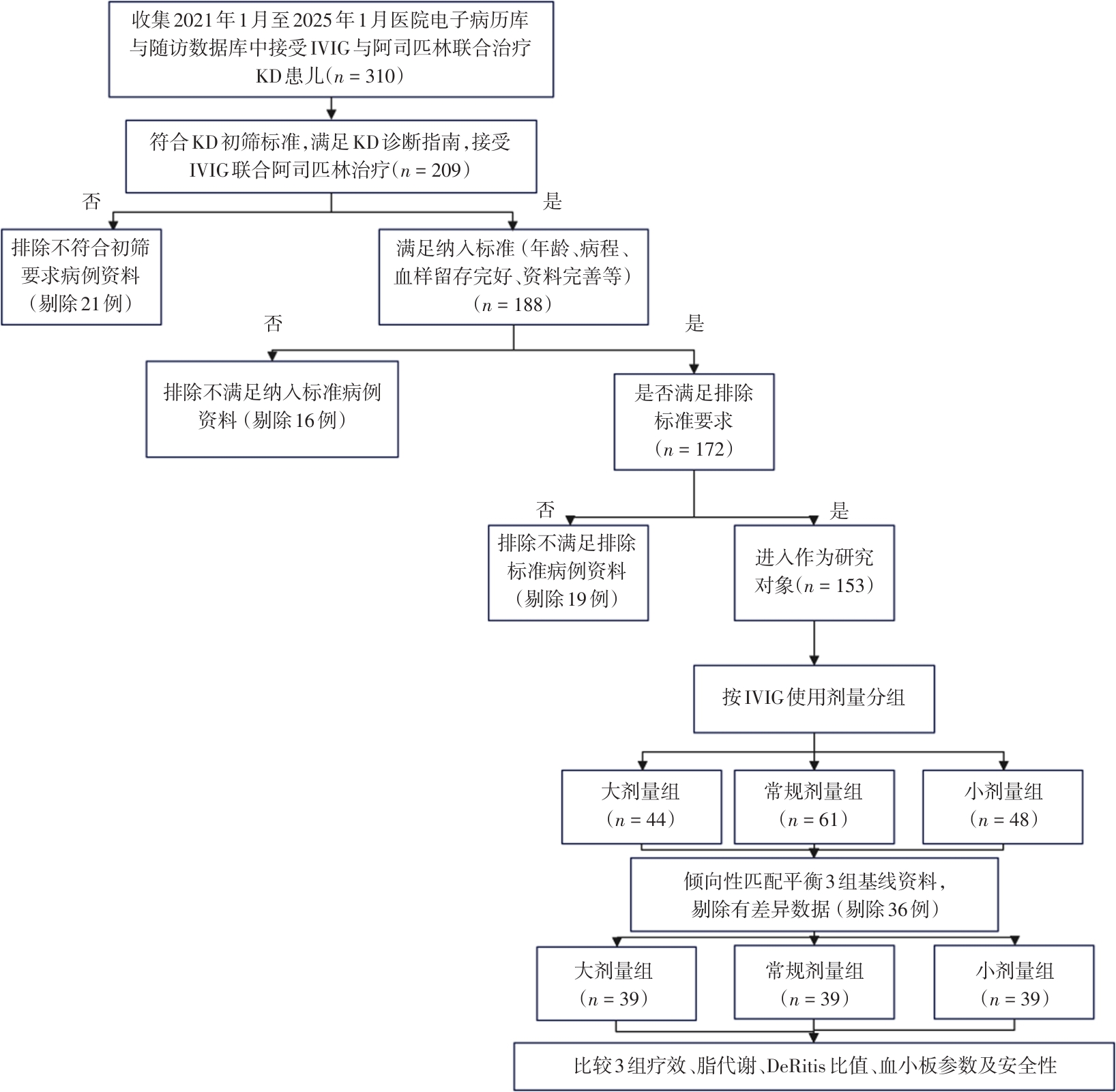
Fig.1
Flowchart of case screening for children with Kawasaki disease"

Tab.1
Comparison of baseline data of the three groups before matching"
| 项目 | 大剂量组(n = 44) | 常规剂量组(n = 61) | 小剂量组(n = 48) | F/χ2值 | P值 |
|---|---|---|---|---|---|
| 性别/例 | 0.040 | 0.980 | |||
| 男 | 27 | 38 | 29 | ||
| 女 | 17 | 23 | 19 | ||
| 年龄/岁 | 2.64 ± 0.76 | 2.71 ± 0.83 | 2.68 ± 0.71 | 0.105 | 0.901 |
| 病程/d | 5.82 ± 1.11 | 5.04 ± 1.65 | 4.89 ± 1.27 | 5.916 | 0.003 |
| 体质量/kg | 12.84 ± 2.67 | 12.98 ± 2.85 | 13.01 ± 2.78 | 0.049 | 0.952 |
| CRP/(mg/L) | 74.56 ± 20.61 | 69.81 ± 15.26 | 60.75 ± 18.17 | 7.223 | 0.001 |
| PLT/(× 109/L) | 390.52 ± 101.56 | 386.85 ± 112.31 | 380.57 ± 106.13 | 0.102 | 0.903 |
| DeRitis比值 | 1.72 ± 0.33 | 1.64 ± 0.21 | 1.60 ± 0.14 | 3.106 | 0.048 |
| TC/(mmol/L) | 3.66 ± 0.71 | 3.72 ± 0.93 | 3.75 ± 1.05 | 0.115 | 0.891 |
| 热峰/℃ | 39.83 ± 0.86 | 39.65 ± 0.71 | 39.35 ± 0.62 | 5.122 | 0.007 |
| 冠脉Z-score值 | |||||
| 右冠脉 | 1.45 ± 0.34 | 1.47 ± 0.41 | 1.44 ± 0.36 | 0.091 | 0.913 |
| 左冠脉 | 1.76 ± 0.42 | 1.78 ± 0.44 | 1.75 ± 0.39 | 0.073 | 0.930 |
| 左前降支 | 1.91 ± 0.32 | 1.95 ± 0.34 | 1.94 ± 0.33 | 0.193 | 0.824 |
| 左室射血分数/% | 59.63 ± 4.15 | 58.97 ± 5.36 | 59.23 ± 7.14 | 0.172 | 0.842 |
Tab.2
Comparison of baseline data of the three groups after matching"
| 项目 | 大剂量组(n = 39) | 常规剂量组(n = 39) | 小剂量组(n = 39) | F/χ2值 | P值 |
|---|---|---|---|---|---|
| 性别/例 | |||||
| 男 | 24 | 23 | 25 | ||
| 女 | 15 | 16 | 14 | ||
| 年龄/岁 | 2.62 ± 0.75 | 2.68 ± 0.71 | 2.65 ± 0.66 | 0.070 | 0.932 |
| 病程/d | 5.45 ± 0.97 | 5.25 ± 1.21 | 5.17 ± 1.18 | 0.641 | 0.529 |
| 体质量/kg | 12.79 ± 2.58 | 12.83 ± 2.63 | 12.96 ± 2.51 | 0.047 | 0.955 |
| CRP/(mg/L) | 70.56 ± 15.69 | 69.98 ± 16.35 | 66.52 ± 16.25 | 0.718 | 0.490 |
| PLT/(× 109/L) | 388.63 ± 98.76 | 384.52 ± 110.54 | 381.52 ± 99.77 | 0.047 | 0.954 |
| DeRitis比值 | 1.68 ± 0.21 | 1.65 ± 0.19 | 1.64 ± 0.26 | 0.343 | 0.710 |
| TC/(mmol/L) | 3.68 ± 0.58 | 3.69 ± 0.82 | 3.74 ± 0.99 | 0.061 | 0.941 |
| 热峰/℃ | 39.52 ± 0.78 | 39.54 ± 0.68 | 39.53 ± 0.65 | 0.008 | 0.992 |
| 冠脉Z-score值 | |||||
| 右冠脉 | 1.44 ± 0.36 | 1.46 ± 0.38 | 1.45 ± 0.39 | 0.027 | 0.973 |
| 左冠脉 | 1.77 ± 0.35 | 1.76 ± 0.51 | 1.79 ± 0.38 | 0.052 | 0.950 |
| 左前降支 | 1.93 ± 0.34 | 1.96 ± 0.33 | 1.93 ± 0.32 | 0.107 | 0.898 |
| 左室射血分数/% | 59.79 ± 4.36 | 59.07 ± 5.55 | 59.76 ± 6.97 | 0.197 | 0.821 |
Tab.3
Comparison of therapeutic effects among"
| 组别 | 显效 | 有效 | 无效 | 总有效率 |
|---|---|---|---|---|
| 大剂量组(n = 39) | 21(53.85) | 15(38.46) | 3(7.69) | 36(92.31) |
| 常规剂量组(n = 39) | 15(38.46) | 16(41.03) | 8(20.51) | 31(79.49) |
| 小剂量组(n = 39) | 11(28.21) | 16(41.03) | 12(30.77) | 27(69.23)a |
| χ2值 | 8.031 | 6.602 | ||
| P值 | 0.018 | 0.037 | ||
Tab.4
Comparison of lipid metabolism parameters among three groups"
| 指标 | 时间 | 大剂量组(n = 39) | 常规剂量组(n = 39) | 小剂量组(n = 39) | F值 | P值 |
|---|---|---|---|---|---|---|
| TC/(mmol/L) | 治疗前 | 3.68 ± 0.58 | 3.69 ± 0.82 | 3.74 ± 0.99 | 0.061 | 0.941 |
| 治疗1周 | 3.76 ± 0.63 | 3.81 ± 0.74 | 3.79 ± 0.68 | 0.053 | 0.949 | |
| t值 | -0.826 | -0.961 | -0.374 | |||
| P值 | 0.411 | 0.340 | 0.709 | |||
| HDL-C/(mmol/L) | 治疗前 | 0.86 ± 0.14 | 0.84 ± 0.19 | 0.82 ± 0.21 | 0.469 | 0.627 |
| 治疗1周 | 1.02 ± 0.22a | 0.91 ± 0.24ab | 0.89 ± 0.23b | 3.608 | 0.030 | |
| t值 | -5.551 | -2.033 | -1.987 | |||
| P值 | < 0.001 | 0.046 | 0.051 | |||
| TG/(mmol/L) | 治疗前 | 1.46 ± 0.25 | 1.51 ± 0.32 | 1.49 ± 0.33 | 0.271 | 0.763 |
| 治疗1周 | 1.21 ± 0.16a | 1.31 ± 0.22ab | 1.33 ± 0.19ab | 4.392 | 0.015 | |
| t值 | 7.616 | 4.626 | 3.843 | |||
| P值 | < 0.001 | < 0.001 | < 0.001 | |||
| LDL-C/(mmol/L) | 治疗前 | 2.38 ± 0.41 | 2.41 ± 0.32 | 2.43 ± 0.38 | 0.179 | 0.837 |
| 治疗1周 | 2.31 ± 0.39 | 2.35 ± 0.46 | 2.38 ± 0.51 | 0.231 | 0.794 | |
| t值 | 1.093 | 0.961 | 0.702 | |||
| P值 | 0.278 | 0.340 | 0.485 | |||
| ApoA1/(g/L) | 治疗前 | 0.48 ± 0.12 | 0.49 ± 0.14 | 0.48 ± 0.15 | 0.069 | 0.933 |
| 治疗1周 | 0.79 ± 0.16a | 0.69 ± 0.11ab | 0.70 ± 0.13ab | 6.500 | 0.002 | |
| t值 | -12.490 | -9.992 | -9.814 | |||
| P值 | < 0.001 | < 0.001 | < 0.001 | |||
| vLDL-C/(mmol/L) | 治疗前 | 0.65 ± 0.15 | 0.66 ± 0.17 | 0.64 ± 0.19 | 0.134 | 0.875 |
| 治疗1周 | 0.61 ± 0.18 | 0.63 ± 0.19 | 0.65 ± 0.16 | 0.497 | 0.609 | |
| t值 | 1.514 | 1.041 | -0.357 | |||
| P值 | 0.134 | 0.301 | 0.722 |
Tab.5
Comparison of DeRitis ratios among the three groups"
| 指标 | 时间 | 大剂量组(n = 39) | 常规剂量组(n = 39) | 小剂量组(n = 39) | F值 | P值 |
|---|---|---|---|---|---|---|
| DeRitis比值 | 治疗前 | 1.68 ± 0.21 | 1.65 ± 0.19 | 1.64 ± 0.26 | 0.343 | 0.710 |
| 治疗1周 | 1.55 ± 0.11a | 1.61 ± 0.13b | 1.62 ± 0.09b | 4.520 | 0.013 | |
| t值 | 5.074 | 1.561 | 0.714 | |||
| P值 | < 0.001 | 0.123 | 0.477 |
Tab.6
Comparison of platelet parameters among the three groups"
| 参数 | 时间 | 大剂量组(n = 39) | 常规剂量组(n = 39) | 小剂量组(n = 39) | F值 | P值 |
|---|---|---|---|---|---|---|
| PDW/% | 治疗前 | 13.65 ± 3.25 | 13.71 ± 3.19 | 13.58 ± 3.31 | 0.016 | 0.984 |
| 治疗1周 | 8.11 ± 0.65a | 8.76 ± 0.54ab | 8.94 ± 1.06ab | 12.137 | < 0.001 | |
| t值 | 17.742 | 16.575 | 13.262 | |||
| P值 | < 0.001 | < 0.001 | < 0.001 | |||
| PLT/(× 109/L) | 治疗前 | 388.63 ± 98.76 | 384.52 ± 110.54 | 381.52 ± 99.77 | 0.047 | 0.954 |
| 治疗1周 | 211.26 ± 42.14a | 236.17 ± 30.59ab | 245.63 ± 26.78ab | 10.756 | < 0.001 | |
| t值 | 15.723 | 13.129 | 13.412 | |||
| P值 | < 0.001 | < 0.001 | < 0.001 | |||
| PCT/% | 治疗前 | 0.16 ± 0.05 | 0.15 ± 0.04 | 0.16 ± 0.04 | 0.684 | 0.507 |
| 治疗1周 | 0.15 ± 0.04 | 0.16 ± 0.04 | 0.15 ± 0.03 | 0.951 | 0.389 | |
| t值 | 1.388 | -1.561 | 1.784 | |||
| P值 | 0.169 | 0.123 | 0.078 | |||
| MPV/fl | 治疗前 | 8.72 ± 1.26 | 8.69 ± 1.31 | 8.63 ± 1.22 | 0.051 | 0.950 |
| 治疗1周 | 7.32 ± 0.59a | 7.56 ± 0.62a | 7.66 ± 0.53ab | 3.525 | 0.033 | |
| t值 | 9.452 | 7.313 | 6.923 | |||
| P值 | < 0.001 | < 0.001 | < 0.001 | |||
| P-LCR/% | 治疗前 | 0.36 ± 0.07 | 0.35 ± 0.09 | 0.36 ± 0.08 | 0.201 | 0.818 |
| 治疗1周 | 0.11 ± 0.02a | 0.14 ± 0.03ab | 0.15 ± 0.04ab | 17.483 | < 0.001 | |
| t值 | 32.868 | 21.857 | 21.857 | |||
| P值 | < 0.001 | < 0.001 | < 0.001 |
Tab.7
Comparison of adverse reactions during treatment in the three groups"
| 不良反应 | 大剂量组(n = 39) | 常规剂量组(n = 39) | 小剂量组(n = 39) | χ2值 | P值 |
|---|---|---|---|---|---|
| 发热 | 6(15.38) | 4(10.26) | 2(5.13) | 2.229 | 0.328 |
| 寒战 | 1(2.56) | 0(0.00) | 0(0.00) | 2.017 | 0.365 |
| 恶心 | 3(7.69) | 1(2.56) | 2(5.13) | 1.054 | 0.590 |
| 血管刺激 | 1(2.56) | 0(0.00) | 0(0.00) | 2.017 | 0.365 |
| 皮疹 | 1(2.56) | 0(0.00) | 0(0.00) | 2.017 | 0.365 |
| 肝损伤 | 2(5.13) | 1(2.56) | 1(2.56) | 0.518 | 0.772 |
| 肾损伤 | 2(5.13) | 1(2.56) | 0(0.00) | 2.053 | 0.358 |
| 血栓栓塞事件 | 1(2.56) | 0(0.00) | 0(0.00) | 2.017 | 0.365 |
Tab.8
Comparison of Z-score values of three groups of coronary arteries"
| Z-score值 | 时间 | 大剂量组(n = 39) | 常规剂量组(n = 39) | 小剂量组(n = 39) | F值 | P值 |
|---|---|---|---|---|---|---|
| 右冠脉 | 治疗前 | 1.44 ± 0.36 | 1.46 ± 0.38 | 1.45 ± 0.39 | 0.027 | 0.973 |
| 随访12周 | 1.21 ± 0.12a | 1.32 ± 0.15ab | 1.31 ± 0.16ab | 6.926 | 0.001 | |
| t值 | 3.785 | 2.140 | 2.074 | |||
| P值 | 0.001 | 0.036 | 0.042 | |||
| 左冠脉 | 治疗前 | 1.77 ± 0.35 | 1.76 ± 0.51 | 1.79 ± 0.38 | 0.052 | 0.950 |
| 随访12周 | 1.38 ± 0.16a | 1.51 ± 0.17ab | 1.53 ± 0.21ab | 7.871 | 0.001 | |
| t值 | 6.329 | 2.904 | 3.740 | |||
| P值 | < 0.001 | 0.005 | 0.001 | |||
| 左前降支 | 治疗前 | 1.93 ± 0.34 | 1.96 ± 0.33 | 1.93 ± 0.32 | 0.107 | 0.898 |
| 随访12周 | 1.51 ± 0.13a | 1.72 ± 0.14ab | 1.71 ± 0.16ab | 26.440 | < 0.001 | |
| t值 | 7.206 | 4.181 | 3.840 | |||
| P值 | < 0.001 | < 0.001 | 0.001 |
Tab.9
Comparison of cardiovascular complications among the three follow-up groups"
| 组别 | 大剂量组(n = 39) | 常规剂量组(n = 39) | 小剂量组(n = 39) | χ2值 | P值 |
|---|---|---|---|---|---|
| 合计 | 8(20.51) | 11(28.21) | 12(30.77) | 1.141 | 0.565 |
| 心包积液 | 1(2.56) | 2(5.13) | 2(5.13) | 0.418 | 0.811 |
| 冠脉损害 | 3(7.69) | 6(15.38) | 7(17.95) | 1.882 | 0.390 |
| 瓣膜反流 | 3(7.69) | 2(5.13) | 2(5.13) | 0.304 | 0.859 |
| 冠脉瘤 | 1(2.56) | 1(2.56) | 1(2.56) | 0.000 | 1.000 |
| [1] |
AE R, MAKINO N, KUWABARA M, et al. Incidence of Kawasaki Disease Before and After the COVID-19 Pandemic in Japan: Results of the 26th Nationwide Survey, 2019 to 2020[J]. JAMA Pediatr, 2022,176(12): 1217-1224. doi: 10.1001/jamapediatrics.2022.3756 .
doi: 10.1001/jamapediatrics.2022.3756 |
| [2] |
JO D S. Kawasaki Disease During COVID-19 Pandemic in Korea - Data Were Added but Are Needed More[J]. J Korean Med Sci, 2022, 37(20): e170. doi: 10.3346/jkms.2022.37.e170 .
doi: 10.3346/jkms.2022.37.e170 |
| [3] |
WANG S, QIAN G, LIU Y, et al. Kawasaki disease: Insights into the roles of T cells[J]. Front Immunol, 2025, 16: 1582638. doi: 10.3389/fimmu.2025.1582638 .
doi: 10.3389/fimmu.2025.1582638 |
| [4] |
BRODERICK C, KOBAYASHI S, SUTO M, et al. Intravenous immunoglobulin for the treatment of Kawasaki disease[J]. Cochrane Database Syst Rev, 2023, 1(1): CD014884. doi: 10.1002/14651858.CD014884.pub2 .
doi: 10.1002/14651858.CD014884.pub2 |
| [5] |
SAFAR F M, KAABI W M, ALJUDAIBI R S, et al. The Effectiveness of No or Low-Dose versus High-Dose Aspirin in Treating Acute Kawasaki Disease: A Systematic Review and Meta-Analysis[J]. Clin Pract, 2024, 14(4): 1296-1309. doi: 10.3390/clinpract14040105 .
doi: 10.3390/clinpract14040105 |
| [6] |
MATSUURA M, SUGAWARA D, MAKITA E, et al. Stratified therapy for Kawasaki disease using a new scoring system to predict the response to a lower dose of intravenous immunoglobulin therapy[J]. Cardiol Young, 2022, 32(3): 405-409. doi: 10.1017/S1047951121002237 .
doi: 10.1017/S1047951121002237 |
| [7] |
薛燕, 尹晶, 许俐, 等. 外周血淋巴细胞亚群对静脉注射免疫球蛋白无反应型川崎病患儿的预测价值[J]. 中国当代儿科杂志, 2023, 25(12): 1211-1218. doi: 10.7499/j.issn.1008-8830.2305067 .
doi: 10.7499/j.issn.1008-8830.2305067 |
| [8] |
DE GRAEFF N, GROOT N, OZEN S, et al. European consensus-based recommendations for the diagnosis and treatment of Kawasaki disease-the SHARE initiative[J]. Rheumatology (Oxford), 2019, 58(4): 672-682. doi: 10.1093/rheumatology/key344 .
doi: 10.1093/rheumatology/key344 |
| [9] |
Research Committee of the Japanese Society of Pediatric Cardiology; Cardiac Surgery Committee for Development of Guidelines for Medical Treatment of Acute Kawasaki Disease. Guidelines for medical treatment of acute Kawasaki disease: Report of the Research Committee of the Japanese Society of Pediatric Cardiology and Cardiac Surgery (2012 revised version)[J]. Pediatr Int, 2014, 56(2): 135-158. doi: 10.1111/ped.12317 .
doi: 10.1111/ped.12317 |
| [10] |
JONE P N, TREMOULET A, CHOUEITER N, et al. Update on Diagnosis and Management of Kawasaki Disease: A Scientific Statement From the American Heart Association[J]. Circulation, 2024, 150(23): e481-e500. doi: 10.1161/CIR. 0000000000001295 .
doi: 10.1161/CIR. 0000000000001295 |
| [11] |
MCCRINDLE B W, ROWLEY A H, NEWBURGER J W, et al. Diagnosis, Treatment, and Long-Term Management of Kawasaki Disease: A Scientific Statement for Health Professionals From the American Heart Association[J]. Circulation, 2017, 135(17): e927-e999. doi: 10.1161/CIR.0000000000000484 .
doi: 10.1161/CIR.0000000000000484 |
| [12] |
MOSSBERG M, MOHAMMAD A J, KAHN F, et al. High risk of coronary artery aneurysm in Kawasaki disease[J]. Rheumatology (Oxford), 2021, 60(4): 1910-1914. doi: 10.1093/rheumatology/keaa512 .
doi: 10.1093/rheumatology/keaa512 |
| [13] |
陕西省川崎病诊疗中心/陕西省人民医院儿童病院, 上海交通大学附属儿童医院,首都医科大学附属北京儿童医院, 等. 阿司匹林在川崎病治疗中的儿科专家共识[J]. 中国当代儿科杂志, 2022, 24(6): 597-603. doi: 10.7499/j.issn.1008-8830. 2203190 .
doi: 10.7499/j.issn.1008-8830. 2203190 |
| [14] |
KUO H C, LIN M C, KAO C C, et al. Intravenous Immunoglobulin Alone for Coronary Artery Lesion Treatment of Kawasaki Disease: A Randomized Clinical Trial[J]. JAMA Netw Open, 2025, 8(4): e253063. doi: 10.1001/jamanetworkopen.2 025.3063 .
doi: 10.1001/jamanetworkopen.2 025.3063 |
| [15] |
ELEFTHERIOU D, MORAES Y C, PURVIS C, et al. Multi-centre, randomised, open-label, blinded endpoint assessed, trial of corticosteroids plus intravenous immunoglobulin (IVIG) and aspirin, versus IVIG and aspirin for prevention of coronary artery aneurysms (CAA) in Kawasaki disease (KD): The KD CAA prevention (KD-CAAP) trial protocol[J]. Trials, 2023, 24(1): 60. doi: 10.1186/s13063-022-07051-9 .
doi: 10.1186/s13063-022-07051-9 |
| [16] |
WANG J R, ZHAO H Z, CHANG L J, et al. Predictive value of monocyte to HDL-C ratio for coronary artery lesions and intravenous immunoglobulin resistance in Kawasaki disease[J]. Eur J Pediatr, 2023, 182(10): 4399-4406. doi: 10.1007/s00431-023-05122-w .
doi: 10.1007/s00431-023-05122-w |
| [17] |
LI L, XU X, GUO Y, et al. C-reactive protein to high density lipoprotein cholesterol ratio for predicting coronary artery lesions, and intravenous immunoglobulin resistance in Kawasaki disease[J]. Pediatr Rheumatol Online J, 2025, 23(1): 108. doi: 10.1186/s12969-025-01160-w .
doi: 10.1186/s12969-025-01160-w |
| [18] |
KANAI T, ITO T, TAJIMA T. Decreased Serum Apolipoprotein CIII in the Acute Phase of Kawasaki Disease[J]. Pediatr Cardiol, 2025, 46(5): 1282-1288. doi: 10.1007/s00246-024-03546-1 .
doi: 10.1007/s00246-024-03546-1 |
| [19] |
YANG C, YANG Y, CAO S, et al. Kawasaki disease coronary artery lesions prediction with monocyte-to-high-density lipoprotein ratio[J]. Pediatr Res, 2023, 94(1): 246-251. doi: 10.1038/s41390-022-02401-4 .
doi: 10.1038/s41390-022-02401-4 |
| [20] |
BRODERICK C, KOBAYASHI S, SUTO M, et al. Intravenous immunoglobulin for the treatment of Kawasaki disease[J]. Cochrane Database Syst Rev, 2023, 1(1): CD014884. doi: 10.1002/14651858 .
doi: 10.1002/14651858 |
| [21] |
邓斌, 王爱莲, 程波利, 等. NLRP3炎症小体、Cav-1、S1P1在川崎病患儿中的表达及其与冠状动脉损伤的关系[J]. 实用医学杂志, 2025, 41(13): 2094-2099. doi: 10.3969/j.issn.1006-5725.2025.13.022 .
doi: 10.3969/j.issn.1006-5725.2025.13.022 |
| [22] |
SON M B F, GAUVREAU K, NEWBURGER J W. Failure of Risk Prediction Modeling for IVIG Resistance in Kawasaki Disease[J]. Pediatrics, 2023, 151(5): e2022060423. doi: 10.1542/peds.2022-060423 .
doi: 10.1542/peds.2022-060423 |
| [23] |
WU R, JIANG W, SUN Y, et al. Indicators of Oxidative Stress in the Prediction of Coronary Artery Lesions in Patients With Kawasaki Disease[J]. J Clin Rheumatol, 2023, 29(3): 126-131. doi: 10.1097/RHU.0000000000001925 .
doi: 10.1097/RHU.0000000000001925 |
| [24] |
CAO L, TANG Y J, GANG M, et al. AST-to-ALT ratio and coronary artery lesions among patients with Kawasaki disease[J]. World J Pediatr, 2021, 17(6): 659-668. doi: 10.1007/s12519-021-00479-0 .
doi: 10.1007/s12519-021-00479-0 |
| [25] | 黄沂徐. 川崎病IVIG无反应危险因素分析及临床预测模型建立[D]. 成都:成都医学院, 2023. |
| [26] |
MUTO T, NAKAMURA N, MASUDA Y, et al. Serum free carnitine levels in children with Kawasaki disease[J]. Pediatr Int, 2022, 64(1): e14849. doi: 10.1111/ped.14849 .
doi: 10.1111/ped.14849 |
| [27] | 王金鑫. AST/ALT与川崎病患儿冠脉损害的关联[D]. 温州:温州医科大学, 2020. |
| [28] |
NOVAL RIVAS M, KOCATÜRK B, FRANKLIN B S, et al. Platelets in Kawasaki disease: Mediators of vascular inflammation[J]. Nat Rev Rheumatol, 2024, 20(8): 459-472. doi: 10.1038/s41584-024-01119-3 .
doi: 10.1038/s41584-024-01119-3 |
| [29] |
ZHANG Y, JIA C, GUO M, et al. Platelet-Monocyte Aggregate Instigates Inflammation and Vasculopathy in Kawasaki Disease[J]. Adv Sci (Weinh), 2025, 12(5): e2406282. doi: 10.1002/advs.202406282 .
doi: 10.1002/advs.202406282 |
| [30] |
FU L, MACKEIGAN D T, GONG Q, et al. Thymic stromal lymphopoietin induces platelet mitophagy and promotes thrombosis in Kawasaki disease[J]. Br J Haematol, 2023, 200(6): 776-791. doi: 10.1111/bjh.18531 .
doi: 10.1111/bjh.18531 |
| [31] |
黄沂徐, 黄宇, 皮光环. 川崎病静脉注射免疫球蛋白无反应预测评分模型的建立[J]. 中国当代儿科杂志, 2025, 27(1): 75-81. doi: 10.7499/j.issn.1008-8830.2408077 .
doi: 10.7499/j.issn.1008-8830.2408077 |
| [32] |
SAFAR F M, KAABI W M, ALJUDAIBI R S, et al. The Effectiveness of No or Low-Dose versus High-Dose Aspirin in Treating Acute Kawasaki Disease: A Systematic Review and Meta-Analysis[J]. Clin Pract, 2024, 14(4): 1296-1309. doi: 10.3390/clinpract14040105 .
doi: 10.3390/clinpract14040105 |
| [33] |
LIN S Y, HE L, XIE L P, et al. Effects of immunoglobulin plus prednisolone in reducing coronary artery lesions in patients with Kawasaki disease: Study protocol for a phase Ⅲ multicenter, open-label, blinded-endpoints randomized controlled trial[J]. Trials, 2021, 22(1): 898. doi: 10.1186/s13063-021-05807-3 .
doi: 10.1186/s13063-021-05807-3 |
| [34] |
刘玲, 张海洋, 张雪霜. 免疫球蛋白辅助治疗对儿童川崎病的疗效及T淋巴细胞、NK细胞水平的影响[J]. 国际免疫学杂志, 2025, 48(3): 295-300. doi: 10.3760/cma.j.issn.1673-4394.2025.03.009 .
doi: 10.3760/cma.j.issn.1673-4394.2025.03.009 |
| [35] |
廖景文. 儿童川崎病标准初始治疗方案中使用静脉输注免疫球蛋白的适宜时机探讨[J]. 中国免疫学杂志, 2024, 40(6): 1253-1258. doi: 10.3969/j.issn.1000-484X.2024.06.023 .
doi: 10.3969/j.issn.1000-484X.2024.06.023 |
| [1] | Bin DENG,Ailian WANG,Boli CHENG,Jiahao CHEN,Yun HE,Chonghai. LIU. Expression of NLRP3 inflammatory vesicles, Cav-1, and S1P1 in children with Kawasaki disease and their association with coronary artery injury [J]. The Journal of Practical Medicine, 2025, 41(13): 2094-2099. |
| [2] | Min ZHOU,Xiaoxiao ZHANG,Zhao WU. The effect of aspirin on frozen thawed embryo transfer in endometriosis with thin endometrium [J]. The Journal of Practical Medicine, 2025, 41(1): 95-99. |
| [3] |
HU Lin, YANG Yanjuan, LI Jieying, ZHOU Zhong, TIAN Zheng, JIAO Rong. .
Salidroside improves coronary artery injury in Kawasaki disease by activating PI3K/Akt and inhibiting NF ⁃ κB signaling pathway [J]. The Journal of Practical Medicine, 2022, 38(21): 2657-2669. |
| [4] |
ZHOU Zhong, WANG Feng, TIAN Zheng, JIAO Rong. .
Recent advances in relationship between advanced glycation end products receptor pathways and Kawasa⁃ ki disease [J]. The Journal of Practical Medicine, 2021, 37(23): 3077-3081. |
| Viewed | ||||||
|
Full text |
|
|||||
|
Abstract |
|
|||||
