The Journal of Practical Medicine ›› 2026, Vol. 42 ›› Issue (12): 2105-2111.doi: 10.3969/j.issn.1006-5725.2026.12.003

• Perioperative Management and Critical Care Support • Previous Articles    

The application effect of digital intelligent diagnosis and treatment technology combined with nurses′ full participation in assisting decision-making in preoperative doctor-patient communication for grade surgery in hepatobiliary surgery

Shuanghua LI1,Jinsheng MAI1,Jun LIU1,2,3,4,Yanyun GENG1,Dongting XU1,Xiaoping JI1,Xiaoping BAI1,Ning ZENG1,2,3,4()   

  1. 1.Department of Hepatobiliary Surgery,General Surgery Center,Zhujiang Hospital,Southern Medical University,Guangzhou 510280,Guangdong,China
    4.Guangdong Provincial Clinical Engineering Technology Research Center for Digital Medicine,Guangzhou 510280,Guangdong,China
    2.National Engineering Research Center for Minimally Invasive Device Innovation and Application?South China Research Institute,Guangzhou 510280,Guangdong,China
    3.Institute of Digital Intelligent Minimally Invasive Surgery,Zhujiang Hospital,Southern Medical University,Guangzhou 510280,Guangdong,China
  • Received:2026-02-13 Online:2026-06-25 Published:2026-06-30
  • Contact: Ning ZENG E-mail:chen_ning16@foxmail.com

Abstract:

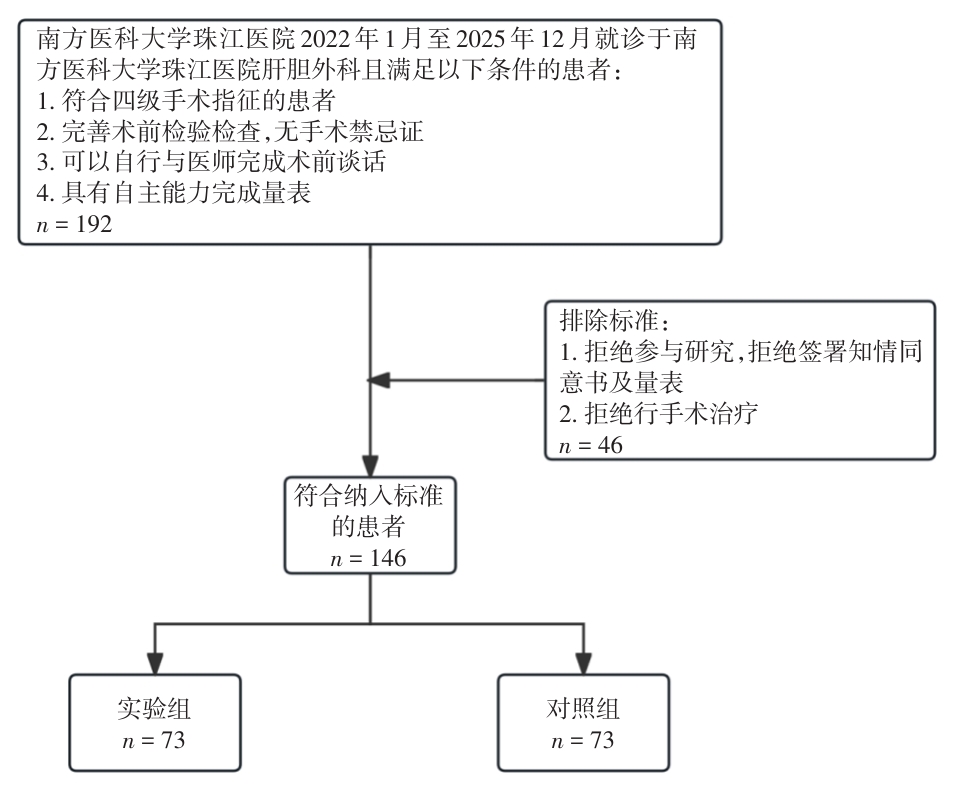
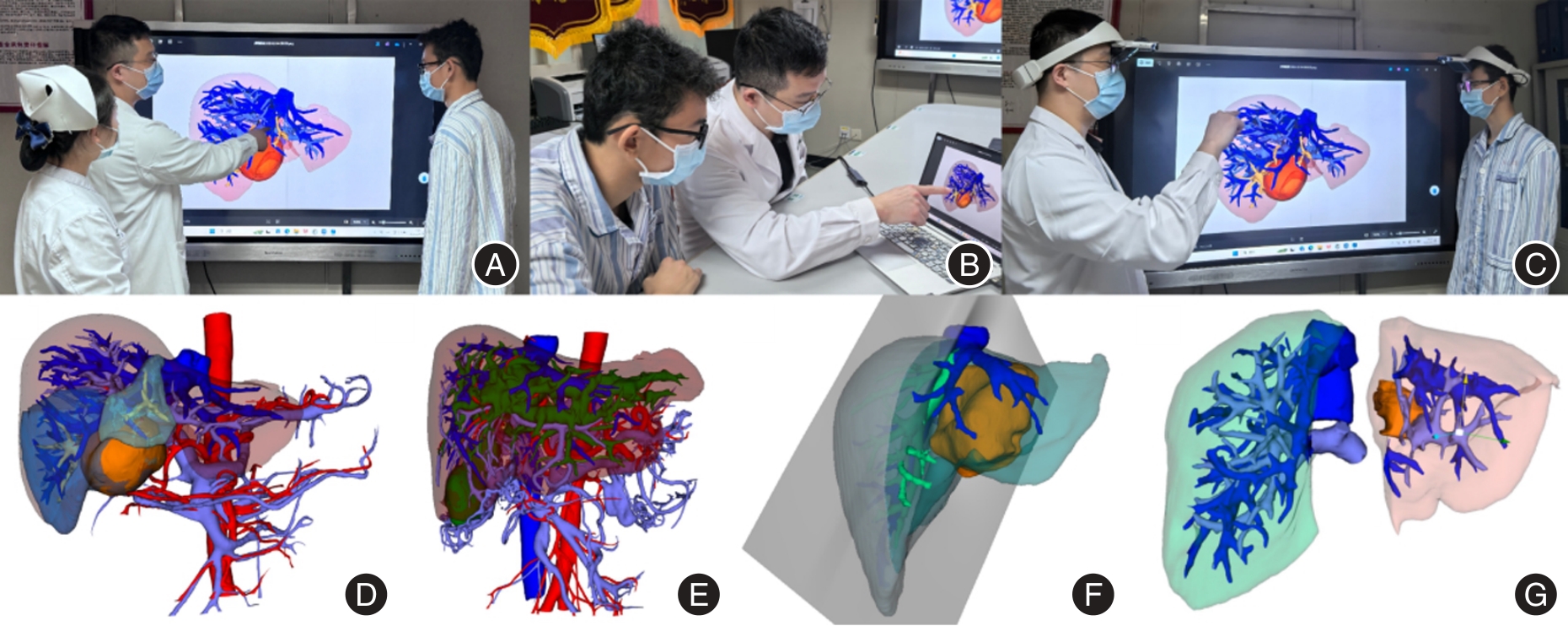
Objective To explore the application effect of digital intelligent diagnosis and treatment technology combined with nurses' full participation in assisting decision-making in preoperative patient-physician communication for grade Ⅳ hepatobiliary surgery, and to analyze the influence of gender and education level on patients' preoperative anxiety and satisfaction with communication, and to clarify the correlation between communication methods and preoperative anxiety as well as independent influencing factors. Methods This study employed a retrospective cohort design. From January 2022 to December 2025, a total of 146 eligible patients were enrolled and divided into a digital intelligent group and a traditional group. In the digital intelligent group, nurses assisted patients in surgical decision-making throughout the process. The research team brought patients into a conversation room equipped with digital intelligent three-dimensional model posters for popular science introduction, patient education tools, and displays, and conducted preoperative conversations based on individualized three-dimensional models made from patients' imaging data, showing surgical plans and procedures on the models. The traditional group only received conventional preoperative conversations. Both groups of patients filled out the Self-Rating Anxiety Scale (SAS) to assess their preoperative anxiety status; they also filled out a self-designed communication effectiveness questionnaire to evaluate communication effectiveness and satisfaction with the conversation. Subgroup analyses were conducted based on gender and education level, and Spearman correlation analysis was used to analyze the correlation between communication indicators and anxiety, while binary logistic regression analysis was used to identify independent influencing factors of preoperative anxiety. Results The preoperative SAS score of patients in the digital intelligent group was 37.5 (32.5, 43.8), significantly lower than that of the traditional group (51.3, 50.0, 53.8), with a statistically significant difference (P < 0.001). The communication effectiveness score of patients in the digital intelligent group was 13.0 (12.0, 15.0), significantly higher than that of the traditional group (12.0, 12.0, 13.0), with a statistically significant difference (P < 0.001). Subgroup analyses based on gender and education level showed no statistically significant differences in intervention effects (P > 0.05); communication indicators were negatively correlated with SAS scores, and communication methods were an independent influencing factor for preoperative anxiety (OR = 33.261, P < 0.001). Subgroup analyses based on gender and education level also showed no statistically significant differences. Conclusion Integrating digital intelligent technology with nurses' full participation in assisting decision-making into the preoperative communication process for grade Ⅳ hepatobiliary surgery can reduce patients' preoperative anxiety levels, improve the quality of doctor-patient communication, and enhance patients' participation in decision-making.

Key words: digital intelligence, hepatobiliary surgery, grade Ⅳ surgery, doctor-patient communication

CLC Number: