

The Journal of Practical Medicine ›› 2025, Vol. 41 ›› Issue (24): 3940-3947.doi: 10.3969/j.issn.1006-5725.2025.24.019
• Medical Examination and Clinical Diagnosis • Previous Articles
Dan WU1,Ling LING2,Wenping WANG1,Tingting. LI2( )
)
Received:2025-09-28
Online:2025-12-25
Published:2025-12-25
Contact:
Tingting. LI
E-mail:liling668899@126.com
CLC Number:
Dan WU,Ling LING,Wenping WANG,Tingting. LI. Evaluation of pelvic floor structure changes in patients with pelvic floor dysfunction based on perineal real⁃time three⁃dimensional ultrasound and relationship with serum relaxin, connective tissue growth factor and soluble microfiber⁃associated protein 4[J]. The Journal of Practical Medicine, 2025, 41(24): 3940-3947.

Tab.1
Comparison of baseline data among the three groups"
| 组别 | 例数 | 年龄/岁 | 分娩孕周/周 | 产后至检查时间/d | 体质量指数/(kg/m2) | 第二产程时长/min |
|---|---|---|---|---|---|---|
| PFD Ⅰ度亚组 | 43 | 30.24 ± 4.11 | 38.65 ± 0.96 | 50.45 ± 5.38 | 25.44 ± 2.19 | 48.76 ± 7.24 |
| PFD Ⅱ度亚组 | 59 | 30.89 ± 3.56 | 38.70 ± 0.91 | 51.74 ± 4.96 | 25.87 ± 2.28 | 49.43 ± 8.31 |
| 对照组 | 32 | 29.77 ± 3.27 | 38.44 ± 0.95 | 50.06 ± 5.12 | 25.29 ± 2.36 | 47.96 ± 7.83 |
| F/χ2值 | 1.030 | 0.829 | 1.381 | 0.821 | 0.368 | |
| P值 | 0.360 | 0.439 | 0.255 | 0.442 | 0.693 |
Tab.2
Comparison of pelvic floor parameters in resting state"
| 组别 | 例数 | 肛提肌裂孔前后径/cm | 肛提肌裂孔左右径/cm | 肛提肌裂孔面积/cm2 | 肛提肌厚度/cm |
|---|---|---|---|---|---|
| PFD Ⅰ度亚组 | 43 | 4.61 ± 0.89 | 4.06 ± 0.82 | 18.25 ± 1.99 | 0.77 ± 0.12 |
| PFD Ⅱ度亚组 | 59 | 4.68 ± 0.85 | 4.16 ± 0.86 | 18.43 ± 2.06 | 0.76 ± 0.14 |
| 对照组 | 32 | 4.49 ± 0.90 | 4.03 ± 0.81 | 18.13 ± 1.93 | 0.78 ± 0.13 |
| F值 | 1.070 | 0.306 | 0.252 | 0.247 | |
| P值 | 0.346 | 0.737 | 0.778 | 0.781 |
Tab.3
Comparison of pelvic floor parameters in maximum Valsalva maneuver"
| 组别 | 例数 | 肛提肌裂孔前后径/cm | 肛提肌裂孔左右径/cm | 肛提肌裂孔面积/cm2 | 肛提肌厚度/cm |
|---|---|---|---|---|---|
| PFD Ⅰ度亚组 | 43 | 6.41 ± 1.29 | 4.65 ± 0.93 | 21.12 ± 1.85 | 0.67 ± 0.12 |
| PFD Ⅱ度亚组 | 59 | 6.56 ± 1.33 | 4.78 ± 0.89 | 23.20 ± 1.96? | 0.67 ± 0.13 |
| 对照组 | 32 | 6.28 ± 1.27 | 4.49 ± 0.90 | 19.86 ± 1.45?# | 0.68 ± 0.11 |
| F值 | 0.502 | 1.078 | 38.751 | 0.081 | |
| P值 | 0.607 | 0.343 | < 0.001 | 0.922 |
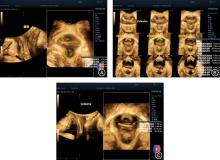
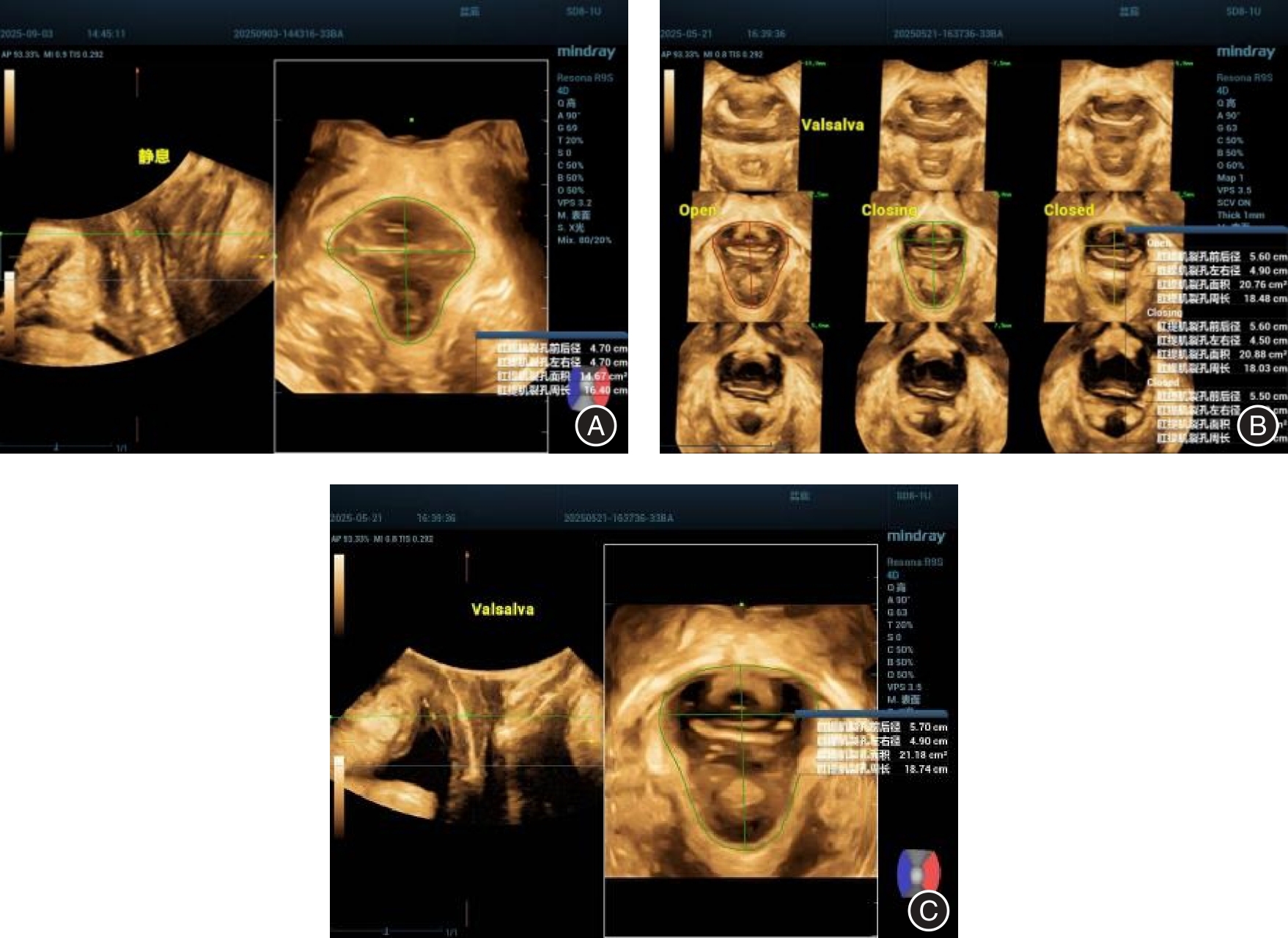
Fig.1
Real-time three-dimensional ultrasound images of perineum of puerperae in PFD I degree subgroup"
Tab.4
Comparison of serum indicators among the three groups"
| 组别 | 例数 | 松弛素/(pg/mL) | CTGF/(μg/L) | sMFAP4/(U/L) |
|---|---|---|---|---|
| PFD Ⅰ度亚组 | 43 | 58.45 ± 7.29 | 48.57 ± 6.11 | 10.05 ± 1.78 |
| PFD Ⅱ度亚组 | 59 | 68.21 ± 8.63? | 59.16 ± 8.24? | 8.90 ± 1.53? |
| 对照组 | 32 | 50.33 ± 7.14?# | 33.49 ± 5.35?# | 11.86 ± 1.85?# |
| F值 | 56.260 | 140.803 | 30.511 | |
| P值 | < 0.001 | < 0.001 | < 0.001 |
Tab.5
Multivariate linear regression analysis of levator hiatus area and serum indicators"
| 项目 | β值 | SE | T值 | P值 | 95%CI |
|---|---|---|---|---|---|
| 松弛素 | 0.312 | 0.120 | 2.572 | 0.011 | 0.070 ~ 0.596 |
| CTGF | 0.972 | 0.301 | 3.261 | 0.002 | 0.571 ~ 1.682 |
| sMFAP4 | -0.352 | 0.144 | 2.511 | 0.015 | -0.614 ~ -0.102 |
| [1] | 韩华平, 吴浪涛, 田恬, 等. 无创矩阵射频技术应用于顺产初产妇盆底功能康复的效果[J]. 实用医学杂志, 2025, 41(4): 607-614. |
| [2] |
SUN C, YANG H, LI K, et al. Pelvic floor structural changes during the first singleton pregnancy and the risk factors of stress urinary incontinence[J]. BMC Pregnancy Childbirth, 2025, 25(1): 552-558. doi:10.1186/s12884-025-07666-1
doi: 10.1186/s12884-025-07666-1 |
| [3] |
LI Z, JIANG L, XU F, et al. Correlation between pelvic floor four-dimensional ultrasound parameters and POP-Q score[J]. Technol Health Care, 2025, 33(3): 1331-1342. doi:10.1177/09287329241293892
doi: 10.1177/09287329241293892 |
| [4] |
BERTUCCI E, RICCIARDIELLO F, GUARIGLIA G, et al. Relaxin in pregnancy: A narrative review of a pleiotropic molecule[J]. Minerva Obstet Gynecol, 2025, 77(3): 237-246. doi:10.23736/s2724-606x.24.05630-6
doi: 10.23736/s2724-606x.24.05630-6 |
| [5] |
KONG M, WANG Z, HAO Y, et al. Role of the integrin-β1/tgf-β1 signaling pathway in the pathogenesis of pelvic organ prolapse: A study on vaginal wall tissue alterations and molecular dysfunction[J]. Mol Med Rep, 2025, 31(4): 104-109. doi:10.3892/mmr.2025.13469
doi: 10.3892/mmr.2025.13469 |
| [6] |
SOFIUDOTTIR B K, MÖLLER S, CHRISTENSEN R, et al. Detecting respiratory impairment in newly diagnosed rheumatoid arthritis by MRC dyspnoea scale and microfibrillar-associated protein 4[J]. Eur Clin Respir J, 2025, 12(1): e2449270. doi:10.1080/20018525.2024.2449270
doi: 10.1080/20018525.2024.2449270 |
| [7] | 中华医学会泌尿外科学分会女性泌尿学组. 盆腔器官脱垂伴压力性尿失禁诊断与治疗中国专家共识[J]. 中华泌尿外科杂志, 2023, 44(6): 401-404. |
| [8] | 河南省超声医学质量控制专家委员会, 王睿丽, 朱兆领, 等.盆底超声临床实用规范化检查专家共识(2022版)[J]. 中国医学影像学杂志, 2023, 31(2): 97-99. |
| [9] |
ARTYMUK N V, KHAPACHEVA S Y. Device-assisted pelvic floor muscle postpartum exercise programme for the management of pelvic floor dysfunction after delivery[J]. J Matern Fetal Neonatal Med, 2022, 35(3): 481-485. doi:10.1080/14767058.2020.1723541
doi: 10.1080/14767058.2020.1723541 |
| [10] | AFSHAR SAFAVI M, NIKNAM H, OKHOVATIAN F, et al. The effect of physiotherapy on erectile dysfunction secondary to prostatic adenectomy: A randomized control trial study[J]. Urol J, 2024, 21(5): 331-339. |
| [11] |
DEL FORNO S, COCCHI L, ARENA A, et al. Effects of pelvic floor muscle physiotherapy on urinary, bowel, and sexual functions in women with deep infiltrating endometriosis: A randomized controlled trial[J]. Medicina (Kaunas), 2023, 60(1):67-76. doi:10.3390/medicina60010067
doi: 10.3390/medicina60010067 |
| [12] |
HE X, DU Q, CHANG L, et al. Analysis of minimal levator ani hiatus area based on MRI in female adults without pelvic floor dysfunction at different age groups[J]. Arch Gynecol Obstet, 2024, 309(5): 2183-2191. doi:10.1007/s00404-023-07253-9
doi: 10.1007/s00404-023-07253-9 |
| [13] |
DELANCEY J O, MASTROVITO S, MASTELING M, et al. A unified pelvic floor conceptual model for studying morphological changes with prolapse, age, and parity[J]. Am J Obstet Gynecol, 2024, 230(5): 476-484.e2. doi:10.1016/j.ajog.2023.11.1247
doi: 10.1016/j.ajog.2023.11.1247 |
| [14] | 潘雪葵,朱玲,蔡婷婷,等. 肛提肌裂孔面积联合剪切波弹性成像对产后盆腔器官脱垂的评估价值[J]. 中国超声医学杂志, 2025, 41(6): 694-698. |
| [15] |
HILDE G, STÆR-JENSEN J, SIAFARIKAS F, et al. Postpartum pelvic floor muscle training, levator ani avulsion and levator hiatus area: A randomized trial[J]. Int Urogynecol J, 2023, 34(2): 413-423. doi:10.1007/s00192-022-05406-z
doi: 10.1007/s00192-022-05406-z |
| [16] |
WANG Q, WU X, WANG S, et al. Mechanical stress-oxidative stress axis: Biological basis in the vaginal wall and pelvic floor muscles of rats with simulated birth injury[J]. Int Urogynecol J, 2024, 35(11): 2141-2152. doi:10.1007/s00192-024-05943-9
doi: 10.1007/s00192-024-05943-9 |
| [17] |
WU H, YANG L, YUAN J, et al. Potential therapeutic targets for pelvic organ prolapse: Insights from key genes related to blood vessel development[J]. Front Med (Lausanne), 2024, 11(1): e1435135. doi:10.3389/fmed.2024.1435135
doi: 10.3389/fmed.2024.1435135 |
| [18] |
PAPWORTH M, KULKARNI S, ANTONSSON M, et al. A novel long-acting relaxin-2 fusion, AZD3427, improves cardiac performance in non-human primates with cardiac dysfunction[J]. Cardiovasc Res, 2025, 121(6): 871-881. doi:10.1093/cvr/cvaf031
doi: 10.1093/cvr/cvaf031 |
| [19] |
MOLINET COLL C, MARTÍNEZ FRANCO E, ALTIMIRA QUERAL L, et al. Hormonal influence in stress urinary incontinence during pregnancy and postpartum[J]. Reprod Sci, 2022, 29(8): 2190-2199. doi:10.1007/s43032-022-00946-7
doi: 10.1007/s43032-022-00946-7 |
| [20] |
LIU K, WU S, CUI Y, et al. Trophoblast fusion in fetal growth restriction is inhibited by CTGF in a cell-cycle-dependent manner[J]. J Mol Histol, 2024, 55(5): 895-908. doi:10.1007/s10735-024-10239-9
doi: 10.1007/s10735-024-10239-9 |
| [21] |
HANSEN S G, TASKIN M B, CHEN M, et al. Electrospun nanofiber mesh with fibroblast growth factor and stem cells for pelvic floor repair[J]. J Biomed Mater Res B Appl Biomater, 2020, 108(1):48-55. doi:10.1002/jbm.b.34364
doi: 10.1002/jbm.b.34364 |
| [22] |
SCHLOSSER A, PILECKI B, ALLEN C, et al. Pharmacological blocking of microfibrillar-associated protein 4 reduces retinal neoangiogenesis and vascular leakage[J]. Mol Ther, 2025, 33(3): 1048-1072. doi:10.1016/j.ymthe.2025.01.038
doi: 10.1016/j.ymthe.2025.01.038 |
| [23] |
SOFÍUDÓTTIR B K, MUNK H L, CHRISTENSEN R, et al. Microfibrillar-associated protein 4 as a predictive biomarker of treatment response in patients with chronic inflammatory diseases initiating biologics: Secondary analyses based on the prospective BELIEVE cohort study[J]. Rheumatol Int, 2024, 44(12): 2935-2947. doi:10.1007/s00296-024-05744-9
doi: 10.1007/s00296-024-05744-9 |
| [24] |
LAURSEN S H, HANSEN S G, TASKIN M B, et al. Electrospun nanofiber mesh with connective tissue growth factor and mesenchymal stem cells for pelvic floor repair: Long-term study[J]. J Biomed Mater Res B Appl Biomater, 2023, 111(2): 392-401. doi:10.1002/jbm.b.35158
doi: 10.1002/jbm.b.35158 |
| [25] |
SAMADZADEH S, OLESEN M N, WIRENFELDT M, et al. Microfibrillar-associated protein 4 as a potential marker of acute relapse in inflammatory demyelinating diseases of the central nervous system: Pathological and clinical aspects[J]. Mult Scler, 2023, 29(14):1721-1735. doi:10.1177/13524585231200720
doi: 10.1177/13524585231200720 |
| [26] |
FRAZÃO L B, COUTO L A, PERES A C A M, et al. Assessment of female pelvic floor muscles: An integrative review[J]. Int J Womens Health, 2025, 17(1): 2377-2393. doi:10.2147/ijwh.s532149
doi: 10.2147/ijwh.s532149 |
| Viewed | ||||||
|
Full text |
|
|||||
|
Abstract |
|
|||||
