

实用医学杂志 ›› 2026, Vol. 42 ›› Issue (9): 1670-1680.doi: 10.3969/j.issn.1006-5725.2026.09.024
• 论著·临床实践 • 上一篇
侯安纳,徐若男,焦风伟,米崧,张黎明( )
)
收稿日期:2026-01-04
出版日期:2026-05-10
发布日期:2026-04-29
通讯作者:
张黎明
E-mail:cyyyzlm@sina.com
Anna HOU,Ruonan XU,Fengwei JIAO,Song MI,Liming ZHANG()
Received:2026-01-04
Online:2026-05-10
Published:2026-04-29
Contact:
Liming ZHANG
E-mail:cyyyzlm@sina.com
摘要:
目的 本研究旨在验证一种能解决经气管高流量氧疗(high-flow tracheal oxygen, HFTO)患者在气管切开后,因缺乏上气道阻力而难以产生有效呼气末正压(positive end-expiratory pressure, PEEP),从而导致急性呼吸窘迫综合征(acute respiratory distress syndrome, ARDS)的新型高流量气管接口,并分析其在ARDS体外肺模型中生成PEEP及改善肺力学的能力。 方法 采用随机交叉体外实验,构建HFTO-新型/传统接口-模拟肺系统,模拟ARDS(顺应性51 mL/cmH2O,阻力5.1 cmH2O·s/L)。设定流量10 ~ 80 L/min(间隔10 L/min),比较两种接口对PEEP、功能残气量(FRC)、潮气量(Vt)及吸入氧浓度(FiO2)等参数的影响。 结果 在40 ~ 60 L/min流量下,新型接口显著提升PEEP(3.9 ~ 7.3 cmH2O vs. 2.5 ~ 5.0 cmH2O,P < 0.001)及FRC(P < 0.01),Vt轻微降低;FiO2稳定性差异无统计学意义(P ? 0.05)。PEEP与流量呈良好幂函数关系(R2 = 0.987)。 结论 该新型接口可通过模拟上气道阻力有效生成临床相关水平的PEEP,有望改善ARDS气管切开患者的肺复张。
中图分类号:
侯安纳,徐若男,焦风伟,米崧,张黎明. 一种可调节呼气末正压的新型高流量气管接口在急性呼吸窘迫综合征体外肺模型中的验证[J]. 实用医学杂志, 2026, 42(9): 1670-1680.
Anna HOU,Ruonan XU,Fengwei JIAO,Song MI,Liming ZHANG. Validation of a novel high-flow tracheal interface with adjustable positive end-expiratory pressure in an ex vivo lung model of acute respiratory distress syndrome[J]. The Journal of Practical Medicine, 2026, 42(9): 1670-1680.
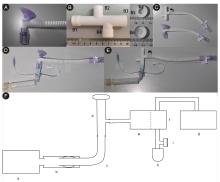
图1
实验研究中所涉及的设备注:A,传统接口;B,新型接口(B1,呼气端;B2,吸气端;B3,患者端;B4,备用端;B5和B6,呼气阀);C,传统接口和新型接口的比较;D,传统接口-气切导管-模拟气道模型;E,新型接口-气切导管-模拟气道模型;F,模拟肺-模拟气道-气切导管-气管接口-高流量氧疗设备模型(a,模拟肺;b,模拟气道;c,气切导管;d,气管接口;e,高流量氧疗设备;f,加温湿化装置(湿化器);g,无创呼吸机;h,夹板模拟肺;i,平台阀)"
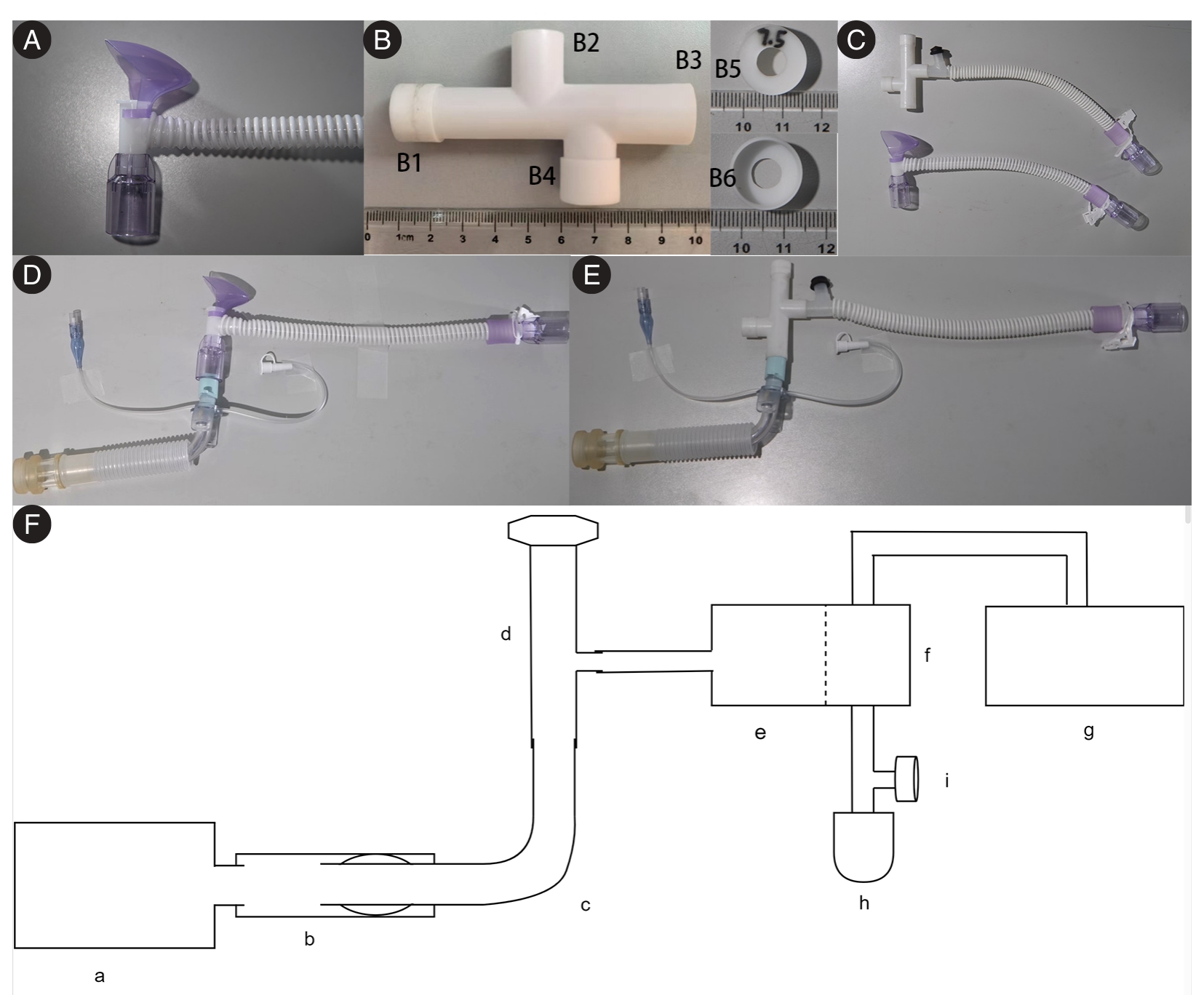
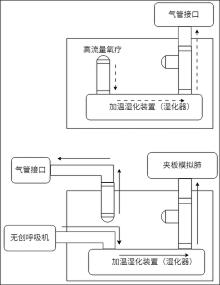
图2
未修改的高流量氧疗设备的气体流动路径的示意图(上)和本研究修改设置的气体流动路径的示意图(下)"
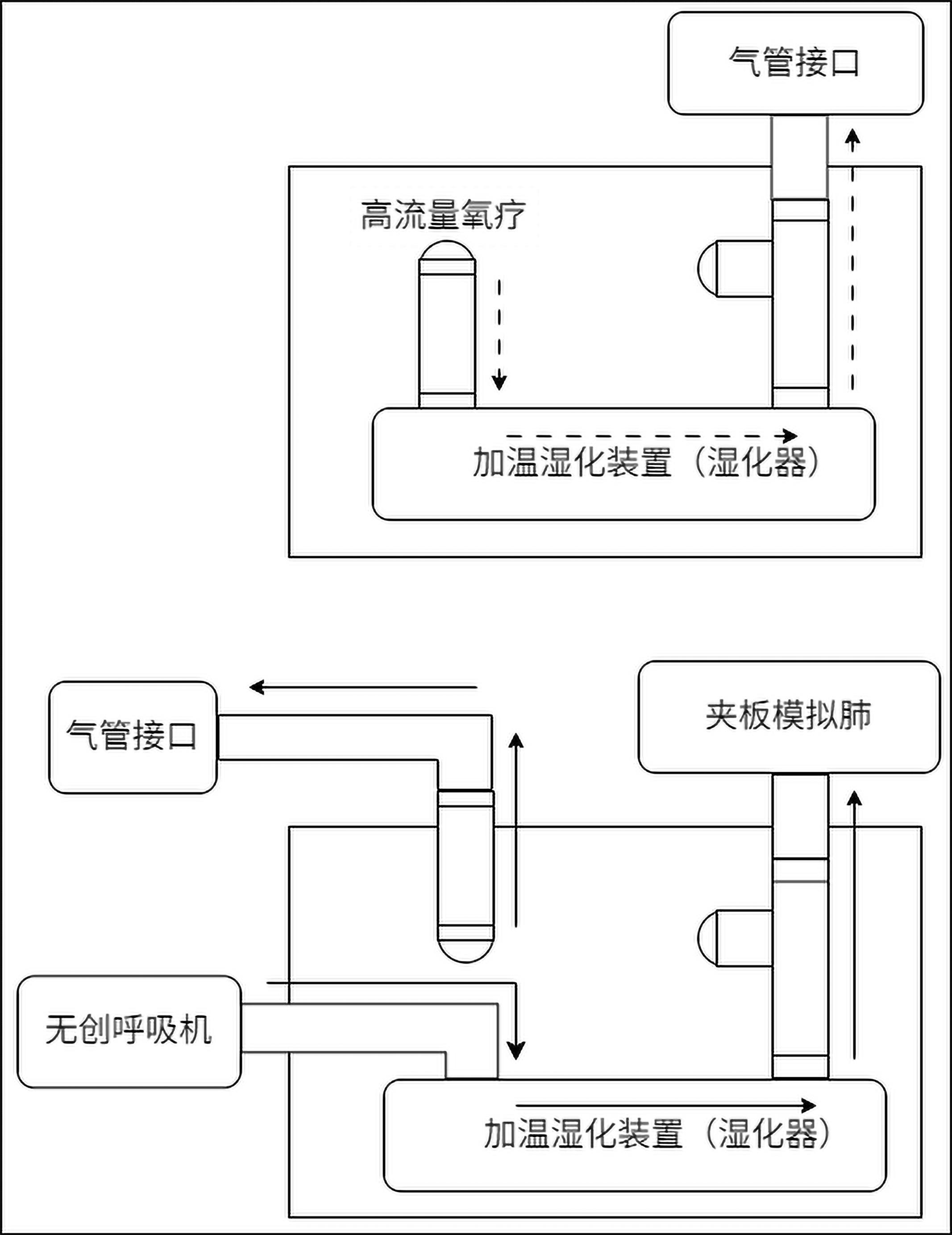

表1
实验研究中的主要和次要终点指标 (x ± s)"
| 参数 | 接口类型 | 气体流量/(L/min) | ||||||||
|---|---|---|---|---|---|---|---|---|---|---|
| 10 | 20 | 30 | 40 | 50 | 60 | 70 | 80 | P值※ | ||
| PEEP/cmH2O | 传统接口 | 0.4 ± 0.2 | 0.8 ± 0.2 | 1.6 ± 0.2 | 2.5 ± 0.3 | 3.2 ± 0.3 | 5.0 ± 0.3 | 6.1 ± 0.5 | 7.9 ± 0.6 | < 0.001 |
| 新型接口 | 0.5 ± 0.2 | 1.0 ± 0.3 | 2.5 ± 0.2 | 3.9 ± 0.5 | 5.1 ± 0.5 | 7.3 ± 0.5 | 10.1 ± 0.6 | 13.4 ± 0.6 | < 0.001 | |
| P值* | 0.605 | 0.233 | < 0.001 | < 0.001 | < 0.001 | < 0.001 | < 0.001 | < 0.001 | ||
| FRC/mL | 传统接口 | 1 502.8 ± 16.3 | 1 511.7 ± 16.6 | 1 522.4 ± 16.5 | 1 537.5 ± 11.6 | 1 553.4 ± 15.0 | 1 578.4 ± 19.3 | 1 604.3 ± 17.9 | 1 650.7 ± 19.3 | < 0.001 |
| 新型接口 | 1 509.7 ± 14.8 | 1 519.7 ± 19.9 | 1 534.6 ± 14.6 | 1 559.3 ± 13.4 | 1 588.5 ± 17.4 | 1 670.5 ± 17.4 | 1 781.6 ± 15.1 | 1 963.7 ± 13.2 | < 0.001 | |
| P值* | 0.335 | 0.337 | 0.096 | 0.001 | < 0.001 | < 0.001 | < 0.001 | < 0.001 | ||
| Vt/mL | 传统接口 | 235.7 ± 6.3 | 229.2 ± 6.9 | 221.3 ± 12.6 | 216.7 ± 16.8 | 212.6 ± 7.0 | 209.1 ± 24.5 | 208.2 ± 8.5 | 205.2 ± 7.8 | < 0.001 |
| 新型接口 | 239.3 ± 9.2 | 227.3 ± 10.2 | 216.0 ± 21.3 | 208.6 ± 10.7 | 198.6 ± 5.9 | 189.9 ± 10.4 | 182.9 ± 11.1 | 178.3 ± 14.9 | < 0.001 | |
| P值* | 0.323 | 0.623 | 0.514 | 0.218 | < 0.001 | 0.034 | < 0.001 | < 0.001 | ||
| Ptp-EI/cmH2O | 传统接口 | 8.1 ± 1.0 | 8.3 ± 1.1 | 8.6 ± 1.2 | 9.0 ± 0.9 | 9.3 ± 0.8 | 9.7 ± 0.4 | 10.2 ± 0.9 | 11.0 ± 0.6 | < 0.001 |
| 新型接口 | 8.3 ± 1.1 | 8.5 ± 1.1 | 9.4 ± 0.8 | 9.8 ± 0.9 | 10.1 ± 1.4 | 10.5 ± 0.9 | 11.9 ± 1.1 | 14.0 ± 0.8 | < 0.001 | |
| P值* | 0.680 | 0.695 | 0.110 | 0.078 | 0.130 | 0.031 | 0.001 | < 0.001 | ||
| Ptp-EE/cmH2O | 传统接口 | 0.0 ± 0.1 | 0.1 ± 0.1 | 0.6 ± 0.1 | 1.3 ± 0.2 | 2.2 ± 0.2 | 3.4 ± 0.3 | 4.9 ± 0.2 | 5.7 ± 0.3 | < 0.001 |
| 新型接口 | 0.1 ± 0.1 | 0.5 ± 0.1 | 1.4 ± 0.2 | 2.6 ± 0.2 | 4.1 ± 0.3 | 6.2 ± 0.2 | 7.3 ± 0.3 | 9.5 ± 0.3 | < 0.001 | |
| P值* | 0.003 | < 0.001 | < 0.001 | < 0.001 | < 0.001 | < 0.001 | < 0.001 | < 0.001 | ||
PIP/ cmH2O | 传统接口 | -3.5 ± 0.5 | -3.1 ± 0.4 | -3.0 ± 0.5 | -2.6 ± 0.5 | -2.3 ± 0.6 | -2.2 ± 0.7 | -1.9 ± 0.6 | -1.6 ± 0.4 | < 0.001 |
| 新型接口 | -3.6 ± 0.7 | -3.0 ± 0.4 | -2.5 ± 0.5 | -2.2 ± 0.6 | -1.9 ± 0.5 | -1.3 ± 0.5 | -0.9 ± 0.4 | -0.5 ± 0.4 | < 0.001 | |
| P值* | 0.710 | 0.497 | 0.063 | 0.128 | 0.154 | 0.003 | < 0.001 | < 0.001 | ||
| PEP/cmH2O | 传统接口 | 3.4 ± 0.8 | 3.9 ± 0.6 | 4.9 ± 0.5 | 5.3 ± 0.8 | 6.3 ± 0.5 | 7.5 ± 0.7 | 9.0 ± 0.4 | 10.2 ± 0.8 | < 0.001 |
| 新型接口 | 3.8 ± 0.5 | 4.9 ± 0.4 | 6.1 ± 0.4 | 7.5 ± 0.5 | 8.3 ± 0.4 | 10.4 ± 0.6 | 12.4 ± 0.5 | 14.8 ± 0.6 | < 0.001 | |
| P值* | 0.213 | 0.001 | < 0.001 | < 0.001 | < 0.001 | < 0.001 | < 0.001 | < 0.001 | ||
| PEIC/cmH2O | 传统接口 | -5.0 ± 0.1 | -4.9 ± 0.5 | -4.8 ± 0.3 | -4.8 ± 0.4 | -4.7 ± 0.5 | -4.7 ± 0.3 | -4.6 ± 0.3 | -4.2 ± 0.3 | < 0.001 |
| 新型接口 | -4.8 ± 0.3 | -4.7 ± 0.3 | -4.7 ± 0.4 | -4.6 ± 0.4 | -4.4 ± 0.3 | -4.0 ± 0.3 | -3.7 ± 0.3 | -2.6 ± 0.3 | < 0.001 | |
| P值* | 0.060 | 0.353 | 0.323 | 0.304 | 0.043 | < 0.001 | < 0.001 | < 0.001 | ||
| PEEC/cmH2O | 传统接口 | -0.1 ± 0.1 | -0.1 ± 0.1 | 0.0 ± 0.0 | 0.1 ± 0.1 | 0.2 ± 0.1 | 0.3 ± 0.1 | 0.5 ± 0.1 | 0.8 ± 0.1 | < 0.001 |
| 新型接口 | -0.1 ± 0.1 | 0.0 ± 0.2 | 0.1 ± 0.1 | 0.2 ± 0.1 | 0.4 ± 0.1 | 0.9 ± 0.1 | 1.5 ± 0.1 | 2.3 ± 0.1 | < 0.001 | |
| P值* | 0.809 | 0.308 | < 0.001 | 0.001 | < 0.001 | < 0.001 | < 0.001 | < 0.001 | ||
| FiO2/% | 传统接口 | 34.8 ± 1.1 | 37.7 ± 1.3 | 42.7 ± 1.7 | 45.0 ± 2.2 | 47.2 ± 1.7 | 47.8 ± 2.2 | 48.3 ± 2.5 | 48.2 ± 1.9 | < 0.001 |
| 新型接口 | 35.4 ± 1.2 | 38.7 ± 3.0 | 43.7 ± 2.1 | 46.2 ± 2.1 | 47.8 ± 2.4 | 48.1 ± 2.5 | 48.6 ± 2.1 | 49.0 ± 2.5 | < 0.001 | |
| P值* | 0.277 | 0.349 | 0.231 | 0.237 | 0.545 | 0.760 | 0.763 | 0.469 | ||
图3
不同气体流量下传统接口与新型接口的影响比较注:A,呼气末正压(PEEP);B,功能残气量(FRC);C,潮气量(Vt);D,吸气末跨肺压(Ptp-EI);E,呼气末跨肺压(Ptp-EE);F,吸气峰压(PIP);G,呼气峰压(PEP);H,吸气末心脏外压(PEIC);I,呼气末心脏外压(PEEC);J,吸氧浓度(FiO2)"
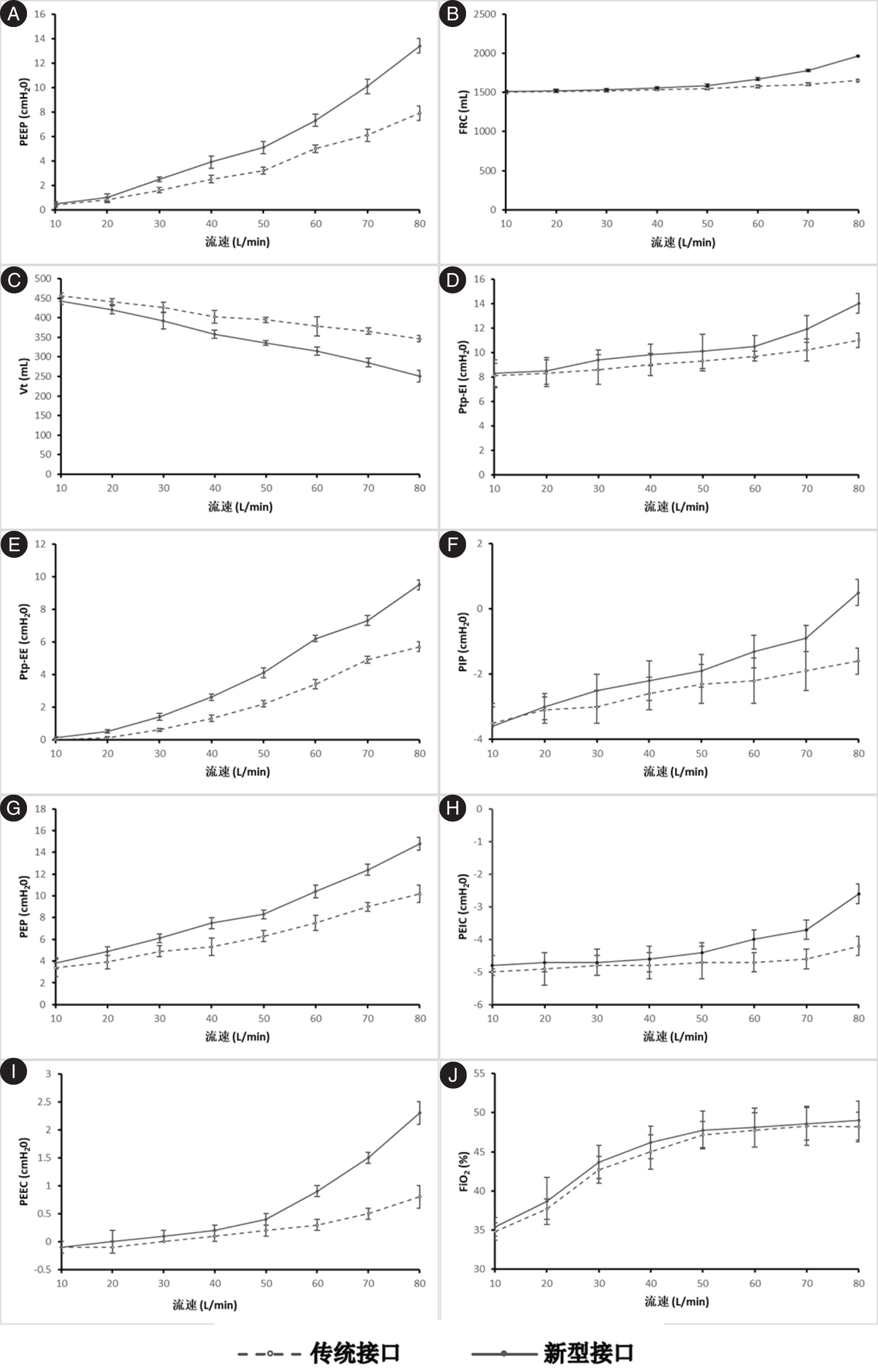
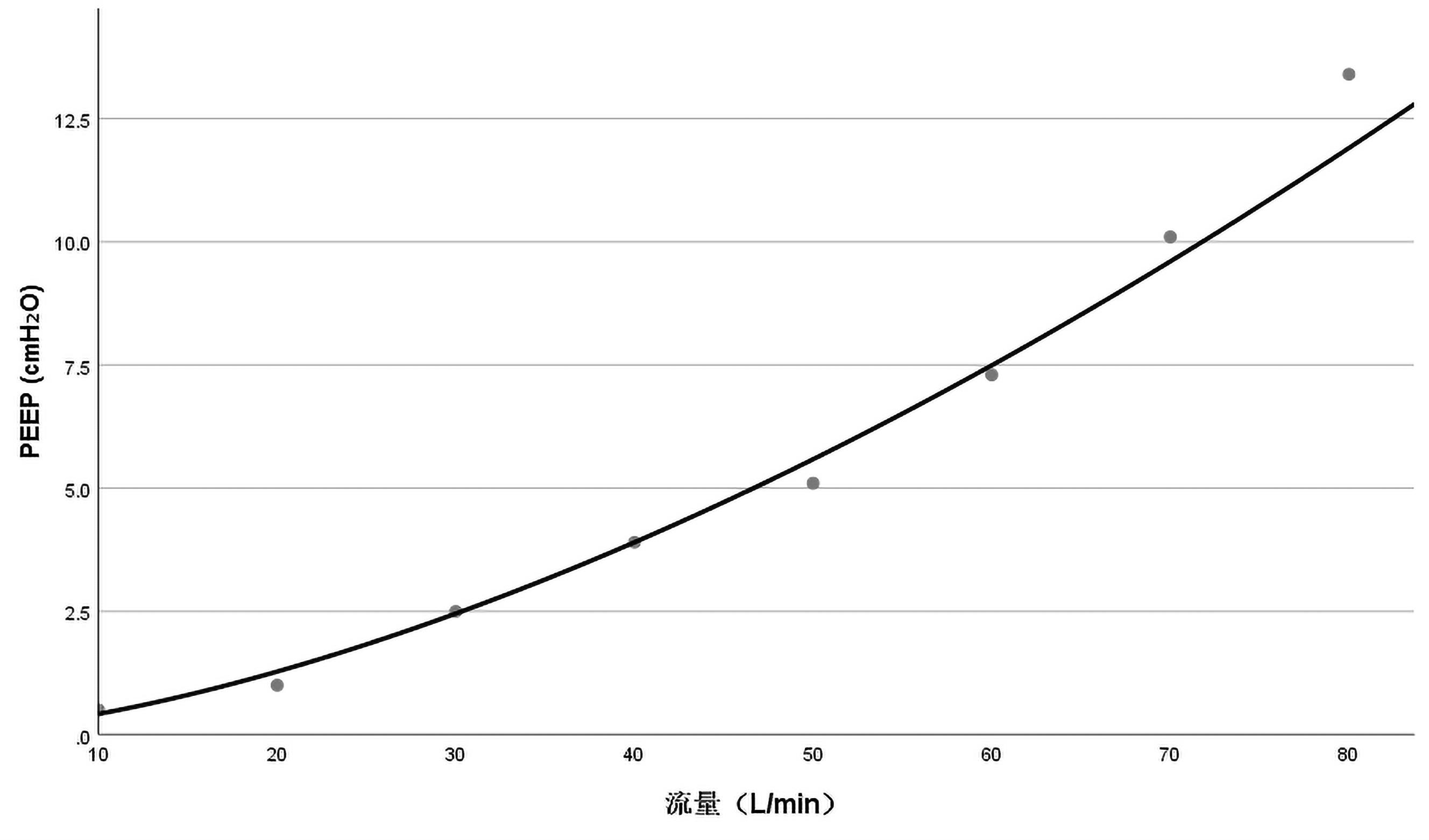
图4
新型接口期间PEEP与流量的关系"
| [1] |
GRASSELLI G, CALFEE C S, CAMPOROTA L, et al. ESICM guidelines on acute respiratory distress syndrome: Definition, phenotyping and respiratory support strategies[J]. Intensive Care Med, 2023, 49(7): 727-759. doi: 10.1007/s00134-023-07050-7 .
doi: 10.1007/s00134-023-07050-7 |
| [2] |
BELLANI G, PHAM T, LAFFEY J, et al. Incidence of Acute Respiratory Distress Syndrome-Reply[J]. JAMA, 2016, 316(3): 347. doi:10.1001/jama.2016.6471 .
doi: 10.1001/jama.2016.6471 |
| [3] |
ABE T, MADOTTO F, PHAM T, et al. Epidemiology and patterns of tracheostomy practice in patients with acute respiratory distress syndrome in ICUs across 50 countries[J]. Crit Care, 2018, 22(1): 195. doi: 10.1186/s13054-018-2126-6 .
doi: 10.1186/s13054-018-2126-6 |
| [4] |
AQUINO ESPERANZA J, PELOSI P, BLANCH L. What's new in intensive care: Tracheostomy-what is known and what remains to be determined[J]. Intensive Care Med, 2019, 45(11): 1619-1621. doi: 10.1007/s00134-019-05758-z .
doi: 10.1007/s00134-019-05758-z |
| [5] |
ESTEBAN A, FRUTOS-VIVAR F, MURIEL A, et al. Evolution of mortality over time in patients receiving mechanical ventilation[J]. Am J Respir Crit Care Med, 2013, 188(2): 220-230. doi: 10.1164/rccm.201212-2169OC .
doi: 10.1164/rccm.201212-2169OC |
| [6] |
PAPAZIAN L, CORLEY A, HESS D, et al. Use of high-flow nasal cannula oxygenation in ICU adults: A narrative review[J]. Intensive Care Med, 2016, 42(9): 1336-1349. doi: 10.1007/s00134-016-4277-8 .
doi: 10.1007/s00134-016-4277-8 |
| [7] |
SZTRYMF B, MESSIKA J, BERTRAND F, et al. Beneficial effects of humidified high flow nasal oxygen in critical care patients: A prospective pilot study[J]. Intensive Care Med, 2011, 37(11): 1780-1786. doi: 10.1007/s00134-011-2354-6 .
doi: 10.1007/s00134-011-2354-6 |
| [8] |
FRAT J P, THILLE A W, MERCAT A, et al. High-flow oxygen through nasal cannula in acute hypoxemic respiratory failure[J]. N Engl J Med, 2015, 372(23): 2185-2196. doi: 10.1056/NEJMoa1503326 .
doi: 10.1056/NEJMoa1503326 |
| [9] |
MESSIKA J, AHMED K BEN, GAUDRY S, et al. Use of High-Flow Nasal Cannula Oxygen Therapy in Subjects With ARDS: A 1-Year Observational Study[J]. Respir Care, 2015, 60(2): 162-169. doi: 10.4187/respcare.03423 .
doi: 10.4187/respcare.03423 |
| [10] |
NAGATA K, MORIMOTO T, FUJIMOTO D, et al. Efficacy of High-Flow Nasal Cannula Therapy in Acute Hypoxemic Respiratory Failure: Decreased Use of Mechanical Ventilation[J]. Respir Care, 2015, 60(10): 1390-1396. doi: 10.4187/respcare.04026 .
doi: 10.4187/respcare.04026 |
| [11] |
HERNÁNDEZ G, VAQUERO C, COLINAS L, et al. Effect of Postextubation High-Flow Nasal Cannula vs Noninvasive Ventilation on Reintubation and Postextubation Respiratory Failure in High-Risk Patients: A Randomized Clinical Trial[J]. JAMA, 2016, 316(15): 1565-1574. doi: 10.1001/jama.2016.14194 .
doi: 10.1001/jama.2016.14194 |
| [12] |
HERNáNDEZ G, VAQUERO C, GONZáLEZ P, et al. Effect of Postextubation High-Flow Nasal Cannula vs Conventional Oxygen Therapy on Reintubation in Low-Risk Patients: A Randomized Clinical Trial[J]. JAMA, 2016, 315(13): 1354-1361. doi: 10.1001/jama.2016.2711 .
doi: 10.1001/jama.2016.2711 |
| [13] |
徐鸿, 孙伟, 廖宗华, 等. 高流量氧疗湿化治疗仪联合还原型谷胱甘肽治疗慢性阻塞性肺疾病急性加重期患者的疗效[J]. 实用医学杂志, 2023, 39(5): 607-612. doi: 10.3969/j.issn.1006-5725.2023.05.014 .
doi: 10.3969/j.issn.1006-5725.2023.05.014 |
| [14] |
安莉, 熊晓苗, 李民晟,等. 经鼻高流量湿化氧疗与无创正压通气对高龄慢性阻塞性肺疾病急性加重合并轻中度高碳酸血症患者的疗效比较[J]. 实用医学杂志, 2025, 41(9): 1332-1338. doi: 10.3969/j.issn.1006-5725.2025.09.009 .
doi: 10.3969/j.issn.1006-5725.2025.09.009 |
| [15] |
STÉPHAN F. High-Flow Nasal Oxygen Therapy for Postextubation Acute Hypoxemic Respiratory Failure-Reply[J]. JAMA, 2015, 314(15): 1644-1645. doi: 10.1001/jama.2015.11438 .
doi: 10.1001/jama.2015.11438 |
| [16] |
GROVES N, TOBIN A. High flow nasal oxygen generates positive airway pressure in adult volunteers[J]. Aust Crit Care, 2007, 20(4): 126-131. doi: 10.1016/j.aucc.2007.08.001 .
doi: 10.1016/j.aucc.2007.08.001 |
| [17] |
CORLEY A, CARUANA L R, BARNETT A G, et al. Oxygen delivery through high-flow nasal cannulae increase end-expiratory lung volume and reduce respiratory rate in post-cardiac surgical patients[J]. Br J Anaesth, 2011, 107(6): 998-1004. doi: 10.1093/bja/aer265 .
doi: 10.1093/bja/aer265 |
| [18] |
PARKE R L, MCGUINNESS S P. Pressures delivered by nasal high flow oxygen during all phases of the respiratory cycle[J]. Respir Care, 2013, 58(10): 1621-1624. doi: 10.4187/respcare.02358 .
doi: 10.4187/respcare.02358 |
| [19] |
VILLALBA D S, MATESA A, BONI S, et al. Impact of High-Flow Nasal Cannula Oxygen Therapy on the Pressure of the Airway System in Humans[J]. Respir Care, 2024, 70(1): 10-16. doi: 10.4187/respcare.12082 .
doi: 10.4187/respcare.12082 |
| [20] |
MITAKA C, ODOH M, SATOH D, et al. High-flow oxygen via tracheostomy facilitates weaning from prolonged mechanical ventilation in patients with restrictive pulmonary dysfunction: Two case reports[J]. J Med Case Rep, 2018, 12(1): 292. doi: 10.1186/s13256-018-1832-7 .
doi: 10.1186/s13256-018-1832-7 |
| [21] |
LIONELLO F, GUARNIERI G, ARCARO G, et al. High-Flow Tracheal Oxygen for Tracheostomy Tube Removal in Lung Transplant Recipients[J]. J Clin Med, 2023, 12(24): 7566. doi: 10.3390/jcm12247566 .
doi: 10.3390/jcm12247566 |
| [22] |
LYTRA E, KOKKORIS S, POULARAS I, et al. The effect of high-flow oxygen via tracheostomy on respiratory pattern and diaphragmatic function in patients with prolonged mechanical ventilation: A randomized, physiological, crossover study[J]. J Intensive Med, 2024, 4(2): 202-208. doi: 10.1016/j.jointm.2023.11.008 .
doi: 10.1016/j.jointm.2023.11.008 |
| [23] |
MOORHOUSE J, ALI T, MOORHOUSE T, et al. Poorly placed tracheostomy tubes: Effects on flow and resistance[J]. J Intensive Care Soc, 2015, 16(4): 282-286. doi: 10.1177/1751143715582040 .
doi: 10.1177/1751143715582040 |
| [24] |
CHEN G Q, SUN X M, WANG Y M, et al. Additional Expiratory Resistance Elevates Airway Pressure and Lung Volume during High-Flow Tracheal Oxygen via Tracheostomy[J]. Sci Rep, 2019, 9(1): 14542. doi: 10.1038/s41598-019-51158-0 .
doi: 10.1038/s41598-019-51158-0 |
| [25] |
NATALINI D, GRIECO D L, SANTANTONIO M T, et al. Physiological effects of high-flow oxygen in tracheostomized patients[J]. Ann Intensive Care, 2019, 9(1): 114. doi: 10.1186/s13613-019-0591-y .
doi: 10.1186/s13613-019-0591-y |
| [26] |
HOU A, MI S, JIAO F, et al. Design and simulation-based evaluation of a novel tracheostomy high-flow therapy device interface: A preclinical study[J]. PeerJ, 2025, 13: e20445. doi: 10.7717/peerj.20445 .
doi: 10.7717/peerj.20445 |
| [27] |
PARKE R, MCGUINNESS S, ECCLESTON M. Nasal high-flow therapy delivers low level positive airway pressure[J]. Br J Anaesth, 2009, 103(6): 886-890. doi: 10.1093/bja/aep280 .
doi: 10.1093/bja/aep280 |
| [28] |
PARKE R L, ECCLESTON M L, MCGUINNESS S P. The effects of flow on airway pressure during nasal high-flow oxygen therapy[J]. Respir Care, 2011, 56(8): 1151-1155. doi: 10.4187/respcare.01106 .
doi: 10.4187/respcare.01106 |
| [29] |
ASHBAUGH D G, BIGELOW D B, PETTY T L, et al. Acute respiratory distress in adults[J]. Lancet, 1967, 2(7511): 319-323. doi: 10.1016/s0140-6736(67)90168-7 .
doi: 10.1016/s0140-6736(67)90168-7 |
| [30] |
THOMAS M, JOSHI R, CAVE G. How Much PEEP Does High Flow Deliver via Tracheostomy? A Literature Review and Benchtop Experiment[J]. Crit Care Res Pract, 2021, 2021: 6036891. doi: 10.1155/2021/6036891 .
doi: 10.1155/2021/6036891 |
| [31] |
KUMAR H, SPENCE C J, TAWHAI M H. Modeling the pharyngeal pressure during adult nasal high flow therapy[J]. Respir Physiol Neurobiol, 2015, 219: 51-57. doi: 10.1016/j.resp.2015.06.011 .
doi: 10.1016/j.resp.2015.06.011 |
| [32] |
LUO J C, LU M S, ZHAO Z H, et al. Positive End-Expiratory Pressure Effect of 3 High-Flow Nasal Cannula Devices[J]. Respir Care, 2017, 62(7): 888-895. doi: 10.4187/respcare.05337 .
doi: 10.4187/respcare.05337 |
| [33] |
MATTHAY M A, ZEMANS R L, ZIMMERMAN G A, et al. Acute respiratory distress syndrome[J]. Nat Rev Dis Primers, 2019, 5(1): 18. doi: 10.1038/s41572-019-0069-0 .
doi: 10.1038/s41572-019-0069-0 |
| [34] |
MERTENS M, TABUCHI A, MEISSNER S, et al. Alveolar dynamics in acute lung injury: Heterogeneous distension rather than cyclic opening and collapse[J]. Crit Care Med, 2009, 37(9): 2604-2611. doi: 10.1097/CCM.0b013e3181a5544d .
doi: 10.1097/CCM.0b013e3181a5544d |
| [35] |
CRESSONI M, CADRINGHER P, CHIURAZZI C, et al. Lung inhomogeneity in patients with acute respiratory distress syndrome[J]. Am J Respir Crit Care Med, 2014, 189(2): 149-158. doi: 10.1164/rccm.201308-1567OC .
doi: 10.1164/rccm.201308-1567OC |
| [36] |
LEITH D E, BROWN R. Human lung volumes and the mechanisms that set them[J]. Eur Respir J, 1999, 13(2): 468-472. doi: 10.1183/09031936.99.13246899 .
doi: 10.1183/09031936.99.13246899 |
| [37] |
RAHN H, OTIS A B, ET A. The pressure-volume diagram of the thorax and lung[J]. Am J Physiol, 1946, 146(2): 161-178. doi: 10.1152/ajplegacy.1946.146.2.161 .
doi: 10.1152/ajplegacy.1946.146.2.161 |
| [38] |
YOSHIDA T, FUJINO Y, AMATO M B, et al. Fifty Years of Research in ARDS. Spontaneous Breathing during Mechanical Ventilation. Risks, Mechanisms, and Management[J]. Am J Respir Crit Care Med, 2017, 195(8): 985-992. doi: 10.1164/rccm.201604-0748CP .
doi: 10.1164/rccm.201604-0748CP |
| [39] |
MAURI T, ALBAN L, TURRINI C, et al. Optimum support by high-flow nasal cannula in acute hypoxemic respiratory failure: Effects of increasing flow rates[J]. Intensive Care Med, 2017, 43(10): 1453-1463. doi: 10.1007/s00134-017-4890-1 .
doi: 10.1007/s00134-017-4890-1 |
| [40] |
RAMACHANDRAN L, JHA O K, SIRCAR M. High-flow Tracheal Oxygenation: A New Tool for Difficult Weaning[J]. Indian J Crit Care Med, 2021, 25(2): 224-227. doi: 10.5005/jp-journals-10071-23724 .
doi: 10.5005/jp-journals-10071-23724 |
| [41] |
VADI S, PHADTARE S, SHETTY K. High-flow Oxygen Therapy via Tracheostomy to Liberate COVID-19-induced ARDS from Invasive Ventilation: A Case Series[J]. Indian J Crit Care Med, 2021, 25(6): 724-728. doi: 10.5005/jp-journals-10071-23858 .
doi: 10.5005/jp-journals-10071-23858 |
| [42] |
HERNÁNDEZ MARTÍNEZ G, RODRIGUEZ M L, VAQUERO M C, et al. High-Flow Oxygen with Capping or Suctioning for Tracheostomy Decannulation[J]. N Engl J Med, 2020, 383(11): 1009-1017. doi: 10.1056/NEJMoa2010834 .
doi: 10.1056/NEJMoa2010834 |
| [43] |
CORLEY A, EDWARDS M, SPOONER A J, et al. High-flow oxygen via tracheostomy improves oxygenation in patients weaning from mechanical ventilation: A randomised crossover study[J]. Intensive Care Med, 2017, 43(3): 465-467. doi: 10.1007/s00134-016-4634-7 .
doi: 10.1007/s00134-016-4634-7 |
| [1] | 吕建磊,刘敏,戴瑶,黄康. 床旁胸部CT指导的个性化呼气末正压策略对中重度急性呼吸窘迫综合征的效果[J]. 实用医学杂志, 2025, 41(24): 3867-3874. |
| [2] | 邓默,贾米山,田彦卿,郑志清,王辉,韩娜. sTREM-1、PCT与MRP8/14对重症肺结核患者急性呼吸窘迫综合征的时序预测价值[J]. 实用医学杂志, 2025, 41(22): 3552-3557. |
| [3] | 朱浩文,徐仕杰,刘冉,洪新华,薛宜婷,田文泽,苏珍. 驱动压导向的两种个体化呼气末正压滴定方法对食管癌根治术患者术中呼吸功能的影响[J]. 实用医学杂志, 2025, 41(14): 2217-2223. |
| [4] | 杨波,金肇权. 西维来司他钠联合乌司他丁治疗脓毒症所致急性呼吸窘迫综合征的临床疗效[J]. 实用医学杂志, 2024, 40(5): 621-626. |
| [5] | 王敬才,郭春艳,杨丽昕,敬小青. 血清RAGE、HMGB1水平与重症肺炎急性呼吸窘迫综合征发病及IFN⁃γ/IL⁃4变化的关系[J]. 实用医学杂志, 2024, 40(4): 515-520. |
| [6] | 李爱琴,张震,徐雅楠,朱金源,张旭. 急性呼吸窘迫综合征肺纤维化中巨噬细胞和成纤维细胞相互作用的研究进展[J]. 实用医学杂志, 2024, 40(4): 571-574. |
| [7] | 黄伟坚,李洋,王海彦,刘晶,罗辉,胡祖荣. 基于驱动压的肺保护性通气策略在婴儿单肺通气中的应用效果[J]. 实用医学杂志, 2024, 40(3): 360-364. |
| [8] | 周峰,尹其翔,魏法星,林海敏,蔡华忠,陈义坤. 血清水通道蛋白1水平联合血管外肺水指数对脓毒症致急性呼吸窘迫综合征的价值[J]. 实用医学杂志, 2024, 40(17): 2483-2488. |
| [9] | 侯勇哲, 张琴 赵霄晨 何苗 鱼玲玲, 白海 吴涛 . 间充质干细胞来源的胞外囊泡在急性肺损伤治疗中的研究进展 [J]. 实用医学杂志, 2023, 39(3): 390-394. |
| [10] | 刘颖,陈先俊,肖川,袁佳,李清,李璐,杨金凤,沈锋. LPAR1基因对脂多糖刺激下Ⅱ型肺泡上皮细胞中组织因子和纤溶酶原激活物抑制剂1表达的影响[J]. 实用医学杂志, 2023, 39(18): 2323-2329. |
| [11] | 辛超 高巨 葛亚丽 吴可汀 陈小萍 . 驱动压导向个体化呼气末正压对机器人辅助 前列腺癌根治术老年患者术中脑血流及局部脑氧饱和度的影响 [J]. 实用医学杂志, 2023, 39(12): 1524-1528. |
| [12] | 李清 古家润 肖川 沈锋 刘颖 李璐 何娟 李伟 李书文 刘博 陈先俊 . 姜辣素对脂多糖诱导的大鼠急性呼吸窘迫综合征肺泡过度促凝及纤溶抑制的防治作用 [J]. 实用医学杂志, 2023, 39(10): 1218-1223. |
| [13] | 周先贵 蒋艳 韩梅 郑杰 覃松. miR21⁃5p靶向转录激活蛋白STAT3减轻 高氧性急性肺损伤 [J]. 实用医学杂志, 2023, 39(1): 21-27. |
| [14] | 郑兴昊, 李清 沈锋 杨贵霞 李想 肖川 . 大黄素对脂多糖刺激下肺泡Ⅱ型上皮细胞表达促凝及纤溶抑制因子的调节作用 [J]. 实用医学杂志, 2022, 38(24): 3032-3036. |
| [15] | 李金兰 张丽中 樊柳汝 李筱妍 . 血管生成素-2及可溶性糖基化终末产物受体在脓毒症相关急性呼吸窘迫综合征发病中的作用 [J]. 实用医学杂志, 2022, 38(24): 3095-3105. |
| 阅读次数 | ||||||
|
全文 |
|
|||||
|
摘要 |
|
|||||
