实用医学杂志 ›› 2025, Vol. 41 ›› Issue (22): 3552-3557.doi: 10.3969/j.issn.1006-5725.2025.22.012

• 临床研究 • 上一篇    

sTREM-1、PCT与MRP8/14对重症肺结核患者急性呼吸窘迫综合征的时序预测价值

邓默,贾米山,田彦卿,郑志清,王辉,韩娜()   

  1. 河北大学附属医院结核科 (河北 保定 071000 )
  • 收稿日期:2025-08-12 出版日期:2025-11-25 发布日期:2025-11-26
  • 通讯作者: 韩娜 E-mail:29210526@qq.com
  • 基金资助:
    河北省医学科学研究课题计划(20231506)

Temporal predictive value of sTREM⁃1, PCT, and MRP8/14 for ARDS in severe pulmonary tuberculosis patients

Mo DENG,Mishan JIA,Yanqing TIAN,Zhiqing ZHENG,Hui WANG,Na. HAN()   

  1. Department of Tuberculosis,Affiliated Hospital of Hebei University,Baoding 071000,Hebei,China
  • Received:2025-08-12 Online:2025-11-25 Published:2025-11-26
  • Contact: Na. HAN E-mail:29210526@qq.com

摘要:

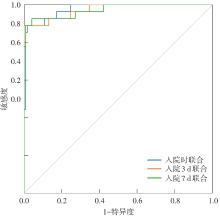
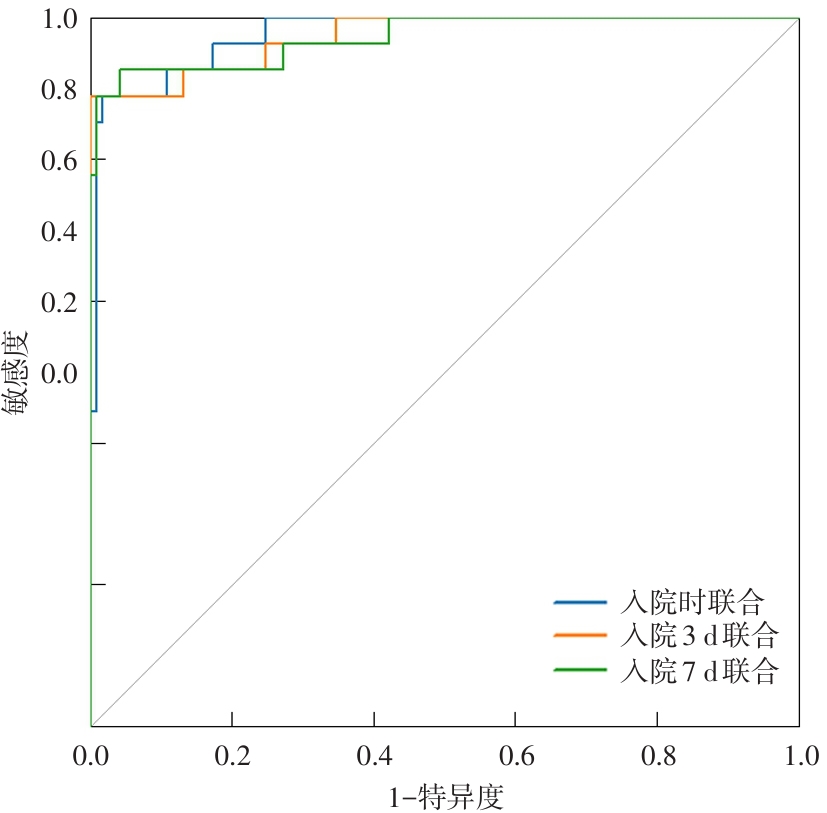
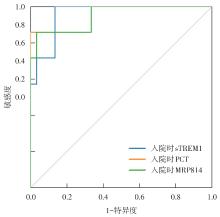
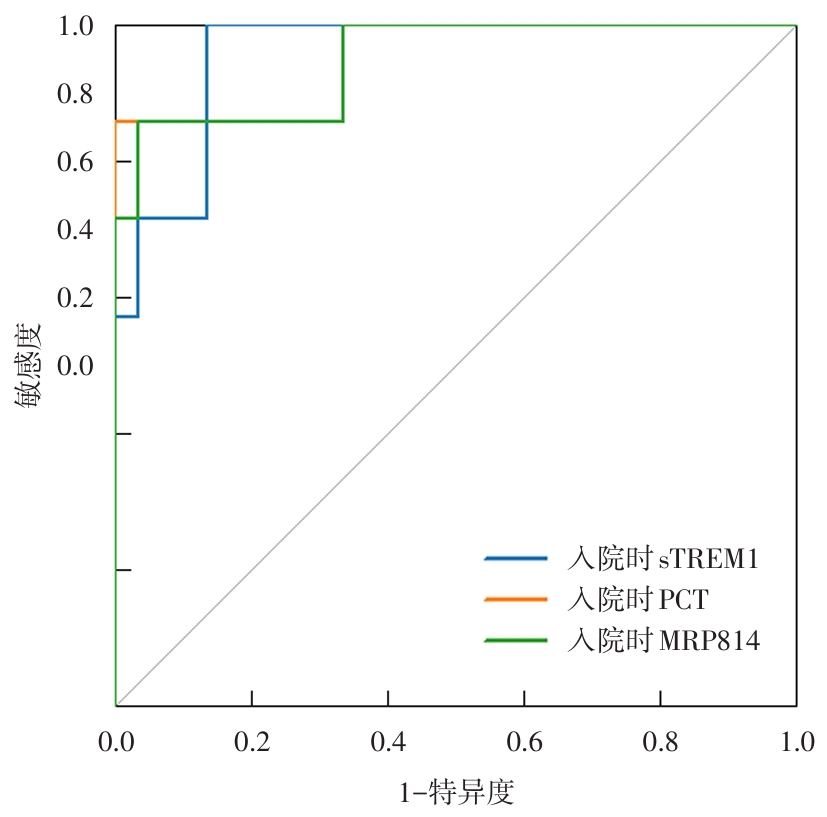
目的 探讨可溶性髓样细胞触发受体-1(sTREM-1)、降钙素原(PCT)与髓系相关蛋白8/14(MRP8/14)对重症肺结核患者继发急性呼吸窘迫综合征(ARDS)的时序预测价值。 方法 采用回顾性队列研究设计,选取2021年1月至2024年12月医院收治的重症肺结核患者作为研究对象,按8∶2的比例将患者随机分为训练集(148例)和验证集(37例)。通过电子病历系统提取患者入院时、入院3 d、入院7 d的sTREM-1、PCT及MRP8/14检测数据,采用多因素logistic回归分析危险因素,并通过ROC曲线评估预测效能。 结果 最终纳入185例重症肺结核患者,其中训练集148例患者中,继发ARDS者27例,未继发ARDS者121例;验证集37例患者中,继发ARDS者7例,未继发ARDS者30例。训练集的两组患者血清sTREM-1、PCT及MRP8/14水平随时间呈现显著变化(P < 0.05)。入院时、入院3 d、入院7 d ARDS组血清sTREM-1、PCT、MRP8/14水平均高于非ARDS组(P < 0.05)。入院时、入院3 d、入院7 d的血清sTREM-1、PCT、MRP8/14水平均是重症肺结核患者继发ARDS的危险因素(P < 0.05)。训练集ROC曲线结果显示,出入院时sTREM-1、PCT水平及MRP8/14联合预测的曲线下面积(AUC)最大为0.976,95%CI为0.952 ~ 1.000,灵敏度为88.9%,特异度为98.3%。验证集ROC曲线结果显示,出入院时sTREM-1、PCT水平及MRP8/14联合预测的AUC最大为0.957,95%CI为0.895 ~ 1.000,灵敏度为100.0%,特异度为86.7%。 结论 sTREM-1、PCT与MRP8/14的水平变化对重症肺结核患者ARDS发生具有时序预测价值,联合检测可提高预警准确性。

关键词: 重症肺结核, 急性呼吸窘迫综合征, 可溶性髓样细胞触发受体-1, 降钙素原, 髓系相关蛋白8/14, 预测

Abstract:

Objective To investigate the temporal predictive value of soluble triggering receptor expressed on myeloid cells-1 (sTREM-1), procalcitonin (PCT), and myeloid-related protein 8/14 (MRP8/14) for secondary acute respiratory distress syndrome (ARDS) in patients with severe pulmonary tuberculosis. Methods A retrospective cohort study was conducted among patients with severe pulmonary tuberculosis admitted between January 2021 and December 2024. Patients were randomly assigned in an 8∶2 ratio to a training set (n = 148) and a validation set (n = 37). Serum sTREM-1, PCT, and MRP8/14 were extracted from the electronic medical record at three time points: on admission (day 0), day 3, and day 7. Multivariable logistic regression was used to identify risk factors, and predictive performance was evaluated using receiver operating characteristic (ROC) curves. Results A total of 185 patients were included. In the training set (n = 148), 27 developed ARDS and 121 did not; in the validation set (n = 37), 7 developed ARDS and 30 did not. In the training set, serum sTREM-1, PCT, and MRP8/14 levels showed significant temporal changes (P < 0.05). At admission, day 3, and day 7, levels of sTREM-1, PCT, and MRP8/14 were higher in the ARDS group than in the non-ARDS group (all P < 0.05). At each time point, sTREM-1, PCT, and MRP8/14 were independently associated with the development of ARDS (P < 0.05). In the training set, the combination of sTREM-1, PCT, and MRP8/14 at admission yielded the largest area under the ROC curve [AUC = 0.976; 95% confidence interval (CI), 0.952 ~ 1.000], with a sensitivity of 88.9% and a specificity of 98.3%. In the validation set, the same combination achieved an AUC of 0.957 (95% CI, 0.895 ~ 1.000), with a sensitivity of 100.0% and a specificity of 86.7%. Conclusion Dynamic changes in sTREM-1, PCT, and MRP8/14 provide temporal predictive value for ARDS in patients with severe pulmonary tuberculosis, and the combined assessment improves early warning accuracy.

Key words: severe pulmonary tuberculosis, acute respiratory distress syndrome, sTREM-1, procalcitonin, MRP8/14, prediction

中图分类号: