实用医学杂志 ›› 2026, Vol. 42 ›› Issue (12): 2105-2111.doi: 10.3969/j.issn.1006-5725.2026.12.003

• 围术期管理与重症支持专栏 • 上一篇    

数字智能化诊疗技术联合护士全程参与辅助决策在肝胆外科四级手术术前医患沟通中的应用效果

李双华1,麦锦胜1,刘军1,2,3,4,耿艳云1,徐冬婷1,纪晓屏1,白小平1,曾宁1,2,3,4()   

  1. 1.南方医科大学珠江医院,普通外科中心肝胆一科,(广东 广州 510280 )
    4.南方医科大学珠江医院,数字智能化微创外科研究所,(广东 广州 510280 )
    2.广东省数字医学临床工程技术研究中心 (广东 广州 510280 )
    3.微创器械创新及应用国家工程研究中心-华南研究院 (广东 广州 510280 )
  • 收稿日期:2026-02-13 出版日期:2026-06-25 发布日期:2026-06-30
  • 通讯作者: 曾宁 E-mail:chen_ning16@foxmail.com
  • 基金资助:
    广东省医学科学技术研究基金项目(A2019086);广东省科技计划项目(2016ZC0082);广东省临床教学基地本科教学改革研究项目(2021JD140);南方医科大学珠江医院院长基金项目(yzjj2025ms06)

The application effect of digital intelligent diagnosis and treatment technology combined with nurses′ full participation in assisting decision-making in preoperative doctor-patient communication for grade surgery in hepatobiliary surgery

Shuanghua LI1,Jinsheng MAI1,Jun LIU1,2,3,4,Yanyun GENG1,Dongting XU1,Xiaoping JI1,Xiaoping BAI1,Ning ZENG1,2,3,4()   

  1. 1.Department of Hepatobiliary Surgery,General Surgery Center,Zhujiang Hospital,Southern Medical University,Guangzhou 510280,Guangdong,China
    4.Guangdong Provincial Clinical Engineering Technology Research Center for Digital Medicine,Guangzhou 510280,Guangdong,China
    2.National Engineering Research Center for Minimally Invasive Device Innovation and Application?South China Research Institute,Guangzhou 510280,Guangdong,China
    3.Institute of Digital Intelligent Minimally Invasive Surgery,Zhujiang Hospital,Southern Medical University,Guangzhou 510280,Guangdong,China
  • Received:2026-02-13 Online:2026-06-25 Published:2026-06-30
  • Contact: Ning ZENG E-mail:chen_ning16@foxmail.com

摘要:

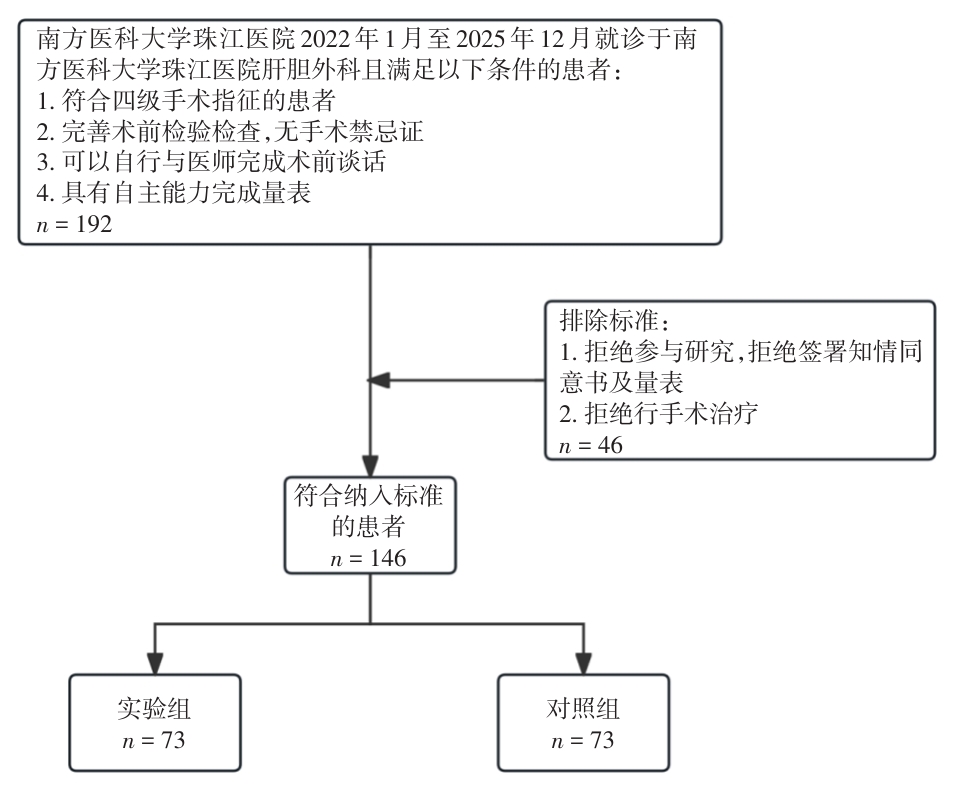
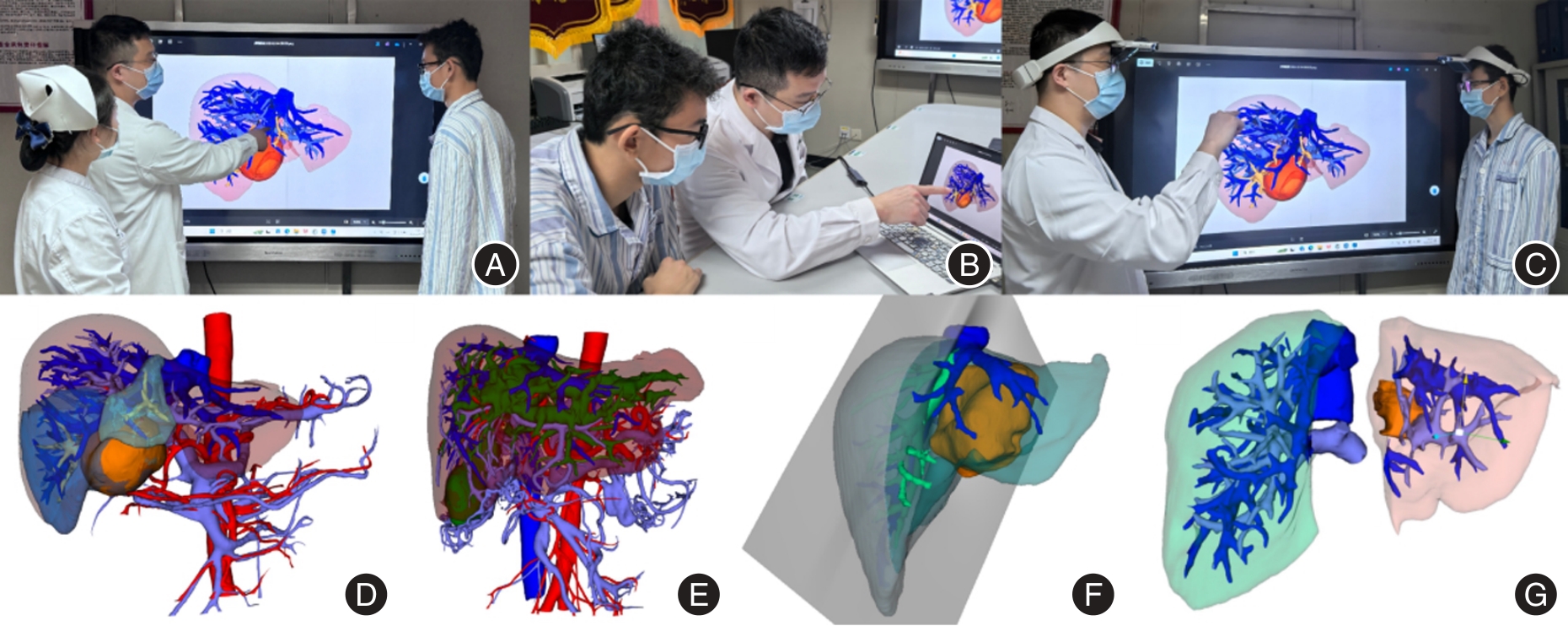
目的 探讨数字智能化诊疗技术联合护士全程参与辅助决策在肝胆外科四级手术术前医患沟通中的应用效果,并分析性别、受教育程度对患者术前焦虑及沟通满意度的影响,明确沟通方式与术前焦虑的相关性及独立影响因素。 方法 本研究采用回顾性队列研究,2022年1月至2025年12月期间一共纳入146例符合条件的患者并分为数智化组与传统组。在数智化组,护士全程辅助患者手术决策,研究团队将患者术前带入设有数智化三维模型海报科普介绍、患教工具及显示屏的谈话间,结合依据患者影像学数据制作的个体化三维模型进行术前谈话,在模型上展示手术方案及流程;传统组则仅采用常规术前谈话方式。两组患者填写焦虑自评量表(Self-Rating Anxiety Scale,SAS)对其术前焦虑状态进行评估;填写自制沟通效果问卷评价沟通效果与谈话满意度。并按性别、受教育程度进行亚组分析,采用Spearman相关分析沟通指标与焦虑的相关性,二元 logistic 回归分析术前焦虑的独立影响因素。 结果 数智化组患者术前SAS评分37.5(32.5,43.8)显著低于传统组SAS评分51.3(50.0,53.8),差异有统计学意义(P < 0.001);数智化组患者在沟通效果评分13.0(12.0,15.0) 显著高于传统组12.0(12.0,13.0),差异有统计学意义(P < 0.001)。性别、受教育程度亚组分析显示干预效果均差异无统计学意义(P > 0.05);沟通指标与SAS评分呈负相关,沟通方式是术前焦虑的独立影响因素(OR = 33.261,P < 0.001)。性别、受教育程度亚组分析结果显示均差异无统计学意义。 结论 将数字智能化技术联合护士全程参与辅助决策融入肝胆外科四级手术术前沟通流程,可降低患者术前焦虑水平,提升医患沟通质量与患者参与决策的效能。

关键词: 数字智能化, 肝胆外科, 四级手术, 医患沟通

Abstract:

Objective To explore the application effect of digital intelligent diagnosis and treatment technology combined with nurses' full participation in assisting decision-making in preoperative patient-physician communication for grade Ⅳ hepatobiliary surgery, and to analyze the influence of gender and education level on patients' preoperative anxiety and satisfaction with communication, and to clarify the correlation between communication methods and preoperative anxiety as well as independent influencing factors. Methods This study employed a retrospective cohort design. From January 2022 to December 2025, a total of 146 eligible patients were enrolled and divided into a digital intelligent group and a traditional group. In the digital intelligent group, nurses assisted patients in surgical decision-making throughout the process. The research team brought patients into a conversation room equipped with digital intelligent three-dimensional model posters for popular science introduction, patient education tools, and displays, and conducted preoperative conversations based on individualized three-dimensional models made from patients' imaging data, showing surgical plans and procedures on the models. The traditional group only received conventional preoperative conversations. Both groups of patients filled out the Self-Rating Anxiety Scale (SAS) to assess their preoperative anxiety status; they also filled out a self-designed communication effectiveness questionnaire to evaluate communication effectiveness and satisfaction with the conversation. Subgroup analyses were conducted based on gender and education level, and Spearman correlation analysis was used to analyze the correlation between communication indicators and anxiety, while binary logistic regression analysis was used to identify independent influencing factors of preoperative anxiety. Results The preoperative SAS score of patients in the digital intelligent group was 37.5 (32.5, 43.8), significantly lower than that of the traditional group (51.3, 50.0, 53.8), with a statistically significant difference (P < 0.001). The communication effectiveness score of patients in the digital intelligent group was 13.0 (12.0, 15.0), significantly higher than that of the traditional group (12.0, 12.0, 13.0), with a statistically significant difference (P < 0.001). Subgroup analyses based on gender and education level showed no statistically significant differences in intervention effects (P > 0.05); communication indicators were negatively correlated with SAS scores, and communication methods were an independent influencing factor for preoperative anxiety (OR = 33.261, P < 0.001). Subgroup analyses based on gender and education level also showed no statistically significant differences. Conclusion Integrating digital intelligent technology with nurses' full participation in assisting decision-making into the preoperative communication process for grade Ⅳ hepatobiliary surgery can reduce patients' preoperative anxiety levels, improve the quality of doctor-patient communication, and enhance patients' participation in decision-making.

Key words: digital intelligence, hepatobiliary surgery, grade Ⅳ surgery, doctor-patient communication

中图分类号: