

The Journal of Practical Medicine ›› 2026, Vol. 42 ›› Issue (9): 1561-1569.doi: 10.3969/j.issn.1006-5725.2026.09.010
• Oncology: Diagnosis, Treatment and Prevention • Previous Articles
Yuting LI1,Qiaoli YIN2,Yuxiu ZHANG1,Nan LI3,Hao KONG1,2( )
)
Received:2026-01-03
Online:2026-05-10
Published:2026-04-29
Contact:
Hao KONG
E-mail:konghao@bjmu.edu.cn
CLC Number:
Yuting LI,Qiaoli YIN,Yuxiu ZHANG,Nan LI,Hao KONG. Comparative study on perioperative comprehensive management and hemodynamic stability in pheochromocytoma and paraganglioma[J]. The Journal of Practical Medicine, 2026, 42(9): 1561-1569.
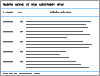
Tab.1
Baseline data"
| 指标 | PCC组(n = 535) | PGL组(n = 157) | χ2/Z值 | P值 |
|---|---|---|---|---|
| 人口学特征 | ||||
| 年龄/岁 | 49.0 (37.0,60.0) | 47.0 (35.0,59.0) | -0.932 | 0.351 |
| 女性/[例(%)] | 281 (52.5) | 90 (57.3) | 1.125 | 0.289 |
| BMI/(kg/m2) | 23.1 (21.1,25.5) | 23.7 (21.4,25.4) | -0.634 | 0.526 |
| 术前合并症/[例(%)] | ||||
| 糖尿病 | 105 (19.6) | 38 (24.2) | 1.551 | 0.213 |
| 冠心病 | 27 (5.0) | 11 (7.0) | 0.898 | 0.343 |
| 脑卒中 | 22 (4.1) | 7 (4.5) | 0.036 | 0.849 |
| 慢性肾脏病 | 6 (1.1) | 2 (1.3) | 0.025 | > 0.999 |
| ASA分级/[例(%)] | -2.328 | 0.020 | ||
| I级 | 18 (3.4) | 2 (1.3) | ||
| Ⅱ级 | 302 (51.6) | 78 (49.7) | ||
| Ⅲ级 | 208 (38.9) | 71 (45.2) | ||
| Ⅳ级 | 7 (1.3) | 6 (3.8) | ||
| 疾病特征 | ||||
| 症状/[例(%)] | 1.046 | 0.306 | ||
| 典型或部分三联征症状a | 277 (51.8) | 74 (47.1) | ||
| 无三联征症状 | 258 (48.2) | 83 (52.9) | ||
| α受体阻滞剂使用前最高SBP/mmHg | 166 (136,190) | 173 (150,200) | -2.349 | 0.019 |
| α受体阻滞剂使用前最高DBP/mmHg | 100 (81,110) | 100 (89,120) | -2.274 | 0.023 |
| 肿瘤最大径/cm | 4.7 (3.5,6.0) | 5.5 (4.2,7.6) | -3.867 | < 0.001 |
| 儿茶酚胺水平检测 | ||||
| 血浆甲氧基肾上腺素/(pmol/L) | 452 (152,2 470) | 170 (105,468) | -2.741 | 0.006 |
| 血浆甲氧基去甲肾上腺素/(pmol/L) | 4 350 (1 485,10 040) | 4 830 (1 375,12 597) | -0.642 | 0.521 |
| 血浆肾上腺素/(pmol/mL) | 0.60 (0.16,1.46) | 0.43 (0.09,1.01) | -1.625 | 0.104 |
| 血浆去甲肾上腺素/(pmol/mL) | 6.96 (2.53,34.72) | 17.35 (4.86,63.69) | -2.009 | 0.044 |
| 尿去甲肾上腺素/(μg/24 h) | 199.7 (77.7,430.3) | 391.6 (130.7,526.4) | -1.398 | 0.162 |
| 尿肾上腺素/(μg/24 h) | 20.1 (3.0,93.9) | 4.7 (3.2,22.2) | -1.294 | 0.196 |
| 术前准备 | ||||
| 服用α受体阻滞剂/[例(%)] | 507 (94.8) | 146 (93.0) | 0.717 | 0.397 |
| 酚苄明/[例(%)] | 307 (57.4) | 103 (65.6) | 3.398 | 0.065 |
| 每天最大剂量/mg | 30 (20,40) | 30 (20,40) | -0.320 | 0.749 |
| 多沙唑嗪/[例(%)] | 185 (34.6) | 41 (26.1) | 3.955 | 0.047 |
| 每天最大剂量/mg | 4 (4,4) | 4 (4,4) | -0.171 | 0.864 |
| 特拉唑嗪/[例(%)] | 15 (2.8) | 2 (1.3) | 1.186 | 0.721 |
| 每天最大剂量/mg | 2 (2,3) | 2 (2,3) | -0.555 | 0.579 |
| α受体阻滞剂使用时长/d | 25 (14,38) | 30 (17,55) | -2.429 | 0.015 |
| 使用β受体阻滞剂/[例(%)] | 120 (22.4) | 35 (22.3) | 0.001 | 0.971 |
| 使用钙通道阻滞剂/[例(%)] | 111 (20.7) | 37 (23.6) | 0.574 | 0.449 |
| 术前血流动力学参数b | ||||
| SBP/mmHg | 126 (115,137) | 129 (119,141) | -1.934 | 0.053 |
| DBP/mmHg | 77 (70,83) | 79 (72,86) | -2.143 | 0.032 |
| HR/(次/min) | 76 (71,80) | 76 (72,80) | -0.256 | 0.798 |
| 手术年份/[例(%)] | 3.504 | 0.320 | ||
| 2005—2009年 | 63 (11.8) | 22 (14.0) | ||
| 2010—2014年 | 108 (20.2) | 33 (21.0) | ||
| 2015—2019年 | 176 (32.9) | 59 (37.6) | ||
| 2020—2024年 | 188 (35.1) | 43 (27.4) |
Tab.2
Intraoperative data"
| 指标 | PCC组(n = 535) | PGL组(n = 157) | χ2/Z值 | P值 |
|---|---|---|---|---|
| 手术方式/[例(%)] | 74.525 | < 0.001 | ||
| 腹腔镜手术 | 375 (70.1) | 55 (34.0) | ||
| 机器人手术 | 36 (6.7) | 9 (5.7) | ||
| 开放手术 | 124 (23.2) | 93 (59.2) | ||
| 麻醉方式/[例(%)] | 8.944 | 0.011 | ||
| 全身麻醉 | 243 (45.2) | 60 (38.2) | ||
| 全身麻醉联合硬膜外麻醉 | 118 (22.1) | 53 (33.8) | ||
| 全身麻醉联合神经阻滞麻醉 | 174 (32.5) | 44 (28.0) | ||
| 手术时长/min | 102 (70,148) | 185 (123,265) | -10.049 | < 0.001 |
| 术中血流动力学 | ||||
| TWA-SBP > 160 | 0.578 (0.118,1.490) | 0.414 (0.102,1.231) | -1.121 | 0.262 |
| TWA-MAP < 60 | 0.001 (0.000,0.042) | 0.012 (0.000,0.104) | -3.791 | < 0.001 |
| TWA-HR > 100 | 0.043 (0.000,0.387) | 0.020 (0.000,0.785) | -0.083 | 0.934 |
| TWA-SBP > 180 | 0.074 (0.001,0.360) | 0.050 (0.001,0.218) | -1.148 | 0.251 |
| TWA-MAP < 65 | 0.031 (0.000,0.252) | 0.082 (0.015,0.388) | -3.104 | 0.002 |
| TWA-HR > 90 | 0.341 (0.024,1.667) | 0.284 (0.013,2.709) | -0.316 | 0.752 |
| 最大SBP/mmHg | 198 (181,225) | 200 (181,222) | -0.040 | 0.968 |
| 最小MAP/mmHg | 60 (52,66) | 55 (49,61) | -3.763 | < 0.001 |
| 最快HR/(次/min) | 108 (96,121) | 105 (96,124) | -0.194 | 0.846 |
| 血管活性药物 | ||||
| 酚妥拉明/mg | 2 (0,10) | 2 (0,12) | -1.330 | 0.184 |
| 尼卡地平/mg | 0.0 (0.0,0.2) | 0.0 (0.0,0.6) | -3.690 | < 0.001 |
| 肾上腺素/μg | 0 (0,0) | 0 (0,0) | -0.953 | 0.341 |
| 去甲肾上腺素/μg | 50 (0,360) | 120 (0,636) | -2.443 | 0.015 |
| 多巴胺/mg | 0 (0,0) | 0 (0,0) | -0.491 | 0.623 |
| 血管收缩剂等效剂量a/mg | 6 (0,39) | 14 (0,64) | -2.202 | 0.028 |
| 持续泵注时间/min | 20 (0,45) | 40 (0,75) | -3.593 | < 0.001 |
| 艾司洛尔/mg | 80 (0,200) | 80 (0,220) | -0.562 | 0.574 |
| 液体管理 | ||||
| 液体输注量/mL | 3 000 (2 300,4 000) | 4 600 (3 150,6 837) | -8.762 | < 0.001 |
| 出血量/mL | 50 (50,200) | 300 (100,1 000) | -7.831 | < 0.001 |
| 尿量/mL | 500 (250,800) | 750 (400,1 500) | -5.367 | < 0.001 |
| 改良血流动力学不稳定评分/分 | 47 (31,63) | 62 (48,77) | -7.144 | < 0.001 |
Tab.3
Postoperative data"
| 指标 | PCC组(n = 535) | PGL组(n = 157) | χ2/Z/t值 | P值 |
|---|---|---|---|---|
| 术后主要并发症a/[例(%)] | 27 (5.0) | 11 (7.0) | 0.898 | 0.343 |
| 术后入住ICU/[例(%)] | 413 (77.2) | 134 (85.4) | 4.872 | 0.027 |
| ICU停留时间/d | 1 (1,1) | 1 (1,2) | -2.083 | 0.037 |
| 术后机械通气/[例(%)] | 276 (51.6) | 97 (61.8) | 5.077 | 0.024 |
| 机械通气时间/h | 1 (0,3) | 2 (0,5) | -2.978 | 0.003 |
| 术后住院时间/d | 5 (4,7) | 7 (5,9) | -7.157 | < 0.001 |
| 术后持续性低血压b/[例(%)] | 111 (20.7) | 36 (22.9) | 0.346 | 0.557 |
| 持续升压药时间/h | 0.0 (0.0,0.5) | 0.0 (0.0,1.5) | -0.698 | 0.485 |
| [1] |
中华医学会内分泌学分会. 嗜铬细胞瘤和副神经节瘤诊断治疗专家共识 (2020 版)[J]. 中华内分泌代谢杂志,2020, 36 (9):737-750. doi:10.3760/cma.j.cn311282-20200629-00482 .
doi: 10.3760/cma.j.cn311282-20200629-00482 |
| [2] |
LENDERS J W, DUH Q Y, EISENHOFER G, et al. Pheochromocytoma and paraganglioma: An endocrine society clinical practice guideline [J]. J Clin Endocrinol Metab, 2014, 99 (6):1915-1942. doi:10.1210/jc.2014-1498 .
doi: 10.1210/jc.2014-1498 |
| [3] |
AL-HARTHY M, AL-HARTHY S, AL-OTIESCHAN A, et al. Comparison of pheochromocytomas and abdominal and pelvic paragangliomas with head and neck paragangliomas [J]. Endocr Pract, 2009, 15 (3):194-202. doi:10.4158/EP.15.3.194 .
doi: 10.4158/EP.15.3.194 |
| [4] |
刘鹭,田杰,吴恺,等. 血浆游离型甲氧基肾上腺素类物质检测正常的嗜铬细胞瘤和副神经节瘤的临床特点 [J]. 北京大学学报 (医学版), 2020, 52 (4):614-620. doi:10.19723/j.issn.1671-167X.2020.04.003 .
doi: 10.19723/j.issn.1671-167X.2020.04.003 |
| [5] | 徐千越.嗜铬细胞瘤及副神经节瘤的临床及病理研究 [D]. 南京:南京大学,2016. |
| [6] |
EZZAT ABDEL-AZIZ T, PRETE F, CONWAY G, et al. Phaeochromocytomas and paragangliomas: A difference in disease behaviour and clinical outcomes [J]. J Surg Oncol, 2015, 112 (5):486-491. doi:10.1002/jso.24030 .
doi: 10.1002/jso.24030 |
| [7] |
周亚琼,严鹏,张华敏,等.腹部副神经节瘤的临床特征及长期预后分析 [J]. 实用医学杂志,2021, 37 (21):2743-2747. doi:10.3969/j.issn.1006-5725.2021.21.008 .
doi: 10.3969/j.issn.1006-5725.2021.21.008 |
| [8] |
NEUMANN H P H, YOUNG W F Jr, ENG C. Pheochromocytoma and Paraganglioma [J]. N Engl J Med, 2019, 381 (6):552-565. doi:10.1056/NEJMra1806651 .
doi: 10.1056/NEJMra1806651 |
| [9] |
BUITENWERF E, OSINGA T E, TIMMERS H J L M, et al. Efficacy of α-Blockers on Hemodynamic Control during Pheochromocytoma Resection: A Randomized Controlled Trial [J]. J Clin Endocrinol Metab, 2020, 105 (7):2381-2391. doi:10.1210/clinem/dgz188 .
doi: 10.1210/clinem/dgz188 |
| [10] |
BUITENWERF E, BOEKEL M F, VAN DER VELDE M I, et al. The haemodynamic instability score: Development and internal validation of a new rating method of intra-operative haemodynamic instability [J]. Eur J Anaesthesiol, 2019, 36 (4):290-297. doi:10.1097/EJA.0000000000001084 .
doi: 10.1097/EJA.0000000000001084 |
| [11] |
KONG H, ZHANG Y X, YIN Q L, et al. Efficacy and Safety of Preemptive Magnesium Sulfate Infusion during Pheochromocytoma and Paraganglioma Resection: A Randomized, Double-blind, Placebo-controlled Trial [J]. Anesthesiology, 2025, 144(2):301-313. doi:10.1097/ALN.0000000000005778 .
doi: 10.1097/ALN.0000000000005778 |
| [12] |
GROUZMANN E, TSCHOPP O, TRIPONEZ F, et al. Catecholamine metabolism in paraganglioma and pheochromocytoma: Similar tumors in different sites?[J]. PLoS One, 2015, 10 (5):e0125426. doi:10.1371/journal.pone.0125426 .
doi: 10.1371/journal.pone.0125426 |
| [13] | VAN DER ZEE P A, DE BOER A. Pheochromocytoma: A review on preoperative treatment with phenoxybenzamine or doxazosin [J]. Neth J Med, 2014, 72 (4):190-201. |
| [14] |
KONG H, LI N, YANG X C, et al. Nonselective Compared With Selective α-Blockade Is Associated With Less Intraoperative Hypertension in Patients With Pheochromocytomas and Paragangliomas: A Retrospective Cohort Study With Propensity Score Matching [J]. Anesth Analg, 2021, 132 (1):140-149. doi:10.1213/ANE.0000000000005070 .
doi: 10.1213/ANE.0000000000005070 |
| [15] |
《嗜铬细胞瘤围术期管理专家共识》专家编写组. 嗜铬细胞瘤围术期管理专家共识(2025版)[J]. 中华内分泌外科杂志(中英文), 2025, 19 (6):793-800. doi:10.3760/cma.j.cn115807-20251102-00307 .
doi: 10.3760/cma.j.cn115807-20251102-00307 |
| [16] |
MA W, MAO Y, ZHUO R, et al. Surgical outcomes of a randomized controlled trial compared robotic versus laparoscopic adrenalectomy for pheochromocytoma [J]. Eur J Surg Oncol, 2020, 46 (10 Pt A):1843-1847. doi:10.1016/j.ejso.2020.04.001 .
doi: 10.1016/j.ejso.2020.04.001 |
| [17] |
LI N, KONG H, LI S L, et al. Combined epidural-general anesthesia was associated with lower risk of postoperative complications in patients undergoing open abdominal surgery for pheochromocytoma: A retrospective cohort study [J]. PLoS One, 2018, 13 (2):e0192924. doi:10.1371/journal.pone.0192924 .
doi: 10.1371/journal.pone.0192924 |
| [18] |
CHANG R Y, LANG B H, WONG K P, et al. High pre-operative urinary norepinephrine is an independent determinant of peri-operative hemodynamic instability in unilateral pheochromocytoma/paraganglioma removal [J]. World J Surg, 2014, 38 (9):2317-2323. doi:10.1007/s00268-014-2597-9 .
doi: 10.1007/s00268-014-2597-9 |
| [19] |
MA L, SHEN L, ZHANG X, et al. Predictors of hemodynamic instability in patients with pheochromocytoma and paraganglioma [J]. J Surg Oncol, 2020, 122 (4):803-808. doi:10.1002/jso.26079 .
doi: 10.1002/jso.26079 |
| [20] |
DE FILPO G, PARENTI G, SPARANO C, et al. Hemodynamic parameters in patients undergoing surgery for pheochromocytoma/paraganglioma: A retrospective study [J]. World J Surg Oncol, 2023, 21 (1):192. doi:10.1186/s12957-023-03072-z .
doi: 10.1186/s12957-023-03072-z |
| [21] |
NIEDERLE M B, FLEISCHMANN E, KABON B, et al. The determination of real fluid requirements in laparoscopic resection of pheochromocytoma using minimally invasive hemodynamic monitoring: A prospectively designed trial [J]. Surg Endosc, 2020, 34 (1):368-376. doi:10.1007/s00464-019-06777-z .
doi: 10.1007/s00464-019-06777-z |
| [22] |
GROEBEN H, WALZ M K, NOTTEBAUM B J, et al. International multicentre review of perioperative management and outcome for catecholamine-producing tumours [J]. Br J Surg, 2020, 107 (2):e170-e178. doi:10.1002/bjs.11378 .
doi: 10.1002/bjs.11378 |
| [23] |
廖远键,姚菁菁,左明顺,等. 转移性嗜铬细胞瘤和副神经节瘤遗传学研究进展 [J].实用医学杂志, 2023, 39 (23):3137-3142. doi:10.3969/j.issn.1006-5725.2023.23.020 .
doi: 10.3969/j.issn.1006-5725.2023.23.020 |
| [24] |
LI N, KONG H, LI S L, et al. Combined epidural-general anesthesia was associated with lower risk of postoperative complications in patients undergoing open abdominal surgery for pheochromocytoma: A retrospective cohort study [J]. PLoS One, 2018, 13 (2):e0192924. doi:10.1371/journal.pone.0192924 .
doi: 10.1371/journal.pone.0192924 |
| [25] |
EFREMOV S, ALEXEEV M, KULESHOV O, et al. Prognostic Model for Vasopressor Requirement After Retroperitoneal Adrenalectomy for Pheochromocytoma: A Retrospective Study [J]. J Cardiothorac Vasc Anesth, 2023, 37 (7):1230-1235. doi:10.1053/j.jvca.2023.02.043 .
doi: 10.1053/j.jvca.2023.02.043 |
| [26] |
ZHANG L, CHEN D, PANG Y, et al. Surgical treatment of large pheochromocytoma (>6 cm): A 10-year single-center experience [J]. Asian J Urol, 2022, 9 (3):294-300. doi:10.1016/j.ajur.2022.04.004 .
doi: 10.1016/j.ajur.2022.04.004 |
| Viewed | ||||||
|
Full text |
|
|||||
|
Abstract |
|
|||||
