

The Journal of Practical Medicine ›› 2026, Vol. 42 ›› Issue (7): 1235-1242.doi: 10.3969/j.issn.1006-5725.2026.07.016
• Chronic Disease Control • Previous Articles
Meixian LIU1,2,Yadong WANG1,Ke TANG1,Chunlan ZHOU1( )
)
Received:2025-11-12
Revised:2025-12-16
Accepted:2025-12-22
Online:2026-04-10
Published:2026-04-13
Contact:
Chunlan ZHOU
E-mail:lanchun200488@126.com
CLC Number:
Meixian LIU,Yadong WANG,Ke TANG,Chunlan ZHOU. Analysis of the parallel mediating effects of health literacy and self-efficacy on empowerment and quality of life among older adults with disabilities[J]. The Journal of Practical Medicine, 2026, 42(7): 1235-1242.
Tab.1
General characteristics of older adults with disabilities and Implications for self-efficacy, empowerment level, health literacy and quality of life(n = 313)"
| 项目 | 例数 | 构成比/% | 自我效能 | 赋能水平 | 健康素养 | 生活质量 | ||||
|---|---|---|---|---|---|---|---|---|---|---|
| χ2值 | P值 | χ2值 | P值 | χ2值 | P值 | χ2值 | P值 | |||
| 性别 | 2.826 | 0.005 | 1.788 | 0.075 | 4.241 | < 0.001 | 0.108 | 0.914 | ||
| 男 | 170 | 54.31 | ||||||||
| 女 | 143 | 45.69 | ||||||||
| 年龄 | 1.350 | 0.127 | 1.355 | 0.148 | 1.265 | 0.094 | 1.125 | 0.291 | ||
| 60 ~ 70岁 | 203 | 64.86 | ||||||||
| 71 ~ 80岁 | 76 | 24.28 | ||||||||
| ≥ 81岁 | 34 | 10.86 | ||||||||
| 教育背景 | 5.295 | < 0.001 | 3.404 | < 0.001 | 2.437 | < 0.001 | 0.894 | 0.729 | ||
| 小学及以下 | 187 | 59.74 | ||||||||
| 初中 | 82 | 26.20 | ||||||||
| 高中或中专 | 31 | 9.91 | ||||||||
| 大学及以上 | 13 | 4.15 | ||||||||
| 居住地 | 1.686 | 0.024 | 2.043 | 0.007 | 1.307 | 0.068 | 0.922 | 0.674 | ||
| 城市 | 95 | 30.35 | ||||||||
| 城镇/乡 | 103 | 32.91 | ||||||||
| 农村 | 115 | 36.74 | ||||||||
| 职业 | 1.122 | 0.316 | 2.213 | 0.003 | 1.675 | 0.002 | 0.984 | 0.549 | ||
| 农民 | 189 | 60.38 | ||||||||
| 职工 | 90 | 28.76 | ||||||||
| 其他 | 34 | 10.86 | ||||||||
| 失能时间 | 2.848 | < 0.001 | 0.935 | 0.539 | 1.080 | 0.328 | 1.152 | 0.252 | ||
| < 1年 | 93 | 29.71 | ||||||||
| 1 ~ < 3年 | 55 | 17.57 | ||||||||
| 3 ~ < 5年 | 37 | 11.82 | ||||||||
| ≥ 5年 | 128 | 40.90 | ||||||||
| 失能程度 | 3.002 | < 0.001 | 2.339 | 0.001 | 1.912 | < 0.001 | 1.654 | 0.009 | ||
| 部分 | 207 | 66.13 | ||||||||
| 轻度 | 18 | 5.75 | ||||||||
| 中度 | 23 | 7.35 | ||||||||
| 重度 | 65 | 20.77 | ||||||||
| 与亲属同住 | 3.487 | 0.001 | 1.679 | 0.094 | 2.743 | 0.006 | 1.717 | 0.087 | ||
| 是 | 304 | 97.12 | ||||||||
| 否 | 9 | 2.88 | ||||||||
| 辅助器使用 | 5.469 | < 0.001 | 3.376 | 0.001 | 6.654 | < 0.001 | 7.843 | < 0.001 | ||
| 是 | 163 | 52.08 | ||||||||
| 否 | 150 | 47.92 | ||||||||
| 子女数量 | 0.540 | 0.967 | 0.916 | 0.563 | 1.060 | 0.365 | 1.401 | 0.054 | ||
| 0个 | 18 | 5.75 | ||||||||
| 1个 | 12 | 3.83 | ||||||||
| 2个 | 68 | 21.73 | ||||||||
| ≥ 3个 | 215 | 68.69 | ||||||||
| 失能原因 | 1.899 | 0.007 | 0.852 | 0.643 | 0.850 | 0.795 | 1.258 | 0.136 | ||
| 疾病 | 238 | 76.04 | ||||||||
| 意外 | 60 | 19.17 | ||||||||
| 其他 | 15 | 4.79 | ||||||||
| 经济收入水平 | 2.457 | < 0.001 | 2.044 | 0.007 | 1.133 | 0.239 | 1.172 | 0.226 | ||
| ≤ 3 000元 | 218 | 69.65 | ||||||||
| 3 001 ~ 6 000元 | 85 | 27.15 | ||||||||
| ≥ 6 001元 | 10 | 3.20 | ||||||||
Tab.2
Correlation analysis of empowermentlevel, self-efficacy, health literacy, and quality of life in older adults with disabilities(n = 313)"
| 变量 | 赋能水平 | 自我效能 | 健康素养 | 生活质量 | |
|---|---|---|---|---|---|
| 赋能水平 | 1 | ||||
| 自我效能 | 0.432** | 1 | |||
| 健康素养 | 0.565** | 0.639** | 1 | ||
| 生活质量 | 0.279** | 0.545** | 0.491** | 1 |
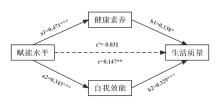
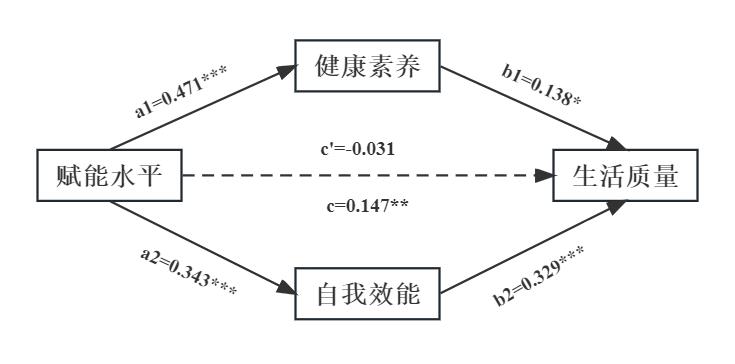
Fig.1
Parallel mediating effects of health literacy and self-efficacy between empowerment and quality of life in older adults with disabilities"
Tab.3
Intermediary model test results 1(n = 313)"
| 变量 | 方程1:健康素养 | |||
|---|---|---|---|---|
| β | SE | t值 | P值 | |
| 赋能水平 | 0.471 | 0.044 | 10.600 | < 0.001 |
| 辅助器使用 | 0.156 | 0.048 | 3.296 | 0.001 |
| 失能程度 | -0.255 | 0.048 | 5.290 | < 0.001 |
Tab.4
Intermediary model test results 2(n = 313)"
| 变量 | 方程2:自我效能 | |||
|---|---|---|---|---|
| β | SE | t值 | P值 | |
| 赋能水平 | 0.343 | 0.050 | 6.887 | < 0.001 |
| 辅助器使用 | 0.121 | 0.053 | 2.274 | 0.024 |
| 失能程度 | -0.261 | 0.054 | 4.834 | < 0.001 |
Tab.5
Intermediary model test results 3(n = 313)"
| 变量 | 方程3:生活质量 | |||
|---|---|---|---|---|
| β | SE | t值 | P值 | |
| 赋能水平 | -0.031 | 0.053 | 0.589 | 0.556 |
| 辅助器使用 | 0.169 | 0.049 | 3.440 | < 0.001 |
| 失能程度 | -0.229 | 0.052 | 4.422 | < 0.001 |
| 健康素养 | 0.138 | 0.065 | 2.126 | 0.034 |
| 自我效能 | 0.329 | 0.058 | 5.676 | < 0.001 |
Tab.6
Results of the analysis of total, direct and mediated effect"
| 路径 | 效应值 | Boot SE | 95%CI |
|---|---|---|---|
| 赋能水平→健康素养→生活质量 | 0.065 | 0.030 | 0.009 ~ 0.130 |
| 赋能水平→自我效能→生活质量 | 0.113 | 0.025 | 0.067 ~ 0.166 |
| 直接效应 | -0.031 | 0.053 | -0.136 ~ 0.073 |
| 总效应 | 0.147 | 0.049 | 0.050 ~ 0.243 |
| [1] |
邓平基. 基于Markov模型的失能老年人口规模预测[J]. 中国老年学杂志, 2022, 42(20):5121-5125. doi:10.3969/j.issn.1005-9202.2022.20.066 .
doi: 10.3969/j.issn.1005-9202.2022.20.066 |
| [2] |
苑杰,龙丽婷,丁佳豪,等. 自我效能感在中国成人大五人格与抑郁症状间的中介效应[J]. 中国健康心理学杂志, 2023, 31(7):993-1000. doi:10.13342/j.cnki.cjhp.2023.07.007 .
doi: 10.13342/j.cnki.cjhp.2023.07.007 |
| [3] |
CIFTCI N, YILDIZ M, YILDIRIM O. The effect of health literacy and health empowerment on quality of life in the elderly[J]. PSychogeriatrics, 2023, 23:609-620. doi:10.1111/psyg.12969 .
doi: 10.1111/psyg.12969 |
| [4] |
UMAR A, MUNDY D. Re-thinking Models of Patient Empowerment[J]. Stud Health Technol Inform, 2015, 209:175-181. doi:10.3233/978-1-61499-505-0-175 .
doi: 10.3233/978-1-61499-505-0-175 |
| [5] |
刘幼华,袁咏娥,刘桂英,等. 脑卒中家庭照顾者赋权能力现状及其影响因素[J]. 护理研究, 2020, 34(7):1150-1156. doi:10.12102/j.issn.1009-6493.2020.07.011 .
doi: 10.12102/j.issn.1009-6493.2020.07.011 |
| [6] |
张连生,江瑞莲. 延续赋能教育对炎症性肠病患者生活质量的影响[J]. 实用医学杂志, 2017, 33(15):2593-2597.doi: 10.3969/j.issn.1006-5725.2017.15.044 .
doi: 10.3969/j.issn.1006-5725.2017.15.044 |
| [7] |
李艳,黄永霞,赵爱平. 基于结构方程模型的社区失能老人主要照顾者焦虑影响因素研究[J]. 中华全科医学, 2018, 16(3):444-447. doi:10.16766/j.cnki.issn.1674-4152.000124 .
doi: 10.16766/j.cnki.issn.1674-4152.000124 |
| [8] |
顾耀华,谭晓东. 健康老龄化对中国启示[J]. 中国公共卫生, 2019, 35(8):941-945. doi:10.11847/zgggws1119501 .
doi: 10.11847/zgggws1119501 |
| [9] |
EHMANN A T, GROENE O, RIEGER M A, et al. The Relationship between Health Literacy, Quality of Life, and Subjective Health: Results of a Cross-Sectional Study in a Rural Region in Germany[J]. Int J Environ Res Public Health, 2020, 17(5):1683. doi:10.3390/ijerph17051683 .
doi: 10.3390/ijerph17051683 |
| [10] |
孙一勤,姜安丽. 慢性病健康赋能理论研究[J]. 中华医院管理杂志, 2017, 33(9):700-703. doi:10.3760/cma.j.issn.1000-6672.2017.09.019 .
doi: 10.3760/cma.j.issn.1000-6672.2017.09.019 |
| [11] |
倪平,陈京立,刘娜. 护理研究中量性研究的样本量估计[J]. 中华护理杂志, 2010, 45(4):378-380. doi:10.3761/j.issn.0254-1769.2010.04.037 .
doi: 10.3761/j.issn.0254-1769.2010.04.037 |
| [12] |
袁野,萧文龙,于媛,等. 结构方程模型的应用准则: CB-SEM和PLS-SEM研究范式的比较与启示[J]. 信息资源管理学报, 2023, 13(3):6-22.doi:10.13365/j.jirm.2023.03.006 .
doi: 10.13365/j.jirm.2023.03.006 |
| [13] |
NEO J, FETTES L, GAO W, et al. Disability in activities of daily living among adults with cancer: A systematic review and meta-analysis[J]. Cancer Treat Rev, 2017;61:94-106. doi:10.1016/j.ctrv.2017.10.006 .
doi: 10.1016/j.ctrv.2017.10.006 |
| [14] |
林晓露,周春兰,肖秀英,等. 失能老年人及其配偶健康素养、赋能水平与生活质量的关系研究[J]. 中华护理杂志, 2022, 57(8):985-991. doi:10.3761/j.issn.0254-1769.2022.08.014 .
doi: 10.3761/j.issn.0254-1769.2022.08.014 |
| [15] |
杨丽潇,周春兰,叶孝灵,等. 国内外老年人健康需求评估工具的研究现状及启示[J]. 护理学报, 2021, 28(21):36-40. doi:10.16460/j.issn1008-9969.2021.21.036 .
doi: 10.16460/j.issn1008-9969.2021.21.036 |
| [16] |
PARK C, PARK Y. Validity and Reliability of Korean Version of Health Empowerment Scale (K-HES) for Older Adults[J]. Asian Nurs Res, 2013, 2013(7):142-148. doi:10.1016/j.anr.2013.07.004 .
doi: 10.1016/j.anr.2013.07.004 |
| [17] |
雷梦杰,刘雅倩,张春梅,等. 简化版老年人健康赋能量表的汉化及信效度检验[J]. 护理学杂志, 2018, 33(18):83-85. doi:10.3870/j.issn.1001-4152.2018.18.083 .
doi: 10.3870/j.issn.1001-4152.2018.18.083 |
| [18] |
WARE J E, SHERBOURNE C D. The MOS 36-Item Short-Form Health Survey (SF-36): I. Conceptual framework and item selection[J]. Med Care, 1992, 30(6):473-483. doi:10.1097/00005650-199206000-00002 .
doi: 10.1097/00005650-199206000-00002 |
| [19] |
李鲁,王红妹,沈毅. SF-36健康调查量表中文版的研制及其性能测试[J]. 中华预防医学杂志, 2002, 36(2):38-42.doi: 10.3760/j:issn:0253-9624.2002.02.011 .
doi: 10.3760/j:issn:0253-9624.2002.02.011 |
| [20] | 鲁显玉.共病老年人健康素养、抗逆力与失能的关系[D].唐山:华北理工大学,2022. |
| [21] | 孙浩林.慢性病病人健康素养量表的研究及其初步应用[D].上海:复旦大学,2012. |
| [22] |
王才康,胡中锋,刘勇. 一般自我效能感量表的信度和效度研究[J]. 应用心理学, 2001, 7(1):37-40. doi:10.3969/j.issn.1006-6020.2001.01.007 .
doi: 10.3969/j.issn.1006-6020.2001.01.007 |
| [23] |
石秀秀,张丽娜,高丁杨,等. 失能老人家庭照顾者积极感受与自我效能的相关性研究[J]. 中华现代护理杂志, 2019, 25(18):2295-2300. doi:10.3760/cma.j.issn.1674-2907.2019.18.012 .
doi: 10.3760/cma.j.issn.1674-2907.2019.18.012 |
| [24] |
周浩,龙立荣. 共同方法偏差的统计检验与控制方法[J]. 心理科学进展, 2004, 12(6):942-950. doi:10.3969/j.issn.1671-3710.2004.06.018 .
doi: 10.3969/j.issn.1671-3710.2004.06.018 |
| [25] |
温忠麟,叶宝娟.中介效应分析:方法和模型发展[J].心理科学进展,2014,22(5):731-745.doi:10.3724/SP.J.1042.2014.00731 .
doi: 10.3724/SP.J.1042.2014.00731 |
| [26] |
GIBSON C H. A concept analysis of empowerment[J]. J Adv Nurs, 1991, 16(3): 354-361. doi:10.1111/j.1365-2648.1991.tb01660.x .
doi: 10.1111/j.1365-2648.1991.tb01660.x |
| [27] |
张月云,葛忠明. 不同残疾状况对中国老年人生活质量的影响[J]. 人口与社会, 2017, 33(4):33-42. doi:10.14132/j.2095-7963.2017.04.004 .
doi: 10.14132/j.2095-7963.2017.04.004 |
| [28] | 傅洪梅,王秀红,汪俊华,等.贵阳市居家失能老年人生活质量调查及影响因素分析[J].现代预防医学, 2018, 45(22):4101-4104. |
| [29] |
袁泉,姚文兵. 老年失能患者的生活质量及社会支持[J]. 中国老年学杂志, 2017, 37(19):4909-4910. doi:10.3969/j.issn.1005-9202.2017.19.099 .
doi: 10.3969/j.issn.1005-9202.2017.19.099 |
| [30] | 陶丽丽,王超群,于琳娜.失能老人生活照料需求未满足状况及其影响因素:基于2005—2018年CLHLS数据的分析[J].中国卫生经济, 2022, 41(8):49-52+60. |
| [31] |
WANG R, XIAO X, TAO Y, et al. Health empowerment and health-related quality of life in older individuals with disabilities and their spouse carers: A cross-sectional study[J]. Res Nurs Health, 2023, 46(6):616-626. doi:10.1002/nur.22345 .
doi: 10.1002/nur.22345 |
| [32] |
唐无双,钱益萍,汤静,等.冠心病患者感知赋能与生活质量的相关性研究[J].上海护理, 2022, 22(2):26-30.doi: 10.3969/j.issn.1009-8399.2022.02.006 .
doi: 10.3969/j.issn.1009-8399.2022.02.006 |
| [33] |
何思涵,秦春香,陈正英,等. 老年人健康自我赋能水平与健康自我管理能力的关联性[J]. 中华健康管理学杂志, 2022, 16(2):117-124. doi:10.3760/cma.j.cn115624-20210709-00382 .
doi: 10.3760/cma.j.cn115624-20210709-00382 |
| [34] |
CHEN X, XIAO X, HUANG X E, et al. Empowerment and quality of life: The mediating role of self-efficacy and health literacy among spousal caregivers in China[J]. Health Promot Int, 2023, 38(5). doi:10.1093/heapro/daad133 .
doi: 10.1093/heapro/daad133 |
| [35] |
于冰,陈梦霞,王梦迪,等. 脑卒中患者复发风险感知和健康行为的关系:自我效能和电子健康素养的链式中介作用[J]. 实用医学杂志, 2025, 41(4):600-606. doi: 10.3969/j.issn.1006-5725.2025.04.021 .
doi: 10.3969/j.issn.1006-5725.2025.04.021 |
| [36] |
BARHAM A, IBRAHEEM R, ZYOUD S H. Cardiac self-efficacy and quality of life in patients with coronary heart disease: A cross-sectional study from Palestine[J]. BMC Cardiovasc Disord, 2019, 19(1):212-290. doi:10.1186/s12872-019-01281-7 .
doi: 10.1186/s12872-019-01281-7 |
| [37] |
PANAGIOTI M, SKEVINGTON SM, HANN M, et al. Effect of health literacy on the quality of life of older patients with long-term conditions: A large cohort study in UK general practice[J]. Qual Life Res, 2018, 27(5):1257-1268. doi:10.1007/s11136-017-1775-2 .
doi: 10.1007/s11136-017-1775-2 |
| [38] | 孙一勤.老年慢性病人健康赋能的影响因素和作用机制研究[D].上海:海军军医大学,2019. |
| [39] |
ABRAHAMS N, GILSON L, LEVITT N S, et al. Factors that influence patient empowerment in inpatient chronic care: Early thoughts on a diabetes care intervention in South Africa[J]. BMC Endocr Disord, 2019, 19(1). doi:10.1186/s12902-019-0465-1 .
doi: 10.1186/s12902-019-0465-1 |
| [40] |
CWIRLEJ-SOZANSKA A B, WISNIOWSKA-SZURLEJ A, WILMOWSKA-PIETRUSZYNSKA A, et al. Factors associated with disability and quality of life among the oldest-old living in community in Poland: A cross-sectional study[J]. Ann Agric Environ Med, 2020, 27(4):621-629. doi:10.26444/aaem/115020 .
doi: 10.26444/aaem/115020 |
| [41] |
ALZAWAHREH S, OZTURK C. Improving self-efficacy, quality of life, and glycemic control in adolescents with type 1 diabetes: Randomized controlled trial for the evaluation of the family-centered empowerment model[J]. JMIR Form Res, 2024, 8:e64463. doi:10.2196/64463 .
doi: 10.2196/64463 |
| [42] | 罗秀琼,苟红霞,陈洪梅,等.老年冠心病合并心力衰竭患者自我效能和生活质量现状及影响因素调查研究[J].预防医学情报杂志,2020,36(11):1455-1459. |
| Viewed | ||||||
|
Full text |
|
|||||
|
Abstract |
|
|||||
