

The Journal of Practical Medicine ›› 2026, Vol. 42 ›› Issue (2): 169-175.doi: 10.3969/j.issn.1006-5725.2026.02.001
• Oncology: Diagnosis, Treatment and Prevention •
Jianhong AN1,Meihui SONG2,Changwen HUANG1( )
)
Received:2025-09-02
Online:2026-01-25
Published:2026-01-22
Contact:
Changwen HUANG
E-mail:ncdxhcw@163.com
CLC Number:
Jianhong AN,Meihui SONG,Changwen HUANG. Advances in pancreatic adenosquamous carcinoma: Histopathological characteristics, molecular mechanisms, and therapeutic perspectives[J]. The Journal of Practical Medicine, 2026, 42(2): 169-175.
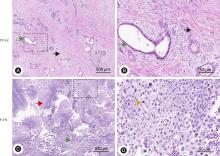
Fig.1
Histological comparison of PDAC and PASC (HE staining)"
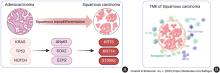
Fig.2
Molecular mechanisms and immune microenvironment of PASC"
| [1] |
MOSLIM M A, LEFTON M D, ROSS E A, et al. Clinical and histological basis of adenosquamous carcinoma of the pancreas: A 30-year experience[J]. J Surg Res, 2021, 259: 350-356. doi:10.1016/j.jss.2020.09.024 .
doi: 10.1016/j.jss.2020.09.024 |
| [2] |
WARD J D, FOWLER M, ROBLEDO-GOMEZ A, et al. PD-L1 expression in pancreaticobiliary adenosquamous carcinoma: A single-institution case series[J]. J Gastrointest Oncol, 2024, 15(2): 768-779. doi:10.21037/jgo-24-9 .
doi: 10.21037/jgo-24-9 |
| [3] |
AN J, JIANG T, QI L, et al. Acinar cells and the development of pancreatic fibrosis[J]. Cytokine Growth Factor Rev, 2023, 71-72: 40-53. doi:10.1016/j.cytogfr.2023.05.003 .
doi: 10.1016/j.cytogfr.2023.05.003 |
| [4] |
HUANG Z, WANG J, ZHANG R, et al. Pancreatic adenosquamous carcinoma: A population level analysis of epidemiological trends and prognosis[J]. Cancer Med, 2023, 12(8): 9926-9936. doi:10.1002/cam4.5700 .
doi: 10.1002/cam4.5700 |
| [5] |
TOSHIMA F, INOUE D, YOSHIDA K, et al. Adenosquamous carcinoma of pancreas: CT and MR imaging features in eight patients, with pathologic correlations and comparison with adenocarcinoma of pancreas[J]. Abdom Radiol, 2016, 41(3): 508-520. doi:10.1007/s00261-015-0616-4 .
doi: 10.1007/s00261-015-0616-4 |
| [6] |
郑立春, 张欢, 顾程, 等. 18F-FDG PET/CT联合血清CA19-9、CEA、NSE鉴别胰腺导管腺癌与胰腺神经内分泌肿瘤[J]. 实用医学杂志, 2023, 39(18): 2395-2400. doi:10.3969/j.issn.1006-5725.2023.18.019 .
doi: 10.3969/j.issn.1006-5725.2023.18.019 |
| [7] |
MARCUS R, MAITRA A, ROSZIK J. Recent advances in genomic profiling of adenosquamous carcinoma of the pancreas[J]. J Pathol, 2017, 243(3): 271-272. doi:10.1002/path.4959 .
doi: 10.1002/path.4959 |
| [8] |
RAJBHANDARI N, HAMILTON M, QUINTERO C M, et al. Single-cell mapping identifies MSI(+) cells as a common origin for diverse subtypes of pancreatic cancer[J]. Cancer Cell, 2023, 41(11): 1989-2005.e9. doi:10.1016/j.ccell.2023.09.008 .
doi: 10.1016/j.ccell.2023.09.008 |
| [9] |
SOMERVILLE T D, BIFFI G, DAßLER-PLENKER J, et al. Squamous trans-differentiation of pancreatic cancer cells promotes stromal inflammation[J]. eLife, 2020, 9: e53381. doi:10.7554/eLife.53381 .
doi: 10.7554/eLife.53381 |
| [10] |
AHMED M, LARSON B K, OSIPOV A, et al. A case of adenosquamous pancreatic cancer with a KRAS G12C mutation with an exceptional response to immunotherapy[J]. Oncotarget, 2024, 15: 741-747. doi:10.18632/oncotarget.28659 .
doi: 10.18632/oncotarget.28659 |
| [11] |
BURDZIAK C, ALONSO-CURBELO D, WALLE T, et al. Epigenetic plasticity cooperates with cell-cell interactions to direct pancreatic tumorigenesis[J]. Science, 2023, 380(6645): eadd5327. doi:10.1126/science.add5327 .
doi: 10.1126/science.add5327 |
| [12] |
MUELLER S, ENGLEITNER T, MARESCH R, et al. Evolutionary routes and KRAS dosage define pancreatic cancer phenotypes[J]. Nature, 2018, 554(7690): 62-68. doi:10.1038/nature25459 .
doi: 10.1038/nature25459 |
| [13] |
XIONG Q, ZHANG Z, XU Y, et al. Pancreatic adenosquamous carcinoma: A rare pathological subtype of pancreatic cancer[J]. J Clin Med, 2022, 11(24): 7401. doi:10.3390/jcm11247401 .
doi: 10.3390/jcm11247401 |
| [14] |
BASTURK O, KHANANI F, SARKAR F, et al. DeltaNp63 expression in pancreas and pancreatic neoplasia[J]. Mod Pathol, 2005, 18(9): 1193-1198. doi:10.1038/modpathol.3800401 .
doi: 10.1038/modpathol.3800401 |
| [15] |
HAUGK B, HORTON D, OPPONG K, et al. Morphological and p40 immunohistochemical analysis of squamous differentiation in endoscopic ultrasound guided fine needle biopsies of pancreatic ductal adenocarcinoma[J]. Sci Rep, 2021, 11(1): 21290. doi:10.1038/s41598-021-00652-5 .
doi: 10.1038/s41598-021-00652-5 |
| [16] |
SOMERVILLE T D D, XU Y, MIYABAYASHI K, et al. TP63-mediated enhancer reprogramming drives the squamous subtype of pancreatic ductal adenocarcinoma[J]. Cell Rep, 2018, 25(7): 1741-1755.e7. doi:10.1016/j.celrep.2018.10.051 .
doi: 10.1016/j.celrep.2018.10.051 |
| [17] |
HERREROS-VILLANUEVA M, ZHANG J S, KOENIG A, et al. SOX2 promotes dedifferentiation and imparts stem cell-like features to pancreatic cancer cells[J]. Oncogenesis, 2013, 2(8): e61. doi:10.1038/oncsis.2013.23 .
doi: 10.1038/oncsis.2013.23 |
| [18] |
ROY S, DUKIC T, KEEPERS Z, et al. SOX2 and OCT4 mediate radiation and drug resistance in pancreatic tumor organoids[J]. Cell Death Discov, 2024, 10(1): 106. doi:10.1038/s41420-024-01871-1 .
doi: 10.1038/s41420-024-01871-1 |
| [19] |
WUEBBEN E L, WILDER P J, COX J L, et al. SOX2 functions as a molecular rheostat to control the growth, tumorigenicity and drug responses of pancreatic ductal adenocarcinoma cells[J]. Oncotarget, 2016, 7(23): 34890-34906. doi:10.18632/oncotarget.8994 .
doi: 10.18632/oncotarget.8994 |
| [20] |
HSIEH M H, CHOE J H, GADHVI J, et al. p63 and SOX2 dictate glucose reliance and metabolic vulnerabilities in squamous cell carcinomas[J]. Cell Rep, 2019, 28(7): 1860-1878.e9. doi:10.1016/j.celrep.2019.07.027 .
doi: 10.1016/j.celrep.2019.07.027 |
| [21] |
OOIZUMI Y, KOJIMA K, IGARASHI K, et al. Comprehensive exploration to identify predictive DNA markers of ΔNp63/SOX2 in drug resistance in human esophageal squamous cell carcinoma[J]. Ann Surg Oncol, 2019, 26(13): 4814-4825. doi:10.1245/s10434-019-07795-w .
doi: 10.1245/s10434-019-07795-w |
| [22] |
HAYASHI A, FAN J, CHEN R, et al. A unifying paradigm for transcriptional heterogeneity and squamous features in pancreatic ductal adenocarcinoma[J]. Nat Cancer, 2020, 1(1): 59-74. doi:10.1038/s43018-019-0010-1 .
doi: 10.1038/s43018-019-0010-1 |
| [23] |
BAILEY P, CHANG D K, NONES K, et al. Genomic analyses identify molecular subtypes of pancreatic cancer[J]. Nature, 2016, 531(7592): 47-52. doi:10.1038/nature16965 .
doi: 10.1038/nature16965 |
| [24] |
BRAY S J. Notch signalling in context[J]. Nat Rev Mol Cell Biol, 2016, 17(11): 722-735. doi:10.1038/nrm.2016.94 .
doi: 10.1038/nrm.2016.94 |
| [25] |
ZHOU B, LIN W, LONG Y, et al. Notch signaling pathway: Architecture, disease, and therapeutics[J]. Signal Transduct Target Ther, 2022, 7(1): 95. doi:10.1038/s41392-022-00934-y .
doi: 10.1038/s41392-022-00934-y |
| [26] |
HANLON L, AVILA J L, DEMAREST R M, et al. Notch1 functions as a tumor suppressor in a model of K-ras-induced pancreatic ductal adenocarcinoma[J]. Cancer Res, 2010, 70(11): 4280-4286. doi:10.1158/0008-5472.CAN-09-4645 .
doi: 10.1158/0008-5472.CAN-09-4645 |
| [27] |
MEANS A L, MESZOELY I M, SUZUKI K, et al. Pancreatic epithelial plasticity mediated by acinar cell transdifferentiation and generation of nestin-positive intermediates[J]. Development, 2005, 132(16): 3767-3776. doi:10.1242/dev.01925 .
doi: 10.1242/dev.01925 |
| [28] |
ANDRICOVICH J, PERKAIL S, KAI Y, et al. Loss of KDM6A activates super-enhancers to induce gender-specific squamous-like pancreatic cancer and confers sensitivity to BET inhibitors[J]. Cancer Cell, 2018, 33(3): 512-526.e8. doi:10.1016/j.ccell. 2018.02.003 .
doi: 10.1016/j.ccell. 2018.02.003 |
| [29] |
BORAZANCI E, MILLIS S Z, KORN R, et al. Adenosquamous carcinoma of the pancreas: Molecular characterization of 23 patients along with a literature review[J]. World J Gastrointest Oncol, 2015, 7(9): 132-140. doi:10.4251/wjgo.v7.i9.132 .
doi: 10.4251/wjgo.v7.i9.132 |
| [30] |
DAVID C J, HUANG Y H, CHEN M, et al. TGF-β tumor suppression through a lethal EMT[J]. Cell, 2016, 164(5): 1015-1030. doi:10.1016/j.cell.2016.01.009 .
doi: 10.1016/j.cell.2016.01.009 |
| [31] |
FEIG C, JONES J O, KRAMAN M, et al. Targeting CXCL12 from FAP-expressing carcinoma-associated fibroblasts synergizes with anti-PD-L1 immunotherapy in pancreatic cancer[J]. Proc Natl Acad Sci USA, 2013, 110(50): 20212-20217. doi:10.1073/ pnas. 1320318110 .
doi: 10.1073/ pnas. 1320318110 |
| [32] |
TAKAHASHI R, MACCHINI M, SUNAGAWA M, et al. Interleukin-1β-induced pancreatitis promotes pancreatic ductal adenocarcinoma via B lymphocyte-mediated immune suppression[J]. Gut, 2021, 70(2): 330-341. doi:10.1136/gutjnl-2019-319912 .
doi: 10.1136/gutjnl-2019-319912 |
| [33] |
O′KANE G M, GRÜNWALD B T, JANG G H, et al. GATA6 expression distinguishes classical and basal-like subtypes in advanced pancreatic cancer[J]. Clin Cancer Res, 2020, 26(18): 4901-4910. doi:10.1158/1078-0432.CCR-19-3724 .
doi: 10.1158/1078-0432.CCR-19-3724 |
| [34] |
张习杰, 李昕, 周文策. 转移性胰腺癌的联合免疫治疗研究进展[J]. 实用医学杂志, 2023, 39(6): 655-659. doi:10.3969/j.issn.1006-5725.2023.06.001 .
doi: 10.3969/j.issn.1006-5725.2023.06.001 |
| [35] |
MOFFITT R A, MARAYATI R, FLATE E L, et al. Virtual microdissection identifies distinct tumor- and stroma-specific subtypes of pancreatic ductal adenocarcinoma[J]. Nat Genet, 2015, 47(10): 1168-1178. doi:10.1038/ng.3398 .
doi: 10.1038/ng.3398 |
| [36] |
MONCADA R, BARKLEY D, WAGNER F, et al. Integrating microarray-based spatial transcriptomics and single-cell RNA-seq reveals tissue architecture in pancreatic ductal adenocarcinomas[J]. Nat Biotechnol, 2020, 38(3): 333-342. doi:10.1038/s41587-019-0392-8 .
doi: 10.1038/s41587-019-0392-8 |
| [37] |
HALDAR S D, SAJ F, PAVLICK D, et al. Pancreatic adenosquamous carcinoma (PASC): A comparative genomic landscape study[J]. J Clin Oncol, 2025, 43(): 4153. doi:10.1200/ jco.2025.43.16_suppl.4153 .
doi: 10.1200/ jco.2025.43.16_suppl.4153 |
| [38] |
ZHANG D, WU S, PAN S, et al. Single-cell sequencing reveals heterogeneity between pancreatic adenosquamous carcinoma and pancreatic ductal adenocarcinoma with prognostic value[J]. Front Immunol, 2022, 13: 972298. doi:10.3389/fimmu.2022.972298 .
doi: 10.3389/fimmu.2022.972298 |
| [39] |
ULLMAN N A, BURCHARD P R, DUNNE R F, et al. Immunologic strategies in pancreatic cancer: Making cold tumors hot[J]. J Clin Oncol, 2022, 40(24): 2789-2805. doi:10.1200/JCO. 21. 02616 .
doi: 10.1200/JCO. 21. 02616 |
| [40] |
GLAPIŃSKI F, ZAJĄC W, FUDALEJ M, et al. The role of the tumor microenvironment in pancreatic ductal adenocarcinoma: Recent advancements and emerging therapeutic strategies[J]. Cancers, 2025, 17(10): 1599. doi:10.3390/cancers17101599 .
doi: 10.3390/cancers17101599 |
| [41] |
ROE J S, HWANG C I, SOMERVILLE T D D, et al. Enhancer reprogramming promotes pancreatic cancer metastasis[J]. Cell, 2017, 170(5): 875-888.e20. doi:10.1016/j.cell.2017.07.007 .
doi: 10.1016/j.cell.2017.07.007 |
| [42] |
PAN Y, ZHAO S, CAO Z. Organoid models of gastrointestinal Neoplasms: Origin, current status and future applications in personalized medicine[J]. Genes Dis, 2018, 5(4): 323-330. doi:10.1016/j.gendis.2018.09.002 .
doi: 10.1016/j.gendis.2018.09.002 |
| [43] |
CHAN-SENG-YUE M, KIM J C, WILSON G W, et al. Transcription phenotypes of pancreatic cancer are driven by genomic events during tumor evolution[J]. Nat Genet, 2020, 52(2): 231-240. doi:10.1038/s41588-019-0566-9 .
doi: 10.1038/s41588-019-0566-9 |
| [1] | Fangyu SHI,Pengfei HAO,Like ZHANG,Quanxiao. XU. Expression characteristics of GZMB and CXCL9 and their regulatory significance in the tumor immune microenvironment and prognosis in gastric cancer patients [J]. The Journal of Practical Medicine, 2025, 41(23): 3744-3752. |
| [2] | Chunhui LIU,Ruipeng WU,Zhiqiang WANG,Wensheng SHAN,Shaojun. LI. Molecular mechanisms and diagnostic value of seminal plasma exosomal miR-26a-5p targeting PTEN in idiopathic teratozoospermia [J]. The Journal of Practical Medicine, 2025, 41(20): 3256-3266. |
| [3] | Wei HE,Liping LIU,Jingwei ZHUO,Xiaodong ZHANG,Tong YANG,Jubin. FENG. CCR5 blockade reduces tumor growth by inducing apoptosis and impairing immunosuppression of tumor microenvironment [J]. The Journal of Practical Medicine, 2024, 40(9): 1204-1210. |
| [4] | Danting WEN,Huiping. ZHOU. TCM medicine understanding of tumor microenvironment based on cancer toxicity theory [J]. The Journal of Practical Medicine, 2023, 39(19): 2556-2560. |
| [5] | Kai DENG,Meng YANG,Ling ZHANG,Jun′an QIAN,Yunqiang SHI,Chunhui. WANG. Bidirectional regulation of tumor associated neutrophils and their role in urothelial bladder cancer: a literature review [J]. The Journal of Practical Medicine, 2023, 39(16): 2142-2147. |
| [6] |
PU Yukang, HUANG Yuqin, LI Wei, LI Mingqun..
Expression and clinical significance of KIF26B in epithelial ovarian cancer based on biological information [J]. The Journal of Practical Medicine, 2022, 38(23): 2919-2926. |
| [7] | DAI Yan, BAO Mengying, ZENG Yanyu, LIU Yun, YE Yu. Using single ⁃ cell techniques to explore the characteristics of tumor ⁃ associated macrophages#br# [J]. The Journal of Practical Medicine, 2021, 37(3): 281-285. |
| [8] |
YE Meif⁃eng, SU Shan, CEN Wenchang, ZHANG Yanbin.
Tumor microenvironment of miliary lung cancer and its relationship with efficacy of EGFR⁃TKI
[J]. The Journal of Practical Medicine, 2021, 37(2): 250-254.
|
| Viewed | ||||||
|
Full text |
|
|||||
|
Abstract |
|
|||||
