

The Journal of Practical Medicine ›› 2025, Vol. 41 ›› Issue (24): 3808-3815.doi: 10.3969/j.issn.1006-5725.2025.24.003
• Brain Science and Psychosomatic Medicine • Previous Articles
Hua ZHANG1,Xiuya LIANG2,Ziyi ZHENG2,Tong YIN1,Sheng LI1,Jianpeng. HUANG1( )
)
Received:2025-07-31
Online:2025-12-25
Published:2025-12-25
Contact:
Jianpeng. HUANG
E-mail:jianpengtcm@gzucm.edu.cn
CLC Number:
Hua ZHANG,Xiuya LIANG,Ziyi ZHENG,Tong YIN,Sheng LI,Jianpeng. HUANG. Research progress on the application of non-invasive brain stimulation techniques in the treatment of generalized anxiety disorder[J]. The Journal of Practical Medicine, 2025, 41(24): 3808-3815.
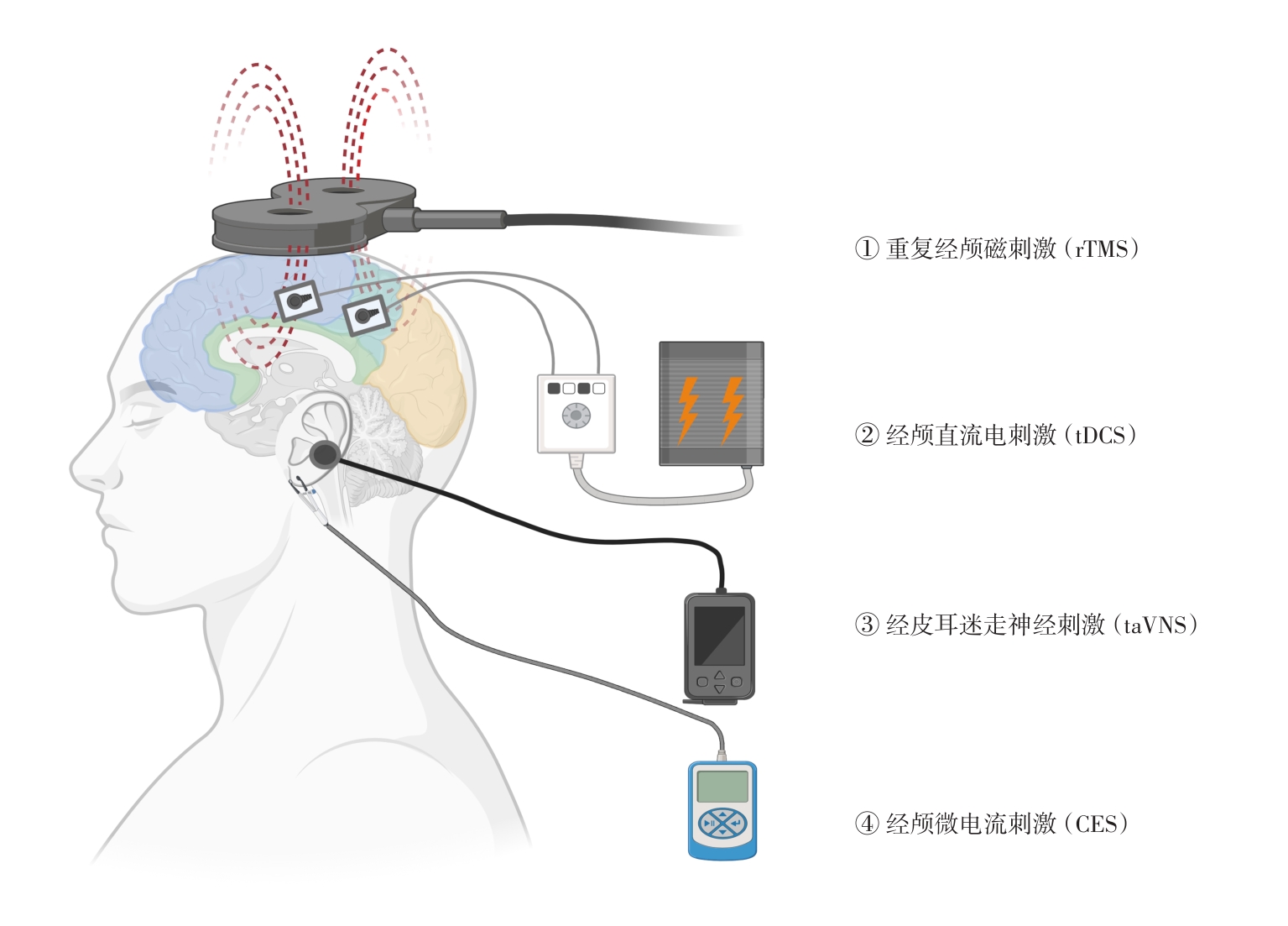
Fig.1
NIBS schematic diagram"
| [1] | BATTLE D E. Diagnostic and Statistical Manual of Mental Disorders (DSM) [J]. Codas, 2013, 25(2): 191-192. |
| [2] |
FAGAN H A, BALDWIN D S. Pharmacological Treatment pf Generalised Anxiety Disorder: Current Practice and Future Direction [J]. Expert Rev Neurother, 2023, 23(5): 535-548. doi:10.1080/14737175.2023.2211767
doi: 10.1080/14737175.2023.2211767 |
| [3] |
ERRAZURIZ A, AVELLO⁃VEGA D, PASSI⁃SOLAR A,et al. Prevalence of anxiety disorders in Latin America: A systematic review and meta⁃analysis [J]. Lancet Rag Health Am, 2025, 45: 101057. doi:10.1016/j.lana.2025.101057
doi: 10.1016/j.lana.2025.101057 |
| [4] |
CARL E, WITCRAFT S M, KAUFFMAN B Y, et al. Psychological and pharmacological treatments for generalized anxiety disorder (GAD): A meta-analysis of randomized controlled trials [J]. Cogn Behav Ther, 2020, 49(1): 1-21. doi:10.1080/16506073.2018.1560358
doi: 10.1080/16506073.2018.1560358 |
| [5] |
WANG H, MOU S, PEI X, et al. The power spectrum and functional connectivity characteristics of resting-state EEG in patients with generalized anxiety disorder [J]. Sci Rep, 2025, 15(1): 5991. doi:10.1038/s41598-025-90362-z
doi: 10.1038/s41598-025-90362-z |
| [6] |
CUI Q, SHENG W, CHEN Y, et al. Dynamic changes of amplitude of low-frequency fluctuations in patients with generalized anxiety disorder [J]. Hum Brain Mapp, 2020, 41(6): 1667-1676. doi:10.1002/hbm.24902
doi: 10.1002/hbm.24902 |
| [7] |
HELLER W, NITSCHKE J B, ETIENNE M A, et al. Patterns of regional brain activity differentiate types of anxiety [J]. J Abnorm Psychol, 1997, 106(3): 376-385. doi:10.1037//0021-843x.106.3.376
doi: 10.1037//0021-843x.106.3.376 |
| [8] |
WHITE L K, MAKHOUL W, TEFERI M, et al. The role of dlPFC laterality in the expression and regulation of anxiety [J]. Neuropharmacology, 2023, 224: 109355. doi:10.1016/j.neuropharm.2022.109355
doi: 10.1016/j.neuropharm.2022.109355 |
| [9] |
MACHADO S, PAES F, VELASQUES B, et al. Is rTMS an effective therapeutic strategy that can be used to treat anxiety disorders? [J]. Neuropharmacology, 2012, 62(1): 125-134. doi:10.1016/j.neuropharm.2011.07.024
doi: 10.1016/j.neuropharm.2011.07.024 |
| [10] |
ZHANG Y, LI L, BIAN Y, et al. Theta-burst stimulation of TMS treatment for anxiety and depression: A FNIRS study [J]. J Affect Disord, 2023, 325: 713-720. doi:10.1016/j.jad.2023.01.062
doi: 10.1016/j.jad.2023.01.062 |
| [11] |
NARMASHIRI A, AKBARI F. The Effects of Transcranial Direct Current Stimulation (tDCS) on the Cognitive Functions: A Systematic Review and Meta-analysis [J]. Neuropsychol Rev, 2025, 35(1): 126-152. doi:10.1007/s11065-023-09627-x
doi: 10.1007/s11065-023-09627-x |
| [12] |
WU Y, TANG L, SHI X, et al. Effects of tDCS on Depression and Comorbid Generalized Anxiety Disorder: A Brain Function Imaging Case Report [J]. Front Neurol, 2022, 13: 879339. doi:10.3389/fneur.2022.879339
doi: 10.3389/fneur.2022.879339 |
| [13] |
LU R, ZHANG C, LIU Y, et al. The effect of bilateral low-frequency rTMS over dorsolateral prefrontal cortex on serum brain-derived neurotropic factor and serotonin in patients with generalized anxiety disorder [J]. Neurosci Lett, 2018, 684: 67-71. doi:10.1016/j.neulet.2018.07.008
doi: 10.1016/j.neulet.2018.07.008 |
| [14] |
FILHO P R, VERCELINO R, CIOATO S G, et al. Transcranial direct current stimulation (tDCS) reverts behavioral alterations and brainstem BDNF level increase induced by neuropathic pain model: Long-lasting effect [J]. Prog Neuropsychopharmacol Biol Psychiatry, 2016, 64: 44-51. doi:10.1016/j.pnpbp.2015.06.016
doi: 10.1016/j.pnpbp.2015.06.016 |
| [15] |
CLARKE D, BEROS J, BATES K A, et al. Low intensity repetitive magnetic stimulation reduces expression of genes related to inflammation and calcium signalling in cultured mouse cortical astrocytes [J]. Brain Stimul, 2021, 14(1): 183-191. doi:10.1016/j.brs.2020.12.007
doi: 10.1016/j.brs.2020.12.007 |
| [16] |
TIAN L, SUN S S, CUI L B, et al. Repetitive Transcranial Magnetic Stimulation Elicits Antidepressant- and Anxiolytic-like Effect via Nuclear Factor-E2-related factor 2-mediated Anti-inflammation Mechanism in Rats [J]. Neuroscience, 2020, 429: 119-133. doi:10.1016/j.neuroscience.2019.12.025
doi: 10.1016/j.neuroscience.2019.12.025 |
| [17] |
YANG L, WANG S, HU Y, et al. Effects of Repetitive Transcranial Magnetic Stimulation on Astrocytes Proliferation and nNOS Expression in Neuropathic Pain Rats [J]. Curr Med Sci, 2018, 38(3): 482-490. doi:10.1007/s11596-018-1904-3
doi: 10.1007/s11596-018-1904-3 |
| [18] |
HONG Y, LIU Q, PENG M, et al. High-frequency repetitive transcranial magnetic stimulation improves functional recovery by inhibiting neurotoxic polarization of astrocytes in ischemic rats [J]. J Neuroinflammation, 2020, 17(1): 150. doi:10.1186/s12974-020-01747-y
doi: 10.1186/s12974-020-01747-y |
| [19] |
SMITS J A, ROSENFIELD D, OTTO M W, et al. D-cycloserine enhancement of exposure therapy for social anxiety disorder depends on the success of exposure sessions [J]. J Psychiatr Res, 2013, 47(10): 1455-1461. doi:10.1016/j.jpsychires.2013.06.020
doi: 10.1016/j.jpsychires.2013.06.020 |
| [20] |
SUN L, MA S, YU Y, et al. Transcutaneous auricular vagus nerve stimulation ameliorates adolescent depressive- and anxiety-like behaviors via hippocampus glycolysis and inflammation response [J]. CNS Neurosci Ther, 2024, 30(2): e14614. doi:10.1111/cns.14614
doi: 10.1111/cns.14614 |
| [21] | 刘晶晶, 相福芹, 黄奇, 等. 经颅直流电刺激治疗广泛性焦虑障碍的疗效观察 [J]. 浙江临床医学, 2022, 24(5): 690-692. |
| [22] |
WANG H N, BAI Y H, CHEN Y C, et al. Repetitive transcranial magnetic stimulation ameliorates anxiety-like behavior and impaired sensorimotor gating in a rat model of post-traumatic stress disorder [J]. PLoS One, 2015, 10(2): e0117189. doi:10.1371/journal.pone.0117189
doi: 10.1371/journal.pone.0117189 |
| [23] |
KECK M E, WELT T, POST A, et al. Neuroendocrine and behavioral effects of repetitive transcranial magnetic stimulation in a psychopathological animal model are suggestive of antidepressant-like effects [J]. Neuropsychopharmacology, 2001, 24(4): 337-349. doi:10.1016/s0893-133x(00)00191-3
doi: 10.1016/s0893-133x(00)00191-3 |
| [24] |
MEHRSAFAR A H, ROSA M A S, ZADEH A M, et al. A feasibility study of application and potential effects of a single session transcranial direct current stimulation (tDCS) on competitive anxiety, mood state, salivary levels of cortisol and alpha amylase in elite athletes under a real-world competition [J]. Physiol Behav, 2020, 227: 113173. doi:10.1016/j.physbeh.2020.113173
doi: 10.1016/j.physbeh.2020.113173 |
| [25] |
QI L, WANG S, LI X, et al. Non-invasive brain stimulation in the treatment of generalized anxiety disorder: A systematic review and meta-analysis [J]. J Psychiatr Res, 2024, 178: 378-387. doi:10.1016/j.jpsychires.2024.07.046
doi: 10.1016/j.jpsychires.2024.07.046 |
| [26] |
CUI H, JIANG L, WEI Y, et al. Efficacy and safety of repetitive transcranial magnetic stimulation for generalised anxiety disorder: A meta-analysis [J]. Gen Psychiatr, 2019, 32(5): e100051. doi:10.1136/gpsych-2019-100051
doi: 10.1136/gpsych-2019-100051 |
| [27] |
SAGLIANO L, ATRIPALDI D, DE VITA D, et al. Non-invasive brain stimulation in generalized anxiety disorder: A systematic review [J]. Prog Neuropsychopharmacol Biol Psychiatry, 2019, 93: 31-38. doi:10.1016/j.pnpbp.2019.03.002
doi: 10.1016/j.pnpbp.2019.03.002 |
| [28] |
DIEFENBACH G J, BRAGDON L B, ZERTUCHE L, et al. Repetitive transcranial magnetic stimulation for generalised anxiety disorder: A pilot randomised, double-blind, sham-controlled trial [J]. Br J Psychiatry, 2016, 209(3): 222-228. doi:10.1192/bjp.bp.115.168203
doi: 10.1192/bjp.bp.115.168203 |
| [29] |
DILKOV D, HAWKEN E R, KALUDIEV E, et al. Repetitive transcranial magnetic stimulation of the right dorsal lateral prefrontal cortex in the treatment of generalized anxiety disorder: A randomized, double-blind sham controlled clinical trial [J]. Prog Neuropsychopharmacol Biol Psychiatry, 2017, 78: 61-65. doi:10.1016/j.pnpbp.2017.05.018
doi: 10.1016/j.pnpbp.2017.05.018 |
| [30] | 陈丽雅, 王红梅. 重复经颅磁刺激治疗焦虑症伴有失眠的临床疗效分析 [J]. 中国现代药物应用, 2020, 14(15): 112-114. |
| [31] | 李越, 王玉平, 詹淑琴, 等. 重复经颅磁刺激治疗广泛性焦虑的对照研究 [J]. 脑与神经疾病杂志, 2012, 20(2): 84-88. |
| [32] |
HUANG Z, LI Y, BIANCHI M T, et al. Repetitive transcranial magnetic stimulation of the right parietal cortex for comorbid generalized anxiety disorder and insomnia: A randomized, double-blind, sham-controlled pilot study [J]. Brain Stimul, 2018, 11(5): 1103-1109. doi:10.1016/j.brs.2018.05.016
doi: 10.1016/j.brs.2018.05.016 |
| [33] | 杨硕. 不同模式重复经颅磁刺激对广泛性焦虑障碍的疗效及安全性评价 [D]. 唐山:华北理工大学, 2023. |
| [34] | 宋明桥, 孙亚南, 钟晓明, 等. 低频重复经颅磁刺激治疗96例焦虑患者的疗效分析 [J]. 医学与哲学(B), 2016, 37(1): 47-49. |
| [35] |
RAMASUBBU R, BROWN E C, SELBY B, et al. Accelerated sequential bilateral theta-burst stimulation in major depression: An open trial [J]. Eur Arch Psychiatry Clin Neurosci, 2024, 274(3): 697-707. doi:10.1007/s00406-023-01648-0
doi: 10.1007/s00406-023-01648-0 |
| [36] |
LI X, ZHANG C, TAN J, et al. Clinical effects of continuous theta burst stimulation for generalized anxiety disorder and a mechanism involving alpha oscillations: A randomized controlled trial [J]. J Psychiatry Neurosci, 2022, 47(2): E123-E133. doi:10.1503/jpn.210134
doi: 10.1503/jpn.210134 |
| [37] |
NITSCHE M A, PAULUS W. Excitability changes induced in the human motor cortex by weak transcranial direct current stimulation [J]. J Physiol, 2000, 527 Pt 3: 633-639. doi:10.1111/j.1469-7793.2000.t01-1-00633.x
doi: 10.1111/j.1469-7793.2000.t01-1-00633.x |
| [38] |
SHIOZAWA P, LEIVA A P G, CASTRO C D C, et al. Transcranial direct current stimulation for generalized anxiety disorder: A case study [J]. Biol Psychiatry, 2014, 75(11): e17-e18. doi:10.1016/j.biopsych.2013.07.014
doi: 10.1016/j.biopsych.2013.07.014 |
| [39] |
NASIRI F, MASHHADI A, BIGDELI I, et al. Augmenting the unified protocol for transdiagnostic treatment of emotional disorders with transcranial direct current stimulation in individuals with generalized anxiety disorder and comorbid depression: A randomized controlled trial [J]. J Affect Disord, 2020, 262: 405-413. doi:10.1016/j.jad.2019.11.064
doi: 10.1016/j.jad.2019.11.064 |
| [40] | 邓明其, 冯尚武, 陈颂玲. 经颅直流电刺激治疗轻中度焦虑和抑郁障碍共病患者的随机对照研究 [J]. 中国康复, 2015, 30(4): 268-270. |
| [41] |
DE LIMA A L, BRAGA F M A, COSTA R M M DA, et al. Transcranial direct current stimulation for the treatment of generalized anxiety disorder: A randomized clinical trial [J]. J Affect Disord, 2019, 259: 31-37. doi:10.1016/j.jad.2019.08.020
doi: 10.1016/j.jad.2019.08.020 |
| [42] |
NEJATI V, MAJDI R, SALEHINEJAD M A, et al. The role of dorsolateral and ventromedial prefrontal cortex in the processing of emotional dimensions [J]. Sci Rep, 2021, 11(1): 1971. doi:10.1038/s41598-021-81454-7
doi: 10.1038/s41598-021-81454-7 |
| [43] |
FERREIRA L M A, BRITES R, FRAIAO G, et al. Transcutaneous auricular vagus nerve stimulation modulates masseter muscle activity, pain perception, and anxiety levels in university students: A double-blind, randomized, controlled clinical trial [J]. Front Integr Neurosci, 2024, 18: 1422312. doi:10.3389/fnint.2024.1422312
doi: 10.3389/fnint.2024.1422312 |
| [44] |
SRINIVASAN V, ABATHSAGAYAM K, SUGANTHIRABABU P, et al. Effect of vagus nerve stimulation (taVNS) on anxiety and sleep disturbances among elderly health care workers in the post COVID-19 pandemic [J]. Work, 2024, 78(4): 1149-1156. doi:10.3233/wor-231362
doi: 10.3233/wor-231362 |
| [45] |
BIKSON M, ESMAEILPOUR Z, ADAIR D, et al. Transcranial electrical stimulation nomenclature [J]. Brain Stimul, 2019, 12(6): 1349-1366. doi:10.1016/j.brs.2019.07.010
doi: 10.1016/j.brs.2019.07.010 |
| [46] |
BYSTRITSKY A, KERWIN L, FEUSNER J. A pilot study of cranial electrotherapy stimulation for generalized anxiety disorder [J]. J Clin Psychiatry, 2008, 69(3): 412-417. doi:10.4088/jcp.v69n0311
doi: 10.4088/jcp.v69n0311 |
| [47] |
CHU C S, CHANG C H, PAN C C, et al. Effect of cranial electrotherapy stimulation as an add-on therapy on late-life generalized anxiety disorder: An open-label study [J]. J Formos Med Assoc, 2024, 123(7): 781-787. doi:10.1016/j.jfma.2023.12.002
doi: 10.1016/j.jfma.2023.12.002 |
| [1] | Xingchi CHEN,Xiaoyu. ZHU. Advances in immunological research on hematopoietic stem cell transplantation [J]. The Journal of Practical Medicine, 2025, 41(5): 641-647. |
| [2] | Hongyi SUN,Sihong LUO,Chengyu ZHANG,Zihang MENG,Zhuo CHEN,Xiaoning LI. Exploring the neural circuitry mechanisms of acupuncture for depression: Insights centered on the nucleus accumbens [J]. The Journal of Practical Medicine, 2025, 41(22): 3618-3624. |
| [3] | Chunhui LIU,Ruipeng WU,Zhiqiang WANG,Wensheng SHAN,Shaojun. LI. Molecular mechanisms and diagnostic value of seminal plasma exosomal miR-26a-5p targeting PTEN in idiopathic teratozoospermia [J]. The Journal of Practical Medicine, 2025, 41(20): 3256-3266. |
| [4] | Qi LI,Jing GAO,Ming ZHANG,Xu ZHANG,Yachen FENG,Rui PAN,Chunxiao WANG,Qiongdi REN. Modulation of microglia by traditional Chinese medicine improves post⁃stroke depression [J]. The Journal of Practical Medicine, 2025, 41(18): 2945-2952. |
| [5] | Wei WANG,Shihua LU,Honghao ZHANG,Hualiang. DENG. Research progress on mechanism of paeonol in the treatment of intestinal diseases [J]. The Journal of Practical Medicine, 2025, 41(10): 1597-1602. |
| [6] | Qiaoyan GUAN,Songyu BAO,Yuanyuan CUI,Siming. LI. Research progress of the mechanisms of fatigue in Long COVID patients [J]. The Journal of Practical Medicine, 2024, 40(9): 1186-1190. |
| [7] | Chen YUAN,Xia ZHAO,Jiabao WU,Hua. YAN. Current research status and application prospects of S1P in asthma [J]. The Journal of Practical Medicine, 2024, 40(7): 936-940. |
| [8] | Shan GAO,Kun JI,Li ZHAO,Yujia XING,Yandong XIE,Xiqiang CAI. Research progress on esophageal squamous intraepithelial neoplasia [J]. The Journal of Practical Medicine, 2024, 40(3): 432-438. |
| [9] | Yimei HUANG,Lulu ZHAO,Baotong. HUA. Application effect of insertable cardiac monitorin atrial fibrillation monitoring [J]. The Journal of Practical Medicine, 2024, 40(21): 3095-3100. |
| [10] | Ganggang LU,Shenglong LI,Yongqiang ZHAO,Yunpeng JIA,Yonglin LIANG,Yuanbo. ZHAO. Research progress on the correlation between oxidative stress and ferroptosis in diabetic impotence [J]. The Journal of Practical Medicine, 2024, 40(16): 2229-2235. |
| [11] | Xin DOU,Changhui HE,Xiao MEI,Haidi PAN,Yuanxin MA,Wei. WANG. Research progress on the intervention of traditional Chinese medicine in IBS⁃D based on the "SCFAs⁃intestinal barrier" pathway [J]. The Journal of Practical Medicine, 2024, 40(15): 2177-2182. |
| [12] | Shan′gao HUANG,Yueling WU,Ying. ZHANG. Aiming for the future: The latest advances in targeted therapy for ovarian cancer [J]. The Journal of Practical Medicine, 2024, 40(14): 1901-1907. |
| [13] | Haixia YUAN,Xinmin HAN,Tianyi CHEN,Yuchen. SONG. Progress on structural abnormalities in the cerebral cortex in children with attention deficit/hyperactivity disorder [J]. The Journal of Practical Medicine, 2024, 40(10): 1455-1459. |
| [14] | Yadan CHE,Lixia. LI. Reaserch progress on small molecule anti⁃angiogenic drugs for advanced breast cancer [J]. The Journal of Practical Medicine, 2023, 39(22): 2866-2871. |
| [15] | Shihuai NIE,Lixu GUO,Yong LIU,Rongxin. CHEN. Clinical application value of DR⁃dacryocystography in lacrimal duct obstructive diseases [J]. The Journal of Practical Medicine, 2023, 39(22): 2969-2973. |
| Viewed | ||||||
|
Full text |
|
|||||
|
Abstract |
|
|||||
