

The Journal of Practical Medicine ›› 2025, Vol. 41 ›› Issue (21): 3322-3329.doi: 10.3969/j.issn.1006-5725.2025.21.004
• Feature Reports:Nephrosis • Previous Articles
Shuo LI,Yunpeng ZHANG,Yan HUANG,Jing WANG,yang BAI,Shuzhong. DUAN( )
)
Received:2025-08-05
Online:2025-11-10
Published:2025-11-13
Contact:
Shuzhong. DUAN
E-mail:duanshuzhong432@126.com
CLC Number:
Shuo LI,Yunpeng ZHANG,Yan HUANG,Jing WANG,yang BAI,Shuzhong. DUAN. The relationship between remnant cholesterol and clinicopathological characteristics in patients with IgA nephropathy[J]. The Journal of Practical Medicine, 2025, 41(21): 3322-3329.
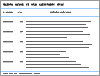
Tab.1
Comparison of clinical indicators among IgAN patients stratified by different RC levels"
| 指标 | 低RC组(n = 183) | 高RC组(n = 183) | χ2/Z值 | P值 |
|---|---|---|---|---|
| 年龄/岁 | 44(32,54) | 42(33,53) | -0.493 | 0.622 |
| 性别/例 | 0.275 | 0.600 | ||
| 男 | 101 | 96 | ||
| 女 | 82 | 87 | ||
| 身高/cm | 168(160,173) | 165(160,171) | -7.15 | 0.474 |
| 体质量/kg | 68.0(61.0,77.0) | 71.0(64.0,81.0) | -2.605 | 0.009 |
| BMI/(kg/m2) | 24.9(22.1,27.1) | 26.1(23.2,28.9) | -3.512 | < 0.001 |
| SBP/mmHg | 132(119,148) | 137(125,152) | -2.069 | 0.039 |
| DBP/mmHg | 83(76,92) | 88(79,97) | -2.793 | 0.005 |
| WBC/(× 109/L) | 6.61(5.74,7.99) | 6.98(5.86,8.12) | -1.238 | 0.216 |
| Hb/(g/L) | 133(122,148) | 137(125,149) | -1.905 | 0.057 |
| PLT/(× 109/L) | 248.0(202.0,293.0) | 238.0(209.0,278.0) | -6.26 | 0.531 |
| ALB/(g/L) | 39.8(34.3,43.0) | 38.1(32.7,41.6) | -2.072 | 0.038 |
| TG/(mmol/L) | 1.39(1.06,1.86) | 2.17(1.66,3.02) | -9.285 | < 0.001 |
| TC/(mmol/L) | 4.45(3.91,5.38) | 5.02(4.47,6.06) | -4.993 | < 0.001 |
| HDL-C/(mmol/L) | 1.15(0.94,1.36) | 1.06(0.92,1.26) | -2.246 | 0.025 |
| LDL-C/(mmol/L) | 2.79(2.25,3.54) | 2.89(2.44,3.90) | -1.863 | 0.062 |
| non-HDL-C/(mmol/L) | 3.38(2.80,4.08) | 3.93(3.49,4.98) | -6.315 | < 0.001 |
| BUN/(mmol/L) | 5.96(4.62,7.41) | 6.28(5.16,8.03) | -1.827 | 0.068 |
| eGFR/[mL/(min·1.73m2)] | 86.0(62.0,106.6) | 75.0(53.5,102.0) | -2.954 | 0.003 |
| UA/(μmol/L) | 366.5(313.8,414.0) | 378.1(331.7,449.8) | -2.867 | 0.004 |
| IgG/(g/L) | 10.10(7.89,11.66) | 10.10(7.57,11.90) | -0.409 | 0.682 |
| IgA/(g/L) | 3.18(2.41,3.88) | 3.26(2.49,3.88) | -0.268 | 0.788 |
| C3/(g/L) | 1.06(0.96,1.22) | 1.14(1.01,1.30) | -3.210 | 0.001 |
| C4/(g/L) | 0.26(0.21,0.33) | 0.28(0.24,0.34) | -1.850 | 0.064 |
| 24 h尿蛋白/(g/24 h ) | 1.98(1.16,4.33) | 3.17(1.66,6.29) | -3.715 | < 0.001 |
Tab.2
Comparison of pathological characteristics of IgAN patients across different RC level groups"
| 病理分型 | 评分 | 低RC组(n = 183) | 高RC组(n = 183) | χ2 值 | P值 |
|---|---|---|---|---|---|
| M | M0 | 37(20.2) | 49(26.8) | 2.189 | 0.139 |
| M1 | 146(79.8) | 134(73.2) | |||
| E | E0 | 157(85.8) | 164(89.6) | 1.242 | 0.265 |
| E1 | 26(14.2) | 19(10.4) | |||
| S | S0 | 111(60.7) | 106(57.9) | 0.283 | 0.595 |
| S1 | 72(39.3) | 77(42.1) | |||
| T | T0 | 126(68.9) | 87(47.5) | 17.082 | < 0.001 |
| T1/2 | 57(31.1) | 96(52.5) | |||
| C | C0 | 147(80.3) | 135(73.7) | 2.225 | 0.136 |
| C1/2 | 36(19.7) | 48(26.3) |
Tab.3
Comparison of clinical indicators in IgAN patients between t lesion groups"
| 指标 | T0组(n = 213) | T1/2组(n = 153) | χ2/Z值 | P值 |
|---|---|---|---|---|
| 年龄/岁 | 43(32,53) | 42(34,52) | -0.032 | 0.974 |
| 性别/例 | 1.997 | 0.158 | ||
| 男 | 108 | 89 | ||
| 女 | 105 | 64 | ||
| 身高/cm | 165(160,171) | 168(160,173) | -1.804 | 0.071 |
| 体质量/kg | 69.5(62.0,77.4) | 70.0(62.7,80.5) | -1.092 | 0.275 |
| BMI/(kg/m2) | 25.4(22.6,28.1) | 25.3(22.4,28.0) | -0.187 | 0.852 |
| SBP/mmHg | 130(118,146) | 143(130,158) | -5.170 | < 0.001 |
| DBP/mmHg | 82(75,92) | 90(81,97) | -3.956 | < 0.001 |
| WBC/(× 109/L) | 6.74(5.67,8.26) | 6.88(6.04,7.97) | -0.940 | 0.347 |
| Hb/(g/L) | 137(127,153) | 131(118,144) | -4.157 | < 0.001 |
| PLT/(× 109/L) | 245.0(202.5,287.5) | 240.0(211.0,281.5) | -0.199 | 0.842 |
| ALB/(g/L) | 39.8(34.1,43.2) | 37.9(33.9,41.2) | -2.269 | 0.023 |
| TG/(mmol/L) | 1.70(1.19,2.43) | 1.82(1.40,2.56) | -1.468 | 0.142 |
| TC/(mmol/L) | 4.72(4.00,5.55) | 4.93(4.30,5.97) | -2.220 | 0.026 |
| HDL-C/(mmol/L) | 1.07(0.93,1.34) | 1.11(0.92,1.30) | -0.201 | 0.840 |
| LDL-C/(mmol/L) | 2.77(2.26,3.66) | 2.92(2.45,3.75) | -1.499 | 0.134 |
| non-HDL-C/(mmol/L) | 3.62(3.00,4.24) | 3.85(3.34,4.66) | -2.435 | 0.015 |
| eGFR/[mL/(min·1.73m2)] | 97.0(72.7,110.5) | 59.9(41.0,77.0) | -10.157 | < 0.001 |
| UA/(μmol/L) | 357.0(309.2,410.8) | 396.0(347.7,463.5) | -4.766 | < 0.001 |
| IgG/(g/L) | 10.1(7.8,12.0) | 10.1(7.6,11.4) | -0.585 | 0.559 |
| IgA/(g/L) | 3.1(2.4,3.8) | 3.3(2.4,3.8) | -0.360 | 0.719 |
| C3/(g/L) | 1.10(0.99,1.28) | 1.07(0.96,1.22) | -1.350 | 0.177 |
| C4/(g/L) | 0.26(0.21,0.32) | 0.27(0.24,0.33) | -1.895 | 0.058 |
| 24 h尿蛋白(g/24 h ) | 1.86(1.11,4.28) | 3.97(1.93,6.60) | -5.236 | < 0.001 |
| RC | 0.71(0.49,0.95) | 0.84(0.63,1.10) | -4.054 | < 0.001 |
Tab.4
Logistic regression analysis of independent risk factors for T1/2 lesions in patients with IgA nephropathy"
| 变量 | 单因素 | 多因素 | |||
|---|---|---|---|---|---|
| OR(95% CI) | P值 | OR(95% CI) | P 值 | ||
| SBP | 1.026(1.016 ~ 1.037) | < 0.001 | 1.008(0.991 ~ 1.025) | 0.375 | |
| DBP | 1.035(1.018 ~ 1.052) | < 0.001 | 1.018(0.990 ~ 1.046) | 0.211 | |
| Hb | 0.972(0.960 ~ 0.984) | < 0.001 | 0.975(0.959 ~ 0.991) | 0.002 | |
| RC | 4.108(2.057 ~ 8.206) | < 0.001 | 3.333(1.371 ~ 8.100) | 0.008 | |
| eGFR | 0.955(0.946 ~ 0.965) | < 0.001 | 0.964(0.953 ~ 0.975) | < 0.001 | |
| UA | 1.006(1.003 ~ 1.008) | < 0.001 | 1.004(1.001 ~ 1.007) | 0.024 | |
| 24 h尿蛋白 | 1.083(1.026 ~ 1.143) | 0.004 | 1.060(0.992 ~ 1.131) | 0.083 | |
| ALB | 0.984(0.954 ~ 1.014) | 0.287 | |||
| TC | 1.088(0.947 ~ 1.249) | 0.233 | |||
| non-HDL-C | 1.132(0.970 ~ 1.321) | 0.115 | |||

Fig.1
Curvilinear relationship between RC and T1/2 lesion of IgAN patient"

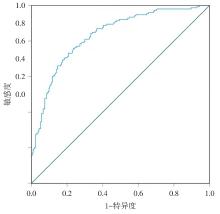
Fig.2
ROC curve of the predictive model for T1/2 lesion of IgAN patient"


Fig.3
Forest plot of the risk of T1/T2 lesions in different subgroups of IgAN patients"

| [1] | 张胜雷,田芮聪,靳晶晶,等. IgA肾病患者的淋巴细及肾脏预后的关系胞亚群与临床病理特征[J]. 实用医学杂志,2025,41(3):352-357. |
| [2] |
LIU S D, LU Z Z, FU Z K, et al. Clinicopathological Characteristics and Outcomes of Immunoglobulin A Nephropathy with Different Types of Dyslipidemia: A Retrospective Single-Center Study[J]. Kidney Blood Press Res,2023,48(1): 186-193. doi:10.1159/000529822
doi: 10.1159/000529822 |
| [3] |
PEI G Q, QIN A Y, DONG L Q,et al. Prognostic value of triglyceride to high-density lipoprotein cholesterol ratio (TG/HDL-C) in IgA nephropathy patients[J].Front Endocrinol (Lausanne),2022,13:877794. doi:10.3389/fendo.2022.877794
doi: 10.3389/fendo.2022.877794 |
| [4] |
ZHUANG H J, LIN Z L, ZENG S H,et al.Dyslipidemia may be a risk factor for progression in children with IgA nephropathy[J].Pediatr Nephrol,2022,37 (12):3147-3156. doi:10.1007/s00467-022-05480-x
doi: 10.1007/s00467-022-05480-x |
| [5] |
ANGELA P, ALBERICO L C. Remnant cholesterol: A reliable prognostic marker?[J]. Eur J Prev Cardiol,2024,31(10): 1203-1204. doi:10.1093/eurjpc/zwad107
doi: 10.1093/eurjpc/zwad107 |
| [6] |
DENG J H, TANG R Y, CHEN J X,et al. Remnant cholesterol as a risk factor for all-cause and cardiovascular mortality in incident peritoneal dialysis patients[J]. Nutr Metab Cardiovasc Dis,2023,33(5):1049-1056. doi:10.1016/j.numecd.2023.02.009
doi: 10.1016/j.numecd.2023.02.009 |
| [7] |
LI B, WANG A, WANG Y,et al. A study on the correlation between remnant cholesterol and urinary albumin to creatinine ratio in Chinese community adults: A report from the REACTION study[J]. J Diabetes,2020, 12(2):870-880. doi:10.1111/1753-0407.13076
doi: 10.1111/1753-0407.13076 |
| [8] |
SOO Y J, MIN W K, EYUN S,et al. Remnant cholesterol is an independent risk factor for the incidence of chronic kidney disease in newly-diagnosed type 2 diabetes: A nationwide population-based study[J]. Diabetes Research and Clinical Practice,2024,210:111639. doi:10.1016/j.diabres.2024.111639
doi: 10.1016/j.diabres.2024.111639 |
| [9] |
ZHU W, LIU Q, LIU F,et al. High remnant cholesterol as a risk factor for developing chronic kidney disease in patients with prediabetes and type 2 diabetes: A cross-sectional study of a US population[J]. Acta Diabetol,2024,61(6):735-743. doi:10.1007/s00592-024-02249-6
doi: 10.1007/s00592-024-02249-6 |
| [10] | TRIMARCHI H, BARRATT J, CATTRAN D C, et al. Oxford classification of IgA nephropathy 2016:An update from the IgA nephropathy classification working group[J]. Kidney Int,2017,91(5):1014-1021. |
| [11] | XIONG Y J, SHAO D M, ZHU X Y,et al. Joint Association of Remnant Cholesterol and Body Mass Index with Hypertension: A National Cohort Study in Chinese Adults[J]. J Multidiscip Healthc,2025,30(18):1813-1825. |
| [12] | PASCHALIS K, DIMITRIOS P, MANFREDI R,et al. Association between remnant cholesterol and chronic kidney disease: Systematic review and meta-analysis[J]. Diabe tes Obes Metab,2025,27(5):2573-2583. |
| [13] | YUAN Y G, HU X M, ZHANG S H,et al. High remnant-cholesterol levels increase the risk for end-stage renal disease: A nationwide, population-based,cohort study[J]. J Multidiscip Healthc,2025,30 (18):1813-1825. |
| [14] |
DUCASA G M, MITROFANOVA A, MALLELA S K, et al. ATP-binding cassette A1 deficiency causes cardiolipin-driven mitochondrial dysfunction in podocytes[J]. J Clin Invest,2019,129(8):3387-3400. doi:10.1172/jci125316
doi: 10.1172/jci125316 |
| [15] |
ZHAO Y F, ZHU L, LIU L J, et al. Measures of urinary protein and albumin in the prediction of progression of IgA nephropathy[J]. Clin J Am Soc Nephrol,2016,11(6):947-955. doi:10.2215/cjn.10150915
doi: 10.2215/cjn.10150915 |
| [16] |
WANG S Q, DONG L Q, QIN A Y, et al. Roles of mesangial C3 and C1q deposition in the clinical manifestations and prognosis of IgAN[J]. Int Immunopharmacol,2023,120:110354. doi:10.1016/j.intimp.2023.110354
doi: 10.1016/j.intimp.2023.110354 |
| [17] |
HONG Y A, MIN J W, MYUNGy A H, et al. The Impact of Obesity on the Severity of Clinicopathologic Parameters in Patients with IgA Nephropathy[J]. J Clin Med,2020,9(9):2824. doi:10.3390/jcm9092824
doi: 10.3390/jcm9092824 |
| [18] |
NORDESTGAAR D B G.Triglyceride-rich lipoproteins and atherosclerotic cardiovascular disease:New insights from epidemiology,genetics,and biology[J]. Circ Res,2016,118(4):547-563. doi:10.1161/circresaha.115.306249
doi: 10.1161/circresaha.115.306249 |
| [19] |
MA L, GILANI A, RUBIO-NAVARRO A, et al. Adipsin and adipocyte-derived C3aR1 regulate thermogenic fat in a sex-dependent fashion[J]. JCI Insight,2024,9(11):e178925. doi:10.1172/jci.insight.178925
doi: 10.1172/jci.insight.178925 |
| [20] |
ZHOU W, WANG T, ZHU L J, et al. Associations of body mass index and remnant cholesterol with hyperuricemia in patients with hypertension[J]. BMC Endocr Disord,2025,25(1):73. doi:10.1186/s12902-025-01902-7
doi: 10.1186/s12902-025-01902-7 |
| [21] |
LIU B M, ZHAO L Y, YANG Q Q, et al. Hyperuricemia and hypertriglyceridemia indicate tubular atrophy/interstitial fbrosis in patients with IgA nephropathy and membranous Nephropathy[J].Int Urol Nephrol, 2021,53(11): 2321-2332. doi:10.1007/s11255-021-02844-4
doi: 10.1007/s11255-021-02844-4 |
| [22] |
ZHANG K, TANG L, JIANG S S,et al. Is hyperuricemia an independent prognostic factor for IgA nephropathy: A systematic review and meta-analysis of observational cohort studies[J]. Ren Fail,2022,44(1):70-80. doi:10.1080/0886022x.2021.2019589
doi: 10.1080/0886022x.2021.2019589 |
| [23] |
TU M Y, HU S P, LOU Z Q. A high value of fibrinogen in immunoglobulin A nephropathy patients is associated with a worse renal tubular atrophy/interstitial fibrosis score[J]. J Clin Lab Anal,2022,36 (1):e24120. doi:10.1002/jcla.24120
doi: 10.1002/jcla.24120 |
| [24] |
MOHD R, MOHAMMAD K N E, ABDUL C R,et al. Long term outcome of immunoglo bulin A (IgA) nephropathy: A single center experience[J]. PloS one,2021,16 (4):249-265. doi:10.1371/journal.pone.0249592
doi: 10.1371/journal.pone.0249592 |
| [25] |
CHEN S X, CHEN J X, LI S M, et al. High-fat diet-induced renal proximal tubular inflammatory injury: Emerging risk factor of chronic kidney disease[J]. Front In Physiol,2021,12:786599. doi:10.3389/fphys.2021.786599
doi: 10.3389/fphys.2021.786599 |
| [26] |
DU X G, RUAN X Z. Lipid metabolism disorder and renal fibrosis[J]. Adv In Exp Med Biol,2019,1165:525-541. doi:10.1007/978-981-13-8871-2_26
doi: 10.1007/978-981-13-8871-2_26 |
| [27] |
FERRO C J, MARK P B, KANBAY M,et al. Lipid management in patients with chronic kidney disease[J]. Nat Rev Nephrol,2018,14(12):727-749. doi:10.1038/s41581-018-0072-9
doi: 10.1038/s41581-018-0072-9 |
| [28] |
WEN D M, TANG Y, TAN L,et al. Sex disparities in IgA nephropathy: A retrospective study in Chinese patients[J]. Int Urol Nephrol,2021,53(2):315-323. doi:10.1007/s11255-020-02631-7
doi: 10.1007/s11255-020-02631-7 |
| [29] |
CAO R, SU W, SHENG J, et al. Estrogen receptor β attenuates renal fibrosis by suppressing the transcriptional activity of Smad3[J]. Biochim Biophys Acta Mol Basis Dis,2023,1869(6):166755. doi:10.1016/j.bbadis.2023.166755
doi: 10.1016/j.bbadis.2023.166755 |
| [30] |
NASHAT A. Men's health disparities: Causes and interventions[J]. Nurs Forum,2022,57 (5):785-792. doi:10.1111/nuf.12764
doi: 10.1111/nuf.12764 |
| [1] | Lili SU,Nuo LI,Wei FANG,Menghua CHEN,Sina QIN,Yegui YANG. Association between residual cholesterol and metabolic associated fatty liver disease risk at different triglyceride levels [J]. The Journal of Practical Medicine, 2025, 41(17): 2676-2682. |
| [2] | Rui LU,Ye CHEN,Di WANG,Lijuan ZHAO,Meilan ZHOU,Ming BAI,Lijie HE,Shiren. SUN. Analysis on clinicopathologic features and prognosis of proliferative glomerulonephritis with monoclonal IgG deposits [J]. The Journal of Practical Medicine, 2024, 40(24): 3468-3475. |
| [3] | Ruiting XI,Suxia GENG,Xin HUANG,Minming LI,Chengxin DENG,Yulian WANG,Lisi HUANG,Jianyu WENG,Xin. DU. Levels and significance of γδ T cells and their subpopulations in the bone marrow of MDS patients [J]. The Journal of Practical Medicine, 2023, 39(24): 3195-3199. |
| [4] | Minyu HUANG,Jun WU,Tianzi QIN,Wei ZHOU,Lize SU,Rong QIU,Lu. HUANG. The prognostic value of serum DCLK1 and sTim⁃3 in patients undergoing radical prostatectomy for prostate cancer [J]. The Journal of Practical Medicine, 2023, 39(18): 2368-2372. |
| [5] |
JU Mingfei, LIU Chao, LIU Jiamei, SHAO Wen′ge, LIU Tingting, ZHAO Juan..
Correlation between remnant cholesterol levels and the severity of coronary artery stenosis in patients with ACS [J]. The Journal of Practical Medicine, 2023, 39(1): 71-75. |
| [6] |
HE Guiqiang, ZHAO Shunshun, LANG Yanzhu, WANG Xiaojing, OUYANG Yao..
Role of secretory immunoglobulin A in chronic airway diseases:A review of recent studies [J]. The Journal of Practical Medicine, 2022, 38(20): 2620-2623. |
| [7] |
KELIESI·Batiman, HADEER·Maierbati..
Expression of Toll⁃like receptor,D⁃dimer and sIgA/ALB in patients with repeated viral respiratory infec⁃ tions and their relationship with severity of disease and prognosis [J]. The Journal of Practical Medicine, 2021, 37(18): 2386-2390. |
| Viewed | ||||||
|
Full text |
|
|||||
|
Abstract |
|
|||||
