

The Journal of Practical Medicine ›› 2026, Vol. 42 ›› Issue (3): 497-503.doi: 10.3969/j.issn.1006-5725.2026.03.018
• Treatise: Clinical Practice • Previous Articles
Qiaolin ZHANG,Guihong XU,Cheng HANG,Mingming DING,Lamei YU( )
)
Received:2025-09-28
Online:2026-02-10
Published:2026-02-09
Contact:
Lamei YU
E-mail:3938308538@qq.com
CLC Number:
Qiaolin ZHANG,Guihong XU,Cheng HANG,Mingming DING,Lamei YU. The mediating role of sleep quality in adolescents between rumination and depressive symptoms[J]. The Journal of Practical Medicine, 2026, 42(3): 497-503.
Tab. 1
Scores of PSQI, RRS-C, and CES-D in adolescents"
| 项目 | 得分 | 条目均分 | 分类或条目均分排序 |
|---|---|---|---|
| PSQI | 12.06 ± 2.14 | 1.72 ± 0.23 | 睡眠质量良好92例(30.67%);睡眠质量差208例(69.33%) |
| RRS-C | |||
| 抑郁相关(11个条目) | 18.11 ± 3.73 | 1.65 ± 0.26 | 1 |
| 强迫冥想(5个条目) | 8.06 ± 1.22 | 1.61 ± 0.29 | 2 |
| 反思(5个条目) | 7.86 ± 1.14 | 1.57 ± 0.25 | 3 |
| 总计(21个条目) | 34.03 ± 6.17 | 1.62 ± 0.30 | |
| CES-D | |||
| 抑郁情绪(8个条目) | 10.26 ± 2.11 | 1.28 ± 0.23 | 2 |
| 积极情绪(4个条目) | 5.15 ± 1.01 | 1.29 ± 0.24 | 1 |
| 躯体症状与活动迟滞(6个条目) | 6.87 ± 1.29 | 1.15 ± 0.20 | 3 |
| 人际关系(2个条目) | 2.02 ± 0.31 | 1.01 ± 0.15 | 4 |
| 总计(20个条目) | 24.30 ± 4.37 | 1.22 ± 0.22 | 存在抑郁症状132例(88.00%) |
Tab. 2
Comparison of CES-D scores across different"
| 资料 | 例数(n = 300) | CES-D评分 | t/F值 | P值 |
|---|---|---|---|---|
| 性别 | 4.089 | 0.001 | ||
| 男 | 98 | 22.72 ± 5.02 | ||
| 女 | 202 | 25.07 ± 4.49 | ||
| 年龄 | 4.083 | 0.001 | ||
| 12 ~ 15岁 | 122 | 25.54 ± 4.56 | ||
| 16 ~ 18岁 | 178 | 23.45 ± 4.21 | ||
| 居住地 | 0.882 | 0.378 | ||
| 城市 | 204 | 24.45 ± 4.19 | ||
| 农村 | 96 | 23.98 ± 4.54 | ||
| 家庭年收入 | 1.427 | 0.242 | ||
| < 5年 | 84 | 24.10 ± 4.13 | ||
| 5 ~ 10年 | 116 | 23.93 ± 4.65 | ||
| > 10年 | 100 | 24.90 ± 4.32 | ||
| 父母婚姻状况 | 3.945 | 0.001 | ||
| 在婚 | 236 | 23.80 ± 4.13 | ||
| 离异或再婚 | 64 | 26.14 ± 4.49 | ||
| 父亲文化程度 | 0.757 | 0.470 | ||
| 初中及以下 | 124 | 24.67 ± 4.53 | ||
| 高中或中专 | 80 | 24.16 ± 4.79 | ||
| 大专及以上 | 96 | 23.94 ± 4.28 | ||
| 母亲文化程度 | 0.823 | 0.440 | ||
| 初中及以下 | 120 | 24.71 ± 4.87 | ||
| 高中或中专 | 86 | 24.10 ± 4.54 | ||
| 大专及以上 | 94 | 23.96 ± 4.21 | ||
| 独生子女 | 5.213 | < 0.001 | ||
| 是 | 130 | 25.86 ± 4.89 | ||
| 否 | 170 | 23.11 ± 4.23 | ||
| 学习日住校 | 3.093 | 0.002 | ||
| 是 | 96 | 25.44 ± 4.61 | ||
| 否 | 204 | 23.76 ± 4.28 | ||
| 抑郁症家族史 | 0.490 | 0.625 | ||
| 是 | 32 | 24.65 ± 4.59 | ||
| 否 | 268 | 24.26 ± 4.22 | ||
| 每周锻炼次数 | 0.811 | 0.446 | ||
| < 2次 | 130 | 24.67 ± 4.67 | ||
| 2 ~ 4次 | 100 | 24.12 ± 4.28 | ||
| ≥ 5次 | 70 | 23.87 ± 4.81 | ||
| 遭受校园欺凌 | 5.154 | < 0.001 | ||
| 是 | 70 | 27.19 ± 4.62 | ||
| 否 | 82 | 23.21 ± 4.85 |
Tab.3
Factors influencing depressive symptomsin adolescents"
| 变量 | 模型1 | ||||
|---|---|---|---|---|---|
| β | SE | β′ | t值 | P值 | |
| 性别 | 0.468 | 0.195 | 0.449 | 2.400 | 0.036 |
| 年龄 | -0.445 | 0.202 | -0.437 | -2.203 | 0.041 |
| 父母婚姻状况 | 0.434 | 0.213 | 0.419 | 2.038 | 0.048 |
| 独生子女 | 0.492 | 0.189 | 0.468 | 2.603 | 0.031 |
| 学习日住校 | 0.403 | 0.228 | 0.394 | 1.768 | 0.060 |
| 遭受校园欺凌 | 0.496 | 0.177 | 0.482 | 2.652 | 0.030 |
| R2 | 0.379 | ||||
| 调整后R2 | 0.358 | ||||
| F值 | 10.989 | ||||
| P值 | < 0.001 | ||||
| 变量 | 模型2 | ||||
| β | SE | β′ | t值 | P值 | |
| 性别 | 0.440 | 0.191 | 0.423 | 2.304 | 0.038 |
| 年龄 | -0.428 | 0.198 | -0.413 | -2.162 | 0.042 |
| 父母婚姻状况 | 0.415 | 0.211 | 0.402 | 1.967 | 0.054 |
| 独生子女 | 0.463 | 0.196 | 0.431 | 2.362 | 0.038 |
| 学习日住校 | 0.394 | 0.231 | 0.388 | 1.706 | 0.068 |
| 遭受校园欺凌 | 0.495 | 0.199 | 0.482 | 2.487 | 0.034 |
| PSQI评分 | 0.513 | 0.190 | 0.502 | 2.700 | 0.029 |
| R2 | 0.499 | ||||
| 调整后R2 | 0.487 | ||||
| F值 | 18.324 | ||||
| P值 | < 0.001 | ||||
| 变量 | 模型3 | ||||
| β | SE | β′ | t值 | P值 | |
| 性别 | 0.421 | 0.201 | 0.405 | 2.095 | 0.047 |
| 年龄 | -0.408 | 0.215 | -0.396 | -1.898 | 0.057 |
| 父母婚姻状况 | 0.394 | 0.217 | 0.381 | 1.816 | 0.060 |
| 独生子女 | 0.439 | 0.204 | 0.424 | 2.152 | 0.042 |
| 学习日住校 | 0.367 | 0.229 | 0.354 | 1.603 | 0.072 |
| 遭受校园欺凌 | 0.471 | 0.198 | 0.455 | 2.379 | 0.036 |
| PSQI评分 | 0.499 | 0.199 | 0.483 | 2.508 | 0.031 |
| RRS-C评分 | 0.509 | 0.193 | 0.508 | 2.637 | 0.030 |
| R2 | 0.621 | ||||
| 调整后R2 | 0.607 | ||||
| F值 | 24.918 | ||||
| P值 | < 0.001 | ||||
Tab.4
The mediating effect of sleep quality on the relationship between rumination and depressive symptoms in adolescents"
| 回归方程 | 拟合指标 | 系数显著性 | |||||
|---|---|---|---|---|---|---|---|
| 结果变量 | 预测变量 | R2 | 调整R2 | F | β | t值 | P值 |
| 抑郁症状 | 0.329 | 0.322 | 12.698 | ||||
| 冗思 | 0.337 | 4.002 | < 0.001 | ||||
| 睡眠质量 | 0.231 | 0.219 | 6.610 | ||||
| 冗思 | 0.135 | 2.421 | 0.030 | ||||
| 抑郁症状 | 0.439 | 0.418 | 21.325 | ||||
| 睡眠质量 | 0.462 | 4.032 | < 0.001 | ||||
| 冗思 | 0.320 | 3.349 | 0.011 | ||||
Tab.5
Results of mediation effect test"
| 效应 | 效应值 | SE | 95%CI | 效应值占比 |
|---|---|---|---|---|
| 总效应 | 0.493 | 0.037 | 0.233 ~ 1.043 | |
| 直接效应:冗思→抑郁症状 | 0.337 | 0.043 | 0.172 ~ 0.660 | 68.36% |
| 间接效应:冗思→睡眠质量→抑郁症状 | 0.156 | 0.034 | 0.041 ~ 0.594 | 31.64% |
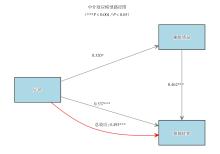
Fig.1
The mediation model diagram of sleep quality between rumination and depressive symptoms"
| [1] |
LIU X, GUO S, ZHANG M,et al. Depressive symptoms among Chinese adolescents from single parent families present a downward trend in the past 25 years: A cross-temporal meta-analysis[J]. Asian J Psychiatr, 2024, 102(1): 104288. doi: 10.1016/j.ajp.2024.104288 .
doi: 10.1016/j.ajp.2024.104288 |
| [2] | 傅小兰,张侃,陈雪峰,等.中国国民心理健康发展报告(2019—2020)[M].北京:社会科学文献出版社,2021. |
| [3] |
董晓杰,王鹏,马俊华,等. 青少年抑郁症患者人格特征与非自杀性自伤行为的相关性分析[J]. 实用医学杂志,2024,40(20):2848-2853. doi: 10.3969/j.issn.1006-5725.2024.20.006 .
doi: 10.3969/j.issn.1006-5725.2024.20.006 |
| [4] |
QIAO X, SHI X, CHEN X,et al. Associations between insomnia symptom trajectories with depression and self-harm behaviors in Chinese college students before and during the COVID-19 pandemic: A five-wave longitudinal investigation[J]. J Affect Disord,2023,339(1):877-886. doi: 10.1016/j.jad.2023.07.108 .
doi: 10.1016/j.jad.2023.07.108 |
| [5] |
张正,孟芸,王园园. 数字疗法在青少年社交焦虑障碍干预中的应用、发展与挑战[J]. 实用医学杂志,2025,41(10):1439-1444. doi: 10.3969/j.issn.1006-5725.2025.10.002 .
doi: 10.3969/j.issn.1006-5725.2025.10.002 |
| [6] |
ZHANG J, WANG E, ZHANG L,et al. Internet addiction and depressive symptoms in adolescents: Joint trajectories and predictors[J]. Front Public Health,2024,12(1):1374762. doi: 10.1016/j.jad.2023.07.108 .
doi: 10.1016/j.jad.2023.07.108 |
| [7] |
LI C, ZHANG Y, CHANG R,et al. The mediation and interaction effects of Internet addiction in the association between family functioning and depressive symptoms among adolescents: A four-way decomposition[J]. J Affect Disord,2024,356(1):41-47. doi: 10.1016/j.jad.2024.03.103 .
doi: 10.1016/j.jad.2024.03.103 |
| [8] | 中国科学院心理研究所国民心理健康评估发展中心. 2024年儿童青少年抑郁治疗与康复痛点调研报告[R]. 北京:中国科学院心理研究所,2024. |
| [9] |
郑芳,陈长香,崔兆一. 衰弱和睡眠质量对农村老年人家庭支持和跌倒风险的链式中介作用研究[J]. 中国全科医学,2021,24(9):1071-1075. doi: 10.12114/j.issn.1007-9572.2021.00.051 .
doi: 10.12114/j.issn.1007-9572.2021.00.051 |
| [10] |
杨娟,凌宇,肖晶,等. 沉思反应量表中文版在高中生中初步运用结果分析[J]. 中国临床心理学杂志,2009,17(1):27-28,31. doi: 10.16128/j.cnki.1005-3611.2009.01.021 .
doi: 10.16128/j.cnki.1005-3611.2009.01.021 |
| [11] |
GUI Y, DENG Y, SUN X,et al. Early childhood sleep trajectories and association with maternal depression: A prospective cohort study[J]. Sleep,2022,45(5):zsac037. doi: 10.1093/sleep/zsac037 .
doi: 10.1093/sleep/zsac037 |
| [12] |
SHANG R, PANG H, JIANG J,et al. Internet addiction and depressive and anxious symptoms among Chinese rural left-behind adolescents: Mediating roles of resilience and friendship quality[J]. Child Care Health Dev,2024,50(1):e13160. doi: 10.1111/cch.13160 .
doi: 10.1111/cch.13160 |
| [13] |
WANG E, ZHANG J, PENG S,et al. The Association Between Family Function and Adolescents' Depressive Symptoms in China: A Longitudinal Cross-Lagged Analysis[J]. Front Psychiatry,2021,12(1):744976. doi: 10.3389/fpsyt.2021.744976 .
doi: 10.3389/fpsyt.2021.744976 |
| [14] |
刘福荣,宋晓琴,尚小平,等. 中学生抑郁症状检出率的meta分析[J]. 中国心理卫生杂志,2020,34(2):123-128. doi: 10.3969/j.issn.1000-6729.2020.2.008 .
doi: 10.3969/j.issn.1000-6729.2020.2.008 |
| [15] |
O'CALLAGHAN V S, COUVY-DUCHESNE B, STRIKE L T,et al. A meta-analysis of the relationship between subjective sleep and depressive symptoms in adolescence[J]. Sleep Med,2021,79(1):134-144. doi: 10.1016/j.sleep.2021.01.011 .
doi: 10.1016/j.sleep.2021.01.011 |
| [16] |
ALONZO R, HUSSAIN J, STRANGES S,et al. Interplay between social media use,sleep quality,and mental health in youth: A systematic review[J]. Sleep Med Rev,2021,56(1):101414. doi: 10.1016/j.smrv.2020.101414 .
doi: 10.1016/j.smrv.2020.101414 |
| [17] |
林荣茂,沈逸琳,林楠,等. 青少年睡眠质量的异质性:基于潜在剖面分析[J]. 中国临床心理学杂志,2023,31(2):442-446. doi: 10.16128/j.cnki.1005-3611.2023.02.037 .
doi: 10.16128/j.cnki.1005-3611.2023.02.037 |
| [18] |
孔令华,王馨悦,俞人婕,等. 苏州市青少年睡眠质量状况调查及影响因素分析[J]. 精神医学杂志,2025,38(1):36-40. doi: 10.3969/j.issn.2095-9346.2025.01.007 .
doi: 10.3969/j.issn.2095-9346.2025.01.007 |
| [19] |
BOLSIUS Y G, ZURBRIGGEN M D, KIM J K,et al. The role of clock genes in sleep,stress and memory[J]. Biochem Pharmacol,2021,191(1):114493. doi: 10.1016/j.bcp.2021.114493 .
doi: 10.1016/j.bcp.2021.114493 |
| [20] |
HASEGAWA A, MATSUMOTO N, YAMASHITA Y,et al. Response inhibition deficits are positively associated with trait rumination,but attentional inhibition deficits are not: Aggressive behaviors and interpersonal stressors as mediators[J]. Psychol Res,2022,86(3):858-870. doi: 10.1007/s00426-021-01537-y .
doi: 10.1007/s00426-021-01537-y |
| [21] |
王燕,海洋. 反刍思维与安全感在青少年抑郁症患者冲动性人格和自杀风险间的链式中介作用[J]. 护理学杂志,2024,39(17):93-96. doi: 10.3870/j.issn.1001-4152.2024.17.093 .
doi: 10.3870/j.issn.1001-4152.2024.17.093 |
| [22] |
刘莉莉,孔凡贞,季彩芳,等.反刍思维对首发抑郁症患者1年结局的影响:家庭功能的中介作用[J].中华行为医学与脑科学杂志,2022,31(10):887-892. doi: 10.3760/cma.j.cn371468-20220402-00157 .
doi: 10.3760/cma.j.cn371468-20220402-00157 |
| [23] |
杨凯,刘娜娜,刘燕. 肺癌患者抑郁与反刍思维和领悟社会支持之间的关系[J]. 中国肿瘤临床与康复,2023,30(4):257-261. doi: 10.13455/j.cnki.cjcor.113494-20230420-0071 .
doi: 10.13455/j.cnki.cjcor.113494-20230420-0071 |
| [24] |
LAYOUS K, KUMAR S A, ARENDTSON M, et al. The effects of rumination, distraction, and gratitude on positive and negative affect[J]. J Pers Soc Psychol,2023,124(5):1053-1078. doi: 10.1037/pspp0000440 .
doi: 10.1037/pspp0000440 |
| [25] |
李娟娟,章荣华,邹艳,等. 浙江省青少年抑郁症状的影响因素分析[J]. 预防医学,2021,33(2):139-142. doi: 10.19485/j.cnki.issn2096-5087.2021.02.008 .
doi: 10.19485/j.cnki.issn2096-5087.2021.02.008 |
| [26] |
ZHU X, AN N, TANG Z,et al. Influencing factors and changing trends of depressive symptoms among middle and junior high school students in Eastern China from 2019 to 2023: A cross-sectional study[J]. BMC Public Health,2025,25(1):17. doi: 10.1186/s12889-024-21252-8 .
doi: 10.1186/s12889-024-21252-8 |
| [27] |
WANG A, XU Z, LIU C,et al. The Relationship Between Childhood Maltreatment and Insomnia in Depressed Adolescents: The Mediating Role of Rumination[J]. Brain Behav,2025,15(5):e70554. doi: 10.1002/brb3.70554 .
doi: 10.1002/brb3.70554 |
| [28] |
ZHANG D, QU Y, ZHAI S,et al. Association between healthy sleep patterns and depressive trajectories among college students: A prospective cohort study[J]. BMC Psychiatry,2023,23(1):182. doi: 10.1186/s12888-023-04596-0 .
doi: 10.1186/s12888-023-04596-0 |
| [29] |
江敏敏,王艳秋,赵颖,等. 大学生睡眠质量在网络成瘾与抑郁、焦虑间的中介效应[J]. 皖南医学院学报,2021,40(3):272-275. doi: 10.3969/j.issn.1002-0217.2021.03.019 .
doi: 10.3969/j.issn.1002-0217.2021.03.019 |
| Viewed | ||||||
|
Full text |
|
|||||
|
Abstract |
|
|||||
