

The Journal of Practical Medicine ›› 2026, Vol. 42 ›› Issue (13): 2388-2395.doi: 10.3969/j.issn.1006-5725.2026.13.015
• Chronic Disease Control • Previous Articles
Junlin XIAO1,2,Guibin WANG3,Junfeng LIU2,Chuofan CHEN4,Xiumei MO2,Dachan CHEN2( ),Xiaobo YU3
Received:2026-04-09
Online:2026-07-10
Published:2026-07-14
Contact:
Dachan CHEN
E-mail:4910702@163.com
CLC Number:
Junlin XIAO,Guibin WANG,Junfeng LIU,Chuofan CHEN,Xiumei MO,Dachan CHEN,Xiaobo YU. Value of combined detection of serum oxct1 and xirp2 with disease severity and prognosis in children with atopic dermatitis[J]. The Journal of Practical Medicine, 2026, 42(13): 2388-2395.
Tab.1
Comparison of the differences of serum OXCT1, XIRP2 between control group and observation group"
| 项目 | 对照组(n = 30) | 观察组(n = 30) | U值 | P值 | logFC |
|---|---|---|---|---|---|
| OXCT1 | 152.96(326.09) | 15 602.93(12 900.51) | -6.62 | 0.01 | 1.44 |
| XIRP2 | 20 969.03(13 840.97) | 295.14(2 658.66) | -6.65 | 0.01 | -1.18 |
Tab.2
Comparison of serum OXCT1、XIRP2 in children with different disease severity"
| 项目 | 中度组(n = 15) | 重度组(n = 15) | r值 | P值 |
|---|---|---|---|---|
| OXCT1 | 7 978.93(11 417.17) | 19 022.86(8 784.42) | 0.547 | 0.002 |
| XIRP2 | 2 245.85(2 728.73) | 110.07(333.81) | -0.561 | 0.001 |
Tab.3
Comparison of clinical data and IgE and Eosinophil level between good prognosis group and poor prognosis group"
| 项目 | 预后不良组(n = 10) | 预后良好组(n = 20) | t/χ2值 | P值 |
|---|---|---|---|---|
| 年龄(x ± s)/岁 | 10.80 ± 2.74 | 9.70 ± 3.28 | 0.912 | 0.37 |
| 性别 | -0.254 | 0.80 | ||
| 男 | 5(50.0) | 11(55.0) | ||
| 女 | 5(50.0) | 9(45.0) | ||
| 病情严重程度 | -1.226 | 0.23 | ||
| 中度 | 6(60.0) | 9(45.0) | ||
| 重度 | 4(40.0) | 11(55.0) | ||
| 瘙痒严重程度 | -1.342 | 0.19 | ||
| 轻度 | 5(50.0) | 6(30.0) | ||
| 中度 | 3(30.0) | 10(50.0) | ||
| 重度 | 2(20.0) | 4(20.0) | ||
| 自评严重程度 | ||||
| 轻度 | 0.002 | 0.96 | ||
| 中度 | 1(10.0) | 3(15.0) | ||
| 重度 | 3(30.0) | 5(25.0) | ||
| 极重度 | 4(40.0) | 7(35.0) | ||
| IgE升高 | 7(70.0) | 16(80.0) | -0.600 | 0.68 |
| EOS升高 | 3(30.0) | 9(45.0) | -0.777 | 0.53 |
Tab.4
Comparison of the differences of serum OXCT1, XIRP2 between good prognosis group and poor prognosis group"
| 项目 | 预后不良组(n = 10) | 预后良好组(n = 20) | U值 | P值 | logFC |
|---|---|---|---|---|---|
| OXCT1 | 5 036.23(8 316.95) | 19 366.77(10 501.72) | -3.94 | 0.01 | 0.42 |
| XIRP2 | 3 012.41(2 775.05) | 124.33(221.95) | -3.39 | 0.01 | -0.75 |
Tab.5
Influencing factors of poor prognosis in children with atopic dermatitis"
| 项目 | β | SE | Wald | P值 | OR值 | 95%CI |
|---|---|---|---|---|---|---|
| OXCT1 | -2.709 | 0.939 | 8.332 | 0.004 | 0.067 | 0.011 ~ 0.419 |
| XIRP2 | 1.996 | 0.652 | 9.366 | 0.002 | 7.357 | 2.049 ~ 26.413 |
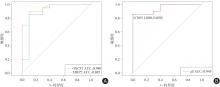
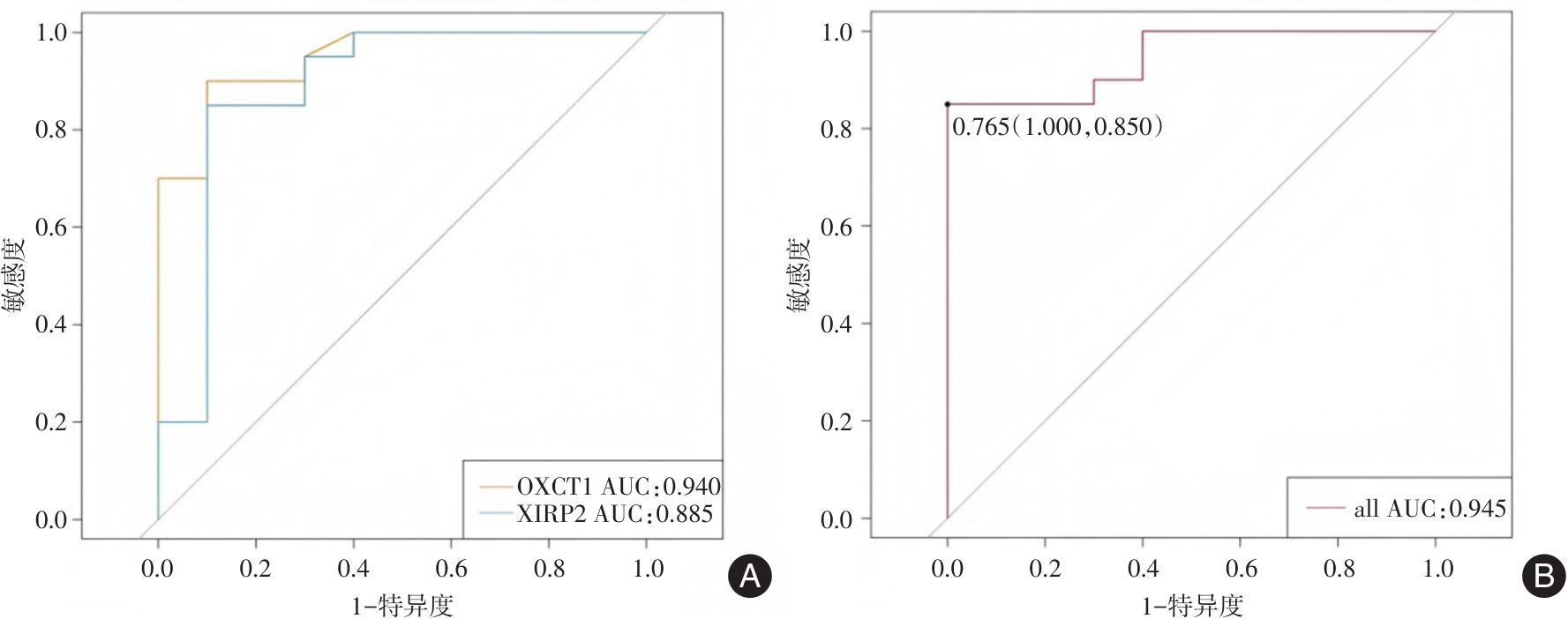
Fig.1
ROC curve of serum OXCT1, XIRP2 and their combination in predicting poor prognosis in children with atopic dermatitis"
| [1] |
CHU D K, SCHNEIDER L, ASINIWASIS R N, et al. Atopic dermatitis (eczema) guidelines: 2023 American Academy of Allergy, Asthma and Immunology/American College of Allergy, Asthma and Immunology Joint Task Force on Practice Parameters GRADE⁃and Institute of Medicine⁃based recommendations[J]. Ann Allergy Asthma Immunol, 2024, 132(3): 274-312. doi:10.1016/j.anai.2023.11.009 .
doi: 10.1016/j.anai.2023.11.009 |
| [2] |
CHUNG W K, VAN TILBORG-DEN BOEFT M, DE SCHEPPER E, et al. Prevalence of childhood atopic triad: Atopic dermatitis, asthma and allergic rhinitis, a Rijnmond Primary Care database study[C]//Child and Adolescent Health. American Academy of Family Physicians, 2023: 4788. doi:10.1370/afm.22.s1.4788 .
doi: 10.1370/afm.22.s1.4788 |
| [3] |
赵鋆, 马春艳, 邓丹, 等. 儿童特应性皮炎(湿疹)中医药干预方案专家共识[J]. 中国中西医结合儿科学, 2024, 16(3): 185-190.doi: 10.3969/j.issn.1674-3865.2024.03.001 .
doi: 10.3969/j.issn.1674-3865.2024.03.001 |
| [4] |
中华医学会皮肤性病学分会, 中国中西医结合学会皮肤性病专业委员会, 中国医师协会皮肤科医师分会. 中国甲真菌病诊疗指南(2015年版)[J]. 中国真菌学杂志, 2015, 10(2): 118-125. doi: 10.3969/j.issn.1673-3827.2015.02.018 .
doi: 10.3969/j.issn.1673-3827.2015.02.018 |
| [5] |
MOREIRAS-ARIAS N, NIETO-FONTARIGO J J, SALGADO F J, et al. Novel Therapeutic Strategies for Atopic Dermatitis: Biomarker Modulation and Clinical Implications. A Systematic Review[J]. Clin Rev Allergy Immunol, 2026, 69(1):4. doi: 10.1007/s12016-025-09129-z .
doi: 10.1007/s12016-025-09129-z |
| [6] |
周文娣, 林佳敏, 琚岱晨, 等. 肺癌合并肺结核的蛋白组学图谱及差异表达蛋白功能分析[J]. 实用医学杂志, 2024, 40(13): 1814-1821. doi:10.3969/j.issn.1006-5725.2024.13.009 .
doi: 10.3969/j.issn.1006-5725.2024.13.009 |
| [7] |
KURGAN N, KJÆRGAARD LARSEN J, DESHMUKH A S. Harnessing the power of proteomics in precision diabetes medicine[J]. Diabetologia, 2024, 67(5): 783-797. doi:10.1007/s00125-024-06097-5 .
doi: 10.1007/s00125-024-06097-5 |
| [8] |
FEHR D, HUYNH-TRAN V H, MAINTZ L, et al. Deciphering the connection between atopic dermatitis and cardiovascular diseases: Analysis of clinical associations and cardiometabolic proteins[J]. Allergy, 2025, 80(8): 2187-2200. doi:10.1111/all.16588 .
doi: 10.1111/all.16588 |
| [9] |
JIN S P, KIM H, MOON J H, et al. Proteomic analysis of cardiovascular disease-associated proteins in Korean patients with moderate-to-severe atopic dermatitis[J]. World Allergy Organ J, 2024, 17(8): 100949. doi:10.1016/j.waojou.2024.100949 .
doi: 10.1016/j.waojou.2024.100949 |
| [10] |
FACHERIS P, ROSA J C DA, PAGAN A D, et al. Age of onset defines two distinct profiles of atopic dermatitis in adults[J]. Allergy, 2023, 78(8): 2202-2214. doi:10.1111/all.15741 .
doi: 10.1111/all.15741 |
| [11] |
GLICKMAN J W, DAVID E, SHOKRIAN N, et al. Large-scale blood proteomic analysis across different inflammatory skin conditions reveals extensive immune dysregulation with distinct biomarker profiles[J]. Allergy, 2026, 81(2): 524-538. doi:10.1111/all.70157 .
doi: 10.1111/all.70157 |
| [12] |
GOLEVA E, BERDYSHEV E, KREIMER S, et al. Longitudinal integrated proteomic and metabolomic skin changes in patients with atopic dermatitis treated with dupilumab[J]. J Allergy Clin Immunol, 2025, 155(5): 1536-1546. doi:10.1016/j.jaci.2025. 01.020 .
doi: 10.1016/j.jaci.2025. 01.020 |
| [13] |
NAKAJIMA S, NAKAMIZO S, NOMURA T, et al. Integrating multi-omics approaches in deciphering atopic dermatitis pathogenesis and future therapeutic directions[J]. Allergy, 2024, 79(9): 2366-2379. doi:10.1111/all.16183 .
doi: 10.1111/all.16183 |
| [14] |
SONG B, NING X, GUO L, et al. Comparative proteomics analysis reveals distinct molecular phenotype and biomarkers in patients with erythrodermic atopic dermatitis and erythrodermic psoriasis[J]. Inflammation, 2025, 48(1): 331-345. doi:10.1007/s10753-024-02078-3 .
doi: 10.1007/s10753-024-02078-3 |
| [15] |
SCHMID-GRENDELMEIER P, GOODERHAM M J, HARTMANN K, et al. Efficacy and safety of abrocitinib in patients with moderate-to-severe atopic dermatitis and comorbid allergies[J]. Allergy, 2024, 79(1): 174-183. doi:10.1111/all.15952 .
doi: 10.1111/all.15952 |
| [16] |
HÜBENTHAL M, DAI C, BROWN S J, et al. Mapping SCORing of Atopic Dermatitis (SCORAD) and objective SCORAD to the Eczema Area and Severity Index to facilitate large-scale meta-analyses of molecular data[J]. Br J Dermatol, 2024, 191(4): 637-639. doi:10.1093/bjd/ljae232 .
doi: 10.1093/bjd/ljae232 |
| [17] |
RUGE I F, HALLING A S, RASMUSSEN RINNOV M, et al. Infant palmar hyperlinearity and type 2 inflammatory markers predict atopic dermatitis at 1 year of age[J]. Acad Dermatol Venereol, 2025, 39(12): 2079-2087. doi:10.1111/jdv.20824 .
doi: 10.1111/jdv.20824 |
| [18] |
中华医学会皮肤性病学分会免疫学组. 特应性皮炎的全程管理共识[J]. 中华皮肤科杂志, 2023, 56(1): 5-15. doi:10.35541/cjd.20220618 .
doi: 10.35541/cjd.20220618 |
| [19] |
TIAN J, ZHANG D, YANG Y, et al. Global epidemiology of atopic dermatitis: A comprehensive systematic analysis and modelling study[J]. Br J Dermatol, 2023, 190(1): 55-61. doi:10.1093/bjd/ljad339 .
doi: 10.1093/bjd/ljad339 |
| [20] |
陈祥, 蒋最明, 李胜, 等. 特应性皮炎患者血清C型凝集素结构域家族4成员G水平及其意义[J]. 实用医学杂志, 2023, 39(21): 2808-2811. doi:10.3969/j.issn.1006-5725.2023.21.019 .
doi: 10.3969/j.issn.1006-5725.2023.21.019 |
| [21] |
QIN W, HU W, GENG Y. The function and mechanism of OXCT1 in tumor progression as a critical ketone body metabolic enzyme[J]. Biomolecules, 2026, 16(1): 4. doi:10.3390/biom16010004 .
doi: 10.3390/biom16010004 |
| [22] |
TABATABAEI DAKHILI S A, YANG K, NEBAIHI H AL, et al. Development of a succinyl CoA: 3-ketoacid CoA transferase inhibitor selective for peripheral tissues that improves glycemia in obesity[J]. iScience, 2025, 28(5): 112336. doi:10.1016/j.isci.2025.112336 .
doi: 10.1016/j.isci.2025.112336 |
| [23] |
BUCKEL W, DORN U, SEMMLER R. Glutaconate CoA-transferase from Acidaminococcus fermentans [J]. Eur J Biochem, 1981, 118(2): 315-321. doi:10.1111/j.1432-1033.1981.tb06404.x .
doi: 10.1111/j.1432-1033.1981.tb06404.x |
| [24] |
BEROD L, FRIEDRICH C, NANDAN A, et al. De novo fatty acid synthesis controls the fate between regulatory T and T helper 17 cells[J]. Nat Med, 2014, 20(11): 1327-1333. doi:10.1038/nm.3704 .
doi: 10.1038/nm.3704 |
| [25] |
NAHM D H. Regulatory T cell-targeted immunomodulatory therapy for long-term clinical improvement of atopic dermatitis: Hypotheses and perspectives[J]. Life, 2023, 13(8): 1674. doi:10.3390/life13081674 .
doi: 10.3390/life13081674 |
| [26] |
秦成, 王芳, 张卓, 等. 连术饮对特应性皮炎小鼠Th17/Treg免疫失衡及芳香烃受体表达的影响[J]. 中国皮肤性病学杂志, 2024, 38(8): 837-848. doi:10.13735/j.cjdv.1001-7089. 202311119 .
doi: 10.13735/j.cjdv.1001-7089. 202311119 |
| [27] |
刘懿, 陈尧, 李小平. 辅助性和调节性T淋巴细胞亚群与特应性皮炎严重程度的相关性[J]. 中国皮肤性病学杂志, 2024, 38(11): 1220-1228. doi:10.13735/j.cjdv.1001-7089.202303032 .
doi: 10.13735/j.cjdv.1001-7089.202303032 |
| [28] |
WINDER W W, HOLLOSZY J O, BALDWIN K M. Enzymes involved in ketone utilization in different types of muscle: Adaptation to exercise[J]. Eur J Biochem, 1974, 47(3): 461-467. doi:10.1111/j.1432-1033.1974.tb03713.x .
doi: 10.1111/j.1432-1033.1974.tb03713.x |
| [29] |
NAGAO M, TOH R, IRINO Y, et al. β-Hydroxybutyrate elevation as a compensatory response against oxidative stress in cardiomyocytes[J]. Biochem Biophys Res Commun, 2016, 475(4): 322-328. doi:10.1016/j.bbrc.2016.05.097 .
doi: 10.1016/j.bbrc.2016.05.097 |
| [30] |
SCHUGAR R C, MOLL A R, ANDRÉ D’AVIGNON D, et al. Cardiomyocyte-specific deficiency of ketone body metabolism promotes accelerated pathological remodeling[J]. Mol Metab, 2014, 3(7): 754-769. doi:10.1016/j.molmet.2014.07.010 .
doi: 10.1016/j.molmet.2014.07.010 |
| [31] |
MAALOUF M, SULLIVAN P G, DAVIS L, et al. Ketones inhibit mitochondrial production of reactive oxygen species production following glutamate excitotoxicity by increasing NADH oxidation[J]. Neuroscience, 2007, 145(1): 256-264. doi:10.1016/j.neuroscience.2006.11.065 .
doi: 10.1016/j.neuroscience.2006.11.065 |
| [32] |
DONG Y N, MESAROS C, XU P, et al. Frataxin controls ketone body metabolism through regulation of OXCT1[J]. PNAS Nexus, 2022, 1(3): pgac142. doi:10.1093/pnasnexus/pgac142 .
doi: 10.1093/pnasnexus/pgac142 |
| [33] |
YANG S, AHN S, KIM J. 3-Oxoacid CoA transferase 1 as a therapeutic target gene for cisplatin-resistant ovarian cancer[J]. Oncol Lett, 2018, 15(2): 2611-2618.doi: 10.3892/ol. 2017. 7560 .
doi: 10.3892/ol. 2017. 7560 |
| [34] |
LEE C L, HUANG C J, YANG S H, et al. Discovery of genes from feces correlated with colorectal cancer progression[J]. Oncol Lett, 2016, 12(5): 3378-3384. doi:10.3892/ol.2016.5069 .
doi: 10.3892/ol.2016.5069 |
| [35] |
HUANG D, LI T, WANG L, et al. Hepatocellular carcinoma redirects to ketolysis for progression under nutrition deprivation stress[J]. Cell Res, 2016, 26(10): 1112-1130. doi:10.1038/cr.2016.109 .
doi: 10.1038/cr.2016.109 |
| [36] |
ZHANG Q, LIANG Z, GAO Y, et al. Differentially expressed mitochondrial genes in breast cancer cells: Potential new targets for anti-cancer therapies[J]. Gene, 2017, 596: 45-52. doi:10.1016/j.gene.2016.10.005 .
doi: 10.1016/j.gene.2016.10.005 |
| [37] |
ZHONG C, YU Q, PENG Y, et al. Novel LncRNA OXCT1-AS1 indicates poor prognosis and contributes to tumorigenesis by regulating miR-195/CDC25A axis in glioblastoma[J]. J Exp Clin Cancer Res, 2021, 40(1): 123. doi:10.1186/s13046-021-01928-4 .
doi: 10.1186/s13046-021-01928-4 |
| [38] |
MARTINEZ-OUTSCHOORN U E, LIN Z, WHITAKER-MENEZES D, et al. Ketone body utilization drives tumor growth and metastasis[J]. Cell Cycle, 2012, 11(21): 3964-3971. doi:10.4161/cc.22137 .
doi: 10.4161/cc.22137 |
| [39] |
WANG Q, LIN J L, ERIVES A J, et al. New insights into the roles of Xin repeat-containing proteins in cardiac development, function, and disease[M]. Int Rev Cell Mol Biol, 2014, 310: 89-128. doi:10.1016/b978-0-12-800180-6.00003-7
doi: 10.1016/b978-0-12-800180-6.00003-7 |
| [40] |
NIELSEN M S, VAN OPBERGEN C J M, VAN VEEN T A B, et al. The intercalated disc: A unique organelle for electromechanical synchrony in cardiomyocytes[J]. Physiol Rev, 2023, 103(3): 2271-2319. doi:10.1152/physrev.00021.2022 .
doi: 10.1152/physrev.00021.2022 |
| [41] |
SCHAARSCHMIDT H, ELLINGHAUS D, RODRÍGUEZ E, et al. A genome-wide association study reveals 2 new susceptibility loci for atopic dermatitis[J]. J Allergy Clin Immunol, 2015, 136(3): 802-806. doi:10.1016/j.jaci.2015.01.047 .
doi: 10.1016/j.jaci.2015.01.047 |
| [42] |
WANG D Z, REITER R S, LIN J L, et al. Requirement of a novel gene, Xin, in cardiac morphogenesis[J]. Development, 1999, 126(6): 1281-1294. doi:10.1242/dev.126.6.1281 .
doi: 10.1242/dev.126.6.1281 |
| [43] |
GUSTAFSON-WAGNER E A, SINN H W, CHEN Y L, et al. Loss of mXinα, an intercalated disk protein, results in cardiac hypertrophy and cardiomyopathy with conduction defects[J]. Am J Physiol Heart Circ Physiol, 2007, 293(5): H2680-H2692. doi:10.1152/ajpheart.00806.2007 .
doi: 10.1152/ajpheart.00806.2007 |
| [44] |
CHEN X, SHEVTSOV S P, HSICH E, et al. The β-catenin/T-cell factor/lymphocyte enhancer factor signaling pathway is required for normal and stress-induced cardiac hypertrophy[J]. Mol Cell Biol, 2006, 26(12): 4462-4473. doi:10.1128/mcb. 02157-05 .
doi: 10.1128/mcb. 02157-05 |
| [45] |
QU J, ZHOU J, XIAN P Y, et al. Cardiac-specific haploinsufficiency of β-catenin attenuates cardiac hypertrophy but enhances fetal gene expression in response to aortic constriction[J]. J Mol Cell Cardiol, 2007, 43(3): 319-326. doi:10.1016/j.yjmcc.2007. 06.006 .
doi: 10.1016/j.yjmcc.2007. 06.006 |
| [46] |
MCCALMON S A, DESJARDINS D M, AHMAD S, et al. Modulation of angiotensin II⁃mediated cardiac remodeling by the MEF2A target gene Xirp2[J]. Circ Res, 2010, 106(5): 952-960. doi:10.1161/circresaha.109.209007 .
doi: 10.1161/circresaha.109.209007 |
| [47] |
PACHOLSKY D, VAKEEL P, HIMMEL M, et al. Xin repeats define a novel actin-binding motif[J]. J Cell Sci, 2004, 117(22): 5257-5268. doi:10.1242/jcs.01406 .
doi: 10.1242/jcs.01406 |
| [48] |
PANIGRAHI A K, ZHANG N, OTTA S K, et al. A cohesin–RAD21 interactome[J]. Biochem J, 2012, 442(3): 661-670. doi:10.1042/bj20111745 .
doi: 10.1042/bj20111745 |
| [49] |
SCALA E, MADONNA S, ABENI D, et al. A microarray-based IgE-molecular mimicry index (IgE-MMI): A biomarker for disease severity, clinical phenotypes, and therapeutic response in atopic dermatitis?[J]. Allergy, 2024, 79(12): 3415-3429. doi:10.1111/all.16377 .
doi: 10.1111/all.16377 |
| [1] | Xiang CHEN,Zuiming JIANG,Sheng LI,Min GU,Xitao ZHOU,Wenhui LUO,Hui LIN,Manling TANG. Serum CLEC4G level and its clinical application value in atopic dermatitis patients [J]. The Journal of Practical Medicine, 2023, 39(21): 2808-2811. |
| Viewed | ||||||
|
Full text |
|
|||||
|
Abstract |
|
|||||
