

The Journal of Practical Medicine ›› 2026, Vol. 42 ›› Issue (11): 1899-1905.doi: 10.3969/j.issn.1006-5725.2026.11.002
• Cardiovascular and Cerebrovascular Diseases Column • Previous Articles
Mengyu LI1,Ruisi TIAN2,Le GAO3,Junjiang LIU4,Jing WANG2,Dexi FANG2,Yanxia LI2( )
)
Received:2026-02-26
Online:2026-06-10
Published:2026-06-15
Contact:
Yanxia LI
E-mail:liyanxia305@126.com
CLC Number:
Mengyu LI,Ruisi TIAN,Le GAO,Junjiang LIU,Jing WANG,Dexi FANG,Yanxia LI. Efficacy of repetitive transcranial magnetic stimulation combined with medium frequency electrotherapy for post-stroke neurogenic bladder[J]. The Journal of Practical Medicine, 2026, 42(11): 1899-1905.
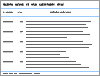
Tab.1
Comparison of general information of the two groups"
| 评价指标 | 观察组(n = 30) | 对照组(n = 30) | t/χ2值 | P值 |
|---|---|---|---|---|
| 性别 | 0.287 | 0.592 | ||
| 男 | 20(66.67) | 18(60.00) | ||
| 女 | 10(33.33) | 12(40.00) | ||
| 年龄(x ± s)/岁 | 63.03 ± 11.30 | 65.60 ± 8.69 | -0.986 | 0.328 |
| 病程(x ± s)/月 | 2.70 ± 1.75 | 3.47 ± 1.31 | -1.927 | 0.059 |
| NB分型 | ||||
| 尿失禁 | 8(26.67) | 11(36.67) | 0.693 | 0.405 |
| 尿潴留 | 22(73.33) | 19(63.33) | ||
| 卒中类型 | ||||
| 脑梗死 | 14(46.67) | 17(56.67) | 0.601 | 0.438 |
| 脑出血 | 16(53.33) | 13(43.33) | ||
| 卒中部位 | ||||
| 左侧 | 9(30.00) | 13(43.33) | 1.148 | 0.284 |
| 右侧 | 21(70.00) | 17(56.67) |
Tab.2
Comparison of urodynamic parameters and RUV"
| 组别 | FDV/mL | MCC/mL | Pves/cmH2O | |||
|---|---|---|---|---|---|---|
| 治疗前 | 治疗后 | 治疗前 | 治疗后 | 治疗前 | 治疗后 | |
| 观察组(n = 30) | 220.00 ± 34.22 | 273.00 ± 36.53* | 270.87 ± 39.95 | 328.43 ± 38.70* | 41.24 ± 5.80 | 34.71 ± 4.36* |
| 对照组(n = 30) | 226.37 ± 37.02 | 251.97 ± 31.09* | 270.70 ± 46.63 | 304.20 ± 44.51* | 41.87 ± 4.89 | 38.25 ± 4.20* |
| t值 | -0.692 | 2.402 | 0.015 | 2.250 | -0.457 | -3.198 |
| P值 | 0.492 | 0.020 | 0.988 | 0.028 | 0.649 | 0.002 |
| 组别 | Qmax/(mL/s) | Pdet Qmax/cmH2O | RUV/mL | |||
| 治疗前 | 治疗后 | 治疗前 | 治疗后 | 治疗前 | 治疗后 | |
| 观察组(n = 30) | 8.54 ± 2.61 | 16.77 ± 2.57* | 16.51 ± 2.53 | 28.91 ± 3.42* | 172.03 ± 34.77 | 111.07 ± 25.74* |
| 对照组(n = 30) | 8.80 ± 2.13 | 14.08 ± 2.84* | 16.27 ± 1.45 | 23.54 ± 3.28* | 174.97 ± 40.63 | 134.10 ± 26.83* |
| t值 | -0.422 | 3.827 | 0.457 | 6.212 | -0.300 | -3.394 |
| P值 | 0.674 | < 0.001 | 0.649 | < 0.001 | 0.765 | < 0.001 |
Tab.3
Comparison of urination diary indicators between the two groups of patients"
| 组别 | 日均排尿次数/次 | 日均漏尿次数/次 | 日均单次排尿量/mL | |||
|---|---|---|---|---|---|---|
| 治疗前 | 治疗后 | 治疗前 | 治疗后 | 治疗前 | 治疗后 | |
| 观察组(n = 30) | 11.67 ± 2.50 | 7.01 ± 1.64* | 9.07 ± 2.44 | 4.78 ± 1.16* | 66.13 ± 5.66 | 178.92 ± 18.72* |
| 对照组(n = 30) | 11.33 ± 3.11 | 9.19 ± 1.44* | 9.00 ± 2.78 | 6.68 ± 1.42* | 66.74 ± 4.47 | 140.46 ± 12.65* |
| t值 | 0.472 | -5.463 | 0.099 | -5.675 | -0.464 | 9.327 |
| P值 | 0.639 | < 0.001 | 0.922 | < 0.001 | 0.644 | < 0.001 |
Tab.4
Comparison of nbss and qualiveen scores between the two groups of patients"
| 组别 | NBSS | Qualiveen | ||
|---|---|---|---|---|
| 治疗前 | 治疗后 | 治疗前 | 治疗后 | |
| 观察组(n = 30) | 48.70 ± 4.19 | 34.67 ± 3.85* | 63.80 ± 7.33 | 44.00 ± 4.91* |
| 对照组(n = 30) | 49.47 ± 4.47 | 39.40 ± 3.35* | 63.73 ± 5.80 | 47.90 ± 5.29* |
| t值 | -0.686 | -5.078 | 0.039 | -2.960 |
| P值 | 0.496 | < 0.001 | 0.969 | 0.004 |
Tab.5
Efficacy comparison of the two groups of patients"
| 组别 | 痊愈 | 显效 | 有效 | 无效 | 总有效率 |
|---|---|---|---|---|---|
| 观察组(n = 30) | 11(36.67) | 13(43.33) | 4(13.33) | 2(6.67) | 93.33* |
| 对照组(n = 30) | 5(16.67) | 10(33.33) | 7(23.33) | 8(26.66) | 73.33 |
| [1] |
WANG J, XIAO C, CHENG Z, et al. Analysis and prediction of disease burden of stroke and its subtypes in China from 1990 to 2040[J]. Chin Med J, 2025, 138(19): 2452-2463. doi:10.1097/cm9.0000000000003725 .
doi: 10.1097/cm9.0000000000003725 |
| [2] |
SEVILLA TORRES E, SOTO-JUNCO E J, BAIZAN ORIAS S D, et al. Neurogenic voiding dysfunction in spinal cord injury and stroke: Urodynamic evaluation, functional classification, and therapeutic strategies[J]. Cureus, 2025, 17(8): e89348. doi:10.7759/cureus.89348 .
doi: 10.7759/cureus.89348 |
| [3] |
魏衍旭, 张思鈺, 任慧, 等. 盆底重复磁刺激联合排尿功能训练治疗脑卒中后非认知功能障碍性神经源性膀胱的临床效果[J]. 中国老年学杂志, 2025, 45(11): 2659-2662. doi:10.3969/ j.issn.1005-9202.2025.11.024 .
doi: 10.3969/ j.issn.1005-9202.2025.11.024 |
| [4] |
WANG Y, DONG T, LI X, et al. Research progress on the application of transcranial magnetic stimulation in spinal cord injury rehabilitation: A narrative review[J]. Front Neurol, 2023, 14: 1219590. doi:10.3389/fneur.2023.1219590 .
doi: 10.3389/fneur.2023.1219590 |
| [5] |
CHEN J, TAN B, CHEN Y, et al. A randomized controlled trial of low-frequency repeated transcranial magnetic stimulation in patients with poststroke neurogenic bladder[J]. Sci Rep, 2024, 14: 18404. doi:10.1038/s41598-024-69345-z .
doi: 10.1038/s41598-024-69345-z |
| [6] |
DAIA C, BUMBEA A, BADIU C, et al. Interferential electrical stimulation for improved bladder management following spinal cord injury[J]. Biom Rep, 2019, 11(3): 115-122. doi:10.3892/br.2019.1227 .
doi: 10.3892/br.2019.1227 |
| [7] |
JIA J. Exploration on neurobiological mechanisms of the central–peripheral–central closed-loop rehabilitation[J]. Front Cell Neurosci, 2022, 16: 982881. doi:10.3389/fncel.2022.982881 .
doi: 10.3389/fncel.2022.982881 |
| [8] |
中华人民共和国国家卫生健康委员会. 脑血管病防治指南(2024年版)[J]. 磁共振成像, 2025, 16(1): 1-8. doi:10.12015/ issn.1674-8034.2025.01.001 .
doi: 10.12015/ issn.1674-8034.2025.01.001 |
| [9] | 王毅, 赵耀瑞. 卒中后神经源性膀胱诊治专家共识[J]. 中国卒中杂志, 2016, 11(12): 1057-1066. |
| [10] |
孙婉婷, 艾丽皮乃·亚森, 龚翔, 等. 基于运动序列学习探讨高频重复经颅磁刺激对脑卒中患者上肢功能的效果[J]. 中国康复理论与实践, 2025, 31(7): 812-821. doi:10.3969/j.issn. 1006-9771.2025.07.008 .
doi: 10.3969/j.issn. 1006-9771.2025.07.008 |
| [11] |
NARDONE R, VERSACE V, SEBASTIANELLI L, et al. Transcranial magnetic stimulation and bladder function: A systematic review[J]. Clin Neurophysiol, 2019, 130(11): 2032-2037. doi:10.1016/j.clinph.2019.08.020 .
doi: 10.1016/j.clinph.2019.08.020 |
| [12] |
CARRO D F, SILVEIRA L T Y DA, BARACAT E C, et al. Validity and reliability study of a free mobile app for assessing voiding habits[J]. Int J Med Inform, 2026, 207: 106183. doi:10.1016/j.ijmedinf.2025.106183 .
doi: 10.1016/j.ijmedinf.2025.106183 |
| [13] |
WELK B, LENHERR S, ELLIOTT S, et al. The Neurogenic Bladder Symptom Score (NBSS): A secondary assessment of its validity, reliability among people with a spinal cord injury[J]. Spinal Cord, 2018, 56(3): 259-264. doi:10.1038/s41393-017-0028-0 .
doi: 10.1038/s41393-017-0028-0 |
| [14] |
BAUER S, GRASSNER L, MAIER D, et al. Early sacral neuromodulation: A promising opportunity or an overload for patients with a recent spinal cord injury? a cross-sectional study[J]. J Clin Med, 2025, 14(3): 1031. doi:10.3390/jcm14031031 .
doi: 10.3390/jcm14031031 |
| [15] |
董艳, 刘震钢, 刘媛, 等. 火针联合膀胱功能训练治疗脊髓损伤所致神经源性膀胱: 随机对照试验[J]. 中国针灸, 2024, 44(12): 1395-1400. doi: 10.13703/j.0255-2930.20240316-k0001 .
doi: 10.13703/j.0255-2930.20240316-k0001 |
| [16] |
许艳, 王凤丽, 耿德勤. 高频重复经颅磁刺激联合丁苯酞对缺血性脑卒中患者肢体功能的作用[J]. 实用医学杂志, 2026, 42(4): 618-625. doi:10.3969/j.issn.1006-5725.2026.04.011 .
doi: 10.3969/j.issn.1006-5725.2026.04.011 |
| [17] |
AGAPIOU E, PYRGELIS E S, MAVRIDIS I N, et al. Lower urinary tract dysfunction following stroke: From molecular mechanisms to clinical anatomy[J]. J Biol Meth, 2024, 11(4): e99010024. doi:10.14440/jbm.2024.0022 .
doi: 10.14440/jbm.2024.0022 |
| [18] |
刘敏琦, 高明威, 褚晓蕾, 等. 不同频率电刺激促进周围神经损伤的恢复[J]. 中国组织工程研究, 2025, 29(14): 3061-3069. doi:10.12307/2025.620 .
doi: 10.12307/2025.620 |
| [19] |
袁泽峰, 田高源, 黄志伟, 等. 生物反馈联合磁电刺激对盆底痉挛综合征患者排粪梗阻的改善作用[J]. 实用医学杂志, 2025, 41(15): 2372-2380. doi:10.3969/j.issn.1006-5725.2025. 15.012 .
doi: 10.3969/j.issn.1006-5725.2025. 15.012 |
| [20] |
BROWN J C, PHILIP N S. Pharmaco-transcranial magnetic stimulation: Letting mechanism guide the way[J]. Am J Psychiatry, 2025, 182(3): 240-242. doi:10.1176/appi.ajp.20241151 .
doi: 10.1176/appi.ajp.20241151 |
| [21] |
SHARBAFSHAAER M, CIRILLO G, ESPOSITO F, et al. Harnessing brain plasticity: The therapeutic power of repetitive transcranial magnetic stimulation (rTMS) and Theta burst stimulation (TBS) in neurotransmitter modulation, receptor dynamics, and neuroimaging for neurological innovations[J]. Biomedicines, 2024, 12(11): 2506. doi:10.3390/biomedicines12112506 .
doi: 10.3390/biomedicines12112506 |
| [22] |
ATAK ÇAKIR P, MUTLUAY F, HANOĞLU L, et al. Effect of transcutaneous posterior tibial nerve stimulation and repetitive transcranial magnetic stimulation on neurogenic overactive bladder symptoms in female patients with multiple sclerosis: The study protocol of a randomized controlled study[J]. Front Neurol, 2022, 13: 1011502. doi:10.3389/fneur.2022.1011502 .
doi: 10.3389/fneur.2022.1011502 |
| [23] |
XIE H, LI X, WANG Y, et al. Differential functional network remodeling induced by low- and high-frequency rTMS: Evidence from concurrent fNIRS monitoring[J]. IEEE Trans Neural Syst Rehabil Eng, 2025, 33: 3827-3836. doi:10.1109/TNSRE.2025. 3611796 .
doi: 10.1109/TNSRE.2025. 3611796 |
| [24] |
SINHA S, GAJEWSKI J B, TARCAN T, et al. Is it possible to regenerate the underactive detrusor? part 2. electrical stimulation therapies, treatment of bladder outlet obstruction, constipation, and pelvic floor disorders-ICI-RS 2024[J]. Neurourol Urodyn, 2025, 44(3): 585-591. doi:10.1002/nau.25594 .
doi: 10.1002/nau.25594 |
| [25] |
中国残疾人康复协会康复评定专业委员会, 甘肃省残疾人康复学会脊柱脊髓损伤康复专业委员会, 甘肃省医学会物理医学与康复分会, 等. 神经源性膀胱综合管理临床实践指南(下)[J]. 中华物理医学与康复杂志, 2025, 47(1): 1-6. doi:10.3760/cma.j.cn421666-20240703-00545-1 .
doi: 10.3760/cma.j.cn421666-20240703-00545-1 |
| [26] |
HAAKANA P, NÄTKYNMÄKI A, KIRVESKARI E, et al. Effects of auricular vagus nerve stimulation and electrical earlobe stimulation on motor-evoked potential changes induced by paired associative stimulation[J]. Eur J Neuroscience, 2024, 60(8): 5949-5965. doi:10.1111/ejn.16539 .
doi: 10.1111/ejn.16539 |
| [27] |
娄晓乐, 宋佳苧, 韩雪, 等. 经颅联合外周双向反馈磁刺激对脊髓损伤后神经源性膀胱患者膀胱及排尿功能的效果[J]. 实用医学杂志, 2025, 41(6): 859-865. doi:10.3969/j.issn.1006-5725.2025.06.013 .
doi: 10.3969/j.issn.1006-5725.2025.06.013 |
| [28] |
ALI M U. Repetitive transcranial magnetic stimulation for the treatment of neurogenic overactive bladder in stroke survivors[D]. Hong Kong: The Hong Kong Polytechnic University, 2025. doi:10.1016/j.mehy.2024.111300
doi: 10.1016/j.mehy.2024.111300 |
| [29] |
金娟, 周钦钦, 刘炜, 等. 盆底肌电刺激治疗脊髓损伤后神经源性膀胱的随机对照试验的Meta分析[J]. 中华物理医学与康复杂志, 2021, 43(1): 64-68. doi:10.3760/cma.j.issn.0254-1424.2021.01.018 .
doi: 10.3760/cma.j.issn.0254-1424.2021.01.018 |
| [30] |
LIU Y, XU G, GENG J. Efficacy of transcutaneous electrical nerve stimulation in the management of neurogenic overactive bladder: A randomized controlled trial[J]. Am J Phys Med Rehabil, 2022, 101(1): 2-10. doi:10.1097/PHM. 0000000000001836 .
doi: 10.1097/PHM. 0000000000001836 |
| [31] |
GU J, ZANG J. Clinical efficacy of bladder function training combined with pelvic floor biofeedback electrical stimulation on neurogenic bladder and its impact on urodynamics[J]. Pak J Med Sci, 2024, 41(1): 251-256. doi:10.12669/pjms.41.1.9655 .
doi: 10.12669/pjms.41.1.9655 |
| [32] |
ATAK ÇAKIR P, GÜZELBURÇ V, BIRDAY E, et al. Effect of neuromodulation on neurogenic bladder in women with multiple sclerosis: A pilot randomized controlled trial[J]. Neurodegener Dis Manag, 2025, 15(2-3): 57-64. doi:10.1080/17582024.2025. 2488712 .
doi: 10.1080/17582024.2025. 2488712 |
| [33] |
黄强, 李春宁, 解鸿宇, 等. “灸刺任脉” 联合膀胱功能训练治疗卒中后神经源性膀胱: 随机对照试验[J]. 中国针灸, 2025, 45(10): 1427-1433. doi:10.13703/j.0255-2930.20250302-0001 .
doi: 10.13703/j.0255-2930.20250302-0001 |
| [34] |
朱光跃, 陈思韵, 霍聪聪, 等. 外周联合中枢双靶磁刺激促进脑卒中运动功能障碍康复专家共识[J]. 中国康复医学杂志, 2023, 38(7): 880-884. doi:10.3969/j.issn.1001-1242.2023.07.003 .
doi: 10.3969/j.issn.1001-1242.2023.07.003 |
| Viewed | ||||||
|
Full text |
|
|||||
|
Abstract |
|
|||||
