

The Journal of Practical Medicine ›› 2026, Vol. 42 ›› Issue (10): 1692-1702.doi: 10.3969/j.issn.1006-5725.2026.10.002
• Feature Reports:Diabetes Mellitus • Previous Articles
Shi LIU1,Bin WEN1,Wei LI2,Enfang ZHU1,Xuefei XU1,Mingsheng CHEN1,Li GUI2( )
)
Received:2026-01-17
Online:2026-05-25
Published:2026-05-27
Contact:
Li GUI
E-mail:guili0527@126.com
CLC Number:
Shi LIU,Bin WEN,Wei LI,Enfang ZHU,Xuefei XU,Mingsheng CHEN,Li GUI. Comparative effect of autologous platelet-rich gel with different preparation methods on treating diabetic foot ulcers and its time-dependent bacteriostatic activity in vitro[J]. The Journal of Practical Medicine, 2026, 42(10): 1692-1702.
Tab.1
Comparison of demographics and diabetic conditions among four groups"
| 项目 | 一次离心(n = 20) | 二次离心(n = 20) | 机采(n = 20) | 对照组(n = 20) | H/F/χ2值 | P值 |
|---|---|---|---|---|---|---|
| 年龄(x | 60.20 ± 9.71 | 57.60 ± 11.35 | 60.40 ± 10.91 | 62.75 ± 9.55 | 0.819 | 0.488 |
| 性别/[例(%)] | 2.218 | 0.528 | ||||
| 男 | 13(65.00) | 12(60.00) | 9(45.00) | 13(65.00) | ||
| 女 | 7(35.00) | 8(40.00) | 11(55.00) | 7(35.00) | ||
| Wagner分级/[例(%)] | - | 0.167 | ||||
| 2 | 3(15.00) | 7(35.00) | 2(10.00) | 2(10.00) | ||
| 3 | 17(85.00) | 13(65.00) | 18(90.00) | 18(90.00) | ||
| 糖尿病病程/年 | 12.50(6.50,16.25) | 12.50(9.00,,17.00) | 9.00(4.75,16.00) | 10.00(3.25,14.75) | 3.228 | 0.358 |
| 糖尿病足溃疡病程 /月 | 1.50(1.00,4.25) | 2.50(1.00,6.00) | 1.00(0.90,2.25) | 3.00(1.00,6.00) | 3.853 | 0.278 |
| 溃疡面积/cm2 | 6.30(2.32,9.14) | 8.02(6.09,12.13) | 9.00(6.76,12.64) | 4.82(1.78,10.49) | 7.010 | 0.069 |
Tab.2
Comparison of laboratory test indicators before treatment in four groups"
| 项目 | 一次离心(n = 20) | 二次离心(n = 20) | 机采(n = 20) | 对照组(n = 20) | H/F值 | P值 |
|---|---|---|---|---|---|---|
| FBG/(mmol/L) | 8.59(7.70,14.51) | 9.43(7.19,17.00) | 7.30(6.15,12.11) | 8.96(5.81,11.56) | 2.033 | 0.566 |
| ESR/(mm/h) | 39.98(29.50,47.25) | 42.67(26.33,54.33) | 37.57(19.31,47.47) | 37.91(28.58,44.89) | 1.354 | 0.716 |
| IL-6/(pg/mL) | 11.38(9.18,14.79) | 5.96(4.30,17.52) | 8.17(5.07,14.26) | 11.92(5.29,17.82) | 2.412 | 0.491 |
| PCT/% | 0.03(0.02,0.04) | 0.10(0.04,0.22) | 0.04(0.02,0.11) | 0.04(0.02,0.11) | 6.527 | 0.089 |
| CRP/(mg/L) | 3.54(2.33,10.83) | 7.99(3.78,11.19) | 9.11(4.02,12.92) | 10.77(8.13,12.97) | 6.259 | 0.100 |
| 糖化血红蛋白/% | 7.75(7.32,9.75) | 8.50(7.74,9.33) | 8.61(7.78,10.16) | 7.76(7.01,8.97) | 3.706 | 0.295 |
| AT-Ⅲ(x ± s)/% | 95.25 ± 13.71 | 101.47 ± 12.49 | 101.19 ± 13.60 | 92.51 ± 15.04 | 2.092 | 0.108 |
| TNF-α(x ± s)/(pg/mL) | 2.89 ± 0.53 | 2.82 ± 0.60 | 2.85 ± 0.53 | 3.24 ± 0.52 | 2.553 | 0.062 |
| Hcy/(μmol/L) | 14.15(13.02,16.18) | 13.55(11.83,15.22) | 13.40(12.18,14.45) | 13.20(12.32,15.83) | 1.984 | 0.576 |
Tab.3
Comparison of laboratory test indicators after treatment in four groups"
| 项目 | 一次离心(n = 20) | 二次离心(n = 20) | 机采(n = 20) | 对照组(n = 20) | H/F值 | P值 |
|---|---|---|---|---|---|---|
| FBG/(mmol/L) | 5.90(5.49,6.40)* | 5.81(5.34,6.81)* | 5.22(4.33,8.55)* | 8.03(6.36,11.00) | 15.300 | 0.002 |
| AT-III/% | 106.60(98.30,114.05)* | 107.90(102.52,111.03)* | 108.75(102.58,114.38)* | 93.70(85.50,97.92) | 14.927 | 0.002 |
| TNF-α(x ± s)/(pg/mL) | 1.50 ± 0.57* | 1.67 ± 0.56* | 1.66 ± 0.55* | 2.38 ± 0.51 | 10.335 | <0.001 |
| Hcy(x ± s)/(μmol/L) | 10.45 ± 1.22* | 10.19 ± 1.74* | 10.43 ± 1.18* | 12.68 ± 2.13 | 10.464 | <0.001 |
| ESR(x ± s)/(mm/h) | 17.44 ± 9.16* | 18.54 ± 8.06* | 19.38 ± 7.24* | 26.20 ± 7.87 | 4.751 | 0.004 |
| IL-6/(pg/mL) | 2.28(1.65,2.54)* | 2.13(1.94,2.32)* | 1.95(1.14,2.57)* | 4.91(3.17,7.31) | 25.281 | <0.001 |
| PCT/% | 0.02(0.01,0.02)* | 0.02(0.01,0.02)* | 0.02(0.01,0.03)* | 0.04(0.02,0.05) | 12.011 | 0.007 |
| CRP/(mg/L) | 3.28(2.01,7.04)* | 3.56(2.31,5.26)* | 3.38(1.59,5.06)* | 6.45(5.42,7.39) | 15.452 | 0.001 |
Tab.4
Description of treatment conditions during three dressing changes"
| 项目 | 一次离心(n = 20) | 二次离心(n = 20) | 机采(n = 20) | 对照组(n = 20) | H/χ2值 | P值 |
|---|---|---|---|---|---|---|
| 第1次换药 | ||||||
| 溃疡面积 | 3.57(1.4,5.21) | 4.89(3.69,7.08) | 5.44(4.04,7.63) | 3.38(1.52,7.66) | 5.759 | 0.124 |
| 缩小率 | 39.41(39.3,40.49) | 39.52(39.33,39.85) | 39.48(39.36,39.57) | 28.42(18.83,32.8) | 35.410 | < 0.001 |
| 第2次换药 | ||||||
| 溃疡面积 | 2.48(0.91,3.64) | 3.32(2.35,4.8) | 3.56(2.66,5.01) | 1.89(0.65,4.21) | 6.567 | 0.087 |
| 缩小率 | 60.89(60.33,62.03) | 60.48(60.2,60.72) | 60.51(60.43,60.59) | 60.68(58.64,61.5) | 4.272 | 0.234 |
| 第3次换药 | ||||||
| 溃疡面积 | 0.99(0.33,1.58) | 1.44(0.95,1.94) | 1.44(1.03,2.26) | 1.12(0.46,3.09) | 3.587 | 0.031 |
| 缩小率 | 85.41(80.61,86.14) | 83.04(81.01,84.78) | 84.64(82.31,85.3) | 70.81(66.94,75.85) | 32.184 | < 0.001 |
| 最终疗效/[例(%)] | 38.187 | < 0.001 | ||||
| 无效 | 0(0.00) | 0(0.00) | 0(0.00) | 0(0.00) | ||
| 有效 | 5(25.00) | 3(15.00) | 3(15.00) | 19(95.00) | ||
| 显效 | 15(75.00) | 17(85.00) | 17(85.00) | 1(5.00) | ||
| 治愈 | 0(0.00) | 0(0.00) | 0(0.00) | 0(0.00) |
Tab.5
Results of GEE model effect test"
| 效应 | Wald χ2 | df | P值 |
|---|---|---|---|
| 截距 | 776.149 | 1 | < 0.001 |
| group | 67.020 | 3 | < 0.001 |
| time | 2 341.159 | 2 | < 0.001 |
| group × time | 78.359 | 6 | < 0.001 |
Tab.6
Estimated marginal means of ulcer area reduction rate in each group at different time points and overall comparison between groups"
| 组别 | time 1 | time 2 | time 3 | 整体边际值 | 与组4比较的差值(95%CI) | P值 |
|---|---|---|---|---|---|---|
| 一次离心组 | 41.52 ± 1.52 | 61.67 ± 0.53 | 82.64 ± 1.52 | 61.94 ± 0.88 | 9.90(7.25 ~ 12.56) | < 0.001 |
| 二次离心组 | 40.12 ± 0.48 | 61.17 ± 0.59 | 83.00 ± 0.79 | 61.43 ± 0.46 | 9.39(6.96 ~ 11.82) | < 0.001 |
| 机采组 | 40.02 ± 0.49 | 60.70 ± 0.47 | 83.82 ± 0.79 | 61.52 ± 0.50 | 9.48(7.13 ~ 11.83) | < 0.001 |
| 对照组 | 26.21 ± 2.24 | 59.53 ± 1.03 | 70.38 ± 1.86 | 52.04 ± 1.10 | 参照组 | – |
Tab.7
Estimated marginal means of ulcer area reduction rate over time and pairwise comparisons between time points"
| 时间点 | 愈合率 | 95%CI | 与time 1比较(差值,95%CI) | 与time 2比较(差值,95%CI) |
|---|---|---|---|---|
| time 1 | 36.96 ± 0.75 | (35.50 ~ 38.43) | – | – |
| time 2 | 60.77 ± 0.37 | (60.04 ~ 61.50) | 23.80(22.31 ~ 25.29) | – |
| time 3 | 79.96 ± 0.66 | (78.66 ~ 81.26) | 42.99(41.23 ~ 44.75) | 18.02 (17.76 ~ 20.37)* |
Tab.8
Estimated marginal means of ulcer area reduction rate and overall between-group comparison in Wagner grade 2 patients"
| 组别 | time 1 | time 2 | time 3 | 整体边际值 | 与组4比较的差值(95%CI) | P值 |
|---|---|---|---|---|---|---|
| 一次离心组 | 44.82 ± 3.61 | 60.24 ± 1.72 | 82.49 ± 1.64 | 62.52 ± 1.86 | 10.98(6.35 ~ 15.61) | 0.890 |
| 二次离心组 | 38.15 ± 0.79 | 59.02 ± 0.82 | 79.84 ± 1.15 | 59.00 ± 0.68 | 7.45(4.21 ~ 10.69) | 0.168 |
| 机采组 | 40.10 ± 0.98 | 61.68 ± 0.85 | 80.10 ± 0.46 | 60.63 ± 0.62 | 9.08(5.92 ~ 12.24) | 0.320 |
| 对照组 | 37.44 ± 2.34 | 68.38 ± 2.78 | 82.97 ± 2.81 | 61.54 ± 1.97 | 参照组 | – |
Tab.9
Estimated marginal means of ulcer area reduction rate and overall between-group comparison in Wagner grade 3 patients"
| 组别 | time 1 | time 2 | time 3 | 整体边际值 | 与组4比较的差值(95%CI) | P值 |
|---|---|---|---|---|---|---|
| 一次离心组 | 40.19 ± 1.41 | 61.17 ± 0.53 | 81.92 ± 1.72 | 61.09 ± 0.87 | 9.62(6.91 ~ 12.34) | < 0.001 |
| 二次离心组 | 40.14 ± 0.69 | 61.29 ± 0.85 | 83.65 ± 0.75 | 61.69 ± 0.57 | 10.22(7.76 ~ 12.69) | < 0.001 |
| 机采组 | 39.95 ± 0.36 | 60.52 ± 0.29 | 84.17 ± 0.61 | 61.55 ± 0.30 | 10.08(7.63 ~ 12.53) | < 0.001 |
| 对照组 | 25.60 ± 2.52 | 59.18 ± 0.95 | 69.62 ± 1.97 | 51.47 ± 1.15 | 参照组 | – |
Tab.10
Univariate analysis of therapeutic efficacy"
| 项目 | 有效(n = 30) | 显效(n = 30) | Z/t/χ2值 | P值 |
|---|---|---|---|---|
| 治疗分组/[例(%)] | 38.187 | < 0.001 | ||
| 一次离心组 | 5(16.67) | 15(30.00) | ||
| 二次离心组 | 3(10.00) | 17(34.00) | ||
| 机采组 | 3(10.00) | 17(34.00) | ||
| 对照组 | 19(63.33) | 1(2.00) | ||
| 年龄(x ± s)/岁 | 60.87 ± 10.01 | 59.86 ± 10.67 | 0.419 | 0.677 |
| 性别/[例(%)] | 1.241 | 0.265 | ||
| 男 | 20(66.67) | 27(54.00) | ||
| 女 | 10(33.33) | 23(46.00) | ||
| Wagner分级/[例(%)] | 0.023 | 0.879 | ||
| 2 | 5(16.67) | 9(18.00) | ||
| 3 | 25(83.33) | 41(82.00) | ||
| 糖尿病病程/年 | 10.00(3.25,15.25) | 12.50(7.00,16.00) | -1.676 | 0.094 |
| 糖尿病足溃疡病程月/年 | 3.00(1.00,5.00) | 1.00(1.00,4.00) | -1.378 | 0.168 |
| 溃疡面积/(cm×cm) | 6.53(1.89,8.69) | 8.53 (5.56,12.52) | -2.172 | 0.030 |
| FBG/(mmol/L) | 9.29(6.59,12.16) | 8.50 (6.42,15.67) | -0.035 | 0.972 |
| ESR(x ± s)/(mm/h) | 37.69 ± 13.10 | 37.71 ± 16.44 | -0.007 | 0.995 |
| IL-6/(pg/mL) | 9.92(4.92,17.69) | 9.71 (5.25,15.76) | -0.035 | 0.972 |
| PCT/% | 0.03(0.02,0.10) | 0.04(0.02,0.13) | -0.666 | 0.505 |
| CRP/(mg/L) | 9.67(3.24,12.42) | 7.76 (3.44,12.69) | -0.114 | 0.909 |
| 糖化血红蛋白/% | 7.76(7.06,9.13) | 8.47(7.60,9.72) | -1.948 | 0.051 |
| AT-Ⅲ(x ± s)/% | 94.01 ± 14.19 | 99.76 ± 13.61 | -1.802 | 0.075 |
| TNF-α(x ± s)/(pg/mL) | 3.03 ± 0.57 | 2.91 ± 0.56 | 0.940 | 0.350 |
| Hcy/(μmol/L) | 13.55(11.98,15.88) | 13.55(12.43,14.75) | -0.408 | 0.684 |
| FBG治疗后/(mmol/L) | 6.92(5.75,10.19) | 5.88(4.74,7.06) | -2.917 | 0.004 |
| AT-Ⅲ治疗后/% | 96.65(90.82,112.40) | 108.30(101.55,112.97) | -2.803 | 0.005 |
| TNF-α治疗后(x ± s)/(pg/mL) | 2.10 ± 0.63 | 1.62 ± 0.58 | 3.470 | 0.001 |
| Hcy治疗后(x ± s)/(μmol/L) | 11.98 ± 2.20 | 10.31 ± 1.33 | 4.247 | < 0.001 |
| ESR治疗后(x ± s)/(mm/h) | 22.45 ± 8.92 | 19.15 ± 8.37 | 1.665 | 0.100 |
| IL-6治疗后/(pg/mL) | 3.23(2.27,6.33) | 2.13(1.58,2.54) | -3.369 | 0.001 |
| PCT治疗后/% | 0.02(0.01,0.05) | 0.02(0.01,0.02) | -1.982 | 0.048 |
| CRP治疗后/(mg/L) | 6.14(3.54,7.21) | 3.72(2.13,5.60) | -2.236 | 0.025 |
Tab.11
Multivariate logistic regression analysis of therapeutic efficacy"
| 最终结局 | OR | SE | P值 | 95%CI |
|---|---|---|---|---|
| 对照组 | ||||
| 一次离心组 | 35.683 | 61.239 | 0.037 | 1.235 ~ 1 031.089 |
| 二次离心组 | 60.431 | 107.289 | 0.021 | 1.862 ~ 1 960.992 |
| 机采组 | 61.182 | 106.360 | 0.018 | 2.027 ~ 1 846.588 |
| 溃疡面积 | 1.029 | 0.047 | 0.529 | 0.941 ~ 1.125 |
| FBG治疗后 | 0.872 | 0.180 | 0.508 | 0.582 ~ 1.308 |
| AT-III治疗后 | 1.018 | 0.033 | 0.591 | 0.955 ~ 1.085 |
| TNF-α治疗后 | 0.951 | 0.624 | 0.940 | 0.263 ~ 3.444 |
| Hcy治疗后 | 0.786 | 0.193 | 0.327 | 0.485 ~ 1.273 |
| ESR治疗后 | 1.061 | 0.051 | 0.225 | 0.964 ~ 1.166 |
| IL-6治疗后 | 0.995 | 0.218 | 0.983 | 0.648 ~ 1.530 |
| PCT治疗后 | 0.003 | 0.051 | 0.702 | 0.000 ~ Inf |
| CRP治疗后 | 1.077 | 0.134 | 0.554 | 0.843 ~ 1.374 |
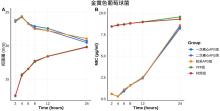
Fig.1
Changes in inhibition zone and MIC levels of Staphylococcus aureus in different groups at different time points"
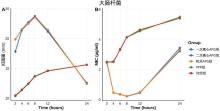
Fig.2
Changes in inhibition zone and MIC levels of Escherichia coli in different groups at different time points"
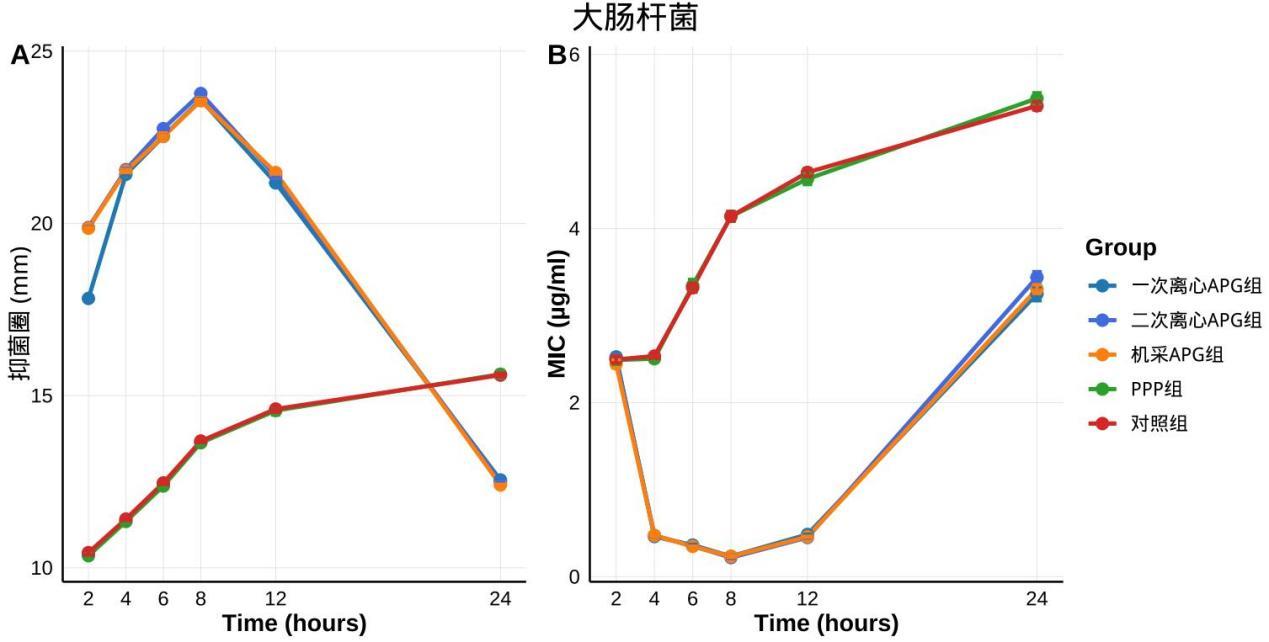
Fig.3
Changes in inhibition zone and MIC levels of enzyme-producing Escherichia coli in different groups at different time points"
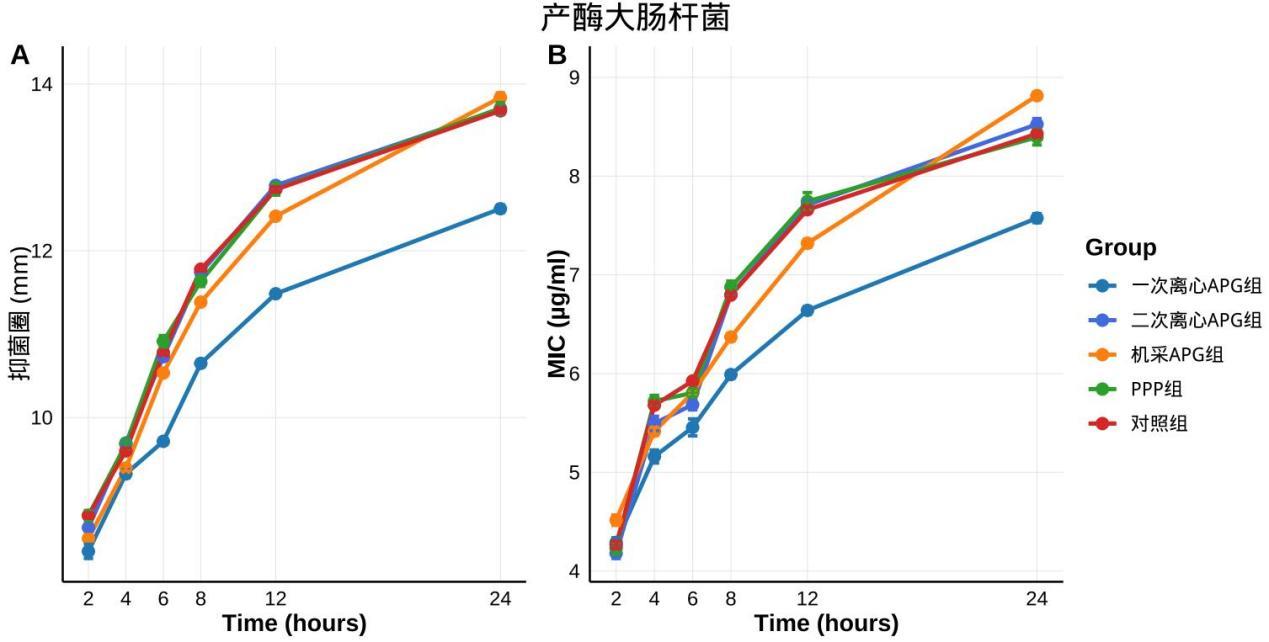
Fig.4
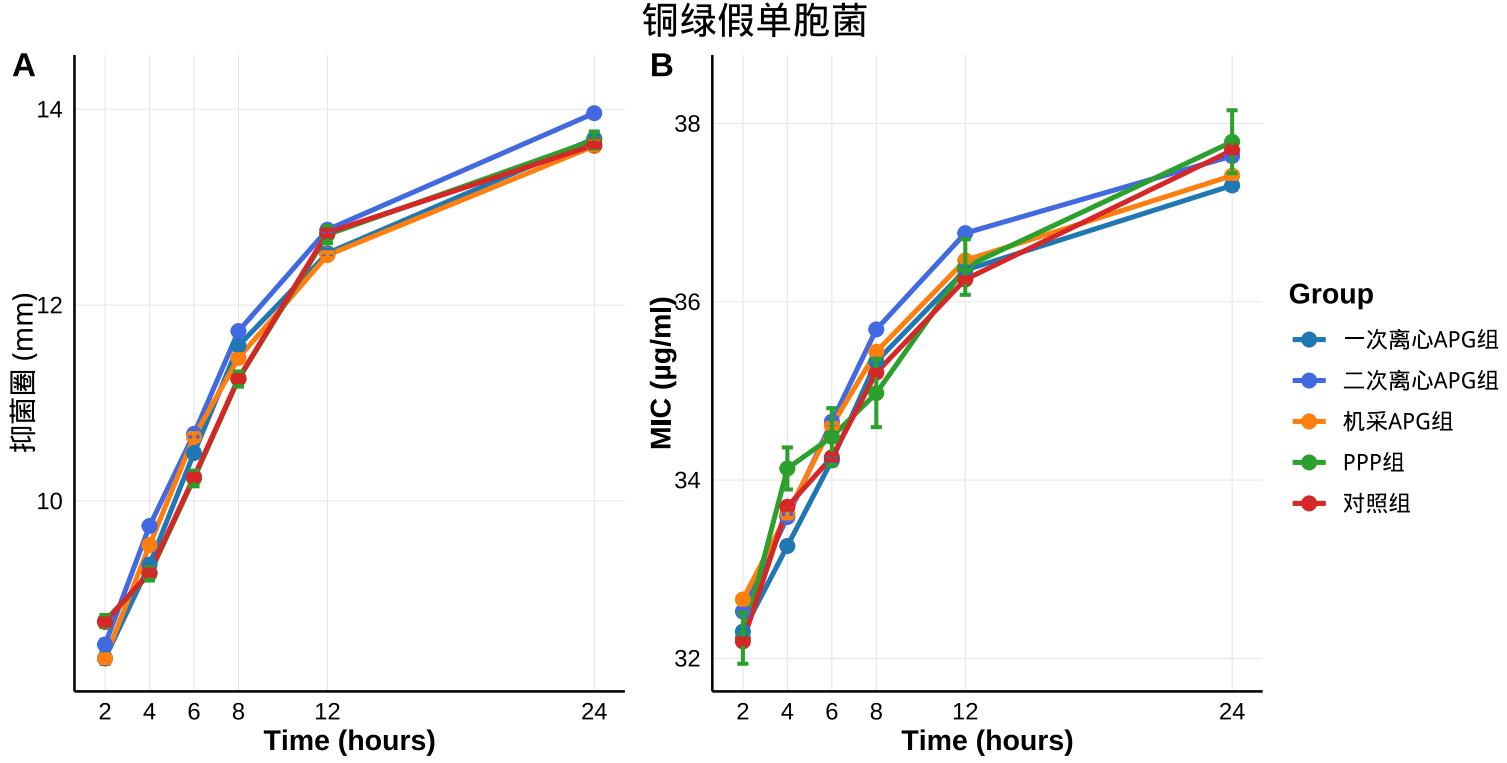
Changes in inhibition zone and MIC levels of Pseudomonas aeruginosa in different groups at different time points"
| [1] |
SUMPIO B J, MEZGHANI I, WANG E, et al. Experimental treatments in clinical trials for diabetic foot ulcers: Wound healers in the pipeline[J]. Expert Opin Investig Drugs, 2023, 32(2): 95-99. doi:10.1080/13543784.2023.2178418 .
doi: 10.1080/13543784.2023.2178418 |
| [2] |
ZHANG P, LU J, JING Y, et al. Global epidemiology of diabetic foot ulceration: A systematic review and meta-analysis[J/OL]. Ann Med, 2017, 49(2):106-116.doi:10.1080/07853890.2016.1231932 .
doi: 10.1080/07853890.2016.1231932 |
| [3] |
SORBER R, ABULARRAGE C J. Diabetic foot ulcers: Epidemiology and the role of multidisciplinary care teams[J]. Semin Vasc Surg, 2021, 34(1): 47-53.doi:10.1053/j.semvascsurg.2021.02.006 .
doi: 10.1053/j.semvascsurg.2021.02.006 |
| [4] |
邓品, 孙志波, 吴琼, 等. 糖尿病足溃疡的现代医学研究现状[J]. 中国中医基础医学杂志, 2025, 31(10): 1867-1872. doi:10.19945/j.cnki.issn.1006-3250.2025.10.036 .
doi: 10.19945/j.cnki.issn.1006-3250.2025.10.036 |
| [5] |
BARDILL J R, LAUGHTER M R, STAGER M, et al. Topical gel-based biomaterials for the treatment of diabetic foot ulcers[J]. Acta Biomaterialia, 2022, 138: 73-91. doi:10.1016/j.actbio.2021.10.045 .
doi: 10.1016/j.actbio.2021.10.045 |
| [6] |
SHEEAN A J, ANZ A W, BRADLEY J P. Platelet-rich plasma: Fundamentals and clinical applications[J]. Arthroscopy, 2021, 37(9): 2732-2734.doi:10.1016/j.arthro.2021.07.003 .
doi: 10.1016/j.arthro.2021.07.003 |
| [7] |
ABOELSAAD E, MOUSTAFA S, AMINE A, et al. Platelet-rich plasma as a potential antimicrobial agent against multidrug-resistant bacteria in diabetic foot infections[J/OL]. Scientific Reports, 2025, 15(1): 15145. doi:10.1038/s41598-025-97418-0 .
doi: 10.1038/s41598-025-97418-0 |
| [8] |
AGHALOO T L, MOY P K, FREYMILLER E G. Investigation of platelet-rich plasma in rabbit cranial defects: A pilot study[J]. J Oral Maxillofac Surg, 2002, 60(10): 1176-1181.doi:10.1053/joms.2002.34994 .
doi: 10.1053/joms.2002.34994 |
| [9] |
张娅丽, 周晖, 刘攀影. 自体富血小板凝胶辅助负压引流治疗糖尿病足溃疡的疗效及对血管新生的影响[J]. 临床医学, 2025, 45(4): 15-18. doi:10.19528/j.issn.1003-3548.2025.04.005 .
doi: 10.19528/j.issn.1003-3548.2025.04.005 |
| [10] |
ÇETINKAYA R A, YENILMEZ E, PETRONE P, et al. Platelet-rich plasma as an additional therapeutic option for infected wounds with multi-drug resistant bacteria: In vitro antibacterial activity study[J]. Eur J Trauma Emerg Surg, 2019, 45(3): 555-565. doi:10.1007/s00068-018-0957-0 .
doi: 10.1007/s00068-018-0957-0 |
| [11] |
肖洁, 李翠莹, 张利, 等. 富血小板血浆体外抑菌作用研究[J]. 四川医学, 2015, 36(4): 470-473. doi:10.16252/j.cnki.issn1004-0501-2015.04.010 .
doi: 10.16252/j.cnki.issn1004-0501-2015.04.010 |
| [12] |
蔡鸿娇, 张斌阳, 陈融斌, 等. 槲皮素和没食子酸对七种水产病原菌抑菌效果测定[J]. 中国饲料, 2025(17): 117-121, 165. doi:10.15906/j.cnki.cn11-2975/s.2024050059-07 .
doi: 10.15906/j.cnki.cn11-2975/s.2024050059-07 |
| [13] | 李卓男. 自体富血小板血浆与传统方法治疗糖尿病足溃疡疗效的Meta分析[D]. 长春: 吉林大学, 2019. |
| [14] |
ZANZOV E, ANASTASOVA V, IVANOVA K, et al. Platelet-rich plasma for wound healing in diabetic patients[J]. Medicina, 2025, 61(9): 1535.doi:10.3390/medicina61091535 .
doi: 10.3390/medicina61091535 |
| [15] |
相佳宁,钟华,任嘉毅,等.门诊应用负压微引流联合超声清创治疗糖尿病足溃疡的疗效[J]. 实用医学杂志, 2026, 42(5): 102-108. doi:10.3969/j.issn.1006-5725.2026.05.013 .
doi: 10.3969/j.issn.1006-5725.2026.05.013 |
| [16] |
BURNOUF T, CHOU M L, WU Y W, et al. Antimicrobial activity of platelet (PLT)-poor plasma, PLT-rich plasma, PLT gel, and solvent/detergent-treated PLT lysate biomaterials against wound bacteria[J]. Transfusion, 2013, 53(1): 138-146. doi:10.1111/j.1537-2995.2012.03668.x .
doi: 10.1111/j.1537-2995.2012.03668.x |
| [17] |
PLATINI H, ADAMMAYANTI K, MAULANA S, et al. The potential of autologous platelet-rich plasma gel for diabetic foot ulcer care among older adults: A systematic review and meta-analysis[J]. Ther Clin Risk Manag, 2024, 20: 21-37.doi:10.2147/TCRM.S433033 .
doi: 10.2147/TCRM.S433033 |
| [18] |
SHENG X, HU L, LI T, et al. Clinical efficacy and mechanism of the combination of autologous platelet-rich gel and recombinant human acidic fibroblast growth factor in the management of refractory diabetic foot[J]. Front Endocrinol (Lausanne), 2024, 15: 1374507. doi:10.3389/fendo.2024.1374507 .
doi: 10.3389/fendo.2024.1374507 |
| [19] |
LI T, MA Y, WANG M, et al. Platelet-rich plasma plays an antibacterial, anti-inflammatory and cell proliferation-promoting role in an in vitro model for diabetic infected wounds[J]. Infect Drug Resist, 2019, 12: 297-309. doi:10.2147/IDR.S186651 .
doi: 10.2147/IDR.S186651 |
| [20] |
RAMAKANT P, VERMA A K, MISRA R, et al. Changing microbiological profile of pathogenic bacteria in diabetic foot infections: Time for a rethink on which empirical therapy to choose[J]. Diabetologia, 2011, 54(1): 58-64. doi:10.1007/s00125-010-1893-7 .
doi: 10.1007/s00125-010-1893-7 |
| [21] |
罗富强, 余电柏, 谢康麒, 等. 糖尿病足溃疡创面修复相关机制的研究进展[J]. 实用医学杂志, 2023, 39(2): 158-163.doi:10.3969/j.issn.1006-5725.2023.02.006 .
doi: 10.3969/j.issn.1006-5725.2023.02.006 |
| [22] |
EVERTS P A, LANA J F, ALEXANDER R W, et al. Profound properties of protein-rich, platelet-rich plasma matrices as novel, multi-purpose biological platforms in tissue repair, regeneration, and wound healing[J]. Int J Mol Sci, 2024, 25(14): 7914. doi:10.3390/ijms25147914 .
doi: 10.3390/ijms25147914 |
| [23] |
DU F, MA J, GONG H, et al. Microbial infection and antibiotic susceptibility of diabetic foot ulcer in China: Literature review[J]. Front Endocrinol (Lausanne), 2022, 13: 881659.doi:10.3389/fendo.2022.881659 .
doi: 10.3389/fendo.2022.881659 |
| [24] |
SMITH O J, WICAKSANA A, DAVIDSON D, et al. An evaluation of the bacteriostatic effect of platelet-rich plasma[J]. Int Wound J, 2021, 18(4): 448-456.doi:10.1111/iwj.13545 .
doi: 10.1111/iwj.13545 |
| [25] |
CIEŚLIK-BIELECKA A, BOLD T, ZIÓŁKOWSKI G, et al. Antibacterial activity of leukocyte- and platelet-rich plasma: An in vitro study[J]. Biomed Res Int, 2018, 2018: 1-8.doi:10.1155/2018/9471723 .
doi: 10.1155/2018/9471723 |
| [26] |
BIELECKI T M, GAZDZIK T S, ARENDT J, et al. Antibacterial effect of autologous platelet gel enriched with growth factors and other active substances: AN IN VITRO STUDY[J]. J Bone Joint Surg Br, 2007, 89(3): 417-420.doi:10.1302/0301-620X.89B3.18491 .
doi: 10.1302/0301-620X.89B3.18491 |
| [27] |
赵连前, 张宇, 回蔷, 等. 富血小板凝胶对金黄色葡萄球菌的体外抗菌性研究[J]. 中国美容整形外科杂志, 2016, 27(6): 371-374. doi:10.3969/j.issn.1673-7040.2016.06.016 .
doi: 10.3969/j.issn.1673-7040.2016.06.016 |
| [1] | Jianing XIANG,Hua ZHONG,Jiayi REN,Keru LIU,Wenrui LI,Zhibin CAO. Efficacy of negative pressure wound therapy combined with ultrasound debridement for diabetic foot ulcers in the outpatient setting [J]. The Journal of Practical Medicine, 2026, 42(5): 824-830. |
| [2] | Aoshuang QIN,Chen YANG,Xin CUI,Gejia MA,Xiaowei GUO,Xuchuan ZHOU,Bin LIU. Hyaluronic acid scaffold combined with adipose⁃derived stem cells [J]. The Journal of Practical Medicine, 2025, 41(7): 991-996. |
| [3] | Liangxi LU,Hong SHI,Zhimin HUANG,Jie LU,Wenjie. WANG. Exploring mechanism of TLR4/NF⁃κB⁃NLRP3 inflammasome signaling pathway in experimental autoimmune prostatitis rats [J]. The Journal of Practical Medicine, 2025, 41(6): 800-805. |
| [4] | Tianzhong PENG,Xuedi HUANG,Xingzhen LIN,Juan YUAN,Feng ZHOU,Langhui LIU,Qi′nan ZHAN,Manhua. ZHU. Effect of Kaiqiao Xingshen acupuncture combined with Buyang Huanwu decoction on IL⁃2, MMP⁃9, BDNF, and cerebral blood flow in patients with cerebral hemorrhage during recovery period (Qi deficiency and blood stasis syndrome) [J]. The Journal of Practical Medicine, 2025, 41(3): 428-433. |
| [5] | Yi WANG,Jie LIU,Li TANG,Mianjing LI,Yan JIANG,Longmei FENG,Ping. NI. Effect of external application of mirabilite combined with infrared irradiation in promoting incision healing after cholelithiasis surgery [J]. The Journal of Practical Medicine, 2025, 41(23): 3760-3766. |
| [6] | Jingyao LI,Xiaodi ZHU,Fei SU,Yunfeng ZHANG,Nilin ZHANG,Qiquan LIU. Association of Hp infection with inflammatory factors and hepatic fibrosis progression in metabolically associated fatty liver disease with type 2 diabetes mellitus [J]. The Journal of Practical Medicine, 2025, 41(13): 2045-2051. |
| [7] | Chunyan LI,Ting XIAO,Bangcui WU,Yong CHEN,Mei TIAN. PKCβ inhibitor modulates macrophage phenotype and affects kidney ischemia-reperfusion injury during transplantation [J]. The Journal of Practical Medicine, 2025, 41(1): 23-29. |
| [8] | Yuying HU,Jinming ZHU,Jie LIU,Yawen PAN,Qian ZHANG,Jinqiu FENG. Expression and significance of miR⁃223⁃3p in serum of pregnant women with preterm premature rupture of membranes [J]. The Journal of Practical Medicine, 2024, 40(9): 1275-1279. |
| [9] | Ling XIAO,Chunlei GAO,Wei GUO,Ning WANG,Xuan ZHANG,Ming. LIU. Codonopsis polysaccharide protected LPS⁃induced acute lung injury by inhibiting MAPK/NF⁃κB signaling pathway in mice [J]. The Journal of Practical Medicine, 2024, 40(7): 948-954. |
| [10] | Lihong DING,Shijia GENG,Yujie WANG. Effects of wedelobata on apoptosis and secretion of inflammatory cytokines in the alveolar epithelium infected by Streptococcus pneumonia [J]. The Journal of Practical Medicine, 2024, 40(3): 316-320. |
| [11] | Hongtao FENG,Xiaoping JIAO,Wenxuan SHANG,Hongpu. LI. Predictive value of Cys C, HMGB1, GDF-15 levels for early infection after flap reconstruction for diabetic foot ulcer [J]. The Journal of Practical Medicine, 2024, 40(23): 3331-3336. |
| [12] | Tianyue YU,Qian GUO,Hao HU,Yujing SU,Jianhua CHEN. Advances in oxidative stress⁃related pathways with diagnostic and predictive value in schizophrenia [J]. The Journal of Practical Medicine, 2024, 40(20): 2935-2940. |
| [13] | Bin ZHANG,Wei HU,Rongzhen TAN,Panpan YANG,Jun HU,Zhong YUAN,Gongtao. JIANG. Effects of Yishen Huayu Xugu prescription combined with Dixumab on IL-6, β-CTX and bone mineral density in elderly patients operated for osteoporotic lumbar vertebral compression fractures [J]. The Journal of Practical Medicine, 2024, 40(19): 2766-2771. |
| [14] | Weifeng ZHANG,Hailong MA,Jinling. ZHANG. Effect of PCSK9 inhibitors on inflammation levels and ventricular remodeling after PCI in ST⁃elevation acute myocardial infarction [J]. The Journal of Practical Medicine, 2024, 40(15): 2142-2147. |
| [15] | Xuan QIU,Yishajiang SHAREZATI,Yulan CHEN,Mengmeng WANG,Yu LI,Tulahong GULINAZI,Abuhan ZUBAIDAN,Abulizi ALIYA,Xingchen WANG. Effect of transient receptor potential channel 5 on myocardial pyroptosis in intermittent hypoxia [J]. The Journal of Practical Medicine, 2024, 40(12): 1637-1642. |
| Viewed | ||||||
|
Full text |
|
|||||
|
Abstract |
|
|||||
