

The Journal of Practical Medicine ›› 2026, Vol. 42 ›› Issue (8): 1435-1443.doi: 10.3969/j.issn.1006-5725.2026.08.018
• Treatise: Clinical Practice • Previous Articles
Yumeng XIAO1,Linlu ZHENG2,Xiaojing HAO1,Yaying CHENG1( )
)
Received:2025-10-21
Online:2026-04-25
Published:2026-04-28
Contact:
Yaying CHENG
E-mail:doctorcyy@126.com
CLC Number:
Yumeng XIAO,Linlu ZHENG,Xiaojing HAO,Yaying CHENG. Construction of a nomogram prediction model for central precocious puberty in girls with premature breast development[J]. The Journal of Practical Medicine, 2026, 42(8): 1435-1443.
Tab.1
Comparison of baseline characteristics between IPT and CPP in grils"
| 项目 | IPT组(n = 59) | CPP组(n = 103) | P值 | t/Z/χ2 值 |
|---|---|---|---|---|
| 年龄/岁 | 6.8(6.0,7.5) | 7.2(6.8,7.4) | 0.191 | -1.308 |
| 身高标准差积分 | 1.02(0.26,2.11) | 1.90(1.04,2.78) | <0.001 | -3.798 |
| 体质量标准差积分( | 1.03 ± 1.39 | 1.59 ± 1.24 | 0.008 | -2.679 |
| BMI标准差积分( | 0.58 ± 1.53 | 0.82 ± 1.34 | 0.297 | -1.045 |
| Tanner分期/[例(%)] | 0.486 | 2.415 | ||
| Ⅰ期 | 7(4.3) | 2(1.2) | ||
| Ⅱ期 | 45(27.8) | 74(45.7) | ||
| Ⅲ期 | 7(4.3) | 24(14.8) | ||
| Ⅳ期 | 0(0) | 3(1.9) | ||
| 骨龄/岁 | 7.0(6.5,8.5) | 8.5(8.0,9.5) | <0.001 | -5.883 |
| 骨龄与实际年龄差/岁 | 0.6(-0.20,1.6) | 1.7(1.20,2.50) | <0.001 | -5.832 |
| 骨龄指数 | 0.09(-0.04,0.24) | 0.23(0.18,0.36) | <0.001 | -5.560 |
| 卵巢容积/cm3 | 2.72(1.48,4.13) | 3.17(2.26,5.10) | 0.108 | -1.606 |
| > 4 mm卵泡数( | 5.85 ± 2.68 | 7.28 ± 2.68 | 0.001 | -3.273 |
| 子宫长径/cm | 2.00(1.70,2.30) | 2.40(2.00,2.63) | <0.001 | -4.522 |
| 子宫容积/cm3 | 1.43(0.99,1.96) | 2.13(1.66,4.22) | <0.001 | -5.191 |
| 泌乳素/(ng/mL) | 9.68(7.48,14.95) | 11.57(8.96,16.16) | 0.058 | -1.895 |
| E2/(pg/mL) | 5.00(5.00,11.36) | 21.22(8.91,36.88) | <0.001 | -5.118 |
| FT3/(pmol/L) | 6.86(6.41,7.29) | 6.95(6.55,7.40) | 0.132 | -1.507 |
| FT4( | 17.01 ± 2.35 | 16.85 ± 2.08 | 0.647 | 0.459 |
| TSH/(μIU/mL) | 2.16(1.63,3.13) | 2.39(1.94,3.27) | 0.164 | -1.391 |
| IGF-1/(ng/mL) | 217.7(188.5,275.1) | 311.4(244.2,365.2) | <0.001 | -5.825 |
| 血清钙( | 2.45 ± 0.18 | 2.49 ± 0.20 | 0.274 | -1.098 |
| 血清磷( | 1.64 ± 0.14 | 1.68 ± 0.11 | 0.071 | -1.820 |
| 血清镁/(mmol/L) | 0.89(0.84,0.93) | 0.86(0.81,0.91) | 0.063 | -1.859 |
| 25-羟基维生素D( | 23.27 ± 3.85 | 22.20 ± 4.43 | 0.122 | 1.557 |
| 碱性磷酸酶( | 302.12 ± 69.47 | 294.65 ± 46.96 | 0.417 | 0.814 |
| LH基础值/(IU/L) | 0.05(0.05,0.12) | 0.37(0.10,1.20) | <0.001 | -6.670 |
| FSH基础值/(IU/L) | 1.89(1.36,2.71) | 3.11(1.62,4.17) | <0.001 | -4.436 |
| LH基础值/FSH基础值 | 0.04(0.03,0.08) | 0.13(0.05,0.27) | <0.001 | -5.592 |
| LH峰值/(IU/L) | 4.02(3.39,4.46) | 8.56(6.26,12.87) | <0.001 | -10.252 |
| FSH峰值/(IU/L) | 11.18(8.17,13.73) | 9.00(6.63,12.01) | 0.004 | -2.863 |
| LH峰值/FSH峰值 | 0.37(0.27,0.44) | 1.08(0.79,1.64) | <0.001 | -10.397 |
Tab.2
Results of univariate logistic regression analysis"
| 变量 | OR值 | 95%CI | P值 |
|---|---|---|---|
| 身高标准差积分 | 1.802 | 1.328 ~ 2.445 | <0.001 |
| 体质量标准差积分 | 1.417 | 1.088 ~ 1.845 | 0.010 |
| 骨龄/岁 | 2.441 | 1.752 ~ 3.399 | <0.001 |
| 骨龄与实际年龄差/岁 | 2.793 | 1.892 ~ 4.123 | <0.001 |
| 骨龄指数,per0.1 | 1.793 | 1.403 ~ 2.291 | 0.001 |
| > 4 mm卵泡数/个 | 1.223 | 1.077 ~ 1.389 | 0.002 |
| 子宫长径/cm | 4.065 | 1.928 ~ 8.573 | <0.001 |
| 子宫容积/cm3 | 1.614 | 1.212 ~ 2.151 | 0.001 |
| E2/(pg/mL) | 1.042 | 1.019 ~ 1.066 | <0.001 |
| LH基础值/(IU/L),per0.1 | 1.459 | 1.183 ~ 1.800 | <0.001 |
| FSH基础值/(IU/L) | 1.837 | 1.389 ~ 2.431 | <0.001 |
| LH基础值/FSH基础值 | 1.077 | 0.488 ~ 2.379 | 0.854 |
| IGF-1/(ng/mL) | 1.014 | 1.009 ~ 1.020 | <0.001 |
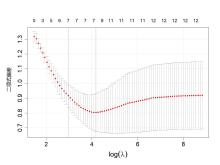
Fig.1
Lasso regression cross-validation"
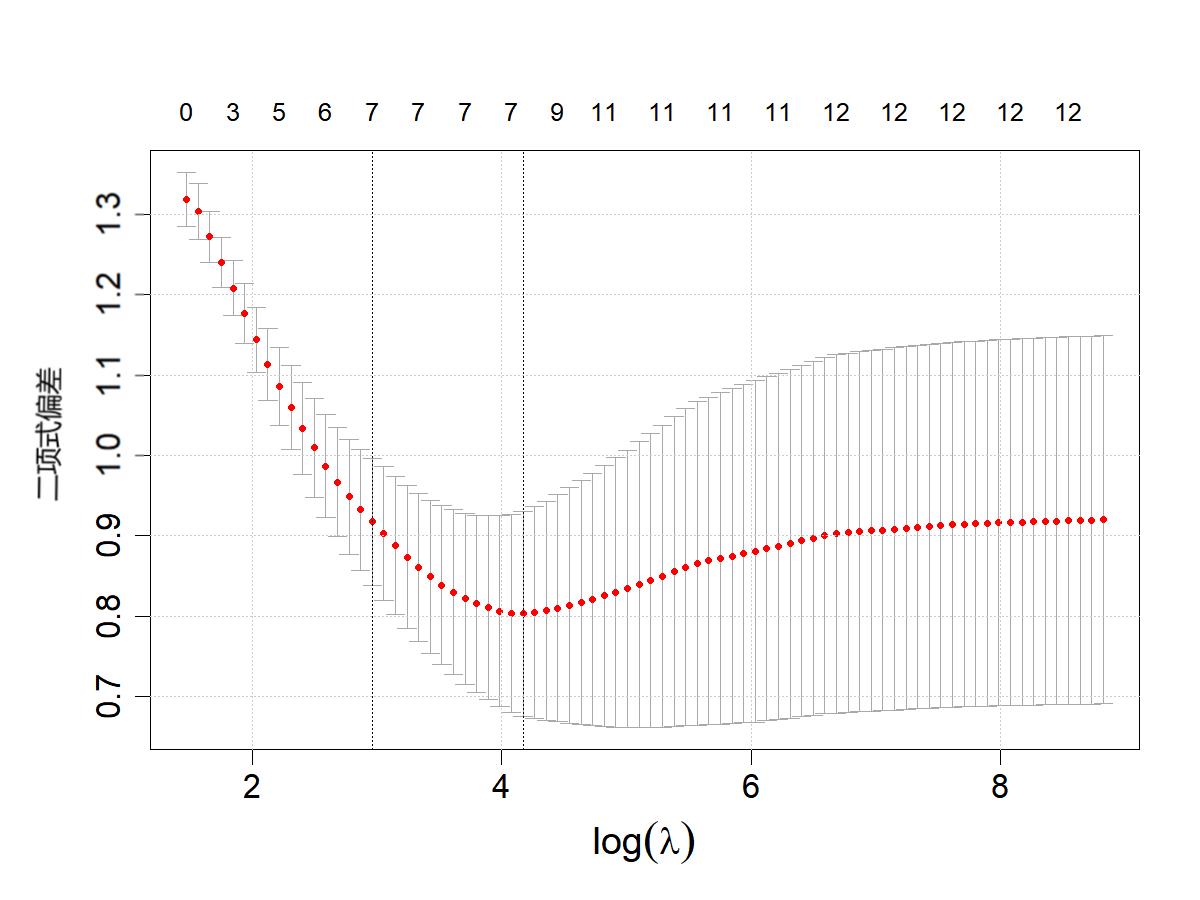
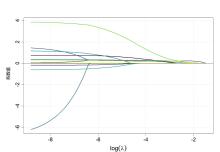
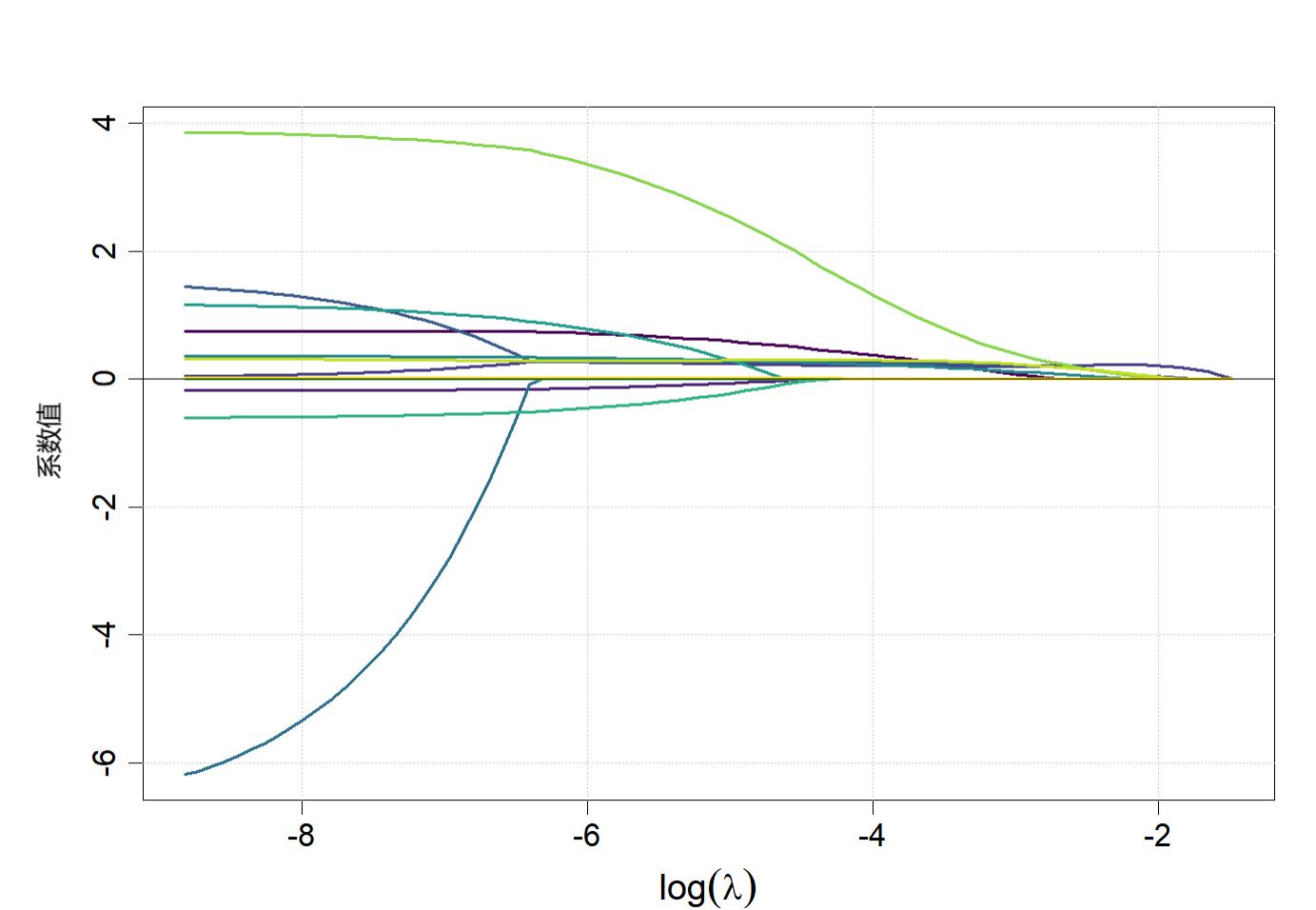
Fig.2
Lasso coefficient paths"
Tab.3
Results of multivariate logistic regression analysis"
| 变量 | OR值 | 95%CI | P值 |
|---|---|---|---|
| 身高标准差积分 | 2.165 | 1.406 ~ 3.335 | <0.001 |
| IGF-1/(ng/mL) | 1.019 | 1.011 ~ 1.028 | <0.001 |
| LH基础值/(IU/L),per0.1 | 1.713 | 1.315 ~ 2.232 | <0.001 |
| > 4 mm卵泡数/个 | 1.421 | 1.186 ~ 1.704 | <0.001 |
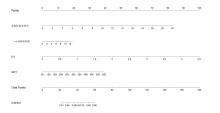
Fig.3
Nomogram prediction model for CPP in premature thelarche girls"
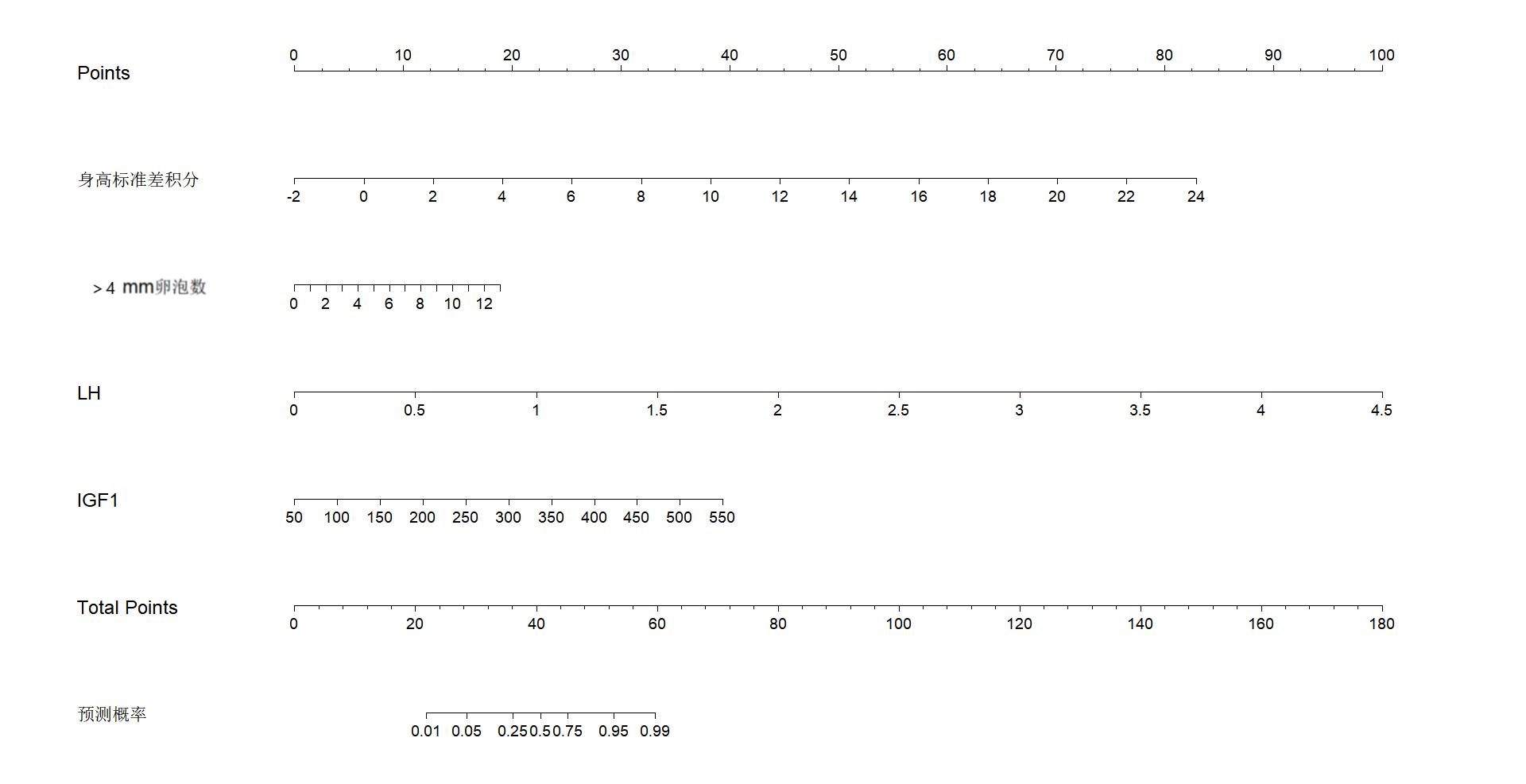
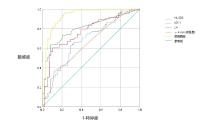
Fig.4
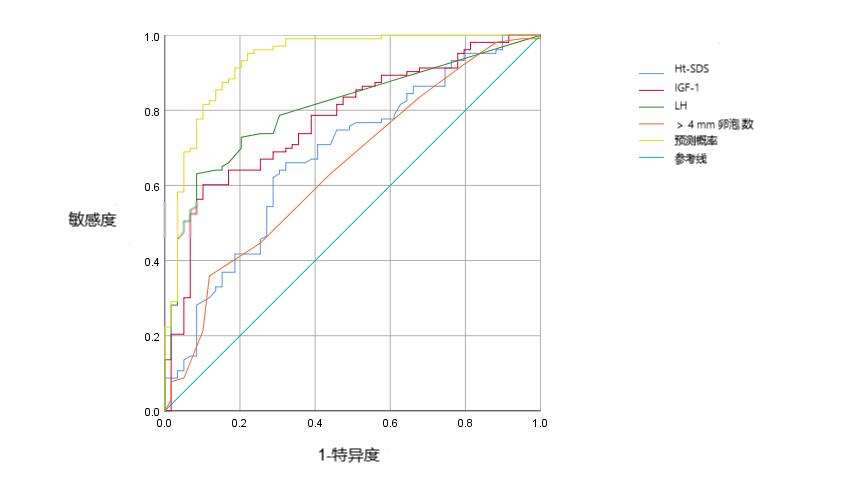
ROC curves of the prediction model and single factor"
Tab.4
ROC curve prediction value"
| 变量 | AUC | 95%CI | P值 | 截断值 | 约登指数 | 敏感度 | 特异度 |
|---|---|---|---|---|---|---|---|
| 身高标准差积分 | 0.680 | 0.594 ~ 0.769 | <0.001 | 1.515 | 0.338 | 0.660 | 0.678 |
| IGF-1/(ng/mL) | 0.775 | 0.702 ~ 0.849 | <0.001 | 296.550 | 0.500 | 0.602 | 0.898 |
| LH基础值/(IU/L) | 0.806 | 0.739 ~ -0.873 | <0.001 | 0.225 | 0.550 | 0.631 | 0.915 |
| > 4 mm卵泡数/个 | 0.647 | 0.559 ~ 0.734 | 0.002 | 8.500 | 0.240 | 0.359 | 0.881 |
| 预测模型 | 0.932 | 0.889 ~ 0.975 | <0.001 | 0.414 | 0.731 | 0.951 | 0.780 |
Fig.5
Calibration curve of prediction model"
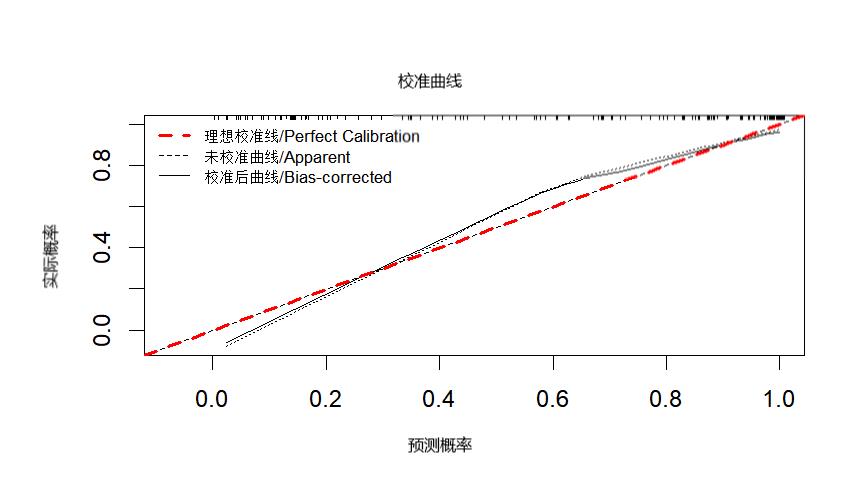
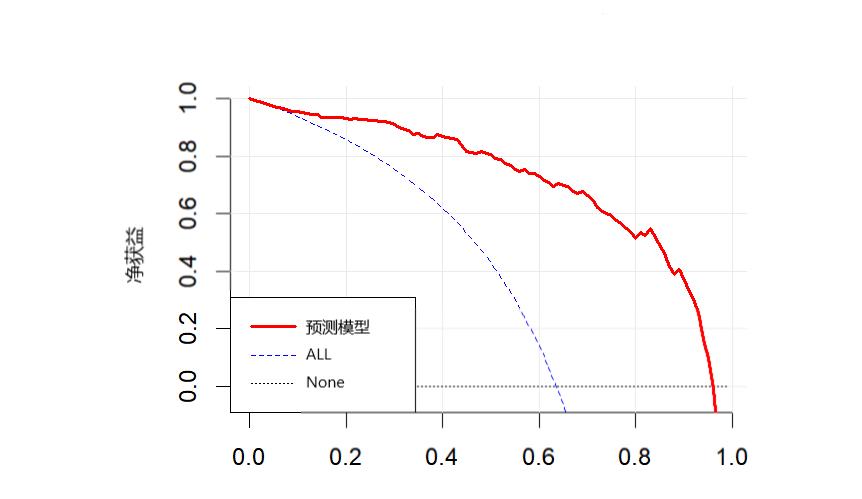
Fig.6
Clinical decision cuive"
| [1] |
KANG S, PARK M J, KIM J M, et al. Ongoing increasing trends in central precocious puberty incidence among korean boys and girls from 2008 to 2020[J]. PLOS One, 2023, 18(3): e0283510.doi: 10.1371/journal.pone.0283510. eCollection 2023 .
doi: 10.1371/journal.pone.0283510. eCollection 2023 |
| [2] |
王冰,陈秋莉,郭松 等.2型5α还原酶缺乏症合并中枢性性早熟的临床特征分析[J].中山大学学报(医学科学版),2025,46(6):1079-1086. doi:10.13471/j.cnki.j.sun.yat-sen.univ(med.sci).2025.0618 .
doi: 10.13471/j.cnki.j.sun.yat-sen.univ(med.sci).2025.0618 |
| [3] |
中华医学会儿科学分会内分泌遗传代谢学组, 中华儿科杂志编辑委员会. 中枢性性早熟诊断与治疗专家共识(2022)[J]. 中华儿科杂志, 2023, 61(1): 16-22. doi:10.3760/cma.j.cn112140-20220802-00693
doi: 10.3760/cma.j.cn112140-20220802-00693 |
| [4] |
MASON L, DASKAS N. Central precocious puberty: assessment, diagnosis and decisions about treatment[J]. Nurs Child Young People,2023, 2024, 36(4): 36-42.doi: 10.7748/ncyp.2024.e1492 .
doi: 10.7748/ncyp.2024.e1492 |
| [5] |
KILBERG M J, VOGIATZI M G. Approach to the patient: central precocious puberty[J]. J Clin Endocrinol Metab, 2023, 108(8): 2115-2123.doi: 10.1210/clinem/dgad081 .
doi: 10.1210/clinem/dgad081 |
| [6] |
余月, 刘德云, 杨琍琦, 等. 特发性中枢性性早熟女童糖脂代谢指标、维生素D和性激素水平分析[J]. 实用医学杂志, 2020, 36(22): 3079-3083.doi: 10.3969/j.issn.1006-5725.2020.22.010 .
doi: 10.3969/j.issn.1006-5725.2020.22.010 |
| [7] |
OUYANG L, YANG F. Combined diagnostic value of insulin-like growth factor-1, insulin-like growth factor binding protein-3, and baseline luteinizing hormone levels for central precocious puberty in girls[J]. J Pediatr Endocrinol Metab, 2022, 35(7): 874-879. doi: 10.1515/jpem-2022-0161 .
doi: 10.1515/jpem-2022-0161 |
| [8] |
XU Y Q, LI G M, LI Y. Advanced bone age as an indicator facilitates the diagnosis of precocious puberty[J]. J Pediatr (Rio J), 2018, 94(1): 69-75.doi: 10.1016/j.jped.2017.03.010 .
doi: 10.1016/j.jped.2017.03.010 |
| [9] |
邱世超, 汪治华, 宋娜, 等. 女童中枢性性早熟诊断模型构建、评分卡设计及外部验证[J]. 中国当代儿科杂志, 2024, 26(12): 1267-1274.doi:10.7499/j.issn.1008-8830.2405079 .
doi: 10.7499/j.issn.1008-8830.2405079 |
| [10] |
ZEVIN E L, EUGSTER E A. Central precocious puberty: A review of diagnosis, treatment, and outcomes[J]. Lancet Child Adolesc Health, 2023, 7(12): 886-896.doi: 10.1016/S2352-4642(23)00237-7 .
doi: 10.1016/S2352-4642(23)00237-7 |
| [11] |
CAO R, LIU J, FU P, et al. The diagnostic utility of the basal luteinizing hormone level and single 60-minute post GnRH agonist stimulation test for idiopathic central precocious puberty in girls[J]. Front Endocrinol (Lausanne), 2021, 12: 713880.doi: 10.3389/fendo.2021.713880 .
doi: 10.3389/fendo.2021.713880 |
| [12] |
ZHANG M, SUN J, WANG Y, et al. The value of luteinizing hormone basal values and sex hormone-binding globulin for early diagnosis of rapidly progressive central precocious puberty[J]. Front Endocrinol (Lausanne), 2024, 14: 1273170.doi: 10.3389/fendo.2023.1273170 .
doi: 10.3389/fendo.2023.1273170 |
| [13] |
HEO S, LEE Y S, YU J. Basal serum luteinizing hormone value as the screening biomarker in female central precocious puberty[J]. Ann Pediatr Endocrinol Metab, 2019, 24(3): 164-171.doi: 10.6065/apem.2019.24.3.164 .
doi: 10.6065/apem.2019.24.3.164 |
| [14] |
ABDELMEGUID Y, ABDELKAREM O, RAAFAT S. Evaluation of the diagnostic value of different serum biomarkers in girls with central precocious puberty[J]. Egyptian Pediatric Association Gazette, 2024, 72(1): 50.doi:10.1186/s43054-024-00291-1 .
doi: 10.1186/s43054-024-00291-1 |
| [15] |
BANGALORE KRISHNA K, FUQUA J S, ROGOL A D, et al. Use of gonadotropin-releasing hormone analogs in children: Update by an international consortium[J]. Horm Res Paediatr, 2019, 91(6): 357-372. doi: 10.1159/000501336 .
doi: 10.1159/000501336 |
| [16] |
YOU J, CHENG X, LI X, et al. Clinical risk score for central precocious puberty among girls with precocious pubertal development: A cross sectional study[J]. BMC Endocr Disord, 2021, 21(1): 75. doi: 10.1186/s12902-021-00740-7 .
doi: 10.1186/s12902-021-00740-7 |
| [17] |
LIU Y, FU R, JIA H, et al. GHRH and its analogues in central nervous system diseases[J]. Rev Endocr Metab Disord. 2025, 26(3): 427-442. doi: 10.1007/s11154-024-09920-x .
doi: 10.1007/s11154-024-09920-x |
| [18] |
袁博, 皮亚雷, 张亚男, 等. 经直肠超声对特发性中枢性性早熟的诊断价值[J]. 实用医学杂志, 2020, 36(14): 1992-1996.doi:10.3969/j.issn.1006-5725.2020.14.026
doi: 10.3969/j.issn.1006-5725.2020.14.026 |
| [19] |
DIXIT M, POUDEL S B, YAKAR S. Effects of GH/IGF axis on bone and cartilage[J]. Mol Cell Endocrinol, 2021, 519: 111052.doi: 10.1016/j.mce.2020.111052 .
doi: 10.1016/j.mce.2020.111052 |
| [20] |
LIU Y, CHENG Y, SUN M, et al. Analysis of serum insulin-like growth factor-1, fibroblast growth factor 23, and Klotho levels in girls with rapidly progressive central precocious puberty[J]. Eur J Pediatr, 2023, 182(11): 5007-5013. doi: 10.1007/s00431-023-05174-y .
doi: 10.1007/s00431-023-05174-y |
| [21] |
DEES W L, HINEY J K, SRIVASTAVA V K. IGF-1 Influences Gonadotropin-Releasing Hormone Regulation of Puberty[J]. Neuroendocrinology, 2021, 111(12): 1151-1163. doi: 10.1159/000514217 .
doi: 10.1159/000514217 |
| [22] |
HAN Y, CHEN Y, YANG F, et al. Mechanism underlying the stimulation by IGF-1 of LHCGR expression in porcine granulosa cells[J]. Theriogenology, 2021, 169: 56-64. doi: 10.1016/j.theriogenology.2021.04.011 .
doi: 10.1016/j.theriogenology.2021.04.011 |
| [23] |
YANG Y, XU L, LEI B, et al. Effects of trichlorobisphenol a on the expression of proteins and genes associated with puberty initiation in GT1-7 cells and the relevant molecular mechanism[J]. Food Chem Toxicol, 2024, 183: 114258. doi: 10.1016/j.fct.2023.114258 .
doi: 10.1016/j.fct.2023.114258 |
| [24] |
TANAKA T, SONEDA S, SATO N, et al. Early growth hormone treatment accelerates delayed onset of puberty in patients with growth hormone deficiency[J]. Endocr J, 2022, 69(2): 199-207.doi: 10.1507/endocrj.EJ21-0209 .
doi: 10.1507/endocrj.EJ21-0209 |
| [25] |
LEITE A L, AZEVEDO L F, CAMPOS R A, et al. Insulin-like growth factor 1 as a diagnostic marker of progressive central precocious puberty: A prospective study[J]. Eur J Pediatr, 2025, 184(7): 438. doi: 10.1007/s00431-025-06276-5 .
doi: 10.1007/s00431-025-06276-5 |
| [26] |
陈杰,王琨蒂,黄蓉,等.GH峰值与IGF-1水平在单纯性乳房早发育女童中的表达及其对中枢性性早熟的预测价值[J].中国当代儿科杂志,2025,27(11):1360-1366.doi:10.7499/j.issn.1008-8830.2505007 .
doi: 10.7499/j.issn.1008-8830.2505007 |
| Viewed | ||||||
|
Full text |
|
|||||
|
Abstract |
|
|||||
