

The Journal of Practical Medicine ›› 2026, Vol. 42 ›› Issue (7): 1286-1293.doi: 10.3969/j.issn.1006-5725.2026.07.023
• Modernization of Traditional Chinese Medicine • Previous Articles
Kaiqing YANG,Jing XIONG,Wanxin WEI,Linyu XIA,Rui XIA,Wei XU( )
)
Received:2025-11-28
Revised:2025-12-25
Accepted:2025-12-26
Online:2026-04-10
Published:2026-04-13
Contact:
Wei XU
E-mail:weixumedical@163.com
CLC Number:
Kaiqing YANG,Jing XIONG,Wanxin WEI,Linyu XIA,Rui XIA,Wei XU. Effect of transcutaneous electrical acupoint stimulation wristband on preventing postoperative nausea and vomiting after ambulatory hysteroscopic surgery[J]. The Journal of Practical Medicine, 2026, 42(7): 1286-1293.
Tab.1
Comparison of baseline characteristics and perioperative parameters between the two groups of patients"
| 项目 | 对照组(n = 121) | 观察组(n = 119) | t/χ2/Z值 | P值 |
|---|---|---|---|---|
| 年龄( | 40.04 ± 8.41 | 41.08 ± 8.50 | 0.96 | 0.34 |
| BMI/(kg/m2) | 22.31(4.56) | 21.48(2.92) | -1.28 | 0.20 |
| ASA分级/例 | 0.54 | 0.46 | ||
| Ⅰ级 | 42 | 36 | ||
| Ⅱ级 | 79 | 83 | ||
| Apfel评分/例 | 0.12 | 0.94 | ||
| 1分 | 5 | 6 | ||
| 2分 | 95 | 93 | ||
| 3分 | 21 | 20 | ||
| 4分 | 0 | 0 | ||
| 丙泊酚用量( | 101.16 ± 11.38 | 99.96 ± 11.04 | -0.83 | 0.41 |
| 舒芬太尼用量( | 19.36 ± 3.51 | 18.85 ± 3.58 | -1.11 | 0.27 |
| 瑞芬太尼用量( | 0.36 ± 0.15 | 0.38 ± 0.14 | 1.39 | 0.17 |
| 输液量/mL | 550(300) | 600(280) | -1.51 | 0.13 |
| 手术时间/min | 32(15) | 35(15) | -0.46 | 0.65 |
| 麻醉时间/min | 60(20) | 60(15) | -0.46 | 0.65 |
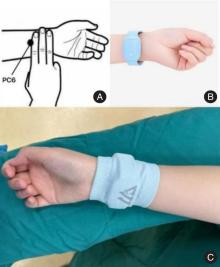
Fig.1
Schematic diagrams of the method for locating the PC6 and the wearing of the TEAS bracelet"
Tab.2
Comparison of the incidence of PONV in the two groups at different periods postoperatively"
| 时间 | 对照组(n = 121) | 观察组(n = 119) | χ2值 | P值 |
|---|---|---|---|---|
| 合计 | 62(51.24) | 39(32.77) | 8.39 | 0.00 |
| 术后在PACU即时 | 21(17.38) | 7(5.88) | 7.66 | 0.01 |
| 术后6 h | 51(42.15) | 27(22.69) | 10.36 | 0.00 |
| 术后6 ~ 24 h | 30(24.79) | 19(15.97) | 2.88 | 0.09 |
| 术后24 ~ 48 h | 12(9.92) | 5(4.20) | 2.98 | 0.08 |
Tab.3
Comparison of the incidence of vomiting in the two groups at different periods postoperatively"
| 时间 | 对照组(n = 121) | 观察组(n = 119) | χ2值 | P值 |
|---|---|---|---|---|
| 合计 | 30(24.79) | 15(12.61) | 5.85 | 0.02 |
| 术后在PACU即时 | 6(4.99) | 2(1.68) | 2.00 | 0.28 |
| 术后在PACU即时至6 h | 19(15.70) | 8(6.72) | 4.85 | 0.03 |
| 术后6 ~ 24 h | 5(4.13) | 4(3.36) | 0.10 | 1.00 |
| 术后24 ~ 48 h | 4(3.31) | 2(1.68) | 0.65 | 0.68 |
Tab.4
Comparison of the severity of PONV in the two groups at different periods postoperatively"
| 时间 | 组别 | Ⅰ级 | Ⅱ级 | Ⅲ级 | Ⅳ级 | Z值 | P值 |
|---|---|---|---|---|---|---|---|
| 术后在PACU即时 | 对照组 | 100(82.64) | 10(8.26) | 5(4.13) | 6(4.99) | -2.77 | 0.01 |
| 观察组 | 112(94.12) | 4(3.36) | 1(0.84) | 2(1.68) | |||
| 术后在PACU即时至6 h | 对照组 | 70(57.85) | 24(19.83) | 8(6.61) | 19(15.70) | -3.25 | 0.00 |
| 观察组 | 92(77.31) | 14(11.76) | 5(4.20) | 8(6.72) | |||
| 术后6 ~ 24 h | 对照组 | 91(75.21) | 19(15.70) | 6(4.96) | 5(4.13) | -1.60 | 0.11 |
| 观察组 | 100(84.03) | 10(8.40) | 5(4.20) | 4(3.36) | |||
| 术后24 ~ 48 h | 对照组 | 109(90.08) | 6(4.96) | 2(1.65) | 4(3.31) | -1.73 | 0.08 |
| 观察组 | 114(95.80) | 3(2.52) | 0(0.00) | 2(1.68) |
Tab.5
Comparison of the use of rescue antiemetics of the two groups postoperatively"
| 时间 | 对照组(n = 121) | 观察组(n = 119) | χ2值 | P值 |
|---|---|---|---|---|
| 术后在PACU即时 | 2(1.65) | 2(1.68) | 0.99 | 1.00 |
| 术后在PACU即时至6 h | 3(2.48) | 1(0.84) | 0.01 | 0.62 |
Tab.6
Comparison of pain scores between the two groups of patients at different postoperative time periods"
| 时间段 | 对照组 | 观察组 | Z值 | P值 | H-B校正后显著性 | Cliff's Delta |
|---|---|---|---|---|---|---|
| 术后在PACU即时 | 0(0) | 0(0) | -1.57 | 0.12 | 不显著 | 0.07 |
| 术后在PACU即时至6 h | 0(2) | 0(1) | -2.26 | 0.02 | 不显著 | 0.14 |
| 术后6 ~ 24 h | 0(0) | 0(0) | -1.47 | 0.14 | 不显著 | 0.07 |
| 术后24 ~ 48 h | 0(0) | 0(0) | -1.22 | 0.22 | 不显著 | 0.04 |
| 时间主效应(GG) | F(2.13,493.4)= 25.21 | 0.00 | ||||
| 时间×组别交互效应(GG) | F(2.07,493.4)= 1.04 | 0.36 |
| [1] |
韩超, 祝学梅, 王莹, 等. 日间医疗的规范化发展思考[J]. 实用医学杂志, 2024, 40(8): 1038-1041. doi: 10.3969/j.issn.1006-5725.2024.08.002 .
doi: 10.3969/j.issn.1006-5725.2024.08.002 |
| [2] |
FAN D, YIN Q Y, LI D N, et al. Development and validation of a machine learning-based predictive model for postoperative nausea and vomiting in patients undergoing day-case laparoscopic cholecystectomy: A single-centre retrospective study[J]. BMJ Open, 2025, 15(10): e093884. doi: 10.1136/bmjopen-2024-093884 .
doi: 10.1136/bmjopen-2024-093884 |
| [3] |
DZIADZKO M, AUBRUN F. Management of postdischarge nausea and vomiting[J]. Best Pract Res Clin Anaesthesiol, 2020, 34(4): 771-778. doi: 10.1016/j.bpa.2020.10.008 .
doi: 10.1016/j.bpa.2020.10.008 |
| [4] |
KNOTH S, WEBER B, LOTZ H, et al. Update PO(N)V – Was gibt es Neues zu Prophylaxe und Therapie von Übelkeit und Erbrechen nach Operationen? [Update PO(N)V-What is new in the prophylaxis and treatment of postoperative nausea and vomiting?][J]. Anaesthesiologie, 2025, 74(3): 171-186. doi: 10.1007/s00101-025-01510-z .
doi: 10.1007/s00101-025-01510-z |
| [5] |
梁鹏. 麻醉医师在日间手术全流程管理中的作用[J]. 实用医学杂志, 2024, 40(8): 1031-1037. doi: 10.3969/j.issn.1006-5725.2024.08.001 .
doi: 10.3969/j.issn.1006-5725.2024.08.001 |
| [6] |
YANG Y D, WANG C P, CAO G R, et al. Risk of Postoperative Nausea and Vomiting After Total Hip or Knee Arthroplasty Under Spinal Anesthesia: Randomized Trial Comparing Conventional Antiemetics with or without the EmeTerm Bracelet[J]. J Bone Joint Surg Am, 2025, 107(10): 1063-1072. doi: 10.2106/JBJS.24.00773 .
doi: 10.2106/JBJS.24.00773 |
| [7] |
龚明, 朱鸿威, 郑栋煜, 等. 经皮穴位电刺激手环行内关穴刺激对全麻甲状腺切除术后恶心呕吐的影响[J]. 临床麻醉学杂志, 2024, 40(2): 124-127. doi: 10.12089/jca.2024.02.003 .
doi: 10.12089/jca.2024.02.003 |
| [8] |
DING P, ZHENG D Y, ZHU H W, et al. Efficacy of wearable transcutaneous electrical acupoint stimulation bracelet on moderate-to-severe postoperative nausea and vomiting in patients after general anesthesia: A study protocol for a multicenter randomized controlled trial[J]. Trials, 2024, 25(1): 805. doi: 10.1186/s13063-024-08650-4 .
doi: 10.1186/s13063-024-08650-4 |
| [9] |
陈丽梅, 全培青, 张宏伟, 等. 门诊、日间和住院3种不同模式宫腔镜手术的比较[J]. 复旦学报(医学版), 2024, 51(5): 742-748. doi: 10.3969/j.issn.1672-8467.2024.05.014 .
doi: 10.3969/j.issn.1672-8467.2024.05.014 |
| [10] |
ATIEH A S, SHAMMA O K ABU, ABDELHAFEZ M O, et al. Acute Severe Hyponatremia following Hysteroscopic Procedure in a Young Patient: A Case Report and Review of the Literature[J].Case Rep Nephrol, 2021, 2021: 7195660. doi: 10.1155/2021/7195660 .
doi: 10.1155/2021/7195660 |
| [11] |
中华医学会麻醉学分会, 郭曲练, 程智刚, 等. 日间手术麻醉指南[J]. 中华医学杂志, 2023, 103(43): 3462-3471. doi: 10.3760/cma.j.cn112137-20230803-00151 .
doi: 10.3760/cma.j.cn112137-20230803-00151 |
| [12] |
吴丹, 刘昕. 无痛消化道内镜术后恶心呕吐的研究进展[J]. 世界华人消化杂志, 2021, 29(17): 1014-1019. doi: 10.11569/wcjd.v29.i17.1014 .
doi: 10.11569/wcjd.v29.i17.1014 |
| [13] |
HJERMSTAD M J, FAYERS P M, HAUGEN D F, et al. Studies comparing Numerical Rating Scales, Verbal Rating Scales, and Visual Analogue Scales for assessment of pain intensity in adults: A systematic literature review[J]. J Pain Symptom Manage, 2011, 41(6): 1073-1093. doi: 10.1016/j.jpainsymman.2010.08.016 .
doi: 10.1016/j.jpainsymman.2010.08.016 |
| [14] |
APFEL C C, LÄÄRÄ E, KOIVURANTA M, et al. A simplified risk score for predicting postoperative nausea and vomiting: Conclusions from cross-validations between two centers[J]. Anesthesiology, 1999, 91(3): 693-700. doi: 10.1097/00000542-199909000-00022
doi: 10.1097/00000542-199909000-00022 |
| [15] | 吴新民, 罗爱伦, 田玉科, 等. 术后恶心呕吐防治专家意见(2012)[J]. 临床麻醉学杂志, 2012, 28(4): 413-416. |
| [16] |
GAN T J, BELANI K G, BERGESE S, et al. Fourth Consensus Guidelines for the Management of Postoperative Nausea and Vomiting[J]. Anesth Analg, 2020, 131(2): 411-448. doi: 10.1213/ANE.0000000000004833 .
doi: 10.1213/ANE.0000000000004833 |
| [17] |
ZHOU T, HOU H J, CAIREN Z, et al. Comparative effectiveness of acupoint stimulation for preventing postoperative nausea and vomiting after general anesthesia: A network meta-analysis of randomized trials[J]. Int J Surg, 2025, 111(1): 1330-1347. doi: 10.1097/JS9.0000000000001976 .
doi: 10.1097/JS9.0000000000001976 |
| [18] |
冯睿智, 依登加甫·多尔加拉, 吕建琴. 内关穴位刺激防治术后恶心呕吐的机制研究进展[J]. 世界中西医结合杂志, 2025, 20(8): 1688-1692. doi: 10.13935/j.cnki.sjzx.250833 .
doi: 10.13935/j.cnki.sjzx.250833 |
| [19] |
冯睿智, 吕建琴. 内关穴刺激防治术后恶心呕吐的临床研究进展[J]. 中国中医急症, 2024, 33(12): 2241-2244. doi: 10.3969/j.issn.1004-745X.2024.12.045 .
doi: 10.3969/j.issn.1004-745X.2024.12.045 |
| [20] |
孙德峰. 日间手术麻醉规范化管理策略[J]. 实用医学杂志,2024, 40(3): 283-288. doi: 10.3969/j.issn.1006-5725.2024.03.001 .
doi: 10.3969/j.issn.1006-5725.2024.03.001 |
| [21] |
中华医学会麻醉学分会《术后恶心呕吐诊疗指南》工作组, 王锷, 俞卫锋, 等. 术后恶心呕吐诊疗指南(2025版)[J]. 中华麻醉学杂志, 2025, 45(9): 1080-1103. doi: 10.3760/cma.j.cn131073-20250715-00903 .
doi: 10.3760/cma.j.cn131073-20250715-00903 |
| [22] |
ZHANG Y, ZHANG C, YAN M H, et al. The effectiveness of PC6 acupuncture in the prevention of postoperative nausea and vomiting in children: A systematic review and meta-analysis[J]. Paediatr Anaesth, 2020, 30(5): 552-563. doi: 10.1111/pan.13860 .
doi: 10.1111/pan.13860 |
| [23] |
USICHENKO T I, HESSE T. Appropriate timing and intensity of PC6 stimulation for the prevention of postoperative nausea and vomiting[J]. Acupunct Med, 2016, 34(1): 70-1. doi: 10.1136/acupmed-2015-010926 .
doi: 10.1136/acupmed-2015-010926 |
| [24] |
王彩红, 魏晓涛, 赵永强, 等. 经皮穴位电刺激对腹腔镜非胃肠手术后恶心呕吐影响的Meta分析[J]. 临床麻醉学杂志, 2024, 40(9): 959-965. doi: 10.12089/jca.2024.09.012 .
doi: 10.12089/jca.2024.09.012 |
| [25] |
JIN L D, LEI W, XU J, et al. Effect of single or multi-period use of transcutaneous acupoint electrical stimulation on postoperative nausea and vomiting in patients undergoing gynecological laparoscopic surgery: A prospective randomized double-blind trial[J]. BMC Complement Med Ther, 2025, 25(1): 110. doi: 10.1186/s12906-025-04847-5 .
doi: 10.1186/s12906-025-04847-5 |
| [26] |
GILBERT R T, FARISH N, BERGLAND E, et al. The Use of Short-Term Acupressure to Prevent Long-Term PONV: Was This a Case of Too Little, Too Late?[J]. J Perianesth Nurs, 2017, 32(5): 445-452. doi: 10.1016/j.jopan.2015.08.014 .
doi: 10.1016/j.jopan.2015.08.014 |
| [27] |
李子超, 肖洪一, 朱腾, 等. 阿芬太尼复合丙泊酚在日间宫腔镜手术麻醉中的应用效果观察[J]. 山东医药, 2022, 62(6): 72-75. doi: 10.3969/j.issn.1002-266X.2022.09.018 .
doi: 10.3969/j.issn.1002-266X.2022.09.018 |
| [28] |
LIU J, HAN L F, ZHANG F X, et al. Construction and validation of a web-based dynamic predictive model for the risk of postoperative nausea and vomiting in patients undergoing day-case hysteroscopic surgery[J]. Front Med (Lausanne), 2025, 12: 1582546. doi: 10.3389/fmed.2025.1582546 .
doi: 10.3389/fmed.2025.1582546 |
| [29] |
LU L Y, XIE C L, LI X, et al. Efficacy and safety of electrical acupoint stimulation for postoperative nausea and vomiting: A systematic review and meta-analysis[J]. PLoS One, 2023, 18(5): e0285943. doi: 10.1371/journal.pone.0285943 .
doi: 10.1371/journal.pone.0285943 |
| [30] |
李雨利, 汪京萍, 张嵘, 等. 妇科宫腔镜术后使用韩氏穴位神经刺激仪对疼痛及恶心呕吐的影响[J]. 中国疼痛医学杂志, 2014, 20(1): 22-25. doi: 10.3969/j.issn.1006-9852.2014.01.006 .
doi: 10.3969/j.issn.1006-9852.2014.01.006 |
| [31] |
高祯蔚, 于利君, 陈春林, 等. 经皮神经电刺激在妇科日间手术中的镇痛疗效研究[J]. 中国实用妇科与产科杂志, 2023, 39(11): 1134-1138. doi: 10.19538/j.fk2023110116 .
doi: 10.19538/j.fk2023110116 |
| [32] |
夏恩兰. 中国宫腔镜30年[J]. 中国微创外科杂志, 2023, 23(10): 721-725. doi: 10.3969/j.issn.1009-6604.2023.10.001 .
doi: 10.3969/j.issn.1009-6604.2023.10.001 |
| [33] |
邱欣彤, 史英武, 曹鹏, 等. 内脏痛的中枢传递与调控机制的研究进展[J]. 神经解剖学杂志, 2020, 36(1): 89-93. doi: 10.16557/j.cnki.1000-7547.2020.01.015 .
doi: 10.16557/j.cnki.1000-7547.2020.01.015 |
| [34] |
HAN J S. Acupuncture: Neuropeptide release produced by electrical stimulation of different frequencies[J]. Trends Neurosci, 2003, 26(1): 17-22. doi: 10.1016/s0166-2236(02)00006-1 .
doi: 10.1016/s0166-2236(02)00006-1 |
| [35] |
WU C W, DENG Z H, ZHU Y B, et al. Transcutaneous electrical acupoint stimulation accelerates gastrointestinal function recovery after abdominal surgery: A systemic review and meta-analysis of randomized controlled trials[J]. Int J Surg, 2025, 111(11): 8592-8603. doi: 10.1097/JS9.0000000000002946 .
doi: 10.1097/JS9.0000000000002946 |
| [36] |
YUAN L, QUAN S J, LI X Y, et al. Transcutaneous electrical acupoint stimulation for preventing postoperative nausea and vomiting after laparoscopic surgery: A meta-analysis[J]. J Nurs Scholarsh, 2025, 57(3): 371-379. doi: 10.1111/JNU.13033 .
doi: 10.1111/JNU.13033 |
| [37] |
RAMIREZ M F, GAN T J. Total intravenous anesthesia versus inhalation anesthesia: How do outcomes compare?[J]. Curr Opin Anaesthesiol, 2023, 36(4): 399-406. doi: 10.1097/ACO.0000000000001274 .
doi: 10.1097/ACO.0000000000001274 |
| [1] | Yu CAI,Yan CHEN,Jianguo LIU. Effect of the frequency of Foley balloon placement after hysteroscopic transcervical resection of adhesion on re-adhesion in patients with severe intrauterine adhesions [J]. The Journal of Practical Medicine, 2026, 42(1): 157-162. |
| [2] | Yue QIAN,Zhengliang. MA. Anesthesia and perioperative quality control of ambulatory surgery under the concept of rapid recovery surgery [J]. The Journal of Practical Medicine, 2024, 40(8): 1042-1046. |
| [3] | Junjie ZHANG,Xiaochun YANG,Zhuoyi LIU,Ruoqiu WU,Ping LI,Qulian GUO,E. WANG. A randomized controlled study of remimazolam tosilate under bispectral index and bypass EtCO2 monitoring in daytime hysteroscopic surgery [J]. The Journal of Practical Medicine, 2024, 40(8): 1047-1051. |
| [4] | Defeng SUN. Standardized management strategy of anesthesia for Day Surgery [J]. The Journal of Practical Medicine, 2024, 40(3): 283-288. |
| Viewed | ||||||
|
Full text |
|
|||||
|
Abstract |
|
|||||
