

The Journal of Practical Medicine ›› 2026, Vol. 42 ›› Issue (4): 646-654.doi: 10.3969/j.issn.1006-5725.2026.04.015
• Emerging Technologies and Applications in Clinical Practice • Previous Articles
Jun LIU,Silue ZENG,Hao ZHONG,Jinsheng MAI,Ji ZHU,Ning ZENG( )
)
Received:2025-11-03
Online:2026-02-25
Published:2026-02-25
Contact:
Ning ZENG
E-mail:chen_ning16@foxmail.com
CLC Number:
Jun LIU,Silue ZENG,Hao ZHONG,Jinsheng MAI,Ji ZHU,Ning ZENG. The application value of three-dimensional visualization combined with ICG fluorescence imaging technology in the surgery of complex hepatolithiasis[J]. The Journal of Practical Medicine, 2026, 42(4): 646-654.
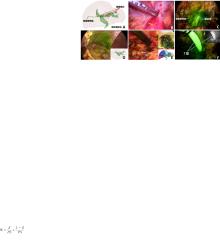
Fig.1
Application of 3DVT-FI in hepatolithiasis with a history of biliary surgery"
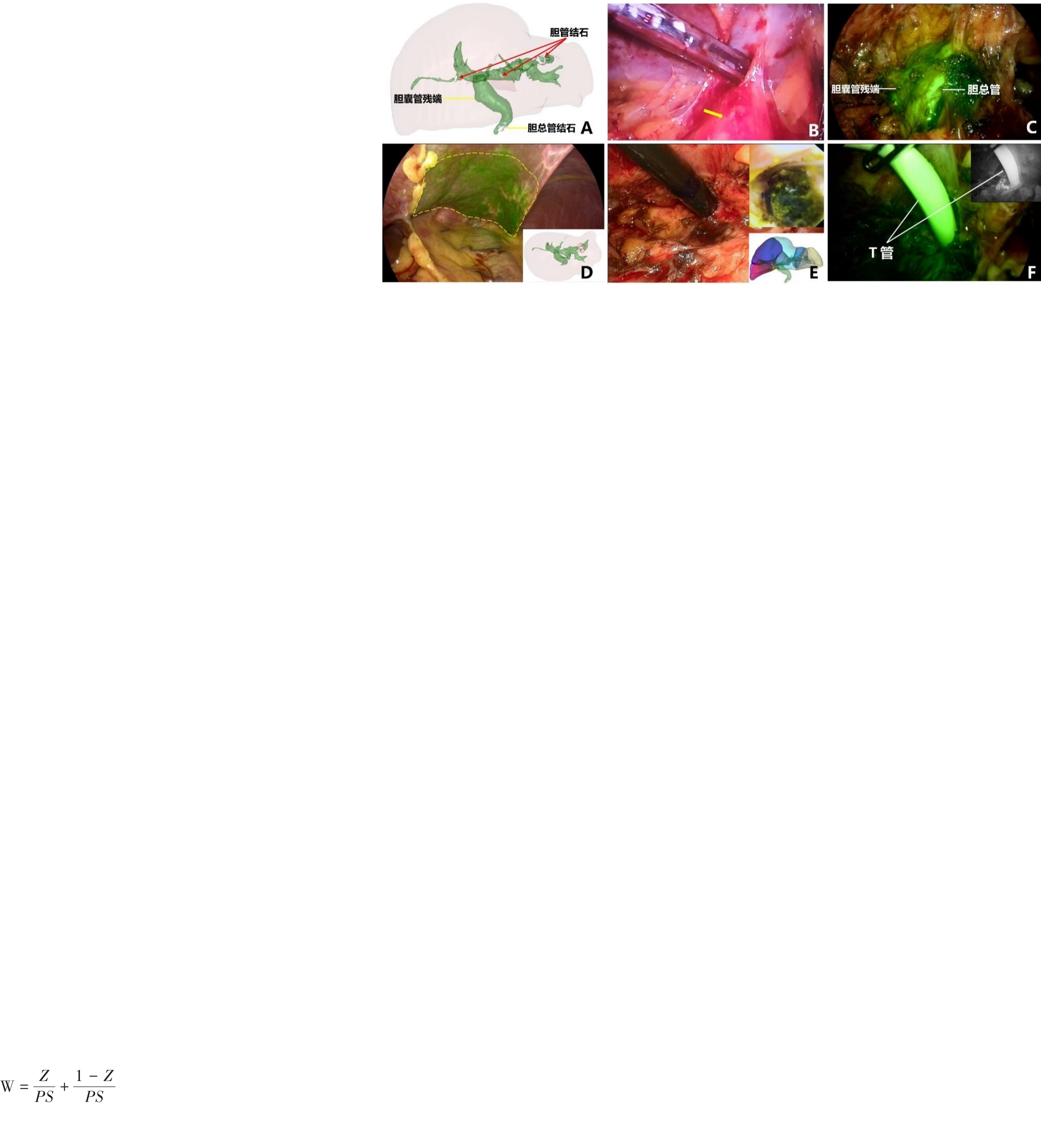
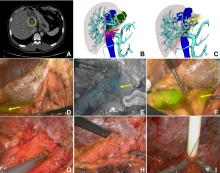
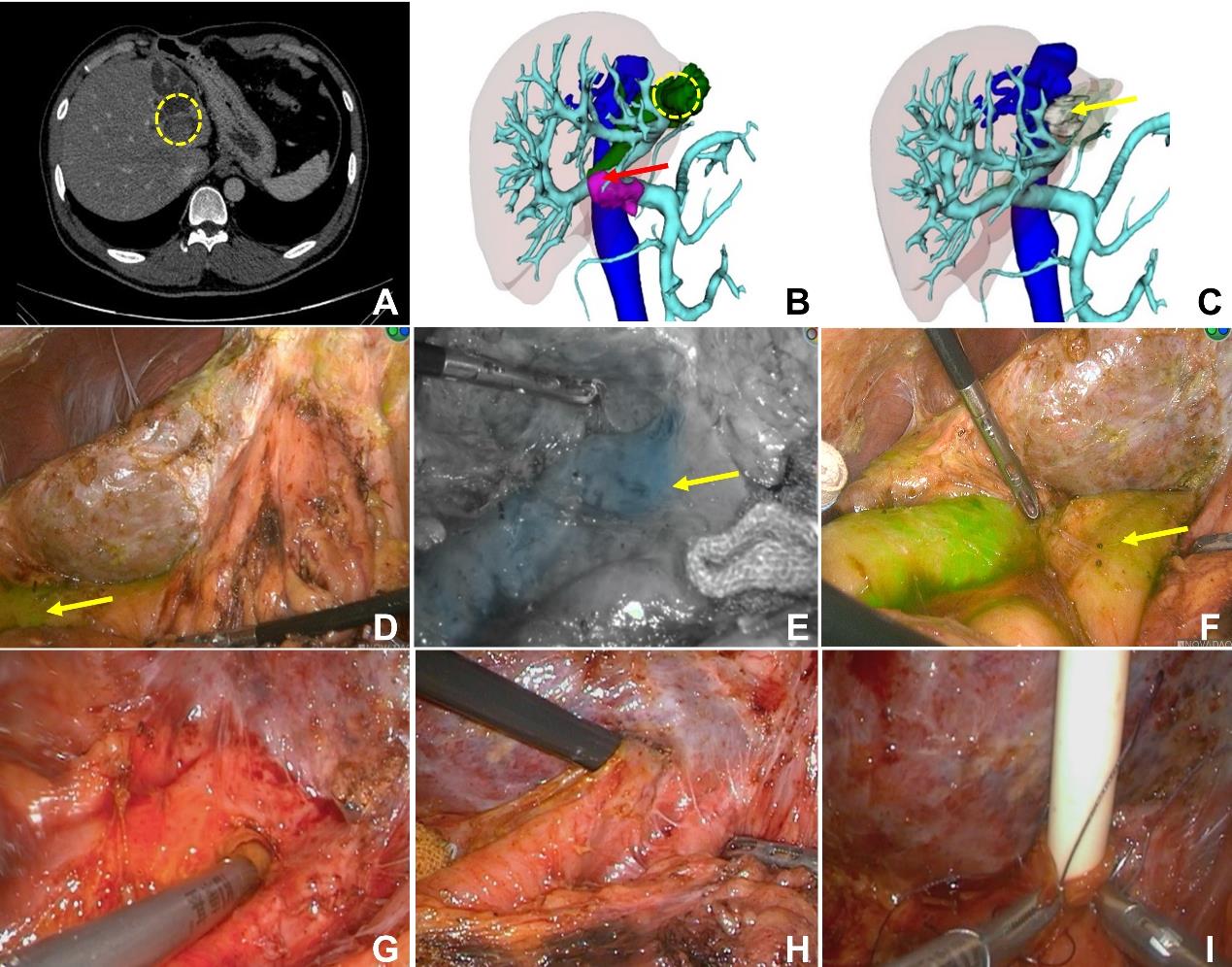
Fig.2
Application of 3DVT-FI in stone extraction via incision of the original choledochojejunostomy"
Tab.1
General information"
| 项目 | IPTW前 | P值 | IPTW后 | P值 | ||
|---|---|---|---|---|---|---|
| 3DVT-FI组(n = 33) | 常规手术组(n = 30) | 3DVT-FI组(n = 63) | 常规手术组(n = 53) | |||
| 年龄(x ± s)/岁 | 60.00 ± 12.56 | 62.63 ± 12.97 | 0.784 | 59.84 ± 11.00 | 61.24 ± 11.87 | 0.513 |
| 性别 | 0.064 | 0.386 | ||||
| 男 | 9(27.3) | 15(50.0) | 30(47.6) | 22(41.5) | ||
| 女 | 24(72.7) | 15(50.0) | 33(52.4) | 31(58.5) | ||
| 糖尿病 | 6(18.1) | 2(6.6) | 0.181 | 7(11.1) | 5(9.4) | 0.768 |
| Child-Pugh分级 | 0.142 | 0.136 | ||||
| A | 29(87.9) | 22(73.3) | 58(92.1) | 44(83.0) | ||
| B | 4(12.1) | 8(26.7) | 5(7.9) | 9(17.0) | ||
| 结石分布(左肝/右肝/双侧) | 0.217 | 0.133 | ||||
| 左肝 | 9(27.3) | 9(30.0) | 14(22.2) | 14(26.4) | ||
| 右肝 | 11(33.3) | 15(50.0) | 21(33.3) | 25(47.2) | ||
| 双侧 | 13(39.4) | 6(20.0) | 28(44.5) | 14(26.4) | ||
| 合并肝外胆管结石 | 23(69.6) | 25(83.3) | 0.204 | 40(63.5) | 37(69.8) | 0.327 |
| 既往胆道手术次数 | 0.062 | 0.182 | ||||
| 1次 | 20(60.6) | 25(83.3) | 49(77.8) | 43(81.1) | ||
| 2次 | 9(27.2) | 5(6.6) | 11(17.5) | 10(18.9) | ||
| ≥ 3次 | 4(12.0) | 0(0.0) | 3(4.7) | 0(0.0) | ||
| 合并≥ 2次胆道手术史 | 13(39.3) | 5(16.6) | 0.116 | 15(23.8) | 10(18.9) | 0.548 |
| 合并肝切除手术史 | 11(33.3) | 8(26.6) | 0.565 | 15(23.8) | 16(30.2) | 0.439 |
| 合并胆肠吻合手术史 | 11(33.3) | 2(6.6) | 0.009 | 12(19.0) | 8(15.1) | 0.574 |
| 术前白蛋白( | 37.56 ± 3.79 | 37.47 ± 5.23 | 0.158 | 37.56 ± 3.12 | 37.00 ± 5.58 | 0.510 |
| 术前血红蛋白( | 120.73 ± 14.32 | 113.00 ± 20.10 | 0.065 | 118.75 ± 12.39 | 114.20 ± 19.56 | 0.148 |
| 术前总胆红素[M(P25,P75)]/(μmol/L) | 17.80(12.15,41.15) | 20.50(15.13,43.28) | 0.286 | 18.92 (9.85,46.30) | 18.94 (15.58,27.40) | 0.621 |
| 术前ALT[M(P25,P75)]/(U/L) | 31.00(21.00,86.00) | 31.00(15.75,65.00) | 0.929 | 26.00(19.00,61.32) | 27.00(26.00,56.86) | 0.083 |
| 术前AST[M(P25,P75)]/(U/L) | 29.00(19.00,61.00) | 30.50(18.50,64.25) | 0.853 | 24.00(19.00,39.00) | 38.00(22.61,63.00) | 0.065 |
| 手术年份 | 0.015 | 0.115 | ||||
| 2017—2020 | 13(39.4) | 21(70.0) | 30(47.6) | 33(62.3) | ||
| 2021—2024 | 20(60.6) | 9(30.0) | 33(52.4) | 20(37.7) | ||
Fig.2 Comparison of operative data"
| 项目 | IPTW前 | P值 | IPTW后 | P值 | ||
|---|---|---|---|---|---|---|
| 3DVT-FI组(n = 33) | 常规手术组(n = 30) | 3DVT-FI组(n = 63) | 常规手术组(n = 53) | |||
| 手术方式 | 0.033 | 0.047 | ||||
| 胆总管切开取石术 | 26(78.8) | 29(96.7) | 50(79.4) | 49(92.5) | ||
| 原胆肠吻合口切开取石术 | 7(21.2) | 1(3.3) | 13(20.6) | 4(7.5) | ||
| 联合原胆肠吻合口拆开重建术 | 3(9.1) | 0(0.0) | 0.091 | 6(9.5) | 0(0.0) | 0.059 |
| 联合胆肠吻合术 | 2(6.0) | 1(3.3) | 0.612 | 5(7.9) | 3(5.7) | 0.909 |
| 联合胆管修补术 | 6(18.1) | 1(3.3) | 0.061 | 12(19.0) | 3(5.7) | 0.131 |
| 术中输血 | 1(3.0) | 1(3.3) | 1.000 | 2(3.2) | 2(3.8) | 1.000 |
| 开腹 | 8(24.2) | 16(53.3) | 0.018 | 17(27.0) | 30(56.6) | 0.035 |
| 手术时间[M(P25,P75)]/min | 254.00(192.50,312.50) | 222.50(150.00,262.50) | 0.126 | 251.49(210.00,300.00) | 220.00(180.00,260.00) | 0.106 |
| 术中出血量[M(P25,P75)]/mL | 50.00(30.00,102.50) | 72.50(45.00,200.00) | 0.115 | 50.00(30.00,105.75) | 71.08(42.47,214.31) | 0.010 |
Tab.3
Comparison of postoperative laboratory parameters"
| 项目 | IPTW前 | P值 | IPTW后 | P值 | ||
|---|---|---|---|---|---|---|
| 3DVT-FI组(n = 33) | 常规手术组(n = 30) | 3DVT-FI组 (n = 63) | 常规手术组 (n = 53) | |||
| 术后总胆红素[M(P25,P75)]/(μmol/L) | 18.60 (14.15,30.95) | 26.60 (15.38,45.00) | 0.171 | 18.80 (11.85,47.30) | 24.80 (12.90,46.50) | 0.596 |
| 术后白蛋白( | 35.19 ± 4.04 | 32.40 ± 5.04 | 0.035 | 35.26 ± 4.27 | 31.95 ± 4.74 | 0.001 |
| 术后ALT[M(P25,P75)]/(U/L) | 57.00 (34.00,84.50) | 63.50 (39.00,105.50) | 0.500 | 63.00 (45.21,86.00) | 68.00 (44.57,88.78) | 0.619 |
| 术后AST[M(P25,P75)]/(U/L) | 53.00 (32.50,105.00) | 72.50 (36.50,152.00) | 0.143 | 90.00 (37.25,131.00) | 86.82 (42.85,152.00) | 0.390 |
| 术后血红蛋白[M(P25,P75)]/(g/L) | 118.00 (110.50,127.50) | 107.50 (95.75,120.25) | 0.064 | 117.79 (111.00,127.00) | 105.00 (98.00,119.00) | 0.002 |
Tab.4
Comparison of surgical prognosis"
| 项目 | IPTW前 | P值 | IPTW后 | P值 | ||
|---|---|---|---|---|---|---|
3DVT-FI组 (n = 33) | 常规手术组 (n = 30) | 3DVT-FI组 (n = 63) | 常规手术组 (n = 53) | |||
| 术后住院时间[M(P25,P75)]/d | 8.00(6.00,12.50) | 8.00(6.00,11.00) | 0.781 | 8.00(6.00,9.01) | 9.00(6.00,11.00) | 0.160 |
| 术后总体并发症发生率 | 6(18.1) | 11(36.6) | 0.099 | 7(10.9) | 17(32.1) | 0.005 |
| 术后出血 | 0(0.0) | 3(10.0) | 0.059 | 0(0.0) | 4(7.7) | 0.084 |
| 切口感染 | 2(6.0) | 1(3.3) | 0.612 | 2(3.2) | 1(1.9) | 0.675 |
| 术后胆漏 | 2(8.3) | 8(26.2) | 0.022 | 2(3.2) | 12(22.6) | 0.001 |
| 术后胰漏 | 1(4.2) | 0(0.0) | 0.336 | 1(1.6) | 0(0.0) | 0.357 |
| 肠梗阻 | 2(8.3) | 0(0.0) | 0.171 | 2(3.2) | 0(0.0) | 0.191 |
| 肠瘘 | 0(0.0) | 2(7.4) | 0.132 | 0(0.0) | 3(5.7) | 0.185 |
| 下肢深静脉血栓 | 1(4.2) | 0(0) | 0.336 | 1(1.6) | 0(0.0) | 0.357 |
| 腹腔积液 | 0(0) | 1(3.3) | 0.290 | 0(0) | 2(3.8) | 0.120 |
| 腹腔感染 | 1(4.2) | 2(7.4) | 0.498 | 1(1.6) | 3(5.7) | 0.231 |
| 术后转ICU | 0(0.0) | 2(7.4) | 0.132 | 0(0.0) | 3(5.7) | 0.185 |
| Clavien-Dindo并发症分级≥ 3级 | 1(3.3) | 2(6.6) | 0.498 | 1(1.6) | 3(5.7) | 0.231 |
| 住院费用[M(P25,P75)]/元 | 66 295.65 (52 423.29, 92 310.77) | 56 769.84 (46 178.88, 67 315.08) | 0.084 | 62 484.30 (30 839.32, 77 406.88) | 52 659.71 (44 754.67, 62 032.41) | 0.373 |
| 最终结石残留 | 3(9.1) | 7(23.3) | 0.122 | 11(17.5) | 8(15.4) | 0.765 |
| 3月内再次手术发生率 | 8(24.2) | 6(20.0) | 0.686 | 25(39.7) | 32(61.5) | 0.020 |
Tab.5
Univariate analysis of postoperative complications"
| 项目 | IPTW后 | χ2/t值 | P值 | |
|---|---|---|---|---|
| 并发症组(n = 24) | 无并发症组(n = 92) | |||
| 年龄(x ± s)/岁 | 59.79 ± 13.84 | 60.65 ± 10.75 | -0.324 | 0.746 |
| 性别 | 1.745 | 0.187 | ||
| 男 | 8(33.3) | 45(48.9) | ||
| 女 | 16(66.7) | 47(51.1) | ||
| 糖尿病 | 2(8.3) | 10(10.9) | 0.074 | 0.768 |
| Child-Pugh分级 | 0.084 | 0.772 | ||
| A | 20(83.3) | 82(89.1) | ||
| B | 4(16.7) | 10(10.9) | ||
| 结石分布 | 4.726 | 0.094 | ||
| 左肝 | 9(37.5) | 19(20.7) | ||
| 右肝 | 9(37.5) | 37(40.2) | ||
| 双侧 | 6(25.0) | 36(39.1) | ||
| 合并肝外胆管结石 | 22(91.7) | 55(59.8) | 8.671 | 0.003 |
| 既往胆道手术次数 | 1.789 | 0.409 | ||
| 1次 | 18(75.0) | 74(80.4) | ||
| 2次 | 4(16.7) | 16(17.4) | ||
| ≥ 3次 | 2(8.3) | 2(2.2) | ||
| 手术年份 | 5.233 | 0.022 | ||
| 2017—2020 | 17(70.8) | 44(47.8) | ||
| 2021—2024 | 7(29.2) | 48(52.2) | ||
| 手术方案 | 7.945 | 0.005 | ||
| 3DVT-FI | 7(29.2) | 57(62.0) | ||
| 常规手术 | 17(70.8) | 35(38.0) | ||
| 开腹 | 13(54.2) | 34(37.0) | 2.461 | 0.117 |
Tab.6
Multivariate analysis of postoperative complications"
| 变量 | β值 | SE | Waldχ2 | P值 | OR | 95%CI |
|---|---|---|---|---|---|---|
| 3DVT-FI | 1.374 | 0.528 | 6.784 | 0.009 | 3.952 | 1.405 ~ 11.114 |
| 无合并肝外胆管结石 | -2.253 | 0.879 | 6.573 | 0.010 | 0.105 | 0.019 ~ 0.588 |
| 常量 | -1.706 | 0.429 | 15.834 | < 0.001 | - | - |
| [1] |
GARCÍA D, MARINO C, FERREIRA COELHO F, et al. Liver resection for hepatolithiasis: A multicenter experience in Latin America[J]. Surgery, 2023, 173(2): 299-304. doi:10.1016/j.surg.2022.10.024 .
doi: 10.1016/j.surg.2022.10.024 |
| [2] |
LI J, WANG X, ZHENG S. Hepatectomy guided by the diseased bile duct and hepatic vein for hepatolithiasis[J]. Hepatobiliary Surg Nutr, 2024, 13(3): 566-568. doi:10.21037/hbsn-23-633 .
doi: 10.21037/hbsn-23-633 |
| [3] |
MOTTA R V, SAFFIOTI F, MAVROEIDIS V K. Hepatolithiasis: Epidemiology, presentation, classification and management of a complex disease[J]. World J Gastroenterol, 2024, 30(13): 1836-1850. doi:10.3748/wjg.v30.i13.1836 .
doi: 10.3748/wjg.v30.i13.1836 |
| [4] |
CHEN X P, ZHANG W J, CHENG B, et al. Clinical and economic comparison of laparoscopic versus open hepatectomy for primary hepatolithiasis: A propensity score-matched cohort study[J]. Int J Surg, 2024, 110(4): 1896-1903. doi:10.1097/JS9. 0000000000001027 .
doi: 10.1097/JS9. 0000000000001027 |
| [5] |
WU X, ZENG N, HU H, et al. Preliminary exploration on the efficacy of augmented reality-guided hepatectomy for hepatolithiasis[J]. J Am Coll Surg, 2022, 235(4): 677-688. doi:10.1097/XCS.0000000000000285 .
doi: 10.1097/XCS.0000000000000285 |
| [6] |
李雪雷, 弓毅, 陈志宇. 肝内胆管结石外科治疗难点与对策[J]. 肝胆外科杂志, 2023, 31(2): 90-93. doi:10.3969/j.issn. 1006-4761.2023.02.006 .
doi: 10.3969/j.issn. 1006-4761.2023.02.006 |
| [7] |
FAN Y, HUANG J, XU L, et al. Laparoscopic anatomical left hemihepatectomy guided by middle hepatic vein in the treatment of left hepatolithiasis with a history of upper abdominal surgery[J]. Surg Endosc, 2023, 37(12): 9116-9124. doi:10.1007/s00464-023-10458-3 .
doi: 10.1007/s00464-023-10458-3 |
| [8] |
石勇平, 王茜, 柴新群. 术前评估及手术策略对腹腔镜再次胆道手术安全性的影响[J]. 肝胆外科杂志, 2022, 30(1): 24-28. doi:10.3969/j.issn.1006-4761.2022.01.008 .
doi: 10.3969/j.issn.1006-4761.2022.01.008 |
| [9] |
何翼彪, 王智鹏, 白磊. 三维可视化系统联合纤维胆道镜治疗肝胆管结石患者近期疗效研究[J]. 实用肝脏病杂志, 2022, 25(2): 287-290. doi:10.3969/j.issn.1672-5069.2022.02.034 .
doi: 10.3969/j.issn.1672-5069.2022.02.034 |
| [10] |
李馨慈, 陶海粟, 方驰华, 等. 基于三维可视化和人工智能技术的肝切除术前精细解剖评估研究进展[J]. 中国实用外科杂志, 2025, 45(8): 955-960. doi:10.19538/j.cjps.issn1005-2208. 2025.08.19
doi: 10.19538/j.cjps.issn1005-2208. 2025.08.19 |
| [11] |
中华医学会数字医学分会, 中国医师协会肝癌专业委员会, 中国医师协会外科医师分会微创外科医师委员会, 等. 数字智能联合吲哚菁绿分子荧光导航肝切除术中国专家共识(2021年版)[J]. 中国实用外科杂志, 2022, 42(3): 274-284. doi:10.19538/j.cjps.issn1005-2208.2022.03.02 .
doi: 10.19538/j.cjps.issn1005-2208.2022.03.02 |
| [12] |
方驰华, 曾宁. 数字智能化诊疗技术在肝胆管结石病诊治中的应用[J]. 中国实用外科杂志, 2024, 44(3): 264-267. doi:10.19538/j.cjps.issn1005-2208.2024.03.05 .
doi: 10.19538/j.cjps.issn1005-2208.2024.03.05 |
| [13] |
方驰华, 卢绮萍, 蔡伟. 肝胆管结石三维可视化精准诊治专家共识(2019版)[J]. 中国实用外科杂志, 2019, 39(10): 1001-1009. doi:10.19538/j.cjps.issn/005-2208.2019.10.01 .
doi: 10.19538/j.cjps.issn/005-2208.2019.10.01 |
| [14] |
FANG C, AN J, BRUNO A, et al. Consensus recommendations of three-dimensional visualization for diagnosis and management of liver diseases[J]. Hepatol Int, 2020, 14(4): 437-453. doi:10.1007/s12072-020-10052-y .
doi: 10.1007/s12072-020-10052-y |
| [15] |
LU JH, LI YL, GUO RF, et al. Clinical features of patients with recurrent primary common bile duct stones after cholecystectomy[J]. J Clin Hepatol, 2025, 41(1): 118-126. doi: 10.12449/JCH250118 .
doi: 10.12449/JCH250118 |
| [16] |
张明雄, 张小文. 胆管空肠吻合术后肝胆管结石复发的危险因素 [J]. 昆明医科大学学报, 2021, 42(9): 76-82. doi: 10.12259/j.issn.2095-610X.S20210937 .
doi: 10.12259/j.issn.2095-610X.S20210937 |
| [17] |
黄振驹, 胡浩宇, 曾思略, 等. 三维可视化联合吲哚菁绿分子荧光影像技术在复杂性肝胆管结石诊疗中应用研究[J]. 中国实用外科杂志, 2023, 43(1): 108-113. doi:10.19538/j.cjps.issn/005-2208 ,2023,01.15.
doi: 10.19538/j.cjps.issn/005-2208 |
| [18] |
GUO Q, CHEN J, PU T, et al. The value of three-dimensional visualization techniques in hepatectomy for complicated hepatolithiasis: A propensity score matching study[J]. Asian J Surg, 2023, 46(2): 767-773. doi:10.1016/j.asjsur.2022.07.005 .
doi: 10.1016/j.asjsur.2022.07.005 |
| [19] |
黄洁, 许丁伟, 李新成, 等. 吲哚菁绿荧光显像技术在腹腔镜再次胆道手术中的应用[J]. 中国普通外科杂志, 2023, 32(8): 1229-1236. doi:10.7659/j.issn.1005-6947.2023.08.011 .
doi: 10.7659/j.issn.1005-6947.2023.08.011 |
| [20] |
ZHANG Z, SHAO G, LI Y, et al. Efficacy and safety of laparoscopic common bile duct exploration with primary closure and intraoperative endoscopic nasobiliary drainage for choledocholithiasis combined with cholecystolithiasis[J]. Surg Endosc, 2023, 37(3): 1700-1709. doi:10.1007/s00464-022-09601-3 .
doi: 10.1007/s00464-022-09601-3 |
| [21] |
HUANG Z, ZENG S, ZENG X, et al. Efficacy of hepatectomy for hepatolithiasis using 3D visualization combined with ICG fluorescence imaging: A retrospective cohort study[J]. World J Surg, 2024, 48(5): 1242-1251. doi:10.1002/wjs.12157 .
doi: 10.1002/wjs.12157 |
| [22] |
赵海鹰. 复发性胆总管结石治疗选择[J]. 中国实用外科杂志, 2024, 44(3): 277-281. doi:10.19538/j.cjps.issn1005-2208. 2024.03.09 .
doi: 10.19538/j.cjps.issn1005-2208. 2024.03.09 |
| [23] |
KIM J, CHO J Y, HAN H S, et al. Validation of a difficulty scoring system for laparoscopic liver resection in hepatolithiasis[J]. Surg Endosc, 2021, 35(3): 1148-1155. doi:10.1007/s00464-020-07479-7 .
doi: 10.1007/s00464-020-07479-7 |
| [24] |
YE Y Q, CAO Y W, LI R Q, et al. Three-dimensional visualization technology for guiding one-step percutaneous transhepatic cholangioscopic lithotripsy for the treatment of complex hepatolithiasis[J]. World J Gastroenterol, 2024, 30(28): 3393-3402. doi:10.3748/wjg.v30.i28.3393 .
doi: 10.3748/wjg.v30.i28.3393 |
| [25] |
HUANG L, LAI J, LIAO C, et al. Classification of left-side hepatolithiasis for laparoscopic middle hepatic vein-guided anatomical hemihepatectomy combined with transhepatic duct lithotomy[J]. Surg Endosc, 2023, 37(7):5737-5751. doi:10.1007/s00464-023-10198-4 .
doi: 10.1007/s00464-023-10198-4 |
| [26] |
LUCOCQ J, NASSAR A H M. The effects of previous abdominal surgery and the utilisation of modified access techniques on the operative difficulty and outcomes of laparoscopic cholecystectomy and bile duct exploration[J]. Surg Endosc, 2024, 38(8): 4559-4570. doi:10.1007/s00464-024-10949-x .
doi: 10.1007/s00464-024-10949-x |
| [1] | Peng CHEN,Zheyu ZHU,Feifan WU,Siyu WANG,Yiyu HU,Weimin WANG,Chunmu MIAO,Yunbing WANG,Xiong DING. Advance on surgical treatment of hepatolithiasis [J]. The Journal of Practical Medicine, 2023, 39(21): 2857-2860. |
| [2] |
ZHANG Jianfeng, GAO Xiangxin, WU Xueliang, MA Hongqing, HU Xuhua, WANG Zhenzhen, FU Bao, WANG Guiying. .
The Safety,feasibility and clinical application of No.253 lymph node dissection in indocyanine green fluo⁃ rescence imaging laparoscopic colorectal cancer surgery [J]. The Journal of Practical Medicine, 2021, 37(12): 1598-1602. |
| Viewed | ||||||
|
Full text |
|
|||||
|
Abstract |
|
|||||
