

The Journal of Practical Medicine ›› 2026, Vol. 42 ›› Issue (4): 571-578.doi: 10.3969/j.issn.1006-5725.2026.04.005
• Chronic Disease Control • Previous Articles
Yue WU1,2,Li LIU1,Lei WU1,Changzhen QIAN1,2,Zhirong ZHAO1,Haiwen LI1,Yongrui YANG1( )
)
Received:2025-11-07
Online:2026-02-25
Published:2026-02-25
Contact:
Yongrui YANG
E-mail:595144613@qq.com
CLC Number:
Yue WU,Li LIU,Lei WU,Changzhen QIAN,Zhirong ZHAO,Haiwen LI,Yongrui YANG. Predictive value of baseline serum HBV RNA levels for HBeAg seroconversion after nucleos(t)ide analogues therapy in chronic hepatitis B[J]. The Journal of Practical Medicine, 2026, 42(4): 571-578.

Tab.1
Patients' general information"
| 指标 | 转换组(n = 76) | 未转换组(n = 241) | t/χ 2 值 | P值 |
|---|---|---|---|---|
| 年龄(x ± s)/岁 | 53.19 ± 1.53 | 49.35 ± 1.86 | 1.394 | 0.165 |
| 男性 | 53(69.74) | 196(81.33) | 3.024 | 0.082 |
| 糖尿病 | 14(18.42) | 40(16.60) | 0.136 | 0.712 |
| 高血压 | 21(27.63) | 79(32.78) | 2.087 | 0.149 |
| 初治 | 28(36.84) | 73(30.29) | 1.142 | 0.285 |
| ETV/TDF/TAF/TMF/例 | 15/17/24/20 | 48/43/68/82 | 1.919 | 0.589 |
Tab.2
Analysis of patients' baseline clinical test data"
| 指标 | 转换组(n = 76) | 未转换组(n = 241) | Z/t/χ2 值 | P值 |
|---|---|---|---|---|
| HBV RNA分级(1/2/3)/例 | 27/22/27 | 6/15/220 | -10.394 | < 0.001 |
| HBV DNA(x ± s)/(lgIU/mL) | 4.58 ± 1.45 | 5.30 ± 1.61 | -2.950 | 0.004 |
| HBeAg/(IU/mL) | 184.11(107.12,224.12) | 193.83(108.08,241.08) | -0.784 | 0.433 |
| HBsAg/(IU/mL) | 632.45(234.83,1347.10) | 1 347.63(635.76,2 796.93) | -4.117 | < 0.001 |
| HBcAb分级(1/2)/例 | 24/52 | 120/121 | -2.776 | 0.005 |
| ALT/(U/L) | 28.00(20.75,38.50) | 32.00(22.75,42.50) | -1.264 | 0.206 |
| AST/(U/L) | 26.00(20.75,39.75) | 32.00(22.00,40.00) | -0.949 | 0.343 |
| GGT/(U/L) | 32.30(16.75,44.50) | 46.80(20.48,86.15) | -2.141 | 0.032 |
| TBIL/(μmol/L) | 15.70(13.75,23.15) | 16.20(12.80,22.05) | -0.762 | 0.446 |
| CHE(x ± s)/(U/L) | 6 815.96 ± 498.04 | 6 990.47 ± 445.96 | -1.073 | 0.286 |
| ALB/(g/L) | 41.10(37.45,44.28) | 41.15(37.78,43.88) | -1.139 | 0.255 |
| ALP/(g/L) | 98.50(85.50,145.25) | 87.00(68.25,105.00) | -0.361 | 0.718 |
| GLB(x ± s)/(g/L) | 29.25 ± 0.77 | 28.31 ± 0.91 | 1.800 | 0.074 |
| AFP/(ng/mL) | 3.27(2.29,5.78) | 3.58(2.97,5.94) | -3.300 | 0.001 |
| WBC(x ± s)/(×109·L -1) | 4.50 ± 0.32 | 4.71 ± 0.21 | -0.907 | 0.367 |
| NEU(x ± s)/(×109·L -1) | 2.70 ± 0.22 | 2.72 ± 0.17 | 1.634 | 0.104 |
| PLT/(×109·L -1) | 114.00(71.00,197.00) | 133.50(90.00,188.00) | -1.063 | 0.288 |
| 尿素(mmol/L) | 4.10(3.65,4.82) | 4.55(3.75,5.39) | -0.442 | 0.659 |
| 肌酐(x ± s)/(μmol/L) | 68.58 ± 3.44 | 66.18 ± 2.71 | 0.799 | 0.426 |
| 尿酸(x ± s)/(μmol/L) | 335.92 ± 13.88 | 331.44 ± 14.293 | 0.041 | 0.967 |
| FIB-4 | 5.035(2.942,7.797) | 4.59(2.69,6.37) | -0.645 | 0.519 |
| APRI | 1.698(0.837,2.844) | 1.33(0.67,2.06) | -0.829 | 0.407 |
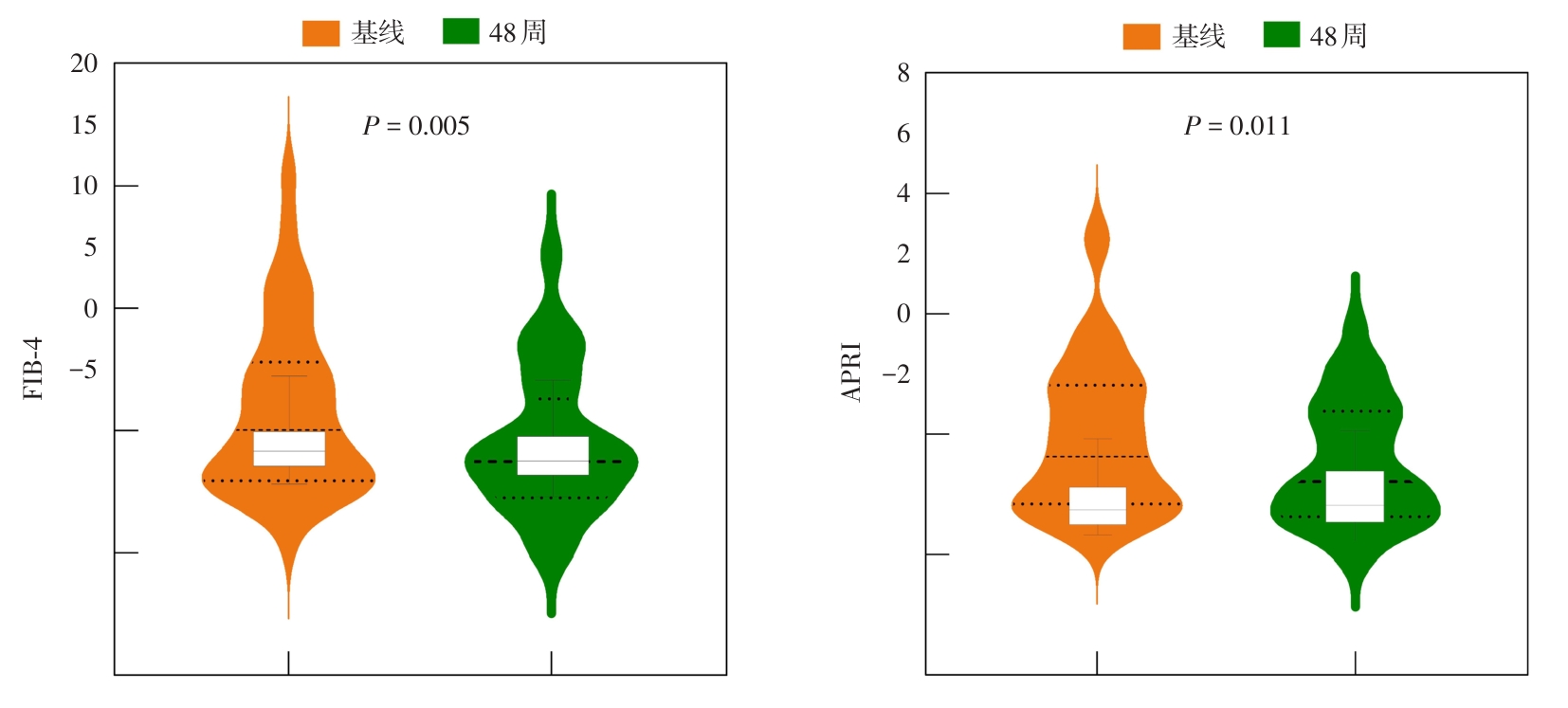
Fig.1
Comparison of baseline FIB-4 index and APRI score levels between baseline and week 48"
Tab.3
Multifactor logistic regression analysis"
| 变量 | β | SE | Wald | OR | 95%CI | P值 |
|---|---|---|---|---|---|---|
| HBV RNA分级 | 2.536 | 0.372 | 46.569 | 12.630 | 6.096 ~ 26.167 | < 0.001 |
| HBcAb分级 | -2.205 | 0.508 | 18.876 | 0.110 | 0.041 ~ 0.298 | < 0.001 |
| AFP/(ng/mL) | 0.208 | 0.071 | 8.660 | 1.231 | 1.072 ~ 1.413 | 0.003 |
| GGT/(U/L) | 0.010 | 0.005 | 4.505 | 1.010 | 1.001 ~ 1.019 | 0.034 |
| 常量 | -3.304 | 0.886 | 13.911 | 0.037 | < 0.001 |
Fig.2
Nomogram of HBeAg seroconversion"
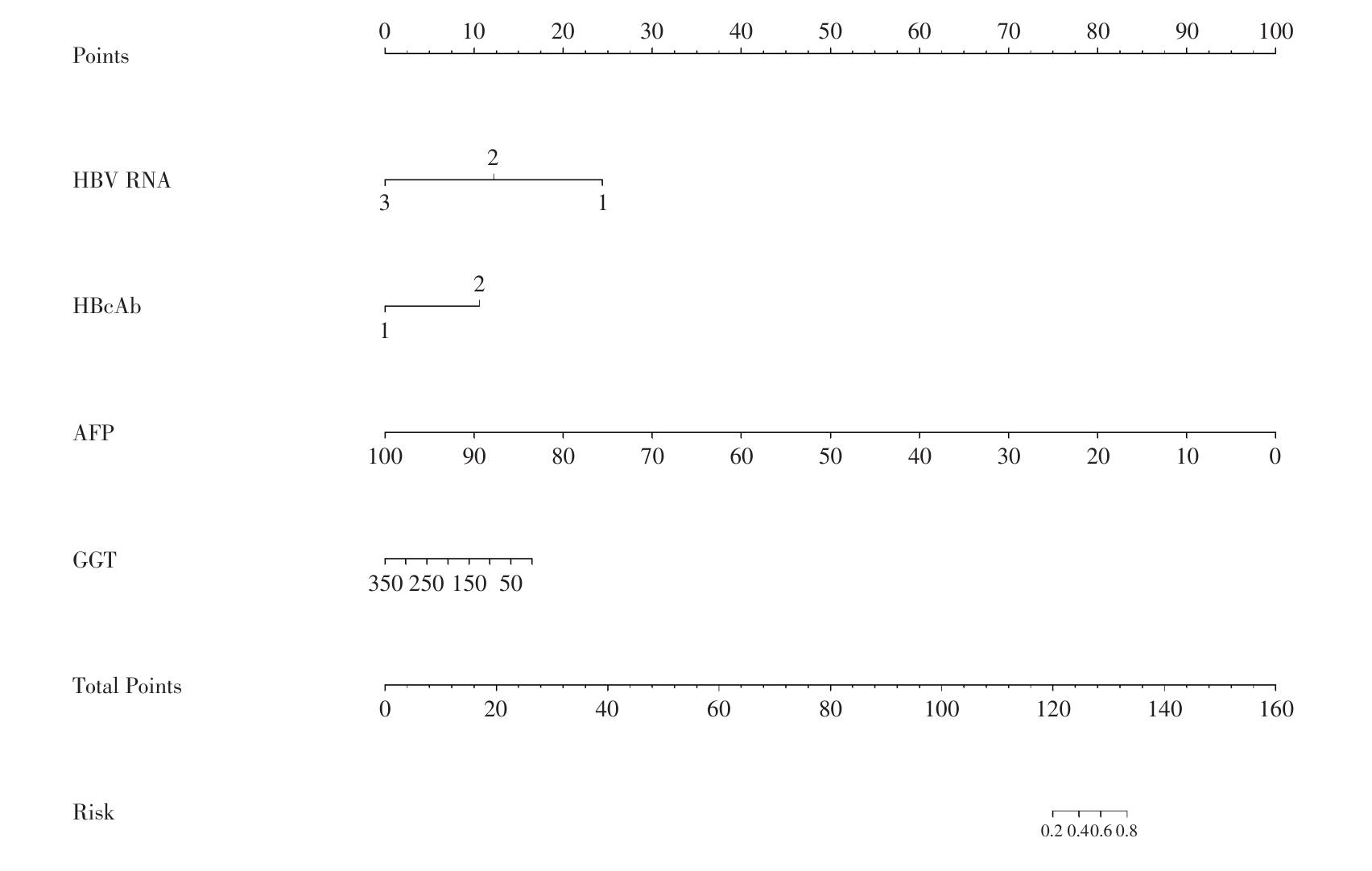
Fig.3
Calibration curve of the nomogram for predicting"
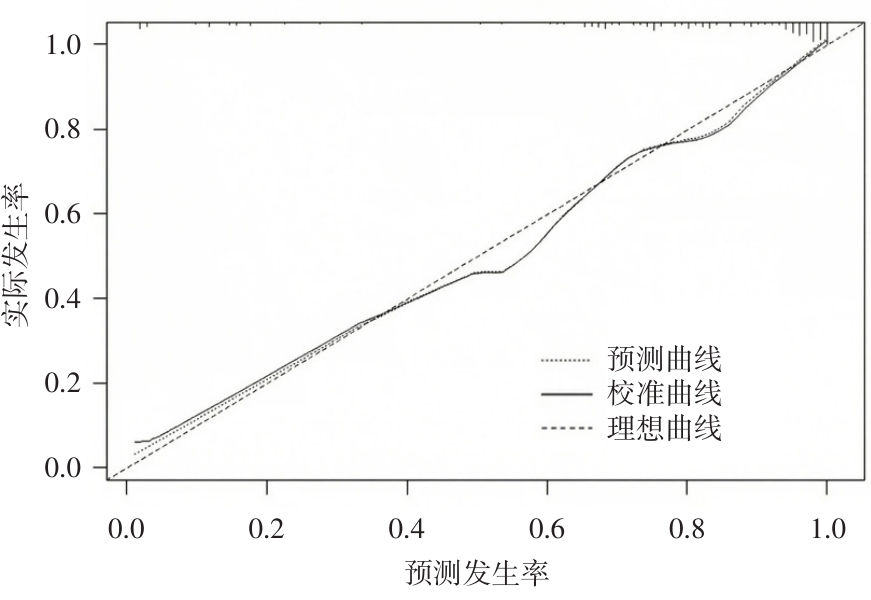
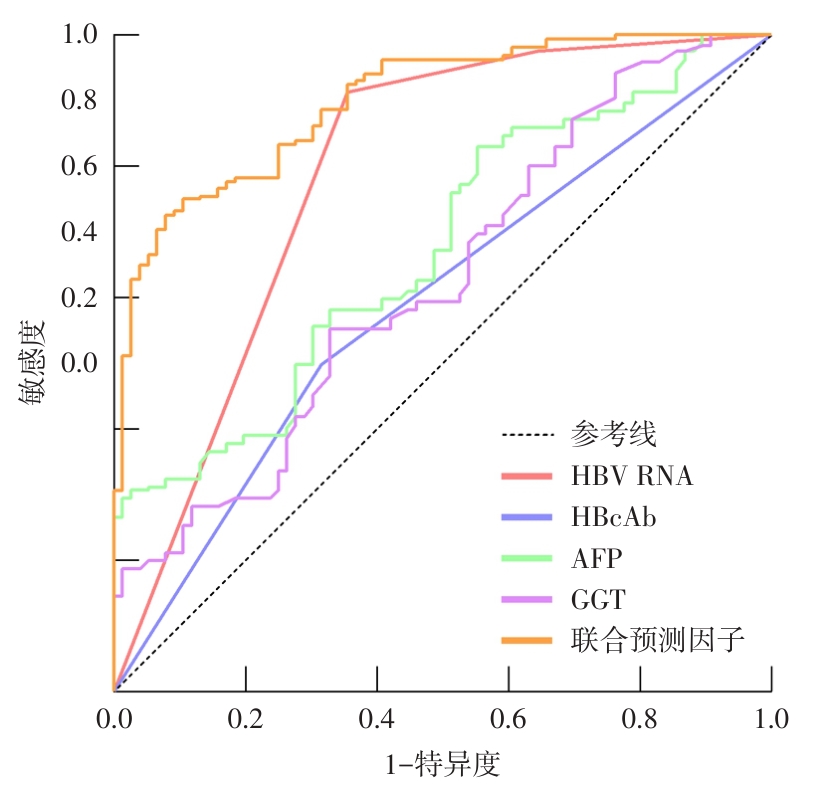
Fig.4
ROC Curves of baseline indicators forpredicting HBeAg seroconversion"
Tab.4
Predictive value of individual and combined predictors"
| 变量 | AUC | 95%CI | 敏感度 | 特异度 | 截断值 |
|---|---|---|---|---|---|
| HBV RNA分级 | 0.786 | 0.718 ~ 0.855 | 0.913 | 0.645 | |
| HBcAb分级 | 0.591 | 0.337 ~ 0.481 | 0.502 | 0.316 | |
| AFP/(ng/mL) | 0.674 | 0.608 ~ 0.739 | 0.295 | 0.987 | 7.97 |
| GGT/(U/L) | 0.626 | 0.554 ~ 0.697 | 0.552 | 0.671 | 43.30 |
| 联合预测因子模型 | 0.894 | 0.855 ~ 0.932 | 0.718 | 0.895 |
| [1] |
陈娅, 罗晓永, 陈应华, 等. HBV RNA预测乙型肝炎病毒相关肝细胞癌发病的价值[J]. 实用医学杂志, 2025, 41(21): 3435-3441. doi:10.3969/j.issn.1006-5725.2025.21.020 .
doi: 10.3969/j.issn.1006-5725.2025.21.020 |
| [2] |
RAZAVI-SHEARER D, GAMKRELIDZE I, PAN C, et al. Global prevalence, cascade of care, and prophylaxis coverage of hepatitis B in 2022: A modelling study[J]. Lancet Gastroenterol Hepatol, 2023, 8(10): 879-907. doi:10.1016/S2468-1253(23)00197-8 .
doi: 10.1016/S2468-1253(23)00197-8 |
| [3] |
XIA Y, GUO H. Hepatitis B virus cccDNA: Formation, regulation and therapeutic potential[J]. Antiviral Res, 2020, 180: 104824. doi:10.1016/j.antiviral.2020.104824 .
doi: 10.1016/j.antiviral.2020.104824 |
| [4] |
KAO J H, HU T H, JIA J, et al. East Asia expert opinion on treatment initiation for chronic hepatitis B[J]. Aliment Pharmacol Ther, 2020, 52(10): 1540-1550. doi:10.1111/apt.16097 .
doi: 10.1111/apt.16097 |
| [5] |
中华医学会肝病学分会, 中华医学会感染病学分会. 慢性乙型肝炎防治指南(2022年版)[J]. 实用肝脏病杂志, 2023, 26(3): 后插1-后插22. doi:10.3969/j.issn.1672-5069. 2023. 03.040 .
doi: 10.3969/j.issn.1672-5069. 2023. 03.040 |
| [6] |
陈娟, 黄爱龙. 从HBV cccDNA角度谈乙型肝炎的功能性治愈[J]. 临床肝胆病杂志, 2022, 38(8): 1716-1720. doi:10.3969/j.issn.1001-5256.2022.08.003 .
doi: 10.3969/j.issn.1001-5256.2022.08.003 |
| [7] |
XU W, LUO Q, ZHANG Y, et al. A case report: CccDNA and pgRNA remain positive in liver tissue in a chronic hepatitis B patient with functional cure[J]. Front Med, 2024, 11: 1427043. doi:10.3389/fmed.2024.1427043 .
doi: 10.3389/fmed.2024.1427043 |
| [8] |
蒋贝, 刘畅, 苏瑞, 等. 血清HBV RNA在HBeAg阴性慢性乙型肝炎患者中的检测价值[J]. 中华肝脏病杂志, 2019, 27(9): 668-672. doi:10.3760/cma.j.issn.1007-3418.2019.09.002 .
doi: 10.3760/cma.j.issn.1007-3418.2019.09.002 |
| [9] |
CORNBERG M, LOK A S, TERRAULT N A, et al. Guidance for design and endpoints of clinical trials in chronic hepatitis B - Report from the 2019 EASL-AASLD HBV Treatment Endpoints Conference(‡)[J]. J Hepatol, 2020, 72(3): 539-557. doi:10.1016/j.jhep.2019.11.003 .
doi: 10.1016/j.jhep.2019.11.003 |
| [10] |
中华医学会感染病学分会, 中华医学会肝病学分会, Chinese Medical Association. 慢性乙型肝炎临床治愈(功能性治愈)专家共识[J]. 临床肝胆病杂志, 2019, 35(8): 1693-1701. doi:10.3969/j.issn.1001-5256.2019.08.008 .
doi: 10.3969/j.issn.1001-5256.2019.08.008 |
| [11] |
LU F, WANG J, CHEN X, et al. Potential use of serum HBV RNA in antiviral therapy for chronic hepatitis B in the era of nucleos(t)ide analogs[J]. Front Med, 2017, 11(4): 502-508. doi:10.1007/s11684-017-0590-z .
doi: 10.1007/s11684-017-0590-z |
| [12] |
顾子杨, 王安辉, 何文昌, 等. 慢性乙型肝炎患者HBeAg血清学转换影响因素的研究进展[J]. 临床肝胆病杂志, 2022, 38(11): 2581-2585. doi:10.3969/j.issn.1001-5256.2022.11.029 .
doi: 10.3969/j.issn.1001-5256.2022.11.029 |
| [13] |
吕高燕, 王春娟. 血清HBeAg阳性慢性乙型肝炎患者接受核苷(酸)类似物治疗疗效和检测血清HBV RNA的意义[J]. 肝脏, 2024, 29(1): 77-80. doi:10.3969/j.issn.1008-1704. 2024. 01.023 .
doi: 10.3969/j.issn.1008-1704. 2024. 01.023 |
| [14] |
THOMPSON A J, JACKSON K, BONANZINGA S, et al. Baseline serum HBV RNA is associated with the risk of hepatitis flare after stopping nucleoside analog therapy in HBeAg-negative participants[J]. Hepatol Commun, 2023, 7(8): e0188. doi:10.1097/HC9.0000000000000188 .
doi: 10.1097/HC9.0000000000000188 |
| [15] |
PAPATHEODORIDI M, PAPACHRISTOU E, MOSCHIDIS Z, et al. Significance of serum HBV RNA in non-cirrhotic HBeAg-negative chronic hepatitis B patients who discontinue effective antiviral therapy[J]. J Viral Hepat, 2022, 29(11): 948-957. doi:10.1111/jvh.13729 .
doi: 10.1111/jvh.13729 |
| [16] |
LARAS A, PAPATHEODORIDI M, PANOPOULOU E, et al. Serum hepatitis B virus RNA detectability, composition and clinical significance in patients with ab initio hepatitis B e antigen negative chronic hepatitis B[J]. Virol J, 2022, 19(1): 22. doi:10.1186/s12985-022-01749-7 .
doi: 10.1186/s12985-022-01749-7 |
| [17] |
CAREY I, GERSCH J, WANG B, et al. Pregenomic HBV RNA and hepatitis B core-related antigen predict outcomes in hepatitis B e antigen-negative chronic hepatitis B patients suppressed on nucleos(T)ide analogue therapy[J]. Hepatology, 2020, 72(1): 42-57. doi:10.1002/hep.31026 .
doi: 10.1002/hep.31026 |
| [18] |
CHOI W M, YIP T C, KIM W R, et al. Chronic hepatitis B baseline viral load and on-treatment liver cancer risk: A multinational cohort study of HBeAg-positive patients[J]. Hepatology, 2024, 80(2): 428-439. doi:10.1097/HEP.0000000000000752 .
doi: 10.1097/HEP.0000000000000752 |
| [19] |
CHEN Y, WANG G, LI M, et al. Virological and immunological characteristics of HBeAg-positive chronic hepatitis B patients with low HBsAg levels[J]. Aliment Pharmacol Ther, 2025, 61(5): 814-823. doi:10.1111/apt.18448 .
doi: 10.1111/apt.18448 |
| [20] |
MOHAREB A M, LIU A F, KIM A Y, et al. Clearance of hepatitis B e antigen in untreated chronic hepatitis B virus infection: A systematic review and meta-analysis[J]. J Infect Dis, 2022, 226(10): 1761-1770. doi:10.1093/infdis/jiac168 .
doi: 10.1093/infdis/jiac168 |
| [21] |
CHAN H L Y, FUNG S, SETO W K, et al. Tenofovir alafenamide versus tenofovir disoproxil fumarate for the treatment of HBeAg-positive chronic hepatitis B virus infection: A randomised, double-blind, phase 3, non-inferiority trial[J]. Lancet Gastroenterol Hepatol, 2016, 1(3): 185-195. doi:10.1016/S2468-1253(16)30024-3 .
doi: 10.1016/S2468-1253(16)30024-3 |
| [22] |
GU Z, JIANG Q, ABULAITI A, et al. Hepatitis B virus enhancer 1 activates preS1 and preS2 promoters of integrated HBV DNA impairing HBsAg secretion[J]. JHEP Rep, 2024, 6(9): 101144. doi:10.1016/j.jhepr.2024.101144 .
doi: 10.1016/j.jhepr.2024.101144 |
| [23] |
LIAO H, LIU Y, LI X, et al. Monitoring of serum HBV RNA, HBcrAg, HBsAg and anti-HBc levels in patients during long-term nucleoside/nucleotide analogue therapy[J]. Antivir Ther, 2019, 24(2): 105-115. doi:10.3851/IMP3280 .
doi: 10.3851/IMP3280 |
| [24] |
WANG J, SHEN T, HUANG X, et al. Serum hepatitis B virus RNA is encapsidated pregenome RNA that may be associated with persistence of viral infection and rebound[J]. J Hepatol, 2016, 65(4): 700-710. doi:10.1016/j.jhep.2016.05.029 .
doi: 10.1016/j.jhep.2016.05.029 |
| [25] |
ZHANG M, LI G, SHANG J, et al. Rapidly decreased HBV RNA predicts responses of pegylated interferons in HBeAg-positive patients: A longitudinal cohort study[J]. Hepatol Int, 2020, 14(2): 212-224. doi:10.1007/s12072-020-10015-3 .
doi: 10.1007/s12072-020-10015-3 |
| [26] |
VAN BÖMMEL F, VAN BÖMMEL A, KRAUEL A, et al. Serum HBV RNA as a predictor of peginterferon Alfa-2a response in patients with HBeAg-positive chronic hepatitis B[J]. J Infect Dis, 2018, 218(7): 1066-1074. doi:10.1093/infdis/jiy270 .
doi: 10.1093/infdis/jiy270 |
| [27] |
VAN CAMPENHOUT M J H, VAN BÖMMEL F, PFEFFERKORN M, et al. Serum hepatitis B virus RNA predicts response to peginterferon treatment in HBeAg-positive chronic hepatitis B[J]. J Viral Hepat, 2020, 27(6): 610-619. doi:10.1111/jvh. 13272 .
doi: 10.1111/jvh. 13272 |
| [28] |
WANG Y, LIAO H, DENG Z, et al. Serum HBV RNA predicts HBeAg clearance and seroconversion in patients with chronic hepatitis B treated with nucleos(t)ide analogues[J]. J Viral Hepat, 2022, 29(6): 420-431. doi:10.1111/jvh.13671 .
doi: 10.1111/jvh.13671 |
| [29] |
朱莹, 罗园香, 郭凤霞, 等. 血清HBV RNA预测恩替卡韦治疗慢性乙型肝炎患者疗效的价值[J]. 南方医科大学学报, 2022, 42(8): 1250-1255. doi:10.12122/j.issn.1673-4254. 2022. 08.19 .
doi: 10.12122/j.issn.1673-4254. 2022. 08.19 |
| [30] |
BRAKENHOFF S M, DE KNEGT R J, OLIVEIRA J, et al. Levels of antibodies to hepatitis B core antigen are associated with liver inflammation and response to peginterferon in patients with chronic hepatitis B[J]. J Infect Dis, 2022, 227(1): 113-122. doi:10.1093/infdis/jiac210 .
doi: 10.1093/infdis/jiac210 |
| [31] |
YANG H C, TSOU H H, PEI S N, et al. Quantification of HBV core antibodies may help predict HBV reactivation in patients with lymphoma and resolved HBV infection[J]. J Hepatol, 2018, 69(2): 286-292. doi:10.1016/j.jhep.2018.02.033 .
doi: 10.1016/j.jhep.2018.02.033 |
| [32] |
SHI Y, WANG Z, GE S, et al. Hepatitis B core antibody level: A surrogate marker for host antiviral immunity in chronic hepatitis B virus infections[J]. Viruses, 2023, 15(5): 1111. doi:10.3390/v15051111 .
doi: 10.3390/v15051111 |
| [33] |
SUN L, GU M, CAI J, et al. Combining γ-GT, PIVKA-II, and AFP to predict long-term prognosis in patients with hepatocellular carcinoma after hepatectomy[J]. Clin Exp Pharmacol Physiol, 2023, 50(4): 287-297. doi:10.1111/1440-1681.13745 .
doi: 10.1111/1440-1681.13745 |
| [34] |
卢英, 雍景超, 刘洋, 等. 血清甲胎蛋白、γ-谷氨酰转肽酶对肝细胞癌发生微血管侵犯的临床应用价值[J]. 南京医科大学学报(自然科学版), 2023, 43(3): 357-364. doi:10.7655/NYDXBNS20230309 .
doi: 10.7655/NYDXBNS20230309 |
| [35] |
邓兰. CHB患者血清HBeAg水平与肝脏炎症活动度及纤维化分级的关系研究[J]. 实用临床医药杂志, 2016, 20(17): 63-66. doi:10.7619/jcmp.201617020 .
doi: 10.7619/jcmp.201617020 |
| [1] | Ya CHEN,Xiaoyong LUO,Yinghua CHEN,Yawen. LUO. Expression of HBV RNA in hepatitis B virus⁃associated hepatocellular carcinoma [J]. The Journal of Practical Medicine, 2025, 41(21): 3435-3441. |
| [2] | Xiaoya YANG,Tianqi HONG,Kaili GE,Renjie ZHANG,Chunshan. WEI. Long⁃term prognosis analysis of chronic hepatitis B patients followed up for 25 years:Retrospective cohort study [J]. The Journal of Practical Medicine, 2024, 40(7): 962-965. |
| [3] | Jin LU,Ming WEN,Qingrong TANG,Chunhua XU,Chunling ZHAN,Yizhou XU,Lihui. YANG. The relationship between the expression of serum GP3 and CHI3L1 and the degree of liver fibrosis and pathological changes in patients with hepatitis [J]. The Journal of Practical Medicine, 2024, 40(11): 1586-1591. |
| [4] | Kedi CHEN,Ximing. ZHANG. Risk factors for osteoporotic vertebral compression fractures in patients with chronic hepatitis B and MRI findings of lumbar paravertebral muscles [J]. The Journal of Practical Medicine, 2023, 39(20): 2643-2650. |
| [5] |
ZHU Xueli, LIN Zhaokun, WANG Liyun..
Correlation between HBV pgRNA expression level andresponsiveness to nucleoside analog therapy in pa⁃ tients with chronic hepatitis B [J]. The Journal of Practical Medicine, 2022, 38(20): 2585-2596. |
| [6] |
GU Lin, HUANG Zexuan, LI Jing, HUANG Yuehua, GU Yurong..
Role of CD107a produced by T cells and their subsets in liver injury and antiviral therapy with Peg⁃inter⁃ feron in chronic HBV infection [J]. The Journal of Practical Medicine, 2021, 37(24): 3143-3147. |
| [7] |
ZHOU Xiaoyuan, LUO Runqi, WAN Lei, WANG Junjie, ZHANG Surong, XU Xiaoming, YE Xiaoguang..
Clinical efficacy of Wuling Capsule combined with Entecavir for chronic hepatitis B patients [J]. The Journal of Practical Medicine, 2021, 37(22): 2939-2945. |
| [8] | YU Chong, GU Yuling, GU Guifang, Gu Erli. Related factors of hepatitis activity after antiviral treatment discontinuation in pregnant women with chronic HBV [J]. The Journal of Practical Medicine, 2020, 36(22): 3121-3125. |
| Viewed | ||||||
|
Full text |
|
|||||
|
Abstract |
|
|||||
