实用医学杂志 ›› 2025, Vol. 41 ›› Issue (22): 3609-3617.doi: 10.3969/j.issn.1006-5725.2025.22.020

• 调查研究 • 上一篇    

基于潜在剖面模型探讨脑卒中行神经血管内诊疗患者失志综合征与死亡焦虑的关系

高翔,马蓓蓓(),鲍婉茹   

  1. 南京医科大学第一附属医院介入放射科 (江苏 南京 210029 )
  • 收稿日期:2025-07-25 出版日期:2025-11-25 发布日期:2025-11-26
  • 通讯作者: 马蓓蓓 E-mail:819570642@qq.com
  • 基金资助:
    江苏省医学科研项目(20230226);江苏省人民医院“临床能力提升工程”护理项目(JSPH-NC-2022-7)

The relationship between demoralization syndrome and death anxiety in stroke patients undergoing neuroendovascular procedures based on latent profile analysis

Xiang GAO,Beibei MA(),Wanru BAO   

  1. Department of Interventional Radiography,the First Affiliated Hospital of Nanjing Medical University,Nanjing 210029,Jiangsu,China
  • Received:2025-07-25 Online:2025-11-25 Published:2025-11-26
  • Contact: Beibei MA E-mail:819570642@qq.com

摘要:

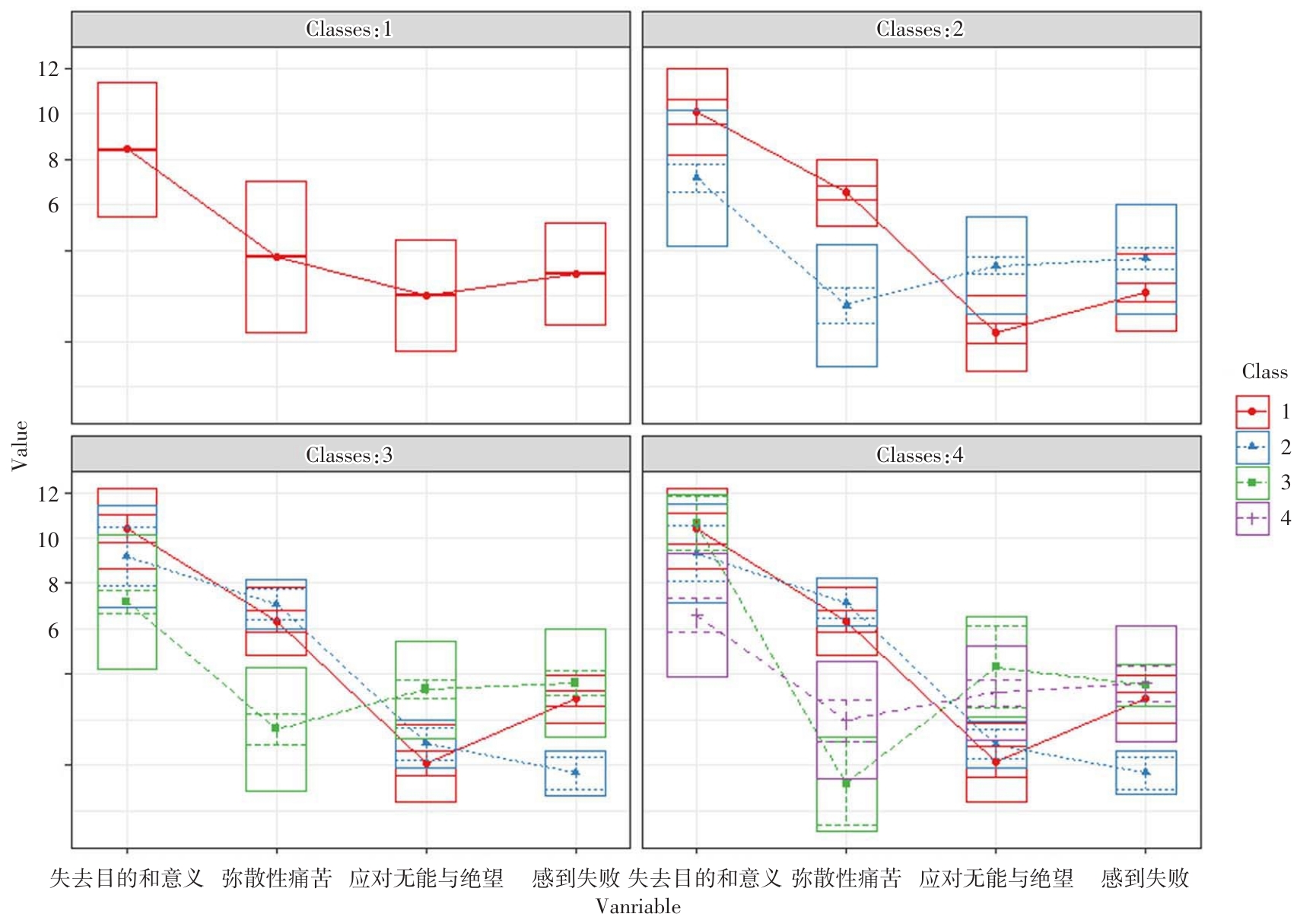
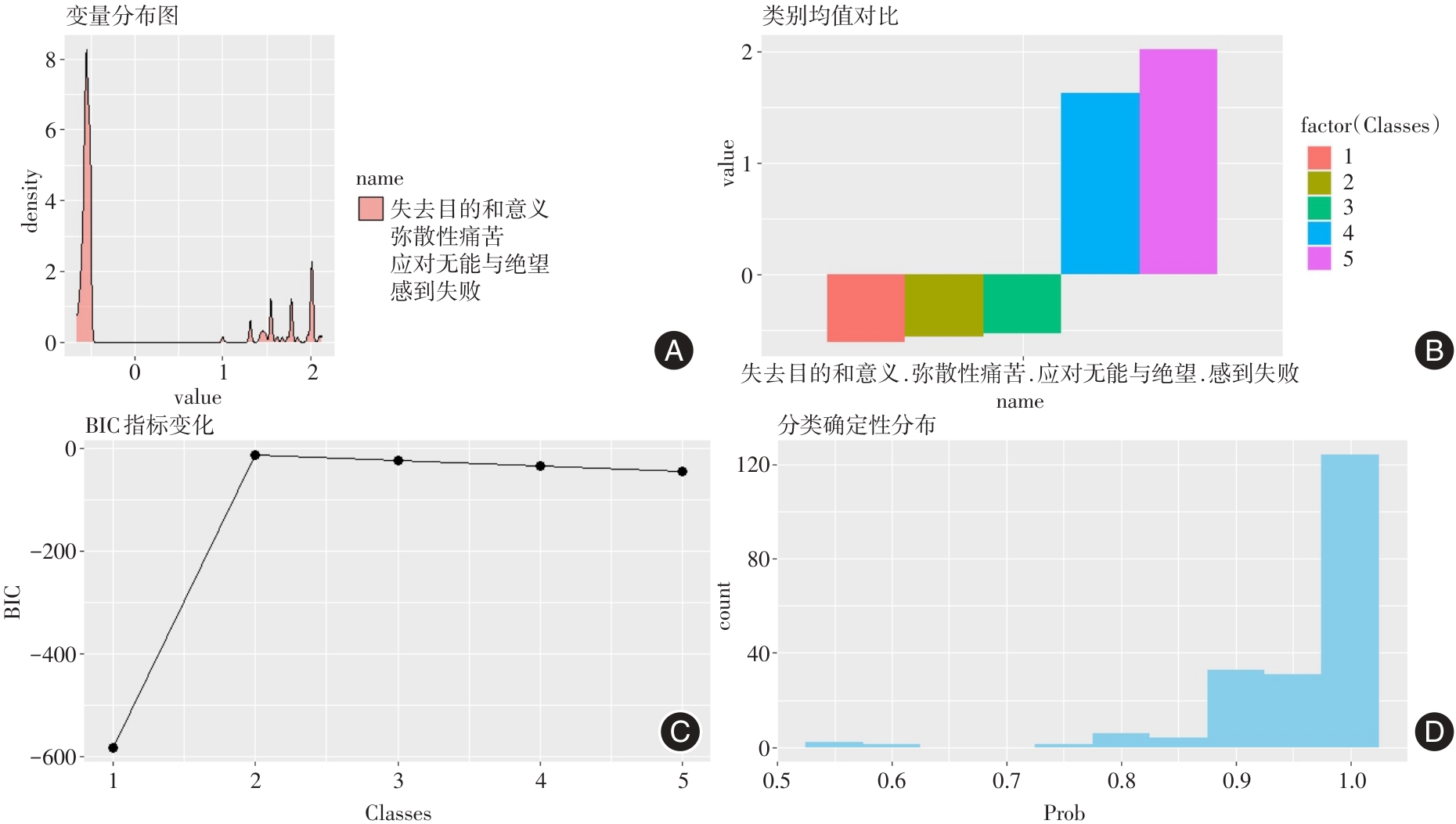
目的 使用潜在剖面分析(latent profile analysis, LPA)行神经血管内诊疗的脑卒中患者失志综合征的潜在亚型,以及死亡焦虑在这些亚型中的差异。 方法 本研究基于横断面设计,于2024年11月至2025年3月,以方便抽样法选取医院的202例行神经血管内诊疗的脑卒中患者,采用一般资料调查表、失志量表(Despair Scale,DS)及中文版死亡焦虑量表(the Chinese version of the Templer's Death Anxiety Scale,CT-DAS)进行调查。采用R软件,基于失志综合征的4个症状表现(即失去意义与目的、弥散性痛苦、应对无能与绝望、感到失败),构建2 ~ 6个剖面的潜在剖面模型系列。从第2个剖面模型开始,逐步增加剖面的数量,对比找出拟合数据最好的模型;根据潜在剖面模型分组,采用logistic回归分析影响脑卒中行神经血管内诊疗患者DS评分的因素;比较不同分组患者DS评分,并采用双变量Pearson相关性分析DS评分(失去意义及目的、弥散性痛苦、应对无能与绝望、感到失败)与CT-DAS评分(情感、压力与痛苦、时间意识、认知)的相关性。 结果 脑卒中患者依据DS总分可分为无意义痛苦组[51.00%(103/202)],应对无效绝望组[49.00%(99/202)];应对无效绝望组性别为女、住院时间为6 ~ 10 d、手术类型为动脉狭窄/闭塞类、文化水平为初中/高中及以上、职业为有工作、居住地为农村患者占比高于无意义痛苦组(P < 0.05);二元logistic回归分析显示,相较于居住地为农村的患者,居住地为城镇(OR = 0.159,P < 0.001)和居住地为市区(OR = 0.224,P = 0.007)的患者归属于应对无效绝望组的概率更低;相较于住院时间为1 ~ 5 d的患者,住院时间为6 ~ 10 d(OR = 2.311,P = 0.017)的患者归属于应对无效绝望组的概率更高;相较于受教育程度小学及以下的患者,受教育程度为初中(OR = 4.956,P < 0.001)和高中及以上(OR = 5.102,P = 0.001)的患者,归属于应对无效绝望组的概率更高;相较于手术类型为脑血管造影类的患者,手术类型为动脉瘤栓塞类(OR = 2.419,P = 0.040)和动脉狭窄/闭塞类(OR = 2.733,P = 0.014)的患者,归属于应对无效绝望组的概率更高;应对无效绝望组认知维度评分低于无意义痛苦组(t = 2.421,P = 0.016),两组情感、压力与痛苦、时间意识维度比较差异无统计学意义(P > 0.05);双变量Pearson相关结果,DS中弥散性痛苦与CT-DAS中情感、时间意识、认知呈正相关(r = 0.192、0.172、0.139,P = 0.006、0.015、0.049)。 结论 脑卒中行神经血管内诊疗患者死亡焦虑水平较高,且在不同亚型失志患者中的表现存在差异,同时居住地、住院时间、焦虑程度、手术类型是影响患者失志综合征的重要因素,临床可通过针对性干预,以降低患者失志综合征严重程度,缓解死亡焦虑。

关键词: 脑卒中, 失志综合征, 神经血管内诊疗, 死亡焦虑, 潜在剖面模型

Abstract:

Objective To identify potential subtypes of demoralization syndrome among stroke patients undergoing neuroendovascular procedures using latent profile analysis, and to examine differences in death anxiety among these subtypes. Method This cross-sectional study used convenience sampling to recruit 202 stroke patients undergoing neuroendovascular procedures at a hospital from November 2024 to March 2025. Participants completed the General Information Questionnaire, Despair Scale (DS), and the Chinese version of the Templer's Death Anxiety Scale (CT-DAS). Using R software, we estimated a series of latent profile models (ranging from 2 to 6 profiles) based on four manifestations of demoralization syndrome: loss of meaning and purpose, dysphoria, helplessness and hopelessness, and sense of failure. Starting from the 2-profile model, we incrementally increased the number of profiles and compared model fit indices to identify the optimal solution. Subsequently, logistic regression analysis was conducted to identify the factors influencing DS scores according to the latent profile classifications. We compared DS scores across subgroups and performed bivariate correlation analysis between DS and CT-DAS subdimensions (Affective, Stress & Pain, Time Awareness, and Cognitive). Results The DS scores classified stroke patients into two distinct subtypes of demoralization syndrome: A Meaninglessness-Dysphoria Group (51.00%, 103/202) and a Helplessness-Hopelessness Group (49.00%, 99/202). The HHG demonstrated significantly higher proportions (P < 0.05) of female patients, those hospitalized for 6 ~ 10 days, recipients of arterial stenosis/occlusion surgery, individuals with junior high school or higher education, employed subjects, and rural residents compared to the MDG. Binary logistic regression analysis revealed: Lower probability of HHG membership for urban (OR= 0.159, P < 0.001) and city (OR = 0.224, P = 0.007) residents versus rural counterparts; Higher HHG probability in patients hospitalized 6-10 days versus 1 ~ 5 days (OR = 2.311, P = 0.017); Elevated HHG risk among junior high school (OR = 4.956, P < 0.001) and high school or above graduates (OR = 5.102, P = 0.001) relative to those with primary education or less; Increased HHG probability in aneurysm embolization (OR = 2.419, P = 0.040) and arterial stenosis/occlusion surgery (OR = 2.733, P = 0.014) recipients compared to cerebrovascular angiography patients. The HHG scored significantly lower on the cognitive dimension of death anxiety than the MDG (t = 2.421, P = 0.016), while showing no differences in affective, stress & pain, or time awareness dimensions (P > 0.05). Bivariate Pearson correlations indicated dysphoria (DS) positively correlated with Affective (r = 0.192, P = 0.006), Time Awareness (r = 0.172, P = 0.015), and Cognitive (r = 0.139, P = 0.049) of death anxiety. Conclusions Stroke patients undergoing neuroendovascular procedures exhibit elevated levels of death anxiety, with significant variations observed across different subtypes of demoralization syndrome. Residential location, hospitalization duration, anxiety severity, and surgical type constitute significant determinants of demoralization syndrome. Targeted clinical interventions should be implemented to alleviate demoralization severity and mitigate death anxiety.

Key words: acute ischemic stroke, demoralization syndrome, neuroendovascular procedures, death anxiety, latent profile model

中图分类号: