

The Journal of Practical Medicine ›› 2025, Vol. 41 ›› Issue (24): 3904-3913.doi: 10.3969/j.issn.1006-5725.2025.24.015
• Clinical Research • Previous Articles
Yexiang MA1,Long AI1,Yu HUANG1,Yanwen GAO1,Jing. YU2( )
)
Received:2025-08-26
Online:2025-12-25
Published:2025-12-25
Contact:
Jing. YU
E-mail:ery_jyu@lzu.edu.cn
CLC Number:
Yexiang MA,Long AI,Yu HUANG,Yanwen GAO,Jing. YU. Construction of a predictive model for left ventricular hypertrophy in female patients with essential hypertension based on plasma aldosterone and clinical parameters[J]. The Journal of Practical Medicine, 2025, 41(24): 3904-3913.
Tab.1
Comparison of demographic and medical history of participants"
| 项目 | NLVH组(n = 96) | LVH组(n = 104) | χ2/t/Z值 | P值 |
|---|---|---|---|---|
| 年龄(x ± s)/岁 | 52.17 ± 10.76 | 53.46 ± 15.21 | 0.494 | 0.622 |
| BMI(x ± s)/(kg/m2) | 25.31 ± 3.59 | 24.77 ± 3.24 | -0.789 | 0.432 |
| 患高血压年限(x ± s)/年 | 3.1 ± 3.63 | 4.57 ± 3.9 | 1.939 | 0.055 |
| 服用降压药 | 68(70.8) | 88(84.6) | 2.03 | 0.154 |
| 糖尿病 | 8(8.3) | 24(23.1) | 4.498 | 0.034 |
| 高脂血症 | 38(39.6) | 42(46.2) | 0.085 | 0.77 |
| 已绝经 | 48(50.0) | 56(53.8) | 2.246 | 0.134 |
| 妇科病 | 10(10.4) | 14(13.5) | 0.045 | 0.831 |
Tab.2
Comparison of blood and urine tests of participants"
| 项目 | NLVH组(n = 96) | LVH组(n = 104) | χ2/t/Z值 | P值 |
|---|---|---|---|---|
| ALT/(U/L) | 27.51 ± 23.2 | 23.5 ± 25.29 | -0.823 | 0.413 |
| AST[M(P25,P75)]/(U/L) | 24(21,33) | 23.5(21,30.5) | -0.716 | 0.474 |
| r-GT[M(P25,P75)]/(U/L) | 17(12.25,33.75) | 14(10,30) | -0.355 | 0.722 |
| UA/(μmol/L) | 286.03 ± 56.76 | 301.72 ± 80.97 | -0.094 | 0.925 |
| UR[M(P25,P75)]/(mmol/L) | 5.11(4.17,5.71) | 5.09(4.16,6.79) | -0.355 | 0.722 |
| Cr[M(P25,P75)]/(μmol/L) | 56.85(51.28,63.17) | 57.15(49.58,66.15) | -0.155 | 0.877 |
| eGFR[M(P25,P75)]/(mL/min/1.73m2) | 105.45(98.73,111.53) | 104.85(94.5,111.75) | -0.462 | 0.644 |
| uALB[M(P25,P75)]/(mg/L) | 8.65(6.99,21.65) | 10.91(6.99,32.65) | -1.139 | 0.255 |
| BG[M(P25,P75)]/(mmol/L) | 5.7(5.07,6.57) | 5.57(5.09,7.05) | -0.776 | 0.438 |
| K+/(mmol/L) | 3.73 ± 0.34 | 3.7 ± 0.34 | -0.387 | 0.700 |
| Na+/(mmol/L) | 137.33 ± 2.08 | 136.98 ± 2.43 | -0.767 | 0.445 |
| TC/(mmol/L) | 4.41 ± 0.76 | 4.58 ± 1.01 | 0.929 | 0.355 |
| TG/(mmol/L) | 1.8 ± 0.84 | 1.88 ± 0.91 | 0.229 | 0.820 |
| HDL/(mmol/L) | 1.22 ± 0.2 | 1.21 ± 0.26 | -0.174 | 0.863 |
| LDL/(mmol/L) | 2.82 ± 0.64 | 2.84 ± 0.77 | 0.159 | 0.874 |
| NT-proBNP/(pg/mL) | 69.08 ± 58.29 | 269.56 ± 768.86 | 1.875 | 0.067 |
Tab.3
Comparison of ambulatory blood pressure indicators of participants"
| 项目 | NLVH组(n = 96) | LVH组(n = 104) | χ2/t/Z值 | P值 |
|---|---|---|---|---|
| 24hSBP/(mmHg) | 125.4 ± 11.61 | 131.17 ± 13.88 | 2.245 | 0.027 |
| 24hDBP/(mmHg) | 78.87 ± 9.9 | 80.22 ± 10.66 | 0.652 | 0.516 |
| dSBP/(mmHg) | 127.25 ± 11.36 | 131.62 ± 13.21 | 1.765 | 0.081 |
| dDBP/(mmHg) | 80.43 ± 9.56 | 81.05 ± 10.49 | 0.313 | 0.755 |
| nSBP/(mmHg) | 119.93 ± 14.8 | 128.38 ± 17.39 | 2.607 | 0.011 |
| dDBP/(mmHg) | 75.34 ± 11.46 | 77.11 ± 12.62 | 0.734 | 0.465 |
| BPL/% | 40.07 ± 24.74 | 51.03 ± 26.93 | 2.114 | 0.037 |
| NBD/% | 6.19 ± 8.22 | 2.58 ± 7.42 | -2.311 | 0.023 |
| MBPS | 19.12 ± 11.27 | 18.83 ± 15.75 | -0.106 | 0.916 |
| CV/% | 11.9 ± 3.87 | 11.92 ± 3.72 | 0.22 | 0.983 |
| ASI | 0.54 ± 0.12 | 0.52 ± 0.14 | -1.044 | 0.270 |
Tab.4
Comparison of aldosterone and renin activity indicators in participants"
| 项目 | NLVH组(n = 96) | LVH组(n = 104) | χ2/t/Z值 | P值 |
|---|---|---|---|---|
| ALD/(pg/mL) | 138.9 ± 48.08 | 227.48 ± 137.59 | 4.378 | < 0.001 |
| PRA/[ng/(mL·hr)] | 2.43 ± 3.91 | 2.1 ± 2.94 | -0.475 | 0.636 |
Tab.5
Logistic regression analysis with LVH as the dependent variable"
| 项目 | 单因素回归分析 | 多因素回归分析 | ||||||||||
|---|---|---|---|---|---|---|---|---|---|---|---|---|
| B | SE | Wald χ2 | P值 | OR | 95%CI | B | SE | Wald χ2 | P值 | OR | 95%CI | |
| ALD | 0.012 | 0.003 | 12.539 | < 0.001 | 1.012 | 1.005 ~ 1.019 | 0.014 | 0.004 | 12.38 | < 0.001 | 1.014 | 1.006 ~ 1.022 |
| 糖尿病 | 1.057 | 0.483 | 4.800 | 0.028 | 2.879 | 1.118 ~ 7.414 | 1.015 | 0.572 | 3.729 | 0.053 | 3.018 | 0.984 ~ 9.261 |
| 24hSBP | 0.036 | 0.017 | 4.651 | 0.031 | 1.036 | 1.003 ~ 1.071 | 0.198 | 0.190 | 1.088 | 0.297 | 1.219 | 0.840 ~ 1.767 |
| BPL | 0.016 | 0.008 | 4.230 | 0.040 | 1.017 | 1.001 ~ 1.033 | -0.015 | 0.030 | 0.246 | 0.620 | 0.985 | 0.930 ~ 1.044 |
| NBD | -0.063 | 0.029 | 4.762 | 0.029 | 0.939 | 0.888 ~ 0.994 | -0.157 | 0.163 | 0.918 | 0.338 | 0.855 | 0.621 ~ 1.178 |
| nSBP | 0.033 | 0.013 | 6.070 | 0.014 | 1.034 | 1.007 ~ 1.061 | -0.140 | 0.171 | 0.621 | 0.430 | 0.874 | 0.625 ~ 1.222 |
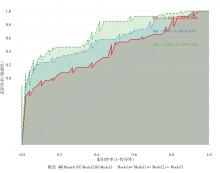
Fig.1
ROC curve of three models for predicting lvh in female patients with EH"
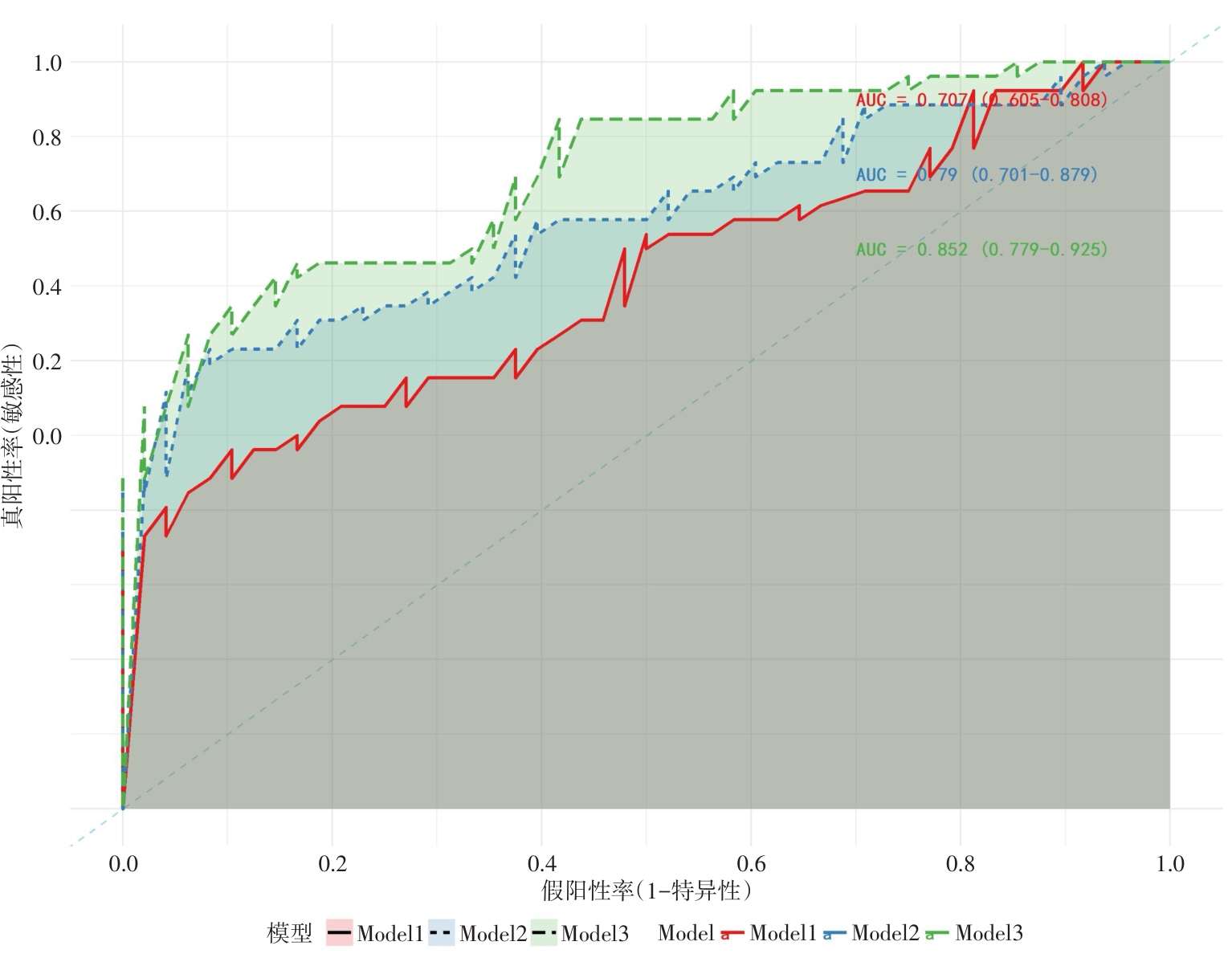
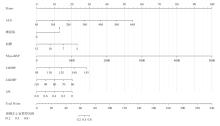
Fig.2
Prediction results of model 3 (line chart)"
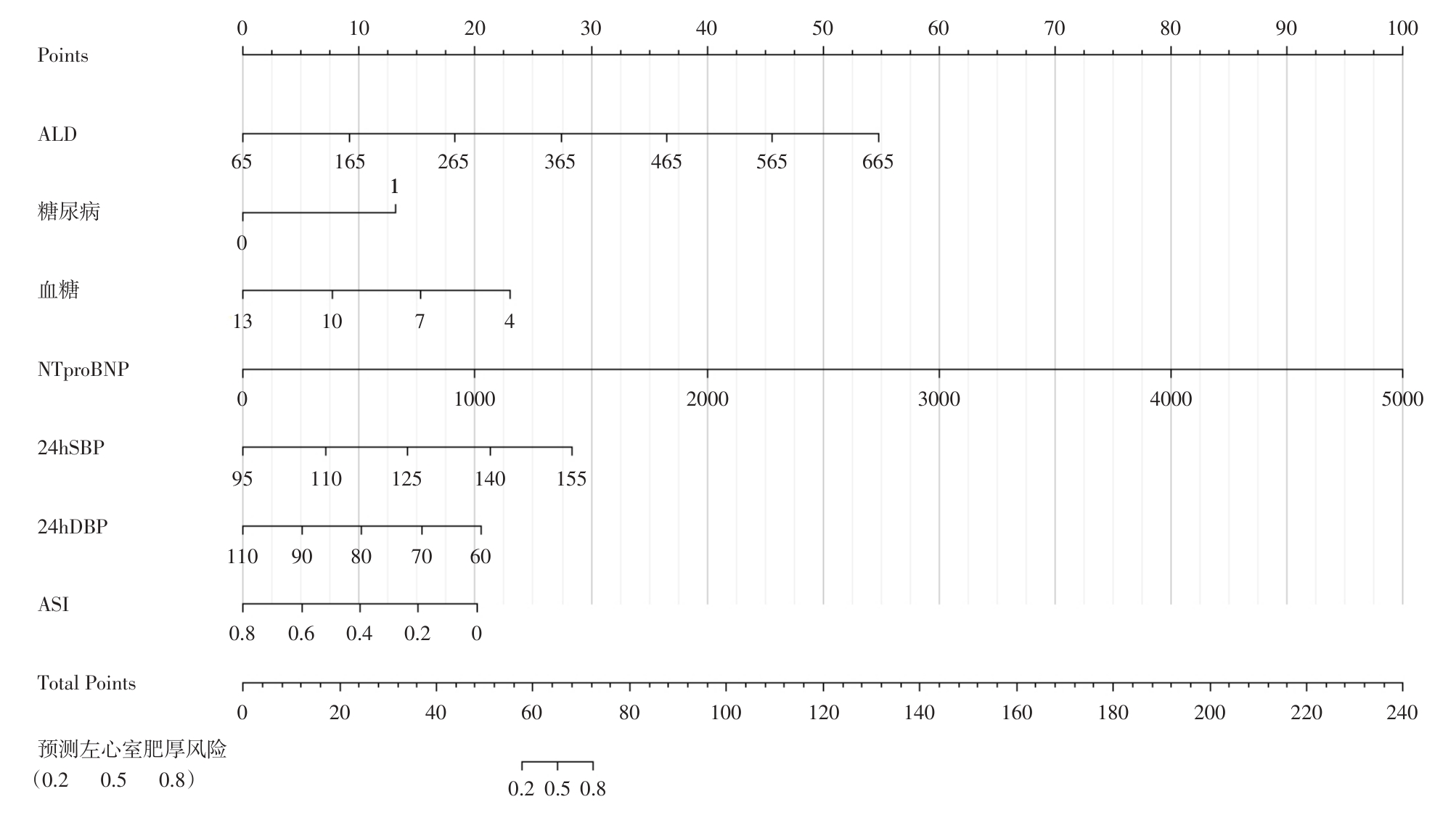
Fig.3
Comprehensive comparison of multidimensional validation results for left ventricular hypertrophy prediction models"
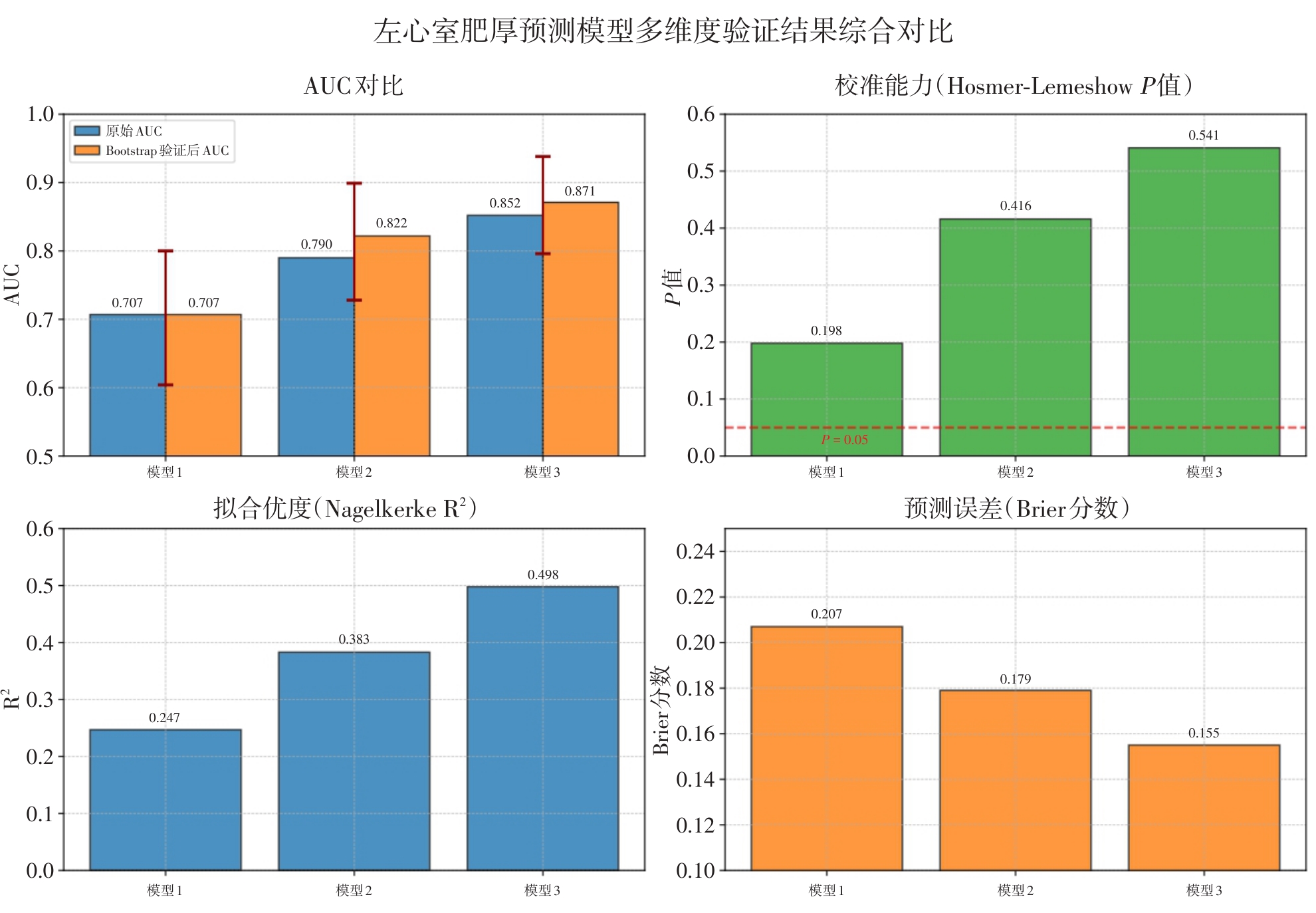
Fig.4
DCA of three prediction models for left ventricular hypertrophy"
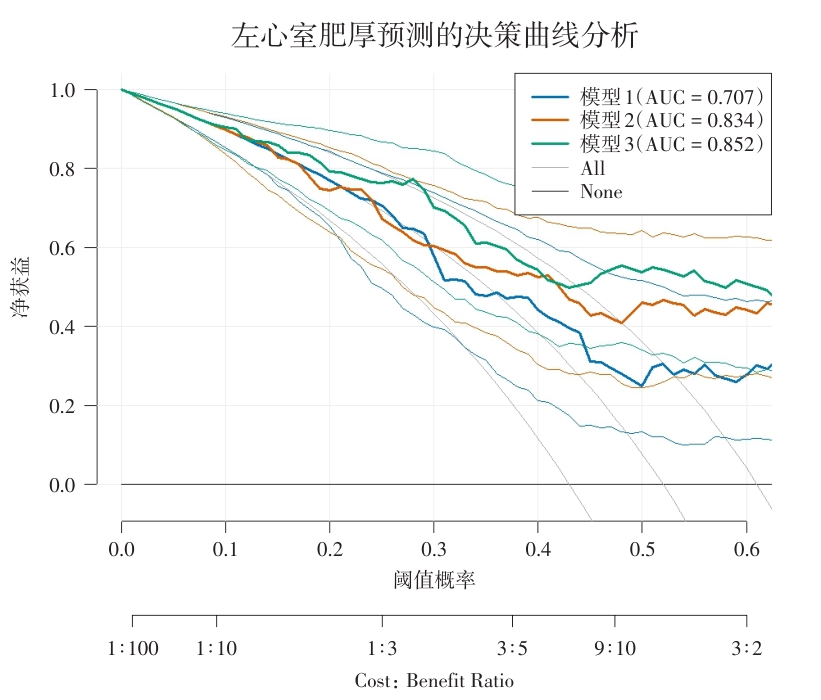
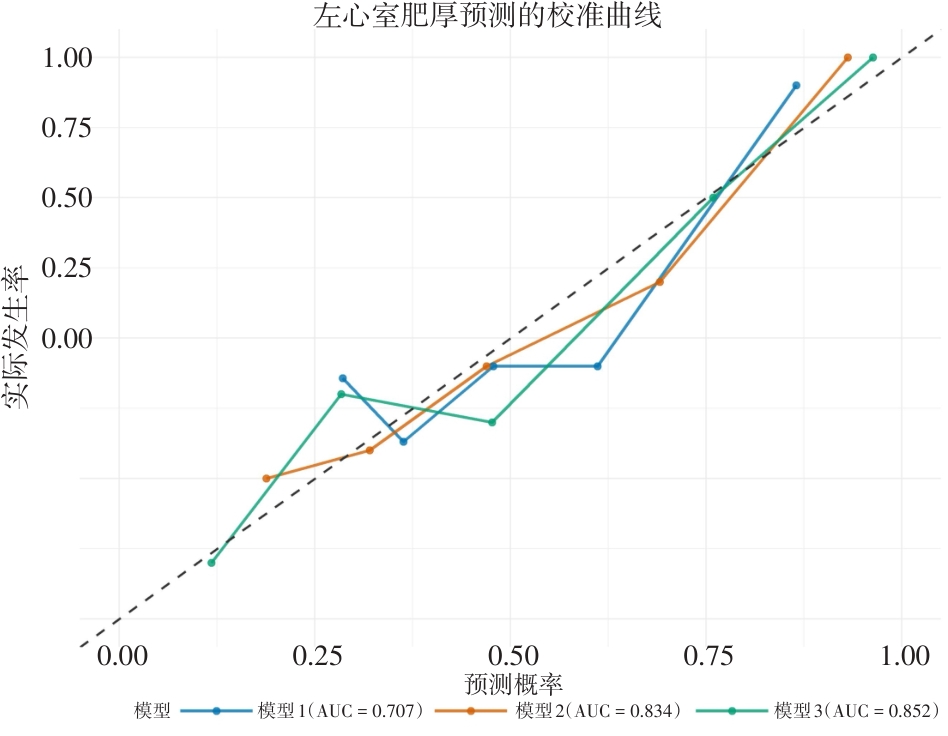
Fig.5
Calibration curves of three models for predicting left ventricular hypertrophy"
| [1] | NCD RISK FACTOR COLLABORATION (NCD-RISC). Worldwide trends in hypertension prevalence and progress in treatment and control from 1990 to 2019: A pooled analysis of 1201 population-representative studies with 104 million participants[J]. Lancet, 2021, 398(10304): 957-980. |
| [2] |
ZHANG L M, SHI Y Z, ZHOU B H, et al. Prevalence, awareness, treatment, and control of hypertension in China, 2004-18:Findings from six rounds of a national survey[J]. BMJ, 2023, 380: e071952. doi:10.1136/bmj-2022-071952
doi: 10.1136/bmj-2022-071952 |
| [3] | 《中国心血管健康与疾病报告》编写组. 中国心血管健康与疾病报告2024概要[J]. 中国循环杂志, 2025, 40(6): 521-559. |
| [4] | XU Y M, WANG W L, LIU Y H, et al. The burden of hypertension in China: The China Hypertension Survey[J]. J Hypertens, 2022, 40(2): 215-223. |
| [5] |
YEO T M, CHIN W L C, SEAH C W A, et al. Global Prevalence of Myocardial Fibrosis among Individuals with Cardiometabolic Conditions: A Systematic Review and Meta-Analysis[J]. Eur J Prev Cardiol, 2025, 32(12):1077-1091. doi:10.1093/eurjpc/zwaf083
doi: 10.1093/eurjpc/zwaf083 |
| [6] |
ĐORĐEVIĆ D B, KORAČEVIĆ G P, ĐORĐEVIĆ A D, et al. Hypertension and left ventricular hypertrophy[J]. J Hypertens, 2024, 42(9): 1505-1515. doi:10.1097/hjh.0000000000003774
doi: 10.1097/hjh.0000000000003774 |
| [7] |
DUMITRESCU M, CONSTANTIN A, NEMECZ A M, et al. Hypertension induces compensatory left ventricular hypertrophy by a mechanism involving gap junction lateralization and overexpression of CD36, PKC and MMP-2[J]. Rom J Morphol Embryol, 2021, 62(3): 713-721. doi:10.47162/rjme.62.3.08
doi: 10.47162/rjme.62.3.08 |
| [8] | 刘旭帮,魏娟玲. 高血压患者左心室肥厚与血清脂联素和炎性因子水平的关系[J]. 中国热带医学,2015,15(7):875-877. |
| [9] | 黄艺霖,李爽,贺正庸,等. 肠道菌群在高血压治疗中的研究进展[J]. 实用医学杂志,2025,41(19):3129-3134. |
| [10] |
WU S L, FENG X Y, ZHENG H Y, et al. Sex-Specific Association of Left Ventricular Hypertrophy With Cardiovascular Events in High-Risk of Cardiovascular Disease Population: Findings From the Sub-Cohort of China PEACE Million Persons Project[J]. J Clin Hypertens (Greenwich), 2025, 27(5): e70072. doi:10.1111/jch.70072
doi: 10.1111/jch.70072 |
| [11] | 崔晓通, 周京敏, 徐亚妹, 等. 左心室肥厚诊断与治疗(复旦中山规范)[J]. 上海医学, 2024, 47(2): 65-73. |
| [12] |
CANCIELLO G, PICCOLO R, IZZO R, et al. Sex-Related Differences in Left Ventricular Geometry Patterns in Patients With Arterial Hypertension[J]. JACC Adv, 2024, 3(10): 101256. doi:10.1016/j.jacadv.2024.101256
doi: 10.1016/j.jacadv.2024.101256 |
| [13] |
GHAZI L, BELLO N A. Hypertension in Women Across the Lifespan[J]. Curr Atheroscler Rep, 2021, 23(8): 43. doi:10.1007/s11883-021-00941-4
doi: 10.1007/s11883-021-00941-4 |
| [14] | 王梦卉, 王梦茹, 骆秦, 等. 高血压及原发性醛固酮增多症患者血清钾及低钾血症与心电图左心室肥大的关系[J]. 中华诊断学电子杂志, 2024, 12(1): 18-24. |
| [15] | 中国高血压防治指南修订委员会, 高血压联盟(中国, 中国医疗保健国际交流促进会高血压病学分会, 等. 中国高血压防治指南(2024年修订版)[J]. 中华高血压杂志(中英文), 2024, 32(7): 603-700. |
| [16] |
NIEWIARA Ł, KLECZYŃSKI P, GUZIK B, et al. Prevalence of coronary microcirculatory dysfunction in patients with chronic coronary syndromes and moderate coronary stenosis[J]. Kardiol Pol, 2025, 83(4): 465-473. doi:10.33963/v.phj.104620
doi: 10.33963/v.phj.104620 |
| [17] |
BOLLATI M, LOPEZ C, BIOLETTO F, et al. Atrial Fibrillation and Aortic Ectasia as Complications of Primary Aldosteronism: Focus on Pathophysiological Aspects[J]. Int J Mol Sci, 2022, 23(4): 2111. doi:10.3390/ijms23042111
doi: 10.3390/ijms23042111 |
| [18] | 丁美琳,徐敏,吴芳,等. 醛固酮诱导的氧化应激损伤内皮祖细胞介导的血管内皮修复功能[J]. 中山大学学报(医学版),2018,39(6):818-826. |
| [19] |
AL-HASHEDI E M, ABDU F A. Aldosterone Effect on Cardiac Structure and Function[J]. Curr Cardiol Rev, 2024, 20(4): e290224227534. doi:10.2174/011573403x281390240219063817
doi: 10.2174/011573403x281390240219063817 |
| [20] |
SAKABE M, THOMPSON M, CHEN N, et al. Inhibition of β1-AR/Gαs signaling promotes cardiomyocyte proliferation in juvenile mice through activation of RhoA-YAP axis[J]. Elife, 2022, 11: e74576. doi:10.7554/elife.74576
doi: 10.7554/elife.74576 |
| [21] |
YANG J H, YOUNG M J, COLE T J, et al. Mineralocorticoid receptor signalling in primary aldosteronism[J]. J Endocrinol, 2023, 259(1): e220249. doi:10.1530/joe-22-0249
doi: 10.1530/joe-22-0249 |
| [22] |
IMPROTA-CARIA A C, ARAS M G, NASCIMENTO L, et al. MicroRNAs Regulating Renin-Angiotensin-Aldosterone System, Sympathetic Nervous System and Left Ventricular Hypertrophy in Systemic Arterial Hypertension[J]. Biomolecules, 2021, 11(12): 1771. doi:10.3390/biom11121771
doi: 10.3390/biom11121771 |
| [23] |
AL ALI H S, RODRIGO G C, LAMBERT D G. Signalling pathways involved in urotensin II induced ventricular myocyte hypertrophy[J]. PLoS One, 2025, 20(1): e0313119. doi:10.1371/journal.pone.0313119
doi: 10.1371/journal.pone.0313119 |
| [24] |
YE C Y, WANG T T, GONG J Y, et al. Development of a nomogram for screening the risk of left ventricular hypertrophy in Chinese hypertensive patients[J]. J Clin Hypertens (Greenwich), 2021, 23(6): 1176-1185. doi:10.1111/jch.14240
doi: 10.1111/jch.14240 |
| [25] |
YANG L X, YAN L N, QIU L S, et al. Preoperative predictive indicators for resolution of hypertension in patients with unilateral primary aldosteronism: Development of a nomogram model[J]. Langenbecks Arch Surg, 2025, 410(1): 52. doi:10.1007/s00423-025-03615-w
doi: 10.1007/s00423-025-03615-w |
| [26] | 黄慧, 苏金虎, 吴冰. 不同降压水平对老年高血压患者复合心血管事件的影响[J]. 实用医学杂志, 2023, 39(17): 2225-2229. |
| [1] | Fanjie HAN,Haibin WANG,Linlin LI,Ran GUO,Changjiang LIU. Construction and validation of a risk prediction model for pneumothorax after CT⁃guided percutaneous lung puncture biopsy based on nomograms [J]. The Journal of Practical Medicine, 2025, 41(15): 2412-2417. |
| [2] | Yuhai QIAO,Chunhua DU,Xinhong ZHAO,Xiaodong MENG,Jianfei. ZHANG. Construction and validation of a risk prediction model for clinical characteristics of patients with chronic non⁃bacterial prostatitis [J]. The Journal of Practical Medicine, 2025, 41(14): 2224-2230. |
| [3] | Xianqun TAN,Fenglin ZHANG,Guangyan ZOU,Xidong CHEN. Establishment of a risk prediction model for neurogenic bladder dysfunction after spinal cord injury [J]. The Journal of Practical Medicine, 2025, 41(13): 2058-2064. |
| [4] | Liangjiang HUANG,Dewen MAO,Jinghui ZHENG,Minggang WANG,Chun YAO. Application of artificial intelligence in HE risk prediction modelling and research advances [J]. The Journal of Practical Medicine, 2024, 40(3): 289-294. |
| [5] | Ming HOU,Youqiang LI,Xuemei LI,Junfeng JIA,Junying CHANG. Construction of a risk prediction model of lung involvement based on chest CT and clinical features in patients with primary Sjogren's syndrome [J]. The Journal of Practical Medicine, 2024, 40(3): 400-405. |
| [6] |
WANG Min, XING Lingling, ZHANG Chunxia, LU Suyu, WU Xiaolei, XU Longyun, JIANG Zujuan, LI Shao⁃ mei, PEI Huaying..
Influence of refractory peritoneal dialysis ⁃ associated peritonitis and the prediction of extubation risk
[J]. The Journal of Practical Medicine, 2023, 39(9): 1143-1147.
|
| [7] | Yang LI,Sijin YANG,Houping XU,Gang LUO,Xianlun PANG,Suqiong HUANG,Zhongfang. ZHOU. Correlation of serum autophagy⁃related protein 9a and galectin⁃3 with left ventricular hypertrophy in essential hypertension patients [J]. The Journal of Practical Medicine, 2023, 39(16): 2071-2076. |
| [8] |
YANG Linlin, LIU Gang, YI Rui, WANG Juan, XIE Zhenhua, LIU Chengqiong, CHEN Jie.
Research progress on risk prediction of acute renal injury
[J]. The Journal of Practical Medicine, 2022, 38(18): 2367-2372.
|
| [9] |
HU Xiaoqi, ZHAI Jinguo, LI Jing, WANG Wenjuan, AN Shengli, HU Xiaolin.
Development and validation of predictive model for gestational diabetes mellitus based on multiple indica⁃tors [J]. The Journal of Practical Medicine, 2021, 37(9): 1141-1149. |
| [10] | LI Cong, ZHONG Pingting, YANG Xiaohong. Research progress of fundus changes and surgical risk prediction of congenital heart disease [J]. The Journal of Practical Medicine, 2021, 37(8): 984-988. |
| [11] |
YISHAJIANG·Sharezati, WANG Mengmeng, LI Yu, CHEN Yulan, SUN Xiaojing, XU Xinjuan, ZHANG Xiangyang..
Association between classical transient receptor potential channel 3 gene polymorphism and MAU in patients with essential hypertension [J]. The Journal of Practical Medicine, 2021, 37(21): 2752-2756. |
| [12] |
ZHANG Ziqu, LIU Yong, LI Jing⁃ wei, WANG Yali, ZHAI Yujun..
Effect of amlodipine ⁃ benazepril tablets on ambulatory blood pressure of grade 2 essential hypertension patients uncontrolled by free combination of two antihypertensive drugs #br#
#br#
[J]. The Journal of Practical Medicine, 2021, 37(18): 2375-2379.
|
| Viewed | ||||||
|
Full text |
|
|||||
|
Abstract |
|
|||||
