实用医学杂志 ›› 2026, Vol. 42 ›› Issue (1): 12-20.doi: 10.3969/j.issn.1006-5725.2026.01.002

• 肿瘤诊治与预后专栏 • 上一篇    下一篇

TyG-BMI对接受免疫检查点抑制剂治疗的肿瘤患者发生免疫相关不良反应的风险分层价值

魏丽1,2,林子怡2,陈珍2,孙荷静2,董敏1()   

  1. 1.中山大学附属第三医院肿瘤内科 (广东 广州 510000 )
    2.中山大学附属第三医院肇庆医院肿瘤内科 (广东 肇庆 526000 )
  • 收稿日期:2025-08-26 出版日期:2026-01-10 发布日期:2026-01-14
  • 通讯作者: 董敏 E-mail:dongmin@mail.sysu.edu.cn
  • 基金资助:
    广东省基础与应用基础研究基金项目(2023A1515011803)

Risk stratification value of TyG-BMI for immune-related adverse events in cancer patients treated with immune checkpoint inhibitors

Li WEI1,2,Ziyi LIN2,Zhen CHEN2,Hejing SUN2,Min DONG1()   

  1. 1.Department of Medical Oncology,Third Affiliated Hospital of Sun Yat?sen University,Guangzhou 510000,Guangdong,China
    2.Department of Medical Oncology,the Third Affiliated Hospital,Sun Yat?Sen University·Zhaoqing Hospital,Zhaoqing 526000,Guangdong,China
  • Received:2025-08-26 Online:2026-01-10 Published:2026-01-14
  • Contact: Min DONG E-mail:dongmin@mail.sysu.edu.cn

摘要:

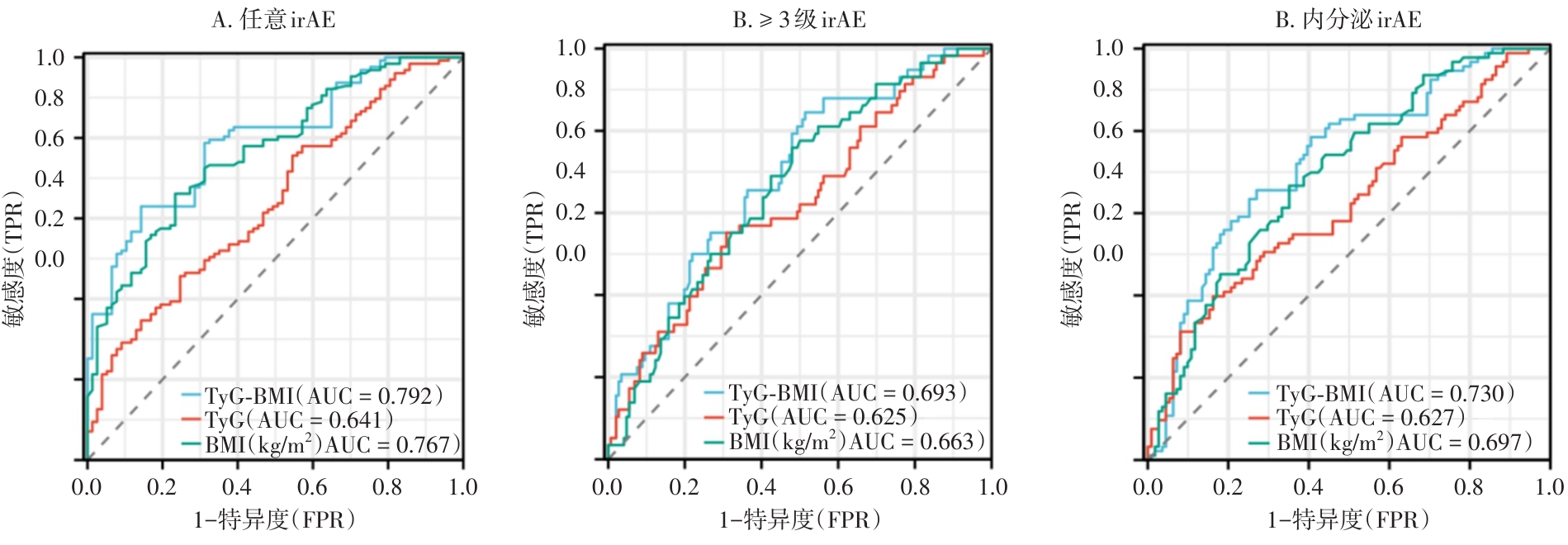
目的 探讨甘油三酯-葡萄糖-体质量指数(TyG-BMI)对接受免疫检查点抑制剂(ICIs)治疗的肿瘤患者发生免疫相关不良反应(irAE)的风险分层价值。 方法 回顾性选取2023年9月至2024年9月中山大学第三附属医院收治的204例接受程序化细胞死亡蛋白/程序化细胞死亡配体-1(PD-1/PD-L1)单克隆抗体治疗的恶性肿瘤住院患者的临床资料,根据TyG-BMI四分位数将所有患者分为TyG-BMI Q1组、TyG-BMI Q2组、TyG-BMI Q3组和TyG-BMI Q4组,各51例。比较4组临床资料、irAE发生率,多因素logistic回归分析免疫检查点抑制剂治疗肿瘤患者发生irAE的影响因素,Pearson相关性分析TyG-BMI水平与炎症因子水平相关性,绘制受试者工作特征曲线(ROC)分析TyG-BMI预测irAE的价值。 结果 4组体质量指数(BMI)、血脂异常、糖尿病史、甘油三酯、低密度脂蛋白(LDL-C)、空腹血糖、游离甲状腺素(FT4)和美国东部肿瘤协作组体能状态评分(ECOG)评分经比较,差异有统计学意义(P < 0.05);4组任意级别irAE、≥ 3级irAE、内分泌irAE、皮肤irAE发生率经比较,差异有统计学意义(P < 0.05);单因素分析显示,TyG-BMI越高,任何级别irAE、≥ 3级irAE、内分泌irAE、肺irAE、皮肤irAE和其他irAE的风险越高(P < 0.05);校正年龄、性别、肿瘤类型、药物类别、肿瘤分期等混杂因素后,多因素logistic回归结果显示,TyG-BMI是任何级别irAE(OR = 1.517,95%CI:1.220 ~ 1.886,P < 0.001)、≥ 3级irAE(OR = 1.215,95%CI:1.046 ~ 1.410,P = 0.011)和内分泌irAE(OR = 1.331,95%CI:1.131 ~ 1.568,P < 0.001)发生的独立危险因素;进一步调整白细胞计数(WBC)、血红蛋白(Hb)、血小板计数(PLT)、丙氨酸氨基转移酶(ALT)、总胆红素(TBIL)、血肌酐(Scr)、肌钙蛋白I(TnI)、促甲状腺激素(TSH)后,TyG-BMI仍为任何级别irAE、≥ 3级irAE和内分泌irAE发生的独立危险因素(P < 0.05);4组白细胞介素-6(IL-6)、肿瘤坏死因子-α(TNF-α)、C反应蛋白(CRP)水平经比较,差异有统计学意义(P < 0.05);Pearson相关性分析显示,TyG-BMI与IL-6、TNF-α、CRP水平均呈正相关(r = 0.643、0.731、0.894,P < 0.001);ROC曲线显示,TyG-BMI预测任何级别irAE、≥ 3级irAE及内分泌irAE价值均高于TyG和BMI(P < 0.05)。 结论 TyG-BMI可用于评估免疫检查点抑制剂治疗肿瘤患者发生irAE风险,为临床制定治疗方案和预后评估提供参考。

关键词: 甘油三酯-葡萄糖-体质量指数, 免疫检查点抑制剂, 恶性肿瘤, 免疫相关不良反应, 风险分层

Abstract:

Objective To explore the risk stratification value of the triglyceride-glucose-body mass index (TyG-BMI) for immune-related adverse reactions (irAE) in tumor patients treated with immune checkpoint inhibitors (ICIs). Methods The clinical data of 204 hospitalized patients with malignant tumors who underwent programmed cell death protein 1/programmed cell death ligand 1 (PD-1/PD-L1) monoclonal antibody treatment at the Third Affiliated Hospital of Sun Yat-sen University from September 2023 to September 2024 were retrospectively collected. All patients were stratified into the TyG-BMI Q1 group, TyG-BMI Q2 group, TyG-BMI Q3 group, and TyG-BMI Q4 group based on the TyG-BMI quartiles, with 51 cases in each group. The clinical data and the incidence of immune-related adverse events (irAE) in the four groups were compared. Multivariate logistic regression analysis was performed to identify the influencing factors of irAE in cancer patients treated with immune checkpoint inhibitors (ICIs). The receiver operating characteristic curve (ROC) was constructed to evaluate the predictive value of TyG-BMI for irAE. Pearson correlation analysis was carried out to examine the correlation between TyG-BMI levels and inflammatory factor levels, and the receiver operating characteristic curve (ROC) was plotted to assess the predictive value of TyG-BMI for irAE. Results Statistically significant differences were observed in body mass index (BMI), dyslipidemia, history of diabetes, triglyceride, low-density lipoprotein (LDL-C), fasting blood glucose, free thyroxine (FT4), and Eastern Cooperative Oncology Group performance status score (ECOG score) among the four groups (P < 0.05). Statistically significant differences were also noted in the incidence of any-grade irAE, grade ≥ 3 irAE, endocrine toxicity, and skin toxicity among the four groups (P < 0.05). Univariate analysis indicated that a higher TyG-BMI was associated with a higher risk of any-grade irAE, grade ≥ 3 irAE, endocrine toxicity, pulmonary toxicity, skin toxicity, and other irAE (P < 0.05). After adjusting for confounding factors such as age, gender, tumor type, drug category, and tumor stage, the results of multivariate logistic regression demonstrated that TyG-BMI was an independent risk factor for the occurrence of any- grade irAE (OR = 1.517, 95%CI: 1.220 ~ 1.886, P < 0.001), grade ≥ 3 irAE (OR = 1.215, 95%CI: 1.046 ~ 1.410, P = 0.011), and endocrine toxicity (OR = 1.331, 95%CI: 1.131 ~ 1.568, P < 0.001). After further adjusting for white blood cell count (WBC), hemoglobin (Hb), platelet count (PLT), alanine aminotransferase (ALT), total bilirubin (TBIL), serum creatinine (Scr), troponin I (TnI), and thyroid-stimulating hormone (TSH), TyG-BMI remained an independent risk factor for the occurrence of any-grade irAE, grade ≥ 3 irAE, and endocrine toxicity (P < 0.05). The levels of interleukin-6 (IL-6), tumor necrosis factor-α (TNF-α), and C-reactive protein (CRP) were compared among the four groups, and the differences were statistically significant (P < 0.05). Pearson correlation analysis indicated that TyG-BMI was positively correlated with the levels of IL-6, TNF-α, and CRP (r = 0.643, 0.731, 0.894, P < 0.001). The ROC curve demonstrated that the predictive value of TYG-BMI for any grade of irAE, grade ≥ 3 irAE, and endocrine irAE was higher than that of TyG and BMI (P < 0.05). Conclusion TyG-BMI can be utilized to assess the risk of immune-related adverse events (irAE) in cancer patients undergoing treatment with immune checkpoint inhibitors (ICIs), offering references for the formulation of clinical treatment plans and the evaluation of prognosis.

Key words: triglyceride-glucose-body mass index, immune checkpoint inhibitors, malignant tumors, immune-related adverse events, risk stratification

中图分类号: