实用医学杂志 ›› 2025, Vol. 41 ›› Issue (23): 3684-3689.doi: 10.3969/j.issn.1006-5725.2025.23.008

• 临床研究 • 上一篇    

分泌性中耳炎患者血清IgE、IL-6、HMGB1、β2-M水平和T淋巴细胞亚群变化及其临床意义分析

张媛媛,何文,黄喜()   

  1. 武汉市第一医院耳鼻咽喉科 (湖北 武汉 430000 )
  • 收稿日期:2025-08-22 出版日期:2025-12-10 发布日期:2025-12-18
  • 通讯作者: 黄喜 E-mail:1148784580@qq.com
  • 基金资助:
    湖北省医学科研项目(2020020601012310)

Changes of levels of serum IgE, IL⁃6, HMGB1, β2⁃M and T lymphocyte subsets in patients with secretory otitis media and their clinical significance

Yuanyuan ZHANG,Wen HE,Xi. HUANG()   

  1. Department of Otolaryngology,Wuhan First Hospital,Wuhan 430000,Hubei,China
  • Received:2025-08-22 Online:2025-12-10 Published:2025-12-18
  • Contact: Xi. HUANG E-mail:1148784580@qq.com

摘要:

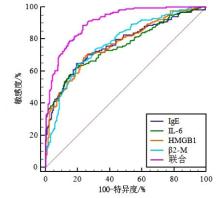
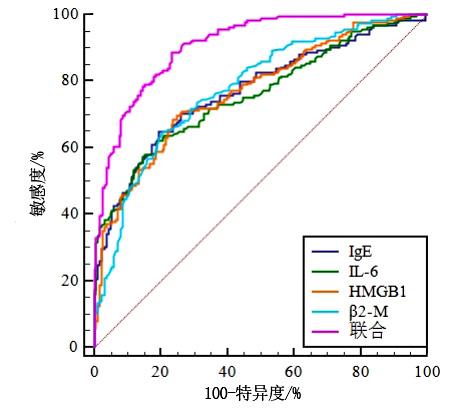
目的 分析分泌性中耳炎(SOM)患者血清免疫球蛋白E(IgE)、白细胞介素-6(IL-6)、高迁移率族蛋白B1(HMGB1)、β2微球蛋白(β2-M)水平和T淋巴细胞亚群变化及其临床意义。 方法 以2023年3月至2025年3月武汉市第一医院收治的SOM患者185例作为病例组,另选取同期在本院进行体检的185名健康人群作为对照组,比较两组血清IgE、IL-6、HMGB1、β2-M和外周血T淋巴细胞亚群水平;根据患者病程将其分为急性组(43例)、亚急性组(61例)和慢性组(81例),比较3组血清指标和外周血T淋巴细胞亚群水平,并分析血清指标对SOM的诊断价值及其与患者外周血T淋巴细胞亚群水平的相关性。 结果 疾病组血清IgE、IL-6、HMGB1、β2-M和外周血CD8+水平高于对照组,外周血CD4+水平及CD4+/CD8+低于对照组(P < 0.05)。急性组、亚急性组、慢性组血清IgE、IL-6、HMGB1、β2-M和外周血CD8+水平呈升高趋势,外周血CD4+水平及CD4+/CD8+呈降低趋势(P < 0.05)。血清IgE、IL-6、HMGB1、β2-M联合诊断SOM的曲线下面积(AUC)高于四者单独检测(P < 0.05),其敏感度和特异度分别为88.65%、76.76%。SOM患者血清IgE、IL-6、HMGB1、β2-M水平与其外周血CD8+水平呈正相关(r = 0.618、0.578、0.622、0.549,P < 0.05),与其外周血CD4+水平及CD4+/CD8+呈负相关(r = -0.539、-0.573、-0.519、-0.559、-0.604、-0.618、-0.559、-0.649,P < 0.05)。 结论 SOM的发生和进展均会引起其血清IgE、IL-6、HMGB1、β2-M和外周血T淋巴细胞亚群水平变化,同时血清指标联合可提高对SOM患者的诊断价值,且四者与患者外周血T淋巴细胞亚群水平存在明显相关性。

关键词: 分泌性中耳炎, 免疫球蛋白E, 白细胞介素-6, 高迁移率族蛋白B1, β2微球蛋白, T淋巴细胞亚群

Abstract:

Objective To analyze the changes in serum immunoglobulin E (IgE), interleukin-6 (IL-6), high-mobility group protein B1 (HMGB1), β2-microglobulin (β2-M), and T lymphocyte subsets in patients with secretory otitis media (SOM) and to evaluate their clinical significance. Methods A total of 185 patients with SOM admitted to Wuhan First Hospital between March 2023 and March 2025 were enrolled as the patient group, and 185 healthy individuals who underwent routine physical examinations at our hospital during the same period served as the control group. Serum levels of IgE, IL-6, HMGB1, and β2-microglobulin(β2-M), as well as peripheral blood T lymphocyte subsets, were compared between the two groups. Based on disease duration, the patients were further classified into acute (n = 43), subacute (n = 61), and chronic (n = 81) subgroups. Levels of the serum markers and T lymphocyte subsets were compared across these three subgroups. The diagnostic value of the serum markers for SOM was evaluated, and their correlations with peripheral blood T lymphocyte subsets were analyzed. Results he levels of serum IgE, IL-6, HMGB1, β2-M, and peripheral blood CD8+ were significantly higher in the disease group than in the control group, whereas the levels of peripheral blood CD4+ and CD4+/CD8+ were significantly lower (P < 0.05). Across the acute, subacute, and chronic subgroups, the levels of serum IgE, IL-6, HMGB1, β2-M, and CD8+ exhibited a progressive increasing trend, while CD4+ and CD4+/CD8+ levels showed a corresponding decreasing trend (P < 0.05). The combined measurement of serum IgE, IL-6, HMGB1, and β2-M yielded a higher area under the curve (AUC) for diagnosing SOM compared to each marker alone (P < 0.05), with a sensitivity of 88.65% and specificity of 76.76%. Furthermore, serum levels of IgE, IL-6, HMGB1, and β2-M were positively correlated with peripheral blood CD8+ levels (r = 0.618, 0.578, 0.622, 0.549; P < 0.05), and negatively correlated with CD4+ and CD4+/CD8+ ratios (r = -0.539, -0.573, -0.519, -0.559 for CD4+r = -0.604, -0.618, -0.559, -0.649 for CD4+/CD8+P < 0.05). Conclusion The progression of SOM is associated with alterations in serum markers and peripheral blood T lymphocyte subsets. Furthermore, the combination of serum IgE, IL-6, HMGB1, and β2-MG demonstrates enhanced diagnostic value in patients with SOM, and a significant correlation exists between these four markers and the levels of peripheral blood T lymphocyte subsets.

Key words: secretory otitis media, immunoglobulin E, interleukin-6, high mobility group protein B1, β2 microglobulin, T lymphocyte subsets

中图分类号: