实用医学杂志 ›› 2025, Vol. 41 ›› Issue (21): 3330-3337.doi: 10.3969/j.issn.1006-5725.2025.21.005

• 专题报道:肾病 • 上一篇    

特发性膜性肾病患者血清B细胞活化因子、补体裂解因子Bb表达意义及与尿白蛋白肌酐比值的关系

郭利芹,韩晓静,王焕,何国斌   

  1. 新乡市中心医院肾内科 (河南 新乡 453000 )
  • 收稿日期:2025-06-04 出版日期:2025-11-10 发布日期:2025-11-13
  • 基金资助:
    河南省医学科技攻关计划项目(LHGJ20220988)

Significance of serum BAFF and complement lytic factor Bb expression in patients with idiopathic membranous nephropathy and their correlation with UACR

Liqin GUO,Xiaojing HAN,Huan WANG,Guobin. HE   

  1. Department of Nephrology,Xinxiang Central Hospital,Xinxiang 453000,Henan,China
  • Received:2025-06-04 Online:2025-11-10 Published:2025-11-13

摘要:

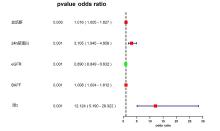
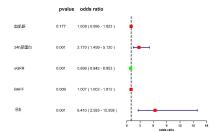
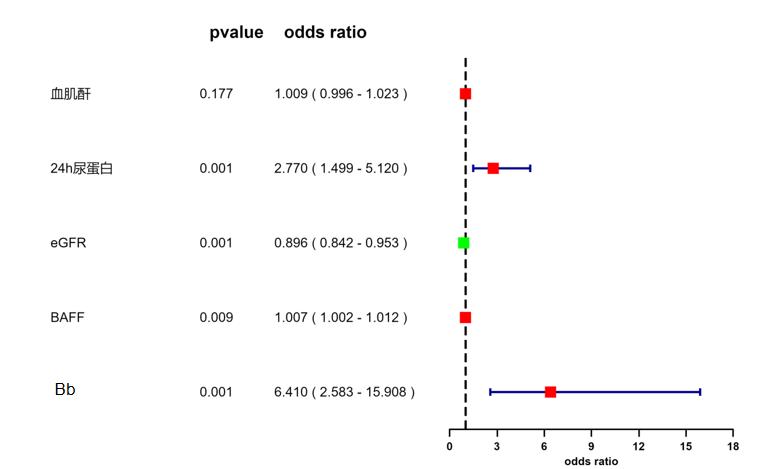
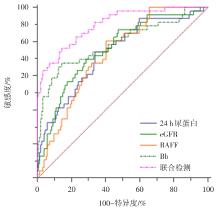
目的 探讨特发性膜性肾病(IMN)患者血清B细胞活化因子(BAFF)、补体裂解因子Bb(Bb)的表达意义及其与尿白蛋白肌酐比值(UACR)的相关性。 方法 选取204例IMN患者为研究组,另选取同期健康体检者100例为对照组。比较两组血清BAFF、Bb、UACR水平。Pearson相关性分析血清BAFF、Bb与UACR的相关性。对研究组患者随访1年,根据病情缓解情况分为预后良好组和预后不良组(未缓解),比较两组患者一般资料、血清BAFF、Bb水平。多因素logistic回归分析IMN患者预后不良的影响因素。受试者工作曲线(ROC)评估相关指标对IMN预后不良评估价值。 结果 研究组BAFF、Bb、UACR水平均高于对照组(P < 0.05);Pearson相关性分析显示,BAFF、Bb均与UACR呈正相关(r = 0.716、0.543,P < 0.05);随访1年,最终完成随访共200例,依据随访结果分为预后不良组46例和预后良好组154例。预后不良组血肌酐、24 h尿蛋白、BAFF、Bb水平均高于预后良好组,eGFR低于预后良好组(P < 0.05);多因素回归分析发现,24 h尿蛋白、BAFF、Bb是IMN患者预后不良的危险因素,eGFR是保护因素(P < 0.05);ROC曲线分析显示,24 h尿蛋白、eGFR、BAFF、Bb联合评估IMN患者预后不良的AUC值高于单项检测(Z = 4.145、3.908、4.308、3.864,P < 0.05)。 结论 IMN患者血清BAFF、Bb水平较高,且均与UACR呈正相关,联合24 h尿蛋白、eGFR评估IMN患者预后不良具有较高价值。

关键词: 特发性膜性肾病, 血清B细胞活化因子, 补体裂解因子Bb, 尿白蛋白肌酐比值, 预后不良

Abstract:

Objective To investigate the clinical significance of serum B cell activating factor (BAFF) and complement lytic factor Bb in patients with idiopathic membranous nephropathy (IMN), as well as their correlation with the urinary albumin?to?creatinine ratio (UACR). Methods A total of 204 IMN patients were enrolled as the study group, and 100 healthy individuals undergoing physical examinations during the same period served as the control group. Serum levels of BAFF, Bb, and UACR were measured and compared between the two groups. Pearson correlation analysis was performed to assess the associations among serum BAFF, Bb, and UACR. The patients in the study group were followed up for 12 months and stratified into a favorable prognosis group and a poor prognosis group (defined as no remission) based on disease remission status. Demographic and clinical characteristics, as well as serum BAFF and Bb levels, were compared between the two outcome groups. Multivariate logistic regression analysis was conducted to identify independent predictors of poor prognosis in IMN patients. Receiver operating characteristic (ROC) curve analysis was employed to evaluate the predictive value of these indicators for poor prognosis. Results The levels of BAFF, Bb, and UACR in the research group were significantly higher than those in the control group (P < 0.05). Pearson correlation analysis revealed that both BAFF and Bb were positively correlated with UACR (r = 0.716 and 0.543, respectively; P < 0.05). After one year of follow?up, a total of 200 patients completed the study, among whom 46 experienced poor prognosis. Based on the follow?up outcomes, patients were categorized into a poor prognosis group (n = 46) and a good prognosis group (n = 154). The poor prognosis group exhibited significantly higher levels of serum creatinine, 24?hour urinary protein, BAFF, and Bb, as well as lower eGFR values, compared to the good prognosis group (P < 0.05). Multivariate regression analysis identified 24?hour urinary protein, BAFF, and Bb as independent risk factors for poor prognosis in patients with IMN, whereas eGFR was identified as a protective factor (P < 0.05). ROC curve analysis demonstrated that the combined assessment of 24?hour urinary protein, eGFR, BAFF, and Bb yielded a higher AUC value for predicting poor prognosis in IMN patients than any single indicator alone (Z = 4.145, 3.908, 4.308, 3.864; P < 0.05). Conclusions The serum levels of BAFF and Bb in patients with IMN are significantly elevated and positively correlated with the UACR. The combination of 24?hour urinary protein excretion and eGFR demonstrates high predictive value for poor prognosis in these patients. These findings suggest that BAFF and Bb may serve as potential biomarkers for prognostic assessment in IMN, and the integrated measurement of multiple parameters could provide a more comprehensive clinical basis for disease management.

Key words: idiopathic membranous nephropathy, serum B cell activating factor, complement lytic factor Bb, urinary albumin creatinine ratio, poor prognosis

中图分类号: